
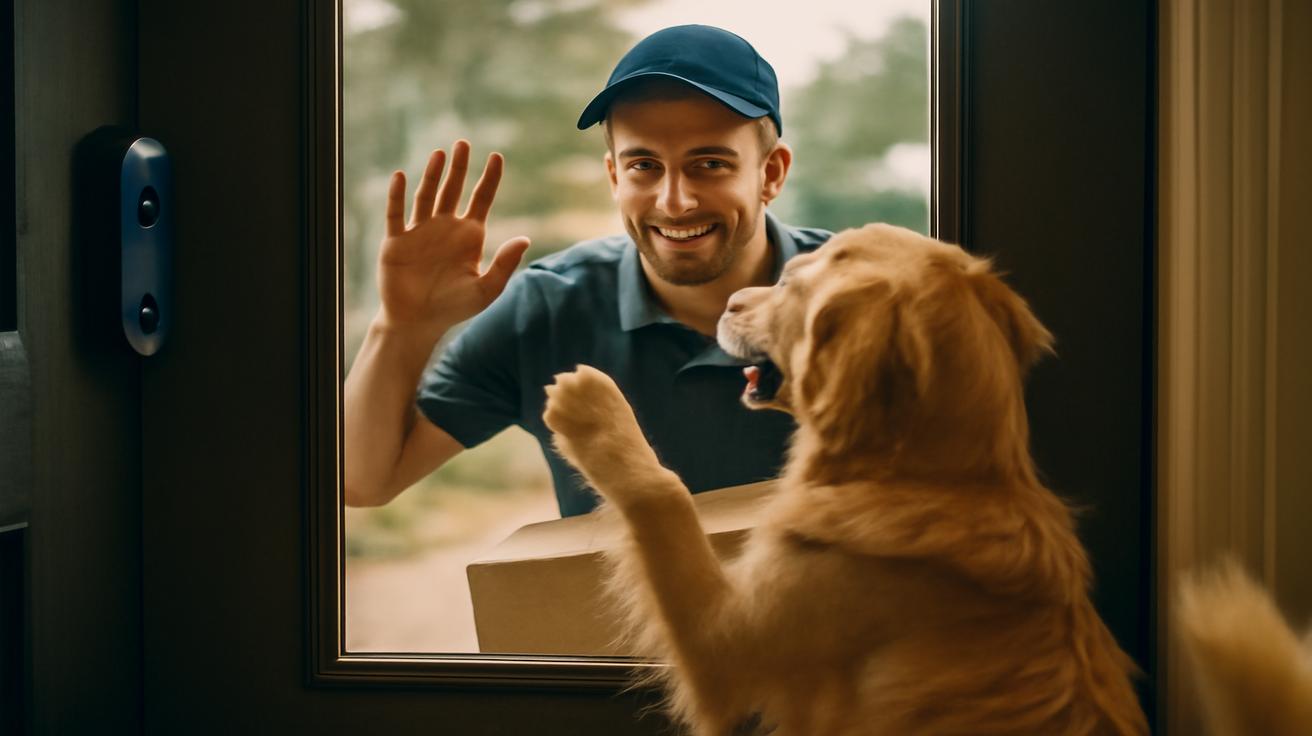
The first time the notification chimed on her phone, Mia barely glanced at it. Another motion alert from the doorbell camera, probably a package drop-off or a squirrel doing parkour on the front steps again. She swiped it away, went back to her spreadsheet, and tried to ignore the soft whine coming from the living room—that now-familiar sound of her golden retriever, Sunny, waiting for something she couldn’t give him.
The Dog Who Waited at the Window
Sunny had always been a people dog. The kind who leaned his whole weight into you when you sat on the couch, who believed that every knock at the door was clearly a visit for him, and that every human on the sidewalk secretly needed to pet him, whether they knew it yet or not.
Before the world shifted, Sunny spent his days in a swirl of sounds and movement. There were neighborhood kids on bikes, the mail carrier who kept biscuits in her pocket, and Mia’s dad, who would stop in almost every afternoon. He and Sunny had their ritual: a slow walk to the end of the street, a shared apple on the front steps, a good long ear rub. And then, suddenly, there were hospital visits, then none, and then there was just silence where his voice used to be.
Sunny didn’t understand words like “stroke” or “rehab” or “gone.” What he understood was that he kept waiting at the window every afternoon, and the tall, gray-haired man with the gentle hands no longer appeared at the gate.
The first few weeks, he whined and paced, a golden shadow caught between the front door and the big window that faced the street. He’d spring up at the faintest sound of footsteps, tail wagging with hope so bright it almost hurt to watch, then sink back down when the sidewalk stayed empty. When he finally accepted that the door wasn’t going to open at four o’clock anymore, he kept his vigil anyway. Not as frantic. Just quiet. A dog-shaped question mark pressed against the glass.
From her desk in the back room, Mia would hear the soft tap of his nose on the window, the sigh that followed, and feel the weight of it like an extra gravity in the house. She tried to make up the difference—extra walks, more playtime, new toys—but there was a specific kind of waiting that only happens at a window, and nothing else could fill its shape.
The Doorbell Camera That Saw What She Didn’t
The doorbell camera had been an impulse purchase, something practical in a world obsessed with convenience: keep an eye on packages, deter porch pirates, check in when she was traveling. It sent alerts for every motion, every passing car, every shifting shadow that looked suspiciously like a raccoon.
On a Wednesday afternoon in early spring, when the sky over the cul-de-sac was the color of wet cotton, another alert buzzed her phone. This time, boredom made her tap it open.
The video loaded in a jittery little frame. On the screen, the familiar view of her front steps appeared: the potted fern, the doormat stamped with muddy paw prints that were both decoration and biography. A white delivery van pulled up to the curb, and a man in a dark-blue jacket stepped out, balancing a small cardboard box in one hand.
He walked toward the house, then slowed. His head tilted, just slightly, toward the window. Mia thumbed the video back a second, turned up the volume. That was when she heard it: the faint, muffled thump of a tail hitting the wall inside, a soft, excited rhythm like a distant drum.
On camera, the man stopped before he reached the porch. He set the package down gently, then took two steps sideways, right into the window’s sightline. And just like that, his whole posture shifted—shoulders lowering, face softening, mouth widening into an unguarded smile.
He raised his hand in a wave, fingers wiggling in a little greeting meant for someone just beyond the glass. His lips moved. There wasn’t enough audio to catch the words, but she could guess: something like “Well, hello there, buddy,” or “Look at you, waiting for me.”
From inside, Sunny appeared in the bottom corner of the frame—a flash of gold, ears up, front paws braced against the sill. Even through the grainy video, Mia could see the wild happiness in his body, that full-body joy specific to dogs who have just realized that yes, this moment, right now, is exactly the one they were hoping for. His tail wagged so hard his whole backside shimmied.
The man laughed, the sound a low blur through the microphone. He leaned closer, bracing a hand on the brick, and Mia watched as her dog pressed his nose to the other side of the glass, fogging it with his breath. For a few seconds, the world shrank to that narrow space between them—man outside, dog inside, both fully focused on each other.
Then, with a final little salute, the man stepped back, turned, and walked away. Twenty-seven seconds, according to the timestamp. Less than half a minute. But when the video ended, Mia realized she was still holding her breath.
The Afternoon Ritual Begins
She thought it was a sweet one-time moment. A chance kindness. A man on his route, pausing for a lonely dog. Life is full of these tiny scenes we’re not supposed to see, the small, unremarkable kindnesses that don’t make the news.
The next day, at almost the same time, her phone chimed again.
She opened the feed to see the same white van, idling at the curb. The same navy jacket, the same easy gait up her front walk. Again, his steps slowed before he reached the porch. Again, that tilt of his head toward the window, as if he could feel the anticipation pressing against the glass from inside.
It became a pattern—a soft, ordinary, astonishing little pattern. Each afternoon, between 3:45 and 4:15, her phone would buzz. Each time, the camera would catch the same scene, with slight variations: sometimes the man brought a package, sometimes he walked up empty-handed, no official reason to be there beyond the invisible tether that had formed between a human and a dog.
He never tried the door or knocked. He didn’t angle himself toward the camera the way people do when they know they’re being recorded. His attention was always on Sunny. Once, he crouched down, peering so closely into the window that the brim of his cap disappeared from view. Another day, he pulled something from his pocket—a crinkling, telltale sound that could only be a treat—and pretended to feed it through the glass, laughing when Sunny’s tongue smeared the pane in eager confusion.
By the end of the week, Sunny’s schedule had adjusted. Long before the van appeared, he would position himself at the window, ears perked, scanning the street. He’d shift his weight from paw to paw, eyes tracking every passing car, ignoring squirrels, joggers, and blowing leaves with laser focus. The world outside had become a waiting room; the visitor worth waiting for wore navy blue.
From the back room, Mia listened to the ritual like a radio play she’d already memorized. The sound of Sunny’s quiet pacing. The sharp, cheerful whoosh of van doors. The uneven crunch of boots on the gravel path. The inevitable, explosive tap-tap-tap of Sunny’s tail against the wall when he finally appeared.
Every day, twenty or thirty seconds. That was all. But the weight of it in the house felt so much larger, like someone had cracked open a window in a room that had gotten too used to stale air.
The Moment the Story Left the Camera
Weeks passed before she saw him in person. Usually, by the time she could have made it to the front hall, the moment was already over, the van’s taillights a red blur at the end of the street. But one Tuesday, a meeting ended a few minutes early. When the alert buzzed, she was already standing, her hand on the doorknob before the video even loaded.
Through the frosted glass, she could see the outline of a man, slightly hunched, arm lifted in a familiar wave. Sunny was already doing his window dance—front paws pressed against the sill, head cocked, tongue lolling in a wide, goofy grin.
She opened the door just as the man said, “See you tomorrow, pal,” and turned to go.
He stopped mid-step, visibly startled. Up close, he was younger than she’d expected. Late twenties, maybe, with tired eyes that still somehow crinkled easily at the corners. The navy jacket bore the logo of the delivery company, faded a shade lighter at the shoulders from sun and rain. In his hand, he held nothing but his phone and a small dog biscuit.
“Oh—hey,” he said, pushing his cap back. “Sorry if I scared you. I, uh—usually he’s my only audience.” He jerked his thumb toward the window, where Sunny had abandoned his post to come bound excitedly toward the open door, nails scrabbling on the hardwood.
“You didn’t scare me,” she said. “I’m pretty sure you’re his favorite part of the day.”
Sunny confirmed this by throwing his entire weight against the man’s shins, tail whipping like a flag in a storm. The man laughed, bending down to ruffle the dog’s ears with the easy familiarity of someone who had already loved this animal quietly from the other side of the glass.
“I’m Jake,” he said. “I, uh, deliver on this route most days. And this guy”—he scratched Sunny’s neck—“has been guarding this window like it’s his job. Figured the least I could do was say hi.”
He hesitated, suddenly self-conscious. “I hope that’s okay. I know we’re supposed to keep moving, but…he just looked like he was waiting for somebody. Felt wrong to walk by.”
For a second, her throat closed. The story tumbled out before she could edit it—the ritual with her dad; the empty afternoons; the way Sunny had stopped bringing toys to the door when the footsteps never came. How, after the funeral, the house had felt both too small and too hollow, the air thick with all the things that weren’t happening anymore.
“He still waits,” she said quietly. “Every day. I think he kept expecting my dad to come back. Then one afternoon, your van showed up and… I don’t know. I think he picked a new person to hope for.”
Jake looked down at Sunny, who had flopped onto his back, paws in the air, trusting belly bared in invitation.
“Well,” he said, voice softer now, “then I better keep showing up.”
Small Kindness, Wide Ripples
After that, the ritual changed shape but not heart. On the doorbell camera, the angles shifted—sometimes the video showed all three of them: Jake on the step, Sunny wagging so hard he drifted sideways like a poorly steered boat, and Mia in the hall, leaning against the frame, one hand wrapped around a mug of tea she’d conveniently started pouring around 3:40 most days.
The visits stayed brief. A quick hello, a treat passed from palm to waiting mouth, a few lines of small talk about the weather, or about the garden bed Sunny had decided was his new digging project. Then Jake would glance at his watch, mumble something about “gotta keep the bosses happy,” and jog back to the van.
The house felt different after those visits. A little brighter. Quieter, in a good way, like the silence left behind after a song you like has played all the way through.
One rainy afternoon, when thunder was cracking the sky into uneven pieces and Sunny was trembling under her desk, she heard the familiar crunch of tires. Seconds later, the motion alert flashed on her phone. By the time she reached the living room, Jake was already at the window, one palm flattened gently against the glass.
“Hey, it’s okay, buddy,” he said, his voice calm and steady, the way you talk to someone on a ledge—even if that someone is thirty inches tall and covered in fur. Sunny, shaking, inched toward that hand on the other side of the glass, his nose almost touching it, eyes locked on Jake’s face rather than the storm.
It struck her then—the quiet power of such a small kindness. A man who stayed thirty seconds longer at a stop than his schedule allowed, a dog who needed someone to look for in the afternoon, a woman who, for those brief moments, didn’t feel like she was the only person responsible for holding the edges of Sunny’s little world together.
A Window Between Their Worlds
Months slid by in the casual, repetitive rhythm of neighborhoods—lawns browning, trees leafing out and then shedding, holiday decorations appearing and disappearing from porches. And always, around four o’clock, the daily scene played out at the front window.
Some days, when Jake’s route changed or ran late, he’d swing by after dark, headlights briefly washing the house in a pale glow. Sunny, already dozing, would hear the van and shoot up like he’d been plugged into an outlet, launching himself toward the door with unrestrained hope. The camera would catch Jake’s apologetic shrug.
“Had to cover another block,” he’d explain. “Didn’t forget you, though.”
On days when Jake couldn’t come at all, when weather or logistics or life got in the way, Sunny’s agitation returned. He paced. He whined. He checked the window every few minutes, each disappointment adding a small restless energy to the room. On those evenings, Mia understood something she hadn’t quite named before: this wasn’t just about a man petting a dog. It was about a promise, however unspoken, that someone would show up.
It made her think of all the windows in all the houses along Jake’s route, all the unseen watchers—dogs, cats, lonely grandparents, toddlers pressing their hands against the glass and waving at the big white van. She wondered how many of them saw Jake not as the guy who dropped off boxes, but as a familiar face in a world that could sometimes feel like it was rushing past them without stopping.
When she mentioned this idea, fumbling for words one afternoon as they watched Sunny gleefully destroy a plush toy on the lawn, Jake just shrugged.
“I mean, most stops, it’s just doors and scanners and those stupid stickers that never peel right,” he said. “But some places…you can tell people are waiting. Not just for packages. For someone to look at them. To say their name. Your guy here just happens to be louder about it.”
He glanced at Sunny, who was proudly parading around with the toy’s limp, stuffing-less shell dangling from his mouth.
“Honestly,” he added, “I think I need this as much as he does. Makes the day feel less like I’m just dropping boxes for ghosts.”
A Tiny Table of Ordinary Magic
There is something tender about how routine can become sacred without anyone officially declaring it so. About how small, repeated actions can stitch a sense of belonging into the seams of an otherwise ordinary day. If you were to list it out, it might look almost laughably simple:
| Time of Day | What Happens | Why It Matters |
|---|---|---|
| 3:45–4:15 pm | Van pulls up, footsteps on gravel, a wave at the window. | Signals to Sunny that someone he loves is about to appear. |
| 4:00 pm (most days) | Short greeting, a treat, a few words shared on the porch. | Breaks the loneliness loop for both dog and human. |
| After the visit | Sunny naps, house feels quieter and lighter. | The ritual leaves a residue of calm and connection. |
| On missed days | Pacing at the window, extra checking, restless energy. | Reminds everyone how deeply the small things are felt. |
It’s not a heroic act. It’s not a grand gesture. It’s a guy on a tight schedule, a dog with a bruised heart, and a woman standing quietly in the hallway, watching the edges of her grief soften a bit each afternoon.
What the Camera Can’t Quite Capture
The doorbell camera kept recording every visit, little rectangles of time stacked in the cloud like paper-thin memories: May_12_4.01pm.mp4, June_03_3.58pm.mp4, July_19_4.07pm.mp4. She could scroll through and see Sunny’s joy frozen at different stages of the year—the first visits with spring light tilting gently across the porch, the high white glare of summer, the softer gold of early autumn.
People talk about how cameras can catch everything now, how nothing is private. But looking at those clips, it felt like the opposite. The device caught the outlines, the choreography. It saw the wave, the wag, the treat, the smile. It didn’t quite catch what was happening just underneath those gestures: the way Sunny’s anxiety unwound each time he recognized Jake’s voice; the tiny, almost imperceptible lift in Mia’s shoulders after each visit; the sense of mutual rescue that settled quietly between the man and the dog.
Some evenings, she’d rewatch the videos—not out of surveillance, but out of gratitude. It was like replaying a favorite scene from a movie where nothing huge happens, yet everything important does.
On screen, you could see a dog learning, slowly, that the world might still bring good things to the front step. That losses are not the only things that arrive uninvited. On the other side of the glass, you could see a man who moved through hundreds of doorways a week, finding one where he was expected for more than his packages.
Why This Story Sticks
If you reduce it to a headline, it sounds almost whimsical: “Doorbell camera catches delivery driver stopping every afternoon just to greet a lonely golden retriever waiting at the window.” It fits neatly into the scroll of feel-good stories, the ones we share to cleanse our feeds between heavier headlines.
But if you sit with it longer, if you imagine the sounds and textures—the scrape of boots on wet stone, the puff of Sunny’s breath fogging the glass, the low murmur of Jake’s voice threading through the hum of passing traffic—it becomes something else. A reminder, perhaps, that most of what steadies us in this world happens in these almost invisible margins of the day.
It’s in the way a dog chooses a new person to wait for when the old one is gone. In the way a stranger notices that waiting and quietly volunteers to be that person. In the way technology, often blamed for distance, sometimes gives us a clearer view of the closeness we might otherwise miss.
The doorbell camera did what it was supposed to do: it recorded motion at the front door. But in doing so, it also recorded devotion, habit, kindness, and a slowly healing grief. It turned what could have been just another private, passing kindness into a story that could be seen, remembered, and retold.
And somewhere, at a front window framed by smudges of nose prints and the faint arcs of a wagging tail, a golden retriever still climbs onto his lookout each afternoon. A white van still pulls up to the curb. A man in a navy jacket still pauses on a busy route to press his hand to the glass and say, with his smile if not his words, “I see you. I’m here. I came back.”
FAQ
Did the delivery driver know he was being recorded?
He likely knew a doorbell camera was installed—most are visible near the door—but his focus was always on the dog at the window. The recordings captured natural, unposed moments rather than interactions performed for the camera.
Why did the golden retriever wait at the window every day?
The dog had a long-standing routine of greeting a beloved family member who used to visit each afternoon. After that person was gone, the dog continued the habit, waiting in the same spot and hoping for a familiar presence. The delivery driver eventually stepped into that emotional gap, becoming the new person worth waiting for.
How long did the driver’s visits usually last?
Most visits were very short—often under a minute. He would pause, greet the dog, offer a quick treat or a few words, and then return to his route. Despite their brevity, these moments had a powerful emotional impact on both the dog and the household.
Is this kind of behavior typical for delivery drivers?
While not part of the official job description, many drivers form small connections with pets and people along their routes. They often see the same homes and faces every day, and simple routines—waves, quick greetings, pats for a dog—naturally develop over time.
What can we learn from this story?
It highlights how small, consistent acts of kindness can make a real difference, especially for those who are lonely or grieving. A few intentional seconds in someone’s day—whether that someone is human or animal—can turn ordinary routines into quiet lifelines of connection.







Leave a Comment