
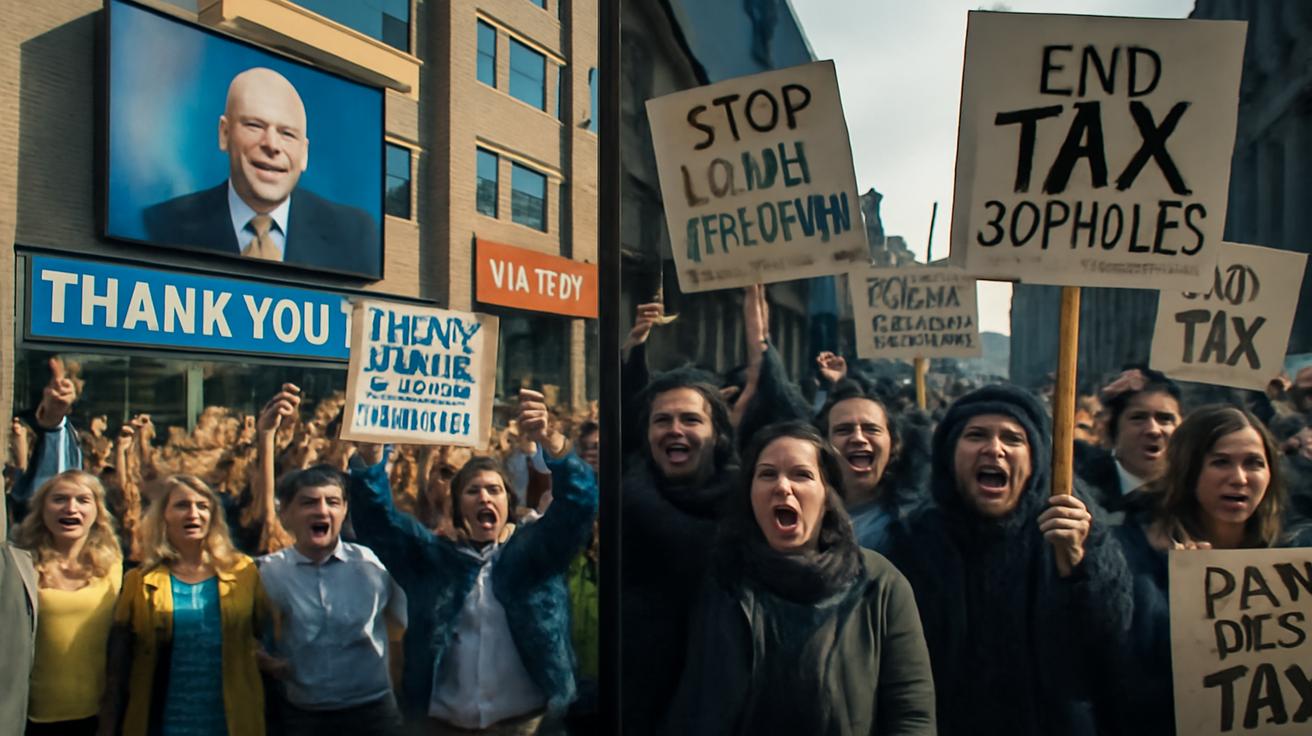
The first time you watch a billionaire in a crisp suit step onto a school playground, it’s strangely moving. The cameras wait. Children hold paper flags, teachers shift anxiously, a brass band stumbles through a pop song. Then comes the moment: a ribbon is cut, a plaque is unveiled, and the applause rolls across cracked asphalt and peeling paint like a small, hopeful wave. “This new wing,” the billionaire says into the microphone, “is my gift to the community.” The crowd cheers. Phone cameras rise like a metal forest. And just beyond the school gate, where the noise softens and the air smells of bus exhaust and wet concrete, a quieter thought settles over a few watching parents: How much tax would he have paid if he hadn’t given us this?
A Tale of Two Feelings: Gratitude and Quiet Fury
We live in a strange moral weather system, where two emotional climates exist side by side. On one side are the people who feel the warm glow of gratitude. They see a billionaire fund a children’s hospital wing, a sports center, a community garden, a scholarship program, and they think: someone is finally stepping up. Governments are slow, budgets are tight, infrastructure is crumbling, yet here is a person who signs a check and makes things happen in months instead of decades.
On the other side are those who feel a cold, simmering anger. They watch the same ribbon-cutting ceremony and see not generosity, but a kind of carefully perfumed guilt. They know that the person holding the scissors likely pays a far smaller slice of their income in tax than the teacher standing behind the students, or the nurse who will one day work in that hospital wing. They see a system so expertly engineered that you can legally dodge billions in taxes, then be exalted as a hero for donating a fraction of what you avoided paying in the first place.
Both emotions—gratitude and fury—are real, raw, and understandable. And they are tearing countries apart. Because the question that haunts the edges of these ceremonies is not whether generosity is good. It’s whether a society can truly be fair when public services depend on the whims of people who can buy yachts like other people buy shoes.
The Theater of Generosity
Walk into a modern hospital and you can almost smell the money. The polished floor tiles that shine like still water, the quiet hum of machines that cost more than most houses, the gentle artwork lining the corridors—all of it often made possible by vast private donations. Look closer at the walls and the story becomes more literal, engraved in metal and stone: “The Smith Foundation Children’s Ward,” “The GlobalCare Imaging Suite,” “The Horizon Trust Cancer Center.” Names are everywhere, like constellations in a medically sterile sky.
It’s hard not to feel grateful when you see what those names have made possible. Imagine being a parent walking into a state-of-the-art pediatric ward, knowing your child will receive world-class treatment because somebody decided to write a very large check. For many, this isn’t an abstract political debate; it’s the difference between life and death. When the choice is between an underfunded public service and a billionaire-funded upgrade, gratitude is not just natural—it’s rational.
And yet, every plaque tells only half a story. The missing half lives in balance sheets and tax returns, in shell companies in faraway islands, and in accounting strategies so intricate they might as well be spells. You don’t see that side engraved on the wall. There is no line that reads: “This wing made possible by funds routed through a maze of jurisdictions designed to minimize legal tax obligations in the country where the patients actually live.”
Public gratitude is loud. Tax codes are quiet. And so the theater of generosity plays on, with spotlights angled away from the backstage scaffolding that holds the whole performance together.
Legal Corruption: A System Hiding in Plain Sight
People often hear the words “tax dodging” and imagine criminality: bags of cash, shady figures, illegal transfers. But much of what sends billions slipping through the cracks of public budgets is entirely legal. Some call it “aggressive tax planning,” others “optimization,” but the effect is simple: money that could have funded schools, roads, climate adaptation, mental health services, or elder care is redirected elsewhere—into private jets, stock buybacks, real estate portfolios, or high-gloss philanthropy.
This is where the phrase “legal corruption” starts to make sense. Not because a law is being broken, but because the law itself has been bent over time by those with enough power and persistence to shape it. Lobbyists work the slow grind of influence: quiet lunches, backroom briefings, political donations, revolving doors between government and industry. The result is a tax system that often treats work and wealth very differently. Wages are taxed at one rate; capital gains and complex structures at another—often much lower—rate.
To many ordinary taxpayers, this feels like walking into a game midway through, only to realize the other team helped write the rules. They pay what their employer withholds from their paycheck. They fill out the forms, hit “submit,” and hope for a small refund. There’s no army of accountants, no offshore trusts, no maze of entities and exemptions. Just a steady drain from each month’s wages into a public pot they’re told is perpetually empty.
Meanwhile, at the highest levels, vast fortunes slide elegantly along legal pathways that lead away from that shared pot. Billions vanish from national budgets—not by breaking the law, but by using it to its full, elastic extent.
How the Numbers Divide Us
To understand why this divides a nation so deeply, you have to feel the numbers in your bones, not just see them on a page. Imagine a teacher, a nurse, a bus driver, a warehouse worker. They might pay, say, 20–30% of their income in taxes. They see it clearly on every payslip. It hurts, but it’s also framed as a duty: this is how we fund roads, schools, hospitals, fire services, clean water. This is the price of civilization.
Now picture a billionaire whose wealth comes not from a salary, but from assets: stocks, property, equity stakes, dividends. Through legal structures, they might end up effectively paying a single-digit percentage of their expanding fortune in tax, if that. Some years, depending on how income is timed, structured, or offset, the effective tax rate might hover very close to zero. Yet their influence on the public realm can appear enormous—through donations, foundations, and headline-making “gifts to society.”
| Profile | Main Income Type | Visible Tax Burden | Public Image |
|---|---|---|---|
| Public School Teacher | Salary | Tax withheld monthly; little room for optimization | “Ordinary taxpayer,” rarely celebrated |
| Nurse | Salary, overtime | Stable, predictable; hard to reduce legally | “Essential worker,” praised in crises |
| Billionaire Investor | Capital gains, dividends, assets | Often low effective rate via legal strategies | “Philanthropist,” name on buildings |
The emotional math is brutal. Those who pay the most, proportionally, often get the least recognition. Those who pay the least, proportionally, get their names on the doors. For millions, this feels less like a social contract and more like a rigged game dressed up as civic virtue.
Why So Many Still Cheer
And yet, month after month, year after year, millions still cheer. They watch televised charity galas, glossy foundation announcements, fundraising marathons hosted by billionaires, and they donate their own money on top. They share the videos, wipe away tears at the heartfelt speeches, and whisper to themselves: At least someone is doing something.
The cheering doesn’t happen in a vacuum. It happens in underfunded neighborhoods where playground swings sit broken for years. In towns where the only after-school program is the one a wealthy donor chose to finance. In countries where hospitals are so overstretched that the difference between an old wing and a new one is measured in survival rates.
When the state fails—or is made to fail through long-term underfunding—private generosity doesn’t just look appealing; it looks like salvation. Parents don’t calculate the lost tax revenue behind a donated children’s library; they see their child sitting in a brightly lit room with colorful books instead of a closed door and a “No Funding” sign. The logic is immediate, visceral, and urgent: this is here now. The rest is theory.
Philanthropy also carries a powerful emotional story: the idea of the enlightened, benevolent individual. It’s the old myth of the wise village elder, scaled up and gilded. A single person, by virtue of extraordinary success, gets to play hero on the national stage. It’s a narrative that flatters the giver and reassures the receiver: someone with power cares enough to share.
In this narrative, tax is dull and faceless; philanthropy is dramatic and human. Paying tax doesn’t come with ribbon-cuttings and heartfelt speeches. No one claps when your paycheck is quietly shaved down each month. But give a large visible donation, and you can stand in the sunlight, surrounded by microphones, while the applause rolls in like a warm tide.
And Why So Many Seethe
For others, that same scene tastes like ash. They see a state starved of revenue by decades of tax loopholes and political choices, then told to be grateful when the very beneficiaries of that system ride in as saviors. They see elected governments losing their ability—or their will—to raise money fairly, and outsourcing social priorities to the preferences of the extremely rich.
The anger isn’t about generosity itself; few would argue that donating money to a children’s hospital is bad. The rage comes from the surrounding architecture: who decides which problems get addressed, how much is given, when it’s given, and to whom we owe thanks.
A billionaire might choose to fund an elite university lab over basic public housing, a museum over maternal health clinics, a high-profile arts center over a low-profile addiction treatment program. Their choices shape the social landscape far beyond their formal authority. Democratic budgeting processes—messy, slow, but collective—are quietly sidestepped.
Those who seethe see power concentrating in unelected hands, shielded by a halo of philanthropy. They watch politicians praise donors while doing little to close the legal channels that made such oversized fortunes possible in the first place. They see laws written with enough loopholes to drive a superyacht through, then hear solemn speeches about “tight budgets” and “hard choices” for everyone else.
Who Gets to Shape the Future?
Underneath all the noise, this conflict is really about who gets to shape the future of a country. Public services—schools, hospitals, parks, transit systems, climate resilience projects—are the physical expression of our collective priorities. In theory, we decide what matters together, through elections, budgets, and public debate. Taxes are the financial tool that turns those decisions into reality.
But when huge pools of wealth can legally flow around the tax system, something shifts. Public budgets shrink or at least grow more slowly than they might. The state retreats from certain areas or offers only bare-minimum services. Into that vacuum steps private money, with its own ideas about what counts as a worthy cause.
Sometimes those ideas align with public needs. Other times, they don’t. A philanthropist might love funding a prestigious concert hall more than fixing the broken buses that get low-income workers to their jobs. They might prefer visible, PR-friendly projects over invisible ones like sewer upgrades or mental health outreach. They might want their name on an art museum, not on a wastewater treatment plant—no matter which one would improve more lives.
When that pattern repeats year after year, country after country, we end up with a distorted landscape of progress. Shiny, donor-branded islands rise up amid neglected plains. Philanthropy starts to look less like a bonus and more like a patch over a deliberately frayed social fabric.
And the deeper question grows louder: Can a democracy remain healthy when its public future depends on private preferences, shaped by fortunes grown in the shadow of a tax system full of escape hatches?
Imagining a Different Kind of Applause
There is a small but growing movement that wants to rewrite the script. Not to abolish generosity, but to relocate the spotlight. They imagine a world where we cheer less for billionaires funding public services, and more for the quiet, unglamorous act of everyone paying their fair share.
In that world, a ribbon-cutting ceremony at a new hospital would still draw a crowd. The brass band would still be there, the air would still buzz with excitement. But when the plaque is unveiled, it wouldn’t bear a single wealthy name. Instead, it might simply read: “Built by the people of this country, through the taxes we chose to pay together.”
There’d be no single hero at the microphone, just a procession of ordinary voices: a teacher, a nurse, a driver, a small-business owner, a student. They’d speak not of personal generosity, but of a system that treated their contributions as valuable, reliable, and enough.
In that kind of story, billionaires would still exist if we allow them to—but the halo would dim. They’d be expected to pay taxes proportionate to their extraordinary success, first and foremost. Their donations, if they gave more on top, would be a genuine extra, not a flashy substitute for a gutted revenue system.
The applause would shift—from the spectacle of wealth stepping in as savior, to the quieter, sturdier miracle of a society that funds itself fairly.
Living Inside the Tension
Until that world is built—if it ever is—we’re stuck inside a deep human tension. A billionaire funds a new cancer center, and people will be rightly grateful. That center may save thousands of lives. It’s not dishonest to feel that gratitude; it’s profoundly human. At the same time, it’s not cynical to ask where the money came from, what was saved in taxes before it became a donation, and what public services may have gone underfunded along the way.
We are complex enough to hold both truths at once: to thank the donor and question the system that made their role so necessary. To appreciate the gift and still insist that health, education, and safety should not depend on who happens to be feeling generous this decade.
Some will go on cheering, their eyes locked on the ribbon and the plaque, because the need in front of them is too urgent to care about anything else. Others will keep seething, their gaze fixed on the invisible flows of capital and the quiet rewriting of laws. Between them, the nation strains and creaks, pulled by gratitude and anger like a rope in a never-ending tug-of-war.
Perhaps the first step out of this tension is simply to see it clearly. To notice both the shining hospital wing and the shadowy tax strategies; both the hearts moved by generosity and the minds sharpened by injustice. To recognize that a system built on legal corruption can still produce real good—but at a price we may not want to keep paying forever.
One day, when a child walks into a bright, well-funded classroom, they might not know the name of a single rich donor. They’ll just know that the lights are on, the roof doesn’t leak, the books are new, and the teacher isn’t exhausted from working a second job. The story of how that classroom came to be will be written not in gold letters, but in something far less glamorous and far more radical: fairness.
FAQ
Is all billionaire philanthropy bad?
No. Many donations fund vital services, research, and cultural projects that genuinely improve lives. The concern is not about generosity itself, but about relying on it to replace fair taxation and democratic budgeting. Philanthropy can be helpful as a complement to strong public systems, but harmful when it becomes a substitute for them.
What does “legal corruption” mean in this context?
“Legal corruption” refers to situations where the rules of the system are shaped to benefit powerful interests, even though no laws are technically broken. In tax policy, this often means loopholes, preferential rates, and complex structures that allow very wealthy individuals or corporations to avoid paying what most people would consider a fair share.
Why do some people still support billionaire-funded public projects?
Because the benefits are immediate and visible. When a hospital wing, school program, or community center is funded by a billionaire, people in need often see real improvements in their lives. In underfunded systems, this can feel like the only practical solution available, even if the underlying inequality is troubling.
Aren’t high taxes on the rich bad for economic growth?
Evidence from different countries and eras is mixed and depends heavily on how taxes are designed and how revenue is used. Reasonable, well-enforced taxes on large fortunes and high incomes can coexist with strong, innovative economies—especially when the revenue funds education, infrastructure, and health, which support long-term growth.
What would a fairer system look like?
A fairer system would close major loopholes, align tax treatment of work and wealth more closely, and reduce the ability to shift profits or assets to low-tax jurisdictions. Public services would be funded reliably through transparent, progressive taxation, and philanthropy—while still welcome—would no longer be a de facto replacement for what governments should be able to provide.







Leave a Comment