
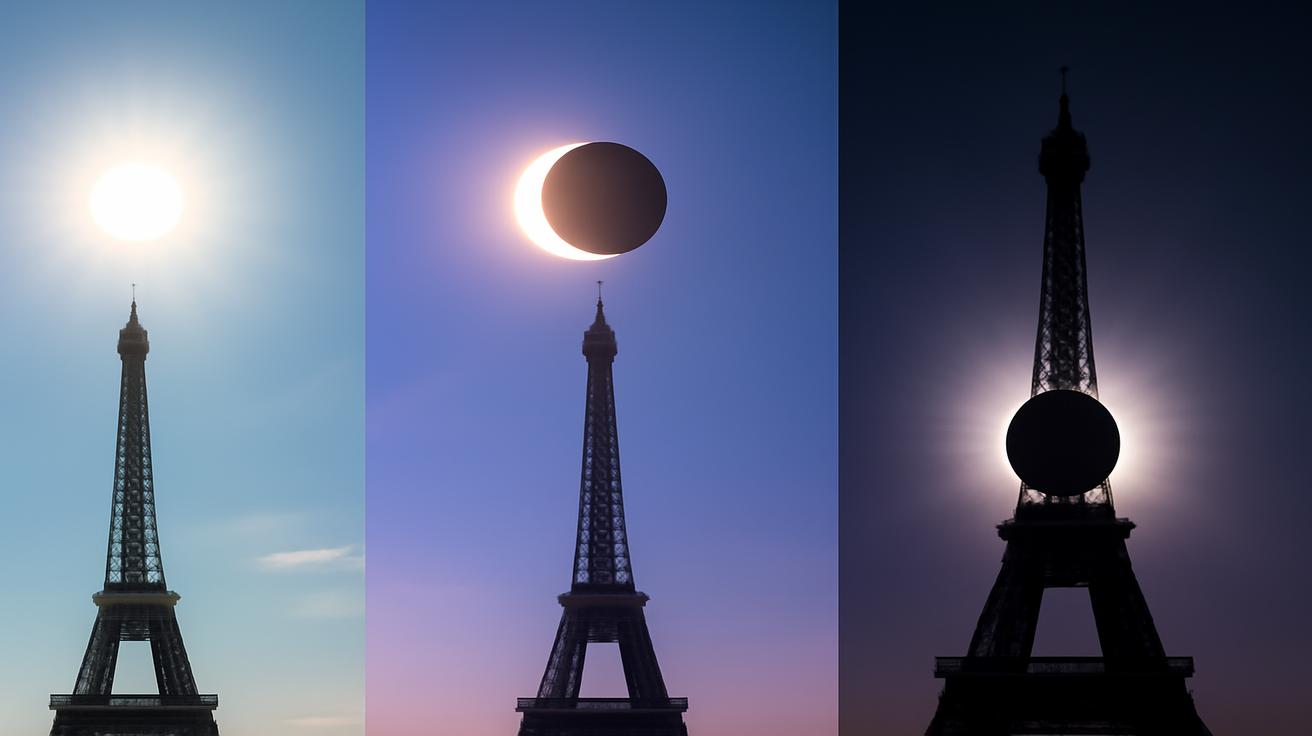
The news broke, quietly at first, in the kind of understated way cosmic announcements often do. A routine press release. A few excited posts from observatories. Then the words began to ripple through timelines and late-night conversations: day will turn to night—longer than it has in a hundred years. Astronomers had officially confirmed it. A solar eclipse so long, so lingering, it would stretch the very idea of daylight into something fragile and temporary. Not just another eclipse, but the longest total solar eclipse of the century.
The Day the Sun Agreed to Disappear
Imagine waking up on a day that scientists have circled in red on calendars all over the planet. The date has been rehearsed in documentaries, science classes, and café chatter. People have booked flights, reserved campsites, taken time off work. Children have drawn shaky circles of black over yellow suns in their notebooks. The world knows what’s coming. The Sun, for once, is on a schedule we can predict to the second.
The morning will begin like any other: traffic lights blinking through dawn, coffee cups steaming on kitchen tables, the ordinary hum of a planet going about its business. Yet, above all of that, the cosmos will already be moving the pieces into place. The Moon, that small and familiar neighbor, will be slipping precisely into alignment, drawing a slow, invisible line across the sky, headed directly toward the Sun.
This is the choreography astronomers have now confirmed with exquisite certainty. Using data from observatories around the world, precise measurements of the Moon’s orbit, and ultra-refined models of Earth’s rotation, they’ve pinned down the timing and path of a total solar eclipse that will last longer than any other in the 21st century. Totality—the spellbinding period when the Moon fully covers the Sun—will stretch not for seconds or a fleeting minute, but for a span so generous it almost feels like a cosmic favor.
You can think of it as an agreement between three celestial bodies. Earth offers the stage. The Moon brings the curtain. The Sun, for a few astonishing minutes, agrees to disappear.
Why This Eclipse Is Different
There are eclipses, and then there are the ones that etch themselves permanently into human memory and history. What makes this one so extraordinary isn’t just the drama of darkness in the daytime. It’s the duration and the precision with which we now understand it.
In most total solar eclipses, the shadow of the Moon skims across Earth’s surface in a narrow path—the path of totality. Step outside that band, and you see only a partial bite taken from the Sun. Stand inside it, and the world transforms. But the window is typically short, sometimes less than a minute, often around two or three, occasionally four.
This time, astronomers are projecting a maximum totality that flirts with the outer limits of what Earth and Moon can physically produce. The Moon’s distance from Earth will be just right: close enough in its elliptical orbit to cast a slightly larger shadow than usual. The alignment will be near perfect. The track of the Moon’s umbra—the darkest, innermost part of its shadow—will sweep across Earth at just the right geometry to prolong the blackout. Everything lines up for a performance that lingers.
To appreciate how unusual that is, it helps to understand that Earth’s spin is gradually slowing, the Moon is drifting farther away, and the geometry of these alignments is always evolving. Our distant descendants, millions of years from now, will live in a time when total solar eclipses are impossible. The Moon will appear too small to cover the Sun completely. What we’re living through now—the era of total solar eclipses—is a precious, finite chapter in planetary time. And within that chapter, this one stands out as a bold-faced line.
The Slow-Building Drama in the Sky
Long before the world goes dark, the sky will begin whispering that something is off. The first contact, as astronomers call it, is subtle—just the slightest nibble of shadow at the Sun’s edge. Through proper eclipse glasses, it will look like a perfect circle with a tiny, almost playful bite missing.
From that moment, every minute will deepen the strangeness. The light around you will start to feel thin, as if someone is slowly turning down a dimmer switch that controls not brightness, but mood. Shadows will sharpen, then split into strange double forms. Leaves will turn into thousands of tiny pinhole projectors, scattering crescent-shaped suns on sidewalks and walls. The air may cool, a faint breeze stirring as temperature gradients shift.
Animals will notice before most humans do. Birds may fall silent, mid-morning songs collapsing into an uneasy hush. Farm animals could drift toward their evening habits, confused by the creeping twilight. Flowers that open and close with the light will hesitate, uncertain which part of the day they’re in.
As more of the Sun is eaten away, the color of the world will change. It won’t look like sunset, with its warm, horizontal glow. Instead, it’s a strange, silvery dimness—directionless, as if the sky itself is unsure where the light is supposed to come from. The human brain, so used to the familiar cues of time and weather, quietly panics. Something in your chest might tighten. Landscapes you know well will begin to look like distant, half-remembered places.
It’s at this edge, this liminal space between almost-day and almost-night, that people tend to either fall utterly silent or burst into startled laughter. We are, after all, creatures who built our entire sense of reality around the assumption that the sun rises and sets in predictable arcs. Watching it vanish in the middle of its journey hits some deep, old part of us.
The Moment the Stars Come Back
Then—suddenly, shockingly—totality. The last sliver of the Sun disappears, and with it, the last grip of normal daylight. The sky plunges into a deep twilight, dark enough that bright stars and planets flicker into view. Venus may blaze near the eclipsed Sun, Jupiter could appear as a small, steady flame. For a few surreal minutes, the daytime sky becomes a strange, inverted night with a black hole at its center.
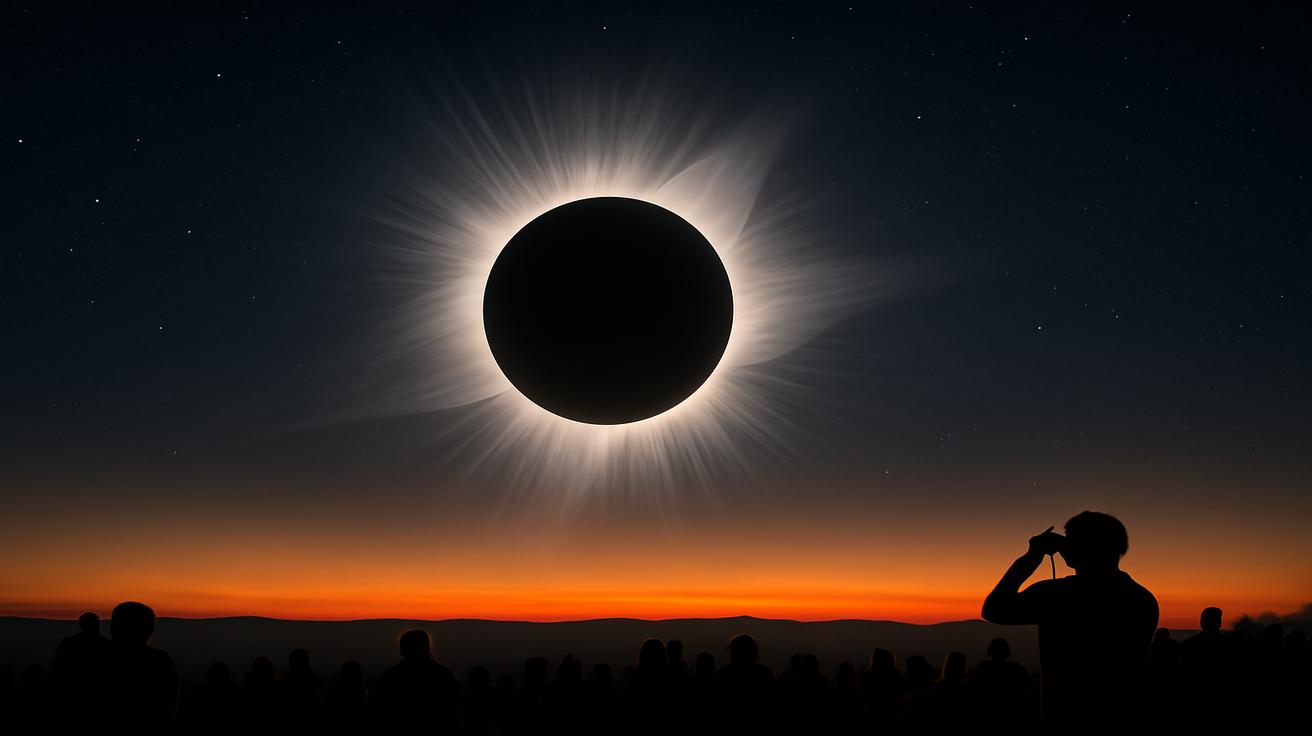
Look up (with your eclipse glasses now safely removed; during totality, it’s safe to look unaided), and you will see not the Sun you know, but its ghostly crown: the solar corona. It’s a delicate, shimmering halo of white fire stretching outward in feathery streams, braids, and loops. This is the outer atmosphere of the Sun, normally drowned by its own blinding glare. During totality, it takes center stage, a celestial veil visible only when the universe turns the brightness down to almost nothing.
The horizon, all around you, glows as if sunset has decided to rise up in a full circle. 360 degrees of muted orange and red hang far away, while directly overhead the sky deepens to indigo. It feels like standing at the bottom of a vast, glowing bowl.
This is the part of the eclipse that changes people. Not because it’s rare—we now know to the second when and where it will happen—but because the human nervous system isn’t built for it. Time itself feels unsteady. Your heart might hammer. You might feel like laughing or crying for no reason at all. Strangers often reach for each other’s hands.
And on this particular date, thanks to the careful work of astronomers, that feeling will stretch on longer than any eclipse this century. A drawn-out pause in the day. A cosmic inhale.
A Sky-Watcher’s Guide to the Longest Eclipse
Even if you never remember the technical details, this eclipse is a story told in minutes, angles, and distances. Astronomers have released their forecasts in painstaking detail: where the path of totality will fall, how long totality will last in each region, when first contact and last contact will occur, how high the Sun will be in the sky, and what kind of weather patterns are likely along the path based on past climate data.
The heart of that story can be experienced through a simple table like this, summarizing the three main phases observable from within the path of totality (times are approximate and will vary by exact location):
| Eclipse Phase | What You See | Approximate Duration | Viewing Safety |
|---|---|---|---|
| Partial Eclipse | Moon slowly covers the Sun, crescent shapes appear in shadows. | 60–90 minutes before and after totality | Use certified solar viewers at all times. |
| Totality | Sun fully covered, corona visible, stars appear in daytime sky. | Up to several minutes at maximum | Safe to look without protection only during full totality. |
| Post-Totality Partial Phase | Sun re-emerges, daylight returns in a sudden brightening. | 60–90 minutes after totality ends | Return to using solar viewers immediately as totality ends. |
The exact date now confirmed by astronomers has already begun to shape human behavior. Hotels along the path have seen a sudden spike in bookings. Amateur astronomers are planning caravans, their vehicles loaded with telescopes and tripods. Photographers are studying maps, trying to find not just clear skies but meaningful foregrounds—old barns, desert mesas, mountain ridges—to frame the moment when the Sun vanishes.
Science museums are sketching out events: hands-on workshops about orbits and shadows, family-friendly viewing parties, live commentary from scientists on the ground. Schools are building lesson plans so that the eclipse is not just a spectacle but an entry point into understanding how our solar system moves.
For many people, however, the plan will be far simpler: find a clear patch of sky, some safe eclipse glasses, and someone you care about to stand beside when the world goes dark.
How Astronomers Nailed the Timing
Behind the calm confidence of those published times lies an astonishing amount of work. Predicting an eclipse at this level of precision is like solving a three-body ballet with millisecond choreography. The key players are Earth, Moon, and Sun—each moving, wobbling, and tugging on one another in ways that, over time, have to be accounted for.
Astronomers combine data from lunar laser ranging—literally bouncing lasers off mirrors placed on the Moon during past missions—with satellite observations and extremely detailed models of how Earth’s rotation is changing. Tiny variations in our planet’s spin, influenced by shifting oceans, atmosphere, and even the slow rebound of crust since the last ice age, are factored in to refine the timing.
The result is a map that isn’t just a pretty graphic but a promise. If you stand in this town, on this road, on this beach, at this minute, the Sun will disappear. If you climb that mountain just a little farther north, you might buy yourself an extra few seconds of totality. Everything down to that level is now charted.
It’s a reminder that, beneath the poetry of the moment, the universe is precise. The same laws that guide spacecraft to distant planets also guide the Moon’s shadow to your feet.
What It Will Feel Like to Be There
Beyond numbers and diagrams, the question that people keep turning over in their minds is more personal: What will it feel like? To stand in the path of the longest total solar eclipse of the century is to put yourself into a story that has repeated across civilizations, but in your own body, it will feel brand new.
You might arrive early, hours before the first bite of shadow appears, to stake out a spot. The air will feel ordinary, the Sun almost rude in its brightness, as if unaware of the performance you’re expecting. People will shuffle, adjust tripods, compare their eclipse glasses like talismans.
As the partial phase deepens—a crescent Sun thinning to a sliver—you’ll notice the temperature drop. Your arms might prickle with goosebumps. Even the sound of the world will subtly change. The whir of insects may rise or fall. Distant traffic might feel muffled, caught in the thickening strangeness of the light.
And then, that moment. A collective gasp as the last gleam of the Sun snaps into a slender “diamond ring” and then disappears. Cameras may go quiet. Words, briefly, fail. You’re standing under a star—our star—that looks nothing like itself.
The longer totality stretches, the more your mind has time to wander inside it. The first seconds are pure shock. Then comes curiosity: tracing the shape of the corona with your eyes, noticing how one side arcs farther, how delicate plumes curl and feather. You might glimpse reddish prominences at the Sun’s edge, eruptions of plasma held in place by magnetic fields, like tiny tongues of fire against the black disk of the Moon.
With minutes instead of seconds, you’ll have time to look down, too. To see the people around you: some frozen, some weeping quietly, some grinning like children. To see the landscape transformed into a hushed, silvery dream. To feel, in a way that bypasses language, your place on a small, turning world beneath enormous, indifferent lights.
And just when your mind begins to accept this impossible noon-night as normal, the spell will break. A bead of sunlight will pierce the Moon’s edge, bright and sudden, like a cosmic floodlight. Day will roar back in a matter of moments. Birds will resume their songs, a little late but earnest. People will exhale, laugh, clap, and immediately start trying to describe something that cannot quite be captured in description.
Why We Keep Chasing the Shadow
In the days and weeks afterward, the world will return to its familiar rhythms. The confirmed date will pass into the past tense, another notch in the long timeline of celestial events. But for those who chase eclipses—or those who accidentally became eclipse chasers by standing in the shadow once—the pull will linger.
There’s something disarming about the way an eclipse shrinks human concerns down to size, but also elevates them. We pour years of planning, billions of miles of travel, and centuries of science into standing under a few minutes of darkness. We bring our children, our elders, our cameras, and our questions. We stand in awe, each of us carrying our small, complicated lives into the Moon’s shadow.
That’s why this particular eclipse, the longest of the century, already feels like a chapter out of a larger human story—a story about curiosity and timing and our stubborn desire to witness the universe doing something out of the ordinary. We have built machines that peer into black holes, rovers that crawl across Mars, sensors that feel the shiver of distant collisions between invisible objects. Yet what moves us most, sometimes, is simply watching our own star disappear.
On the date astronomers have now circled, the cosmos will give us a gift shaped like a pause. Day will turn to night not because anything is broken, but because everything is working with exquisite precision. The Sun will hide. The Moon will shine in shadow. And for a few long, unforgettable minutes, the whole world will be invited to look up and remember just how strange, fragile, and beautiful it is to live on this small, turning sphere.
Frequently Asked Questions
Is it safe to watch the longest solar eclipse with the naked eye?
You can only safely look at the Sun with the naked eye during the brief period of totality, when the Sun is completely covered by the Moon. At all other times—including the partial phases before and after totality—you must use certified solar eclipse glasses or an appropriate solar filter. Ordinary sunglasses are not safe for eclipse viewing.
How long will totality last during this eclipse?
The exact duration of totality depends on where you stand along the path. Near the point of maximum eclipse, totality will last several minutes—making it the longest total solar eclipse of this century. Locations closer to the edges of the path of totality will experience shorter durations.
Do I need special equipment to enjoy the eclipse?
You don’t need a telescope or camera to have a powerful experience. The most important item is a pair of certified solar eclipse glasses for the partial phases. A simple pinhole projector or a colander can be used to project crescent Sun images onto the ground. Binoculars or telescopes must have proper solar filters mounted on the front to be safe.
What’s the difference between a partial and a total solar eclipse?
In a partial solar eclipse, the Moon covers only part of the Sun, so daylight dims but the sky doesn’t turn dark. In a total solar eclipse, from within the path of totality, the Moon completely covers the Sun’s bright disk. The sky darkens, stars and planets can become visible, and the Sun’s corona appears as a glowing halo around the black disk of the Moon.
Why do astronomers know the exact date and time so precisely?
Solar eclipses are predictable because they depend on the regular motions of the Earth and Moon around the Sun. Using precise orbital data, models of Earth’s rotation, and detailed measurements of the Moon’s distance, astronomers can calculate the path and timing of eclipses to within seconds many years in advance.
Will this eclipse be visible from everywhere on Earth?
No. Only locations within the narrow path of totality will see the Sun completely covered. A wider surrounding region will see a partial eclipse. Areas outside those zones will not see the eclipse at all. Local visibility depends on your geographic location and the path the Moon’s shadow takes across Earth.
What should I do if I’m outside the path of totality?
If you’re outside the path of totality, you can still enjoy a partial eclipse using eclipse glasses or a projection method. Alternatively, you might choose to travel into the path of totality if it’s practical. Many people treat such eclipses as an opportunity for a once-in-a-lifetime trip, combining travel, nature, and science into a single unforgettable day.




Leave a Comment