
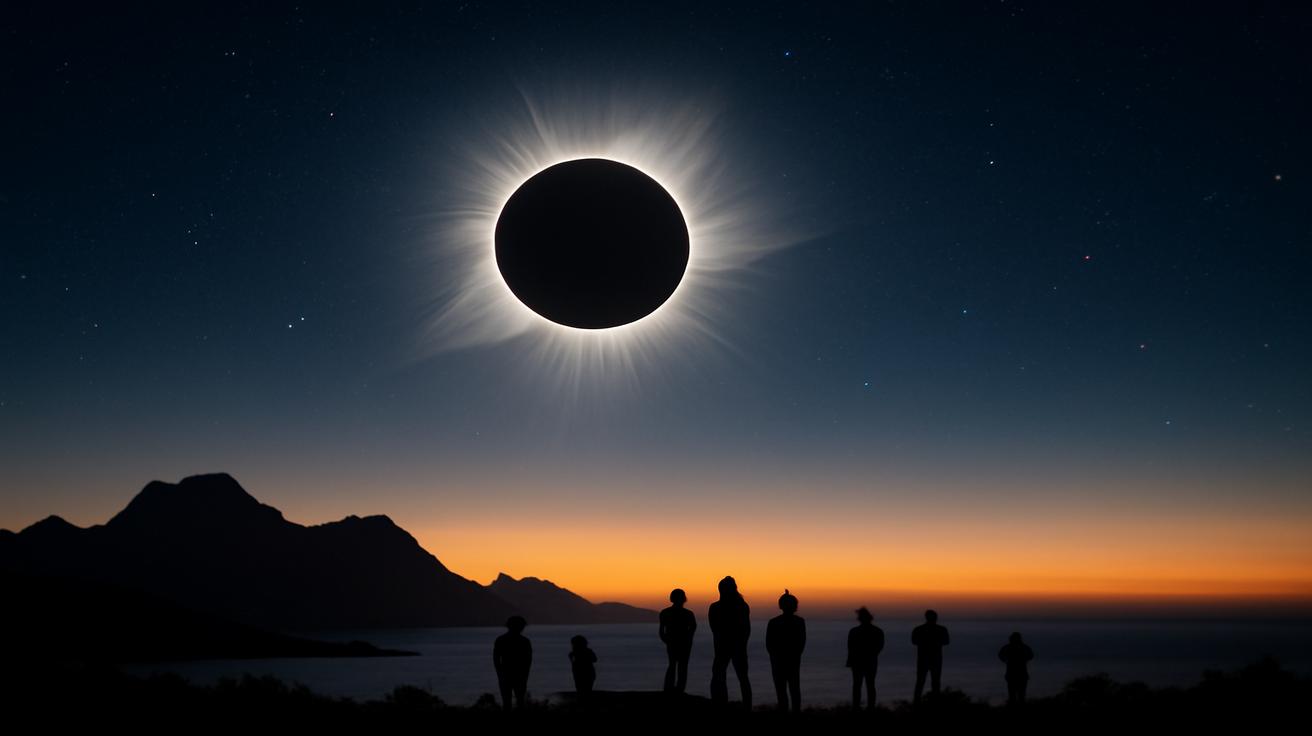
It will begin, as most revolutions do, almost imperceptibly. A soft dimming at the edges of the afternoon. Shadows sharpening into strange, double-lined silhouettes. The warmth on your skin thinning, as if someone has lowered the sun’s volume. In cities and villages, on ships at sea and mountaintop observatories, people will look up through tinted glass and pinhole projections, and they will watch daylight unspool. On this day, for the longest time in a century, the sun will surrender the sky. The day will turn to night.
A Moving Shadow Across a Turning World
This eclipse is not just another celestial event circled on an astronomer’s calendar. It is the kind of alignment that rearranges your sense of scale. The moon, so distant and familiar, will slide with improbable precision between Earth and sun, casting a narrow, racing corridor of shadow across the planet. Within that corridor, the sky will darken to twilight, planets will blink awake, stars will tremble into view, and a gasp will rise from millions of throats at once.
The path of totality—the narrow strip where the sun is fully covered—will sweep across oceans and continents in a slow, deliberate arc. Along that path will be deserts and fishing towns, highlands and sprawling megacities. Airliners will bank to chase the darkness; researchers will pack telescopes into remote plateaus; families will set out lawn chairs and blankets in open fields. There will be children seeing the midday sky go dark for the first time, and elders who remember a different eclipse long ago, when they were the ones holding tight to a parent’s hand.
Outside the path of totality, a partial eclipse will still transform the day into something uncanny. The sun will become a bitten coin, then a narrowing crescent, throwing light as thin and sharp as a blade. Trees will cast hundreds of tiny crescent suns on the ground, each leaf-gap becoming a pinhole projector. The world will look subtly wrong, as if the color has been turned down and reality has stepped a few paces to the left.
The Sound of the Sky Changing
No photograph, however exquisite, captures what an eclipse sounds like. Long before the moon completely covers the sun, the air itself seems to shiver. Birds grow restless, their songs thinning into scattered questions. Dogs pace. Cows drift toward barns. The usual heartbeat of the day hesitates.
As the light drains away, temperatures drop—a few degrees at first, then more rapidly. A breeze can rise out of nowhere, cool and insistent, blowing from the direction of the darkened horizon beneath the moon’s shadow. Insects, tricked by the sudden dusk, begin their evening chorus. Crickets pulse the silence, frogs call from nearby water. Human conversations, so loud and chatty only minutes before, fall into a hushed anticipation.
Then it happens: that breathtaking, nearly physical moment when the last bright edge of the sun—the diamond ring—snaps off and the sky falls fully into shadow. The world gasps, laughs, cries. Somewhere a child squeals with delight; somewhere else, a grown scientist forgets equations and simply says “wow” over and over into the dark. This is the soundscape of an eclipse: animal calls shifting across time, human awe hanging in the air, and, above it all, an immense, resonant silence.
The Science Threaded Through the Wonder
The poetry of an eclipse is written in the precise language of orbital mechanics. The moon orbits Earth at just the right average distance, and the sun sits at just the right colossal distance, that the two disks appear almost exactly the same size from our perspective. It is a cosmic coincidence we live inside, usually unnoticed—until the geometry lines up with exquisite perfection.
During this eclipse, the alignment is not only perfect but prolonged. Because of where Earth is in its orbit, and where the moon is in its own slightly elliptical path, the moon’s shadow will skim our planet in a way that stretches totality to a dramatic maximum. For several precious minutes at the eclipse’s longest point, the sun will vanish entirely behind the moon. In those minutes, the solar corona—the sun’s feathery, million-degree atmosphere—will bloom into view, a ghostly, white flame licking into black space.
Scientists are preparing with almost feverish excitement. Telescopes will be tuned to dissect the corona’s faint light, looking for clues about why this outer atmosphere is so strangely hot and how solar storms evolve. Spectrographs will peel the light into rainbows of information, each color carrying stories of temperature, motion, and magnetic fields. High-speed cameras will capture the brief, delicate flash of the chromosphere—the pinkish edge of the sun’s lower atmosphere—visible only in these fleeting instants when the glare is gone.
For researchers, eclipses are laboratories. For the rest of us, they are reminders: the sun we take for granted as a constant is actually a restless, turbulent star, breathing plasma and light into our every day.
How Long, Where, and When?
Though clocks and coordinates will eventually pin down every detail, the most important fact is simple: if you’re beneath the path of totality, you will see day transformed into night for longer than anyone alive today has ever experienced. The period of complete coverage—when the sun is entirely hidden—can stretch beyond seven minutes at the point of greatest eclipse, an almost luxurious length compared to most total eclipses that last just a couple of minutes.
But eclipses are local experiences. What you see depends entirely on where you are. Even a difference of a few dozen kilometers can change totality into a near miss, a full plunge into darkness into a partial bite out of the sun. Timing, too, will ripple across the globe: one country will watch the sun disappear in late morning, another in mid-afternoon. On an ocean somewhere, a crew of sailors will look up from their deck to see the stars appear in the middle of their watch.
To feel how different locations will experience the event, imagine a simplified snapshot of possible viewing scenarios:
| Location Type | Eclipse Experience | Approx. Totality / Maximum Coverage | Sky Appearance |
|---|---|---|---|
| Center of Path of Totality | Full total eclipse | 6–7+ minutes | Dark twilight, stars and planets visible, corona bright |
| Edge of Path of Totality | Brief total eclipse | A few seconds to 2 minutes | Rapid dimming and brightening, brief view of corona |
| Nearby Partial Zone | Deep partial eclipse | 80–99% coverage | Noticeable dimming, crescent sun, unusual shadows |
| Distant Partial Zone | Shallow partial eclipse | Up to ~50% coverage | Subtle change in light, sun appears slightly bitten |
| Outside Eclipse Region | No eclipse visible | 0% | Normal daytime sky |
Wherever you find yourself, the eclipse will be a lesson in how location shapes experience. Two people, separated by a short drive, may have entirely different stories to tell: one about a sky that truly darkened, one about a day that only felt a little strange around the edges.
Preparing Your Eyes and Your Heart
No event this beautiful arrives without a few clear rules. The first is the most important: your eyes are precious, and the sun is powerful. Looking straight at it without proper protection, even when most of it is covered, can permanently damage your vision. Regular sunglasses are not enough. To watch the partial phases, you need certified eclipse glasses or solar viewers that meet stringent safety standards, or you need to project the sun indirectly using simple tools like a pinhole projector.
During the brief span of totality—when and only when the sun is completely blocked—it becomes safe to look directly with the naked eye. In those minutes, you’ll see details that no filter can reveal: the delicate petals of the corona, streamers of light shaped by magnetic fields, possibly even pink prominences leaping off the solar limb. Then, as soon as the first bright edge of the sun reappears, the glasses must go back on. The story of the eclipse is a rhythm of careful watching and reverent restraint.
There are other kinds of preparation, too. Think about where you want to be, not just geographically but emotionally. Do you want to stand in a big crowd, sharing collective awe with thousands of strangers? Or would you rather experience it in near-silence on a lonely hill or empty beach? Will you try to photograph every stage, or will you set down your camera when totality approaches and simply look, letting the sky write itself directly into your memory?
Some people plan for years to be exactly under the moon’s racing shadow. Others will stumble outside on their lunch break, tipped off by a coworker’s excited “hey, did you know what’s happening today?” Both will witness something that reaches past routine. This is the kind of event that refuses to stay on the surface of your life. It burrows down and becomes one of those days you mark with capital letters in your mind: The Day the Sun Went Out.
Creatures of Habit Facing a Broken Routine
We are not the only ones whose rhythms will be interrupted. Animals, whose lives are wired to the reliable cycle of light and dark, respond in all sorts of ways to solar eclipses. In forests and wetlands, diurnal birds often hush quickly, as if someone has snapped off the conductor’s baton at the end of the day’s last song. Nocturnal species may stir, confused but curious, emerging briefly before the light returns and sends them scuttling back.
On farms, chickens can climb their roosts, convinced that night has fallen ahead of schedule. In zoos, gorillas may gather, watching the sky with a wary stillness. Fish have been known to move toward evening feeding grounds. Pollinators change their routines: bees may return to hives, butterflies tuck themselves into resting spots among the leaves.
Researchers sometimes set up microphones and motion sensors before a big eclipse to capture this sudden ecological misstep—a whole landscape, for a few minutes, acting as if someone pressed fast-forward on the day. It is a reminder that light is not just a backdrop, but a key signal threaded through every living pattern around us.
The Old Stories Standing Beside the New
Long before anyone could calculate the precise dance of Earth, moon, and sun, eclipses were messages from the beyond. In ancient China, it was said that a celestial dragon devoured the sun; communities would drum and shout to scare it away. In parts of South America, myths told of giant animals or spirits taking bites out of the day. In the Mediterranean, eclipses were omens—warnings of shifting power, of kings to fall and battles to be decided.
Imagine, for a moment, experiencing this eclipse without any modern explanation. You’re out in a field beneath a bright, ordinary afternoon. You know the sun as the most stable thing in your world. And then, without warning, it begins to vanish. The air cools. Colors warp. The sky deepens. Stars appear—and then, as quickly as it began, the light returns. How could you not believe, in that moment, that some enormous story beyond your understanding is being told?
Now we stand in a different kind of story. We can predict eclipses centuries in advance, down to minute and kilometer. We understand the motions and forces. We can write equations for them, draw diagrams, simulate them on computers. But none of this precision empties the event of wonder. If anything, it adds a layer: awe not only for the strangeness of the moment, but for the fact that we small creatures on this turning rock have learned enough to foresee it, to understand why the sky behaves as it does.
When the longest eclipse of the century lifts its shadow and the day returns, old myths and new science will stand side by side in the human mind. Somewhere, a child watched with certified eclipse glasses and still half-believed a dragon might be involved. Somewhere else, a physicist took a short break from data-gathering to simply cry at the sheer, overwhelming beauty of the corona. This is what eclipses do: they braid logic and longing, intellect and instinct, into a single shared experience.
What Stays After the Shadow Moves On
The path of totality will pass; the shadow will race on, leaving the places it touched to warm themselves again in ordinary light. People will fold their lawn chairs, traffic will cautiously unclog, telescopes will be disassembled. Students will shuffle back into classrooms, trying to convert what they just saw into words that feel too small.
But something lingers. Once you have watched the sun extinguished and relit in the span of a few minutes, everyday daylight feels a little more precious. The sunrise you typically ignore behind your commute suddenly seems like a minor miracle. You know, now, in your bones, that the star at the center of your days is not just a circle in the sky but a living, dynamic furnace. You have seen its hidden atmosphere flare out like a white halo against a darkened noon.
You might also feel, in some quiet way, more connected to other people. During totality, everyone beneath that shadow shared the same sky, the same tremor of astonishment, no matter what languages they spoke or borders they crossed to get there. For a few moments, politics, deadlines, and arguments dissolved into the simple fact of standing together in the dark, waiting for the light to return.
Years from now, you may barely remember what you had for breakfast that morning, or what tasks waited on your desk. But you will remember the strange stillness of the air as the daylight thinned. You will remember the chorus of crickets at noon, the way the horizon glowed in every direction like a ring of distant sunsets, the collective exhale as the sun’s first returning sliver burned through the sky. You will have your own particular version of a story millions of others also carry: the day the world turned its face for a moment away from the star that feeds it, and let us see the universe in a new light.
Frequently Asked Questions
Is it really safe to look at the eclipse during totality?
During the brief period of totality, when the sun is completely covered by the moon and no bright solar surface is visible, it is safe to look with the naked eye. The moment any part of the bright sun reappears, you must use proper eclipse glasses or solar filters again. Before and after totality, direct viewing without certified protection is dangerous.
Why is this eclipse called the longest of the century?
Not all total solar eclipses last the same amount of time. This one occurs when the moon is relatively close to Earth and the Earth is at a point in its orbit that makes the sun appear slightly smaller. That combination allows the moon’s shadow to cover the sun for longer at the point of greatest eclipse, stretching totality beyond what any other eclipse in this century will reach.
Do animals really behave differently during an eclipse?
Yes. Many animals rely on light cues to time their daily behavior. During a total eclipse, some diurnal animals act as if night is falling—birds may go quiet, insects that sing at dusk may start calling, and livestock can move toward evening shelters. These changes are usually brief and revert quickly when daylight returns.
Can I take photos of the eclipse with my phone?
You can, but you should be careful. During the partial phases, your phone’s camera—like your eyes—should be protected by a proper solar filter if it’s pointed at the sun. During totality only, you can safely photograph without a filter, though focusing and exposure can be tricky. Many people choose to take a few quick shots, then put devices away to simply experience the event.
What if I am not in the path of totality?
If you’re outside the path of totality, you may still see a partial eclipse, where the moon takes a bite out of the sun. With proper eye protection, this can still be a striking and memorable sight, especially if the coverage is deep. Even if the sun is only partly obscured, the light can take on an unusual quality, and shadows become fascinating to watch.







Leave a Comment