
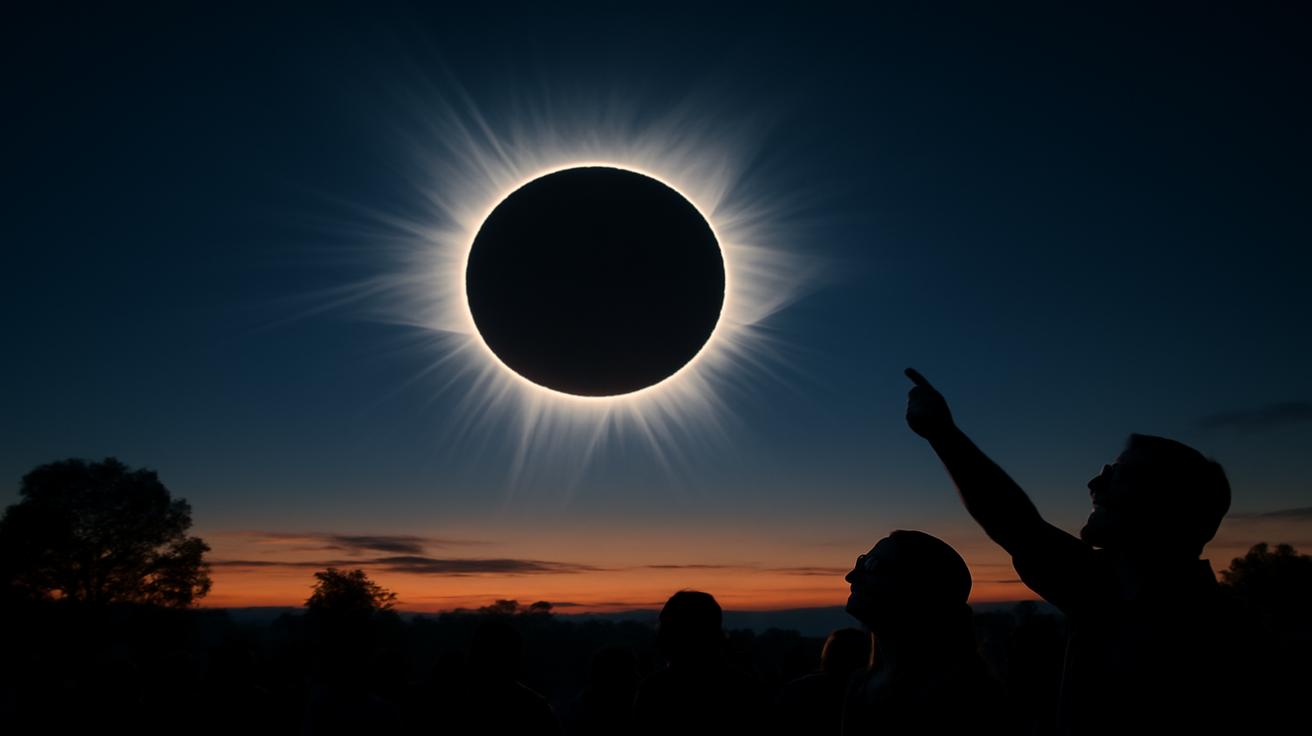
The story begins with a shadow, racing faster than sound. One ordinary morning, somewhere in the middle of an otherwise unremarkable week, the world will pause. Dogs will stop barking. Birds will hesitate mid-song. A cool wind will spill across streets and mountains and cities that were bright just a heartbeat ago. Day will turn to night, not because the sun has set, but because the moon has stepped perfectly, impossibly, between us and the star that gives us life. It will be the longest total solar eclipse of the century, and if you’re lucky enough to stand beneath its path, you will never forget the feeling of watching the sky change its mind.
When the Sun Forgets to Shine
You will probably remember the light first. On the morning of the eclipse, everything might seem too ordinary to believe that something so rare is about to happen. Traffic lights will blink red-green-yellow, children will hurry to school, coffee will hiss and steam in kitchen kettles. The sun will rise as it always does, golden and patient, rolling up over rooftops and hills.
Then, slowly—so slowly you might not notice at first—the world will begin to dim.
It doesn’t look like sunset. It feels stranger than that. The color of the light thins out. Shadows sharpen along the edges, like someone outlined a tree on the sidewalk with ink. If you’re watching the ground beneath a leafy branch, you’ll see dozens of tiny crescent suns dancing in its dappled shade, each leaf acting as a pinhole projector. The air cools in a way that doesn’t match the clock. You might pull your jacket just a little tighter without even realizing why.
Above you, the moon will be sliding across the face of the sun, an invisible ink stain against brightness you can’t look at directly. With the right eclipse glasses, you’ll see it—a gentle dark bite at the sun’s edge, growing steadily. Without protection, you see only that the day is becoming uncanny, wrong in its colors, as if the world’s saturation slider has been nudged down.
As the minutes pass, a hush spreads. The long shadows of trees stretch out like they do at dusk, but the clock insists it is still midday. Insects that belong to evening will begin to stir. Birds will grow restless. The moon keeps coming.
The Longest Shadow of Our Century
Total solar eclipses happen more often than most people realize. Somewhere on Earth, every 18 months or so, the moon’s shadow sweeps across a narrow path, turning day to night for a few brief minutes. But this one is different. This time, the geometry is perfect. The alignment of sun, moon, and Earth will give us a stretch of totality—those precious minutes when the sun is fully hidden—that will last longer than any other eclipse in this century.
Imagine the path of the moon’s shadow as a dark river flowing across the globe, only a couple of hundred kilometers wide, but thousands of kilometers long. If you stand exactly where that river passes over land, you’ll see the full spectacle: the world turning to twilight in the middle of the day, the sun transforming into a black disk ringed in ghostly fire. People will travel from every corner of the planet to stand in that thin band. Some will camp in deserts. Others will crowd onto beaches, rooftops, and rural fields. Hotel rooms months in advance will be sold out in towns that no one usually writes about in travel magazines.
Outside that path, millions more will see only a partial eclipse—still dramatic, but not the same. The sun will be bitten, dimmed, reshaped into a crescent. Yet the stars will not appear, the world will not truly darken. To stand in partial shadow is to sense the miracle from a distance; to stand in the path of totality is to be swallowed by it.
This eclipse will be measured in fractions of seconds by astronomers, in tens of minutes by broadcasters, and in heartbeats by those lucky enough to witness it. For them, the long-awaited darkness will feel impossibly short. Time will become slippery. People will shout, cry, or fall silent. There will be a brief, collective understanding: we are very small, and we live in the thin space between shadows and fire.
The Moment the World Holds Its Breath
Every total solar eclipse has a tipping point—those last seconds before totality when the sky forgets which way it’s supposed to go. On the ground, the light falls away rapidly, like sand through fingers. The western horizon begins to look like sunset, while the eastern horizon stays strangely bright. The wind picks up. Temperature can drop noticeably in a matter of minutes.
If you’re watching the sun through certified eclipse glasses, you’ll see the last bright bead of light clinging to one edge of the darkening circle of the moon. This is the “diamond ring” effect: a single blazing point of sunlight, sharp and brilliant against the black. Around it, a faint halo appears—pale, feathery, otherworldly. Then, as the moon moves a breath more across the sun’s face, that last bead of light is snuffed out.
In that instant, the rules change.
The world around you plunges into an eerie twilight. It is not the blue-gray of evening, nor the black of midnight, but a circular, 360-degree dusk. All along the horizon, like the rim of a vast bowl, you may see bands of orange and pink light—the glow of distant places still under the sun. Overhead, the sky darkens enough for bright stars and planets to appear. Venus may sparkle like a lantern. Jupiter might stand watch a little farther away. The familiar daytime sky has turned into a soft, filtered version of night.
You can now look directly at the sun, but it is no longer the sun you know. Instead, hanging in the sky is a deep, velvet black circle surrounded by a wild crown of silver-white light—the solar corona. It spreads out in tapering streamers and delicate loops, shaped by the invisible forces of the sun’s magnetic field. This is the sun’s atmosphere, usually drowned out by its own blinding brightness, now revealed like a secret whispered only during these rare alignments.
People around you might gasp. Some will talk rapidly, as if words can keep up with what they’re feeling. Others will simply stare, motionless, trying to drink in every second.
A Shadow That Speaks to Our Ancestors
If you were to listen closely during totality, in the quiet between the rustling leaves and the soft murmur of people, you might hear echoes of the past. For most of human history, eclipses were omens—a dragon eating the sun, a cosmic warning, a sign of gods displeased or miracles on the way. In some cultures, people banged pots and pans, fired arrows into the sky, or chanted to scare away the thing swallowing the light.
Today, we can calculate the exact moment the moon’s shadow will first touch the Earth and when it will leave. We can write down, to the fraction of a second, how long each town along its path will sit in darkness. We know there is no dragon, no angry deity—only a dance of gravity and geometry, a moon that just happens to be the right size and distance to perfectly cover the sun from where we’re standing.
And yet, when the sky darkens and the stars appear in the middle of the day, something ancient stirs inside us. Rational understanding doesn’t erase that electric ripple of awe. Instead, it deepens it. You know exactly what’s happening, and still, you feel small, like a single leaf trembling in a vast, invisible wind.
How Long Is “Longest” When You’re Standing in the Dark?
On paper, the numbers for this eclipse look clean and clinical: a path of totality sweeping across continents, a maximum duration of totality measured in long, luxurious minutes at the point where the alignment is most precise. Compared with other eclipses in the 21st century, this one sits at the top of the list, a neat entry in tables and charts: the longest total solar eclipse of its hundred-year window.
But people don’t experience eclipses in data points; they live them in sensations and seconds.
The first minute or two of totality often feels like shock—an explosion of new light in the sky where the sun used to be, the sudden chill on your skin, the chorus of reactions from everyone around you. Then, as your eyes adjust, time stretches. You begin to notice details: the filament-like texture of the corona, the faint pink flames along the sun’s limb called prominences, the dusky blue of the sky overhead swaying between night and day.
Your mind toggles between looking up and looking around. The shadow of the moon has turned you into a citizen of some temporary twilight country. Streetlights may flicker on; automatic porch lamps may glow. Far off, you might hear a confused rooster crow or the uneasy lowing of cattle. City skylines will look like bright necklaces under a false night.
In previous eclipses, many observers reported that totality felt far shorter than it actually was. Even three or four minutes passed like a held breath. With this exceptionally long eclipse, there will be a little more time—a few extra heartbeats to memorize the sky, to try and fix this impossible sight into your memory. You may feel your thoughts slowing, turning from excitement to quiet reverence.
Then, without mercy, the diamond ring will flash again as the moon begins to slip away. Totality ends not as a gentle fade but as a sudden blaze. One bright bead of sunlight bursts from the edge of the dark disk, dazzling and sharp. The world around you inhales light in a rush, like a film played backward. Shadows soften, birds come uncertainly back to song, and ordinary day remakes itself as if nothing extraordinary has just happened.
Preparing for Your Own Journey into the Shadow
Whether you plan to stand under the heart of the eclipse or watch a partial bite from your backyard, there is a quiet ritual to getting ready. It begins with choosing where to be—studying maps of the path of totality, checking the likely cloud cover, deciding which field, rooftop, or shoreline will be your vantage point on the universe’s oldest magic trick.
Then comes the gear, though in truth you need less than you might think. Safe, certified solar viewing glasses are essential for all the partial phases; regular sunglasses are not enough. Some people bring solar filters for telescopes or binoculars, special camera filters, tripods, and gear lists that read like a small expedition. Others bring only their eyes and a willingness to look up.
What matters more than equipment, perhaps, is intention. Eclipses have a way of becoming personal markers—pages in the diary of your life. You may remember who you stood beside, whose hand you held when the light went out, whose laugh broke the silence when the stars appeared at noon. For months before the event, strangers online will trade plans and maps, scientists will share predictions, local communities will arrange viewing gatherings. The eclipse will stitch unexpected connections long before its shadow arrives.
On the day itself, you might pack a blanket, a thermos, a notebook, a warm layer for the sudden chill. You might write down your impressions during the partial phases, then forget the pen entirely once totality begins. You might try—again and again—to capture the corona with your camera, only to realize that no lens can quite contain its living light. The real photograph will be the one your memory keeps.
| Eclipse Feature | What You’ll Notice | When It Happens |
|---|---|---|
| First Contact | A tiny “bite” appears on the edge of the sun (with eclipse glasses). | Start of the partial phase. |
| Crescent Suns | Leaf shadows turn into little crescent shapes on the ground. | As the sun is increasingly covered. |
| Diamond Ring | One bright point of light with a halo, like a shining ring. | Seconds before and after totality. |
| Totality | Day turns to twilight, stars appear, the corona becomes visible. | Peak of the eclipse, lasting several minutes at most. |
| Shadow’s Exit | Light returns quickly, temperature begins to rise again. | After totality as the moon moves away. |
Science Written in Light and Shadow
Beyond the poetry, eclipses have always been laboratories. In 1919, a total solar eclipse helped confirm Einstein’s theory of general relativity, as starlight bending around the sun’s mass could finally be measured when the sun’s glare was dimmed. During modern eclipses, scientists still stare at that ghostly corona with hungry eyes.
The corona is far hotter than the surface of the sun itself—a perplexing fact that solar physicists are still working to fully understand. High-altitude planes, balloons, and teams along the eclipse path may use this unusually long event to capture extended sequences of data. The extra minutes of totality at the eclipse’s peak offer something precious in science: time. Time to watch the corona change, to measure its delicate structures, to see how solar winds behave in real-time.
At the same time, citizen scientists and students will measure temperature drops, animal behavior, and changes in atmospheric conditions. In classrooms, children will build simple pinhole viewers and learn that geometry, not magic, is behind the darkening of the sun. Amateur astronomers will assemble homemade rigs and compare notes across continents. The eclipse becomes not just a spectacle, but a global, cooperative experiment written in light and shadow.
And yet, even those who understand every equation behind the event often fall silent when it actually happens. Data is one language. Awe is another.
After the Shadow Has Passed
Long after the moon’s shadow has left the Earth, long after the last observers have packed up their blankets and tripods, the eclipse will continue to live on in stories. Someone will tell a friend, “I thought I knew what it would look like, and then I saw the corona.” Someone else will remember the exact way the wind shifted, or the low, surprised whistle of a stranger standing nearby. Parents will recall the weight of a child’s hand tightening in their own as the world slid into midday night.
Years from now, this longest total solar eclipse of the century will sit in the memory of those who witnessed it like a bright, steady bead of time. They will remember where they were and who they were then. Perhaps, in a future decade, when another great eclipse is announced, they will dig out fading eclipse glasses from the back of a drawer and smile, thinking back to that single, long, extraordinary shadow that crossed the world.
For everyone else—those who saw it only partially, or through photos, or not at all—there will still be the quiet knowledge that such events unfold above us whether we watch or not. The cosmos is moving, ceaselessly, with or without an audience. The alignment of sun, moon, and Earth does not require our attention to be perfect. But when we do choose to look up, when we pause our bright, busy human lives to stand together in the cooling air and watch the sky flicker from day to night and back again, we briefly align ourselves with something older and larger than any of us.
Day will turn to night. The longest shadow of our century will run its course. And somewhere under that brief and beautiful darkness, someone will look up, feel the hair lift on their arms, and quietly promise themselves this: to never again take ordinary daylight for granted.
Frequently Asked Questions
Is it safe to look at a total solar eclipse with the naked eye?
It is safe to look with the naked eye only during the brief period of totality, when the sun is completely covered by the moon and no direct sunlight is visible. For all other phases—before and after totality—you must use proper, certified eclipse glasses or solar filters. Never look at the partially covered sun through regular sunglasses, binoculars, or a camera without a solar filter.
Why is this called the longest total solar eclipse of the century?
Within the 21st century, total solar eclipses vary in how long totality lasts at their maximum point. This particular eclipse features the longest duration of totality anywhere along its path compared with all others in this hundred-year span, making it the “longest” of the century from an astronomical perspective.
Will everyone on Earth see total darkness during this eclipse?
No. Only people located within the narrow path of totality will experience full darkness and see the corona. Those outside this path may see a partial eclipse, where the moon covers only part of the sun, and the sky does not fully darken.
Why does the sky get cooler and darker even before totality?
As the moon increasingly blocks the sun, less solar energy reaches the ground. This reduces heating of the air, causing a noticeable temperature drop. The light also weakens and shifts in quality, creating a dim, eerie daylight that feels unlike ordinary sunrise or sunset.
How often do total solar eclipses happen?
Total solar eclipses occur somewhere on Earth roughly every 18 months, but any given location may experience them only once every few centuries. Experiencing a total eclipse is rare not because eclipses are scarce, but because the path of totality is so narrow.
What’s the difference between a total and a partial solar eclipse?
In a total solar eclipse, the moon completely covers the sun for observers along the path of totality, revealing the corona and causing twilight-like darkness. In a partial eclipse, the moon covers only part of the sun, so the sky remains mostly bright, and the corona is not visible.
Do animals really act differently during a total solar eclipse?
Yes, many animals respond to the sudden change in light and temperature. Birds may roost as if night has fallen, insects that are active at dusk can emerge, and livestock often behave as though evening has come. These reactions vary by species and location but are commonly reported during total eclipses.






Leave a Comment