
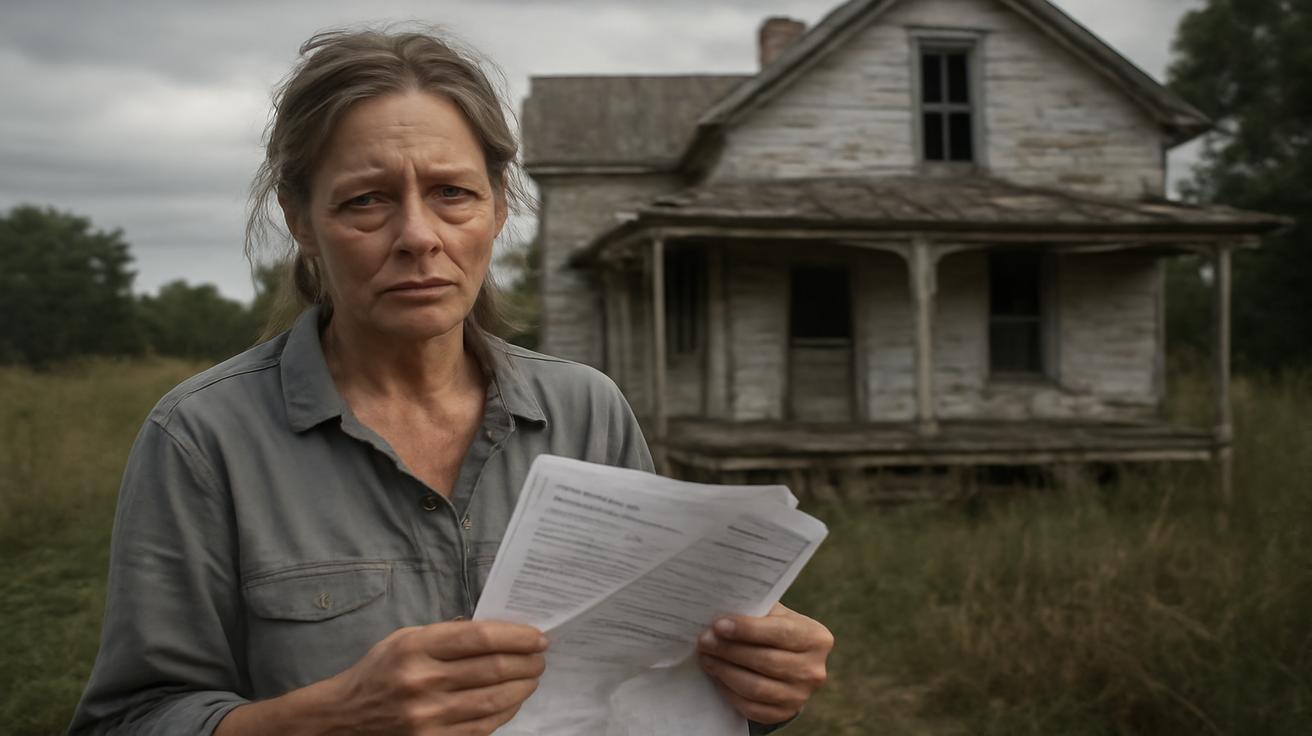
The farmhouse smells like rain and woodsmoke and the faint, sweet trace of your childhood. Or maybe that’s just what Anna tells herself when she pushes open the swollen kitchen door and steps back into the life she thought she’d left behind. The gravel drive is rutted now, the verandah rail leans drunk toward the paddock, and the roof has given up trying to keep out every storm. But the old kettle still whistles, the floorboards still remember every footstep, and in the back room, her father is dying.
Coming Home to a House Already Half-Gone
She moved back because there was nobody else. That’s how this story begins in most families: with a quiet, reluctant heroism that never makes the papers. Her brothers lived hours away with jobs they couldn’t abandon. Her sister had children still in nappies. Anna had work she could do remotely, an apartment in the city she could sublet, and the sort of stubborn love that doesn’t know how to say no.
The farmhouse had been her grandparents’ before it was her parents’, a place where summers were measured in jars of apricot jam cooling on the counter and winters in the length of woodpile stacked by the back door. By the time Anna’s mother died, the house was already starting its slow slide into disrepair. Her father kept insisting he’d “get around to it” once his knees were better, once the harvest was in, once the next bill was paid.
He never did. Life, as usual, got in the way. So when the doctor said the cancer had moved from “manageable” to “we’re running out of options,” it was this house that everyone turned their eyes toward, as if bricks and dust and grass-stained memories could carry the weight of one more sacrifice.
“I’ll go,” Anna said, almost before the question was asked. This is what daughters do, she thought. This is what families do. She put most of her own things into storage. Her city friends texted gentle, supportive messages with heart-shaped reactions. Her boss said, “We’ll figure it out,” and for once actually seemed to mean it.
On her first night back, she lay in her old bedroom, staring at the flaking paint on the ceiling. The wind moved through the broken seal of the window, bringing with it the smell of wet earth and the rustle of the big gum tree by the dam. Somewhere in the house, her father coughed—a ragged, tearing sound. She listened harder, the way you do with babies and the very old, as if you can hear life itself in the pattern of their breathing.
She thought about how temporary this all was supposed to be. A year, maybe. Eighteen months at most. Long enough to shepherd him through the chemo, the appointments, the stubborn, proud refusals to accept help. Long enough to be there when he couldn’t get out of bed alone, but not so long that her own life would drift out of reach.
The Quiet Math of Sacrifice
The deal, such as it was, seemed simple. Her father would write up something so she could pay the utilities and rates properly. The family lawyer suggested making her an “informal tenant” and setting a token rent—“just so it’s clean on paper,” he’d said. It felt like one more adult chore in a long list of them. They agreed on an amount that would barely cover the council bills. She’d transfer it each month from her dwindling savings.
Nothing about it felt like business. She was scrubbing mould from the bathroom grout, figuring out how to keep the old hot water system limping along, and learning how to coax her father into eating more than two mouthfuls at a time. On good days, they’d sit on the back step with tea in chipped mugs and talk about paddocks and neighbours and which birds had nested in the macrocarpa this year.
Her father’s hands shook now when he lifted his cup. Once, they’d been the surest thing she knew—steady on the wheel of the ute, firm around the handle of a shovel, gentle when he’d bandaged her knees after some childhood misadventure. Watching them tremble as they reached for a biscuit felt like seeing the whole house tilt.
The “rent” went out each month, and Anna barely thought about it. On paper, it made her a tenant. In reality, she was a daughter washing sheets at midnight and trying not to cry in the laundry so he wouldn’t hear.
When Grief and Bureaucracy Collide
Her father died in the last wet month of winter. The day after the funeral, the house felt colder than it should have, even with the fire going. Condolence cards stood in hesitant rows along the mantelpiece. Casseroles filled the fridge: lasagne, shepherd’s pie, an improbable number of quiches. People came and went, shifting between rooms as if moving through a museum of their own memories, all of them saying the same things in slightly different words.
When the lawyer called a few weeks later to discuss the estate, it didn’t seem like a big moment. There wasn’t much to inherit. The farmhouse, the surrounding land, a battered tractor, some savings scraped together over forty years. The plan had always been that the house would pass to the children equally. Nobody had ever really talked about how that would work; it just floated in the future like everything else their parents never quite finished.
At the council office, under fluorescent lights that hummed faintly, the story changed. The clerk, polite but distant, frowned at her screen.
“So you’ve been paying rent?”
“Sort of,” Anna said. “Just to cover the bills. It’s my family home.”
The clerk’s fingers tapped at the keyboard. “If you’ve been paying rent, this may have been classified as an income-generating property.”
“It… wasn’t,” Anna said, feeling something cold and unfamiliar start to unspool in her chest. “It was care. I was looking after my dad.”
The clerk nodded in that practiced, sympathetic way of people who spend their days delivering bad news. “I understand, but from a tax perspective, the classification is based on the presence of rental income. It may fall under commercial or investment use rather than primary residence.”
Words like “assessment,” “backdated liability,” and “reclassification” began to tumble out, each one heavier than the last. Somewhere underneath them, the phrase lodged like a shard of glass: a decade of backdated property taxes.
When Caring Becomes “Commercial Activity”
In the official story, this is straightforward. If a property generates rent—any rent—it can be treated as though it’s part of a business. And businesses, even very small, accidental ones, don’t get the same gentle treatment as family homes. They are subject to different rates, stricter rules, and a kind of moral suspicion: if you’ve made money from a property, the system assumes you must have done it on purpose.
The paperwork didn’t ask how many nights Anna had sat awake listening for her father’s breathing. It didn’t ask about the way his personality had thinned out as the medication stacked up, or how the house had become both sanctuary and prison. It didn’t care that she had paid “rent” in part because her father didn’t want to feel like a burden, because pride is its own kind of currency in families like theirs.
The system just saw transfers in a bank account and rebranded her sacrifice as a commercial arrangement.
“It’s not that we think you did anything wrong,” the council officer told her, over the phone now. “But under the regulations, this is the correct categorisation.”
“Then the regulations are wrong,” Anna said. Her voice came out rough, as if she’d been shouting. She hadn’t. She’d just been holding back too many words for too long.
What stung most was the way the story looked from outside. On paper, she was now a “landlord” who had under-declared, under-paid, under-everything. The fact that the “tenant” was her dying father, and that the “income” barely covered the cost of keeping the lights on, didn’t fit the tidy boxes on the form.
The Village Divided by a Ledger
In small towns, news travels faster than wind over stubble. First it was “Did you hear about the tax mess with the old Cooper place?” Then it was “I heard Anna was claiming she was just caring for him, but there was rent, you know, proper rent.” The story spread, changing shape with every retelling.
Neighbours who’d once left casseroles now left opinions. Some were firmly on her side.
“It’s outrageous,” said Mrs. Daly from two properties over, her hands floury from baking. “You gave up your life for him. The government should be paying you.”
At the hardware store, a man in a faded cap shook his head. “Look, I feel for her,” he said to no one in particular, “but rules are rules. If you open the door for one person, everyone’ll want special treatment. Next thing, every ‘carer’ is actually just another landlord dodging taxes.”
It wasn’t just neighbours. Within the family, lines began to appear where none had been before. Her brother, careful and pragmatic, worried about fines compounding and whether they’d have to sell the place that now existed mostly as memory and debt.
“Maybe we should cut our losses,” he said over the phone. “We can’t fight city hall. It’s not about Dad anymore; it’s about not drowning.”
Her sister wept at the thought of losing the house. “It’s the only place that still feels like we belong somewhere,” she said. “And they’re turning our grief into a spreadsheet error.”
What nobody quite said aloud, but everyone felt, was this: Anna had done what everyone said was right. She had come home. She had cared. She had held her father’s hand through the worst of it. And yet the system treated her as if she had merely found a new way to monetise an old asset.
Counting Costs You Can’t Put in Columns
Across the country, versions of this story keep playing out—often quieter, buried under other dramas, but always with the same sharp edges. As populations age, more adult children are moving back in with their parents, or bringing parents into their own homes, improvising care systems where formal ones are patchy or painfully expensive.
On one side of the equation, there is the rhetoric of duty and love. Politicians praise “family values” and “intergenerational solidarity.” On the other, there are tax codes that reduce love to liability the moment money changes hands—even if that money is mostly symbolic, or moving in circles between shared accounts.
It’s not that taxes are evil, or that rules shouldn’t exist. Roads and hospitals and, yes, the healthcare that briefly kept Anna’s father alive all depend on someone paying into the system. But there’s a particular cruelty in failing to distinguish between profit and sacrifice, between a rental empire and a crumbling farmhouse held together with inherited obligation.
In the end, what Anna owed wasn’t just money. It was time: hours spent on hold, navigating menus and case numbers, writing appeal letters that tried to translate her father’s last years into legalese.
She started keeping notes at the kitchen table, because that’s where everything important had always happened in this house: school permission slips, harvest plans, her parents’ whispered arguments about how they would afford new tires for the ute.
| What the System Saw | What Actually Happened |
|---|---|
| Regular rent transfers from daughter to father | A daughter covering household bills so her father could keep his dignity |
| Long-term “income-generating” use of property | Temporary move home to provide end-of-life care |
| Unreported commercial landlord activity | An improvised family arrangement made under stress and grief |
| Tax underpayment over ten years | A bureaucratic blind spot where care work simply didn’t fit |
The more she wrote, the more obvious it seemed that the story wasn’t just hers. It belonged to anyone who had ever stepped in where the social safety net had frayed and then been penalised for not fitting neatly into a checkbox.
A Farmhouse as Battleground Between Generations
The house itself became a kind of argument. At community meetings and over post-church coffee, people talked about “the Cooper case” as if it were a cautionary tale or a parable.
Older neighbours, who remembered when tax bills came on thin, onion-skin paper and could be sorted with a quiet word at the counter, shook their heads. “It was never meant to be like this,” said one, fingers curled around a chipped saucer. “We built our homes. Our kids cared for us. Nobody called that a business.”
Younger locals, many priced out of ever owning a home, saw another angle. “My parents expect me to do what Anna did,” a man in his thirties told a friend, waiting for takeaway coffee. “Quit my job in the city, move back, look after them. But if the system punishes you for it and you end up broke, what’s the point? I love them, but I can’t set my whole life on fire.”
Online, where nuance goes to die, the debate was louder. One camp accused families like Anna’s of wanting “special treatment” and “gaming the system under the cover of sentiment.” The other argued that the real cheats were those who used complex trusts and shell companies to avoid far larger tax bills, while people like Anna were crushed under the weight of technicalities.
Somewhere in the middle, a quieter question took shape: When we talk about intergenerational responsibility, what do we really mean? If we expect adult children to become unpaid nurses, housekeepers, and financial managers for their parents, shouldn’t our laws at least recognise that what’s happening is care, not commerce?
Should Sacrifice Be Counted as Profit?
Behind the abstract policy debates is a simpler, more human dilemma. In a world where so many things are measured in money—time, space, attention—care work stubbornly resists quantification. It happens in the gaps: between meals, in the middle of the night, during stolen hours that could have been overtime or side hustles or rest.
Reclassifying care as profit doesn’t just feel morally wrong; it sends a chilling message. If moving home to look after your dying father can turn you into a “commercial landlord” in the eyes of the state, then every adult child weighing up the decision to care is handed one more quiet reason to say no.
For families already stretched thin, the threat of backdated taxes and bureaucratic entanglement can tip the balance. Why risk your own financial stability—and your siblings’ and children’s—if the reward for stepping up is suspicion and penalty?
Yet the alternative is a society where care is outsourced entirely: to underfunded institutions, underpaid workers, and overburdened systems. Many of those systems already only function because of the invisible scaffolding of family support behind them. Strip that away, and the cracks widen fast.
When Anna looked at the tax bill, it wasn’t just the number that hurt. It was what it symbolised: the official erasure of every tender, painful, messy hour she had spent in that house trying to make her father’s last days bearable. On the page, none of it counted as anything more than a misclassified income stream.
What We Owe Each Other, and What We Penalise
One late afternoon, long after the worst of the paperwork storm had passed but while the ache of it still lingered, Anna walked the fence line behind the farmhouse. The grass was long, gone to seed. The sky was starting to pinken at the edges. In the distance, a neighbour’s dog barked. The house behind her sagged gently into itself, a little more each season.
She thought about what her father would say if he knew. Probably something blunt and unprintable about bureaucrats who’d never changed a bedpan in their life. Then, softer, something about how he never wanted to be the reason she suffered, how it would have been better if he’d just sold the place years earlier and spared them all this.
But the thing about family homes is that they are never only about logic. They are made of stories and loyalties and a strange, stubborn hope that some pieces of us might outlast our bodies. To reduce them to assets alone is to miss the point entirely.
The question that hovers over cases like Anna’s is not really about tax categories at all. It’s about what kind of society we want to live in, and what we’re willing to reward or punish along the way.
If we keep writing laws that see only transactions and never relationships, we will keep creating situations where the most human acts—moving home, showing up, saying “I’ll take care of you”—are rebranded as commercial manoeuvres. We will keep pitting neighbours against each other, turning generations into competing interest groups instead of interwoven lives.
And we will keep sending a quiet, corrosive message: that in the end, the safest choice is not to care too much, or too visibly, or in ways that don’t tidy themselves up for the ledger.
Back in the farmhouse kitchen, the kettle still whistles. The table is littered with envelopes and notes, but also with the ordinary detritus of life—an apple core, a mug with a tea ring, a single sock someone forgot to put away. Outside, the paddock waits for rain. The house is still crumbling, but it’s also still standing, at least for now.
Whether we decide that Anna is a cautionary tale or a call to change will say more about us than it ever could about her. In the end, the real question is disarmingly simple: when we see someone give up their own comfort to care for another, do we treat that as a debt to collect, or a debt we, as a society, owe them in return?
Frequently Asked Questions
Was Anna really a “commercial landlord” in legal terms?
In many jurisdictions, any regular rent payment can trigger a reclassification of a property as income-generating, which may attract different tax rates. The problem is that these rules often don’t distinguish between genuine commercial activity and informal family arrangements born out of care and necessity.
Could this situation have been avoided with different paperwork?
Possibly. Clear written agreements that specify care arrangements, nominal contributions, and the non-commercial nature of the living situation can sometimes help. Legal and tax advice before setting up any payment structure is crucial, though many families simply don’t think in those terms when they are focused on illness and day-to-day survival.
Why do tax authorities backdate liabilities for so many years?
Backdating is common when authorities believe a property has been misclassified over time. They typically recalculate what would have been owed under the “correct” category for each prior year. This can be devastating for families who never realised they might be treated as running a business.
Are there movements to change these kinds of laws?
In many places, advocacy groups and policy researchers are pushing for clearer exemptions or special treatment for genuine family care arrangements. Proposals include caps on backdated liabilities, explicit recognition of caregiving situations, and simplified processes that don’t assume any rent equals profit-driven activity.
What can families do if they’re planning similar care arrangements?
Before anyone moves or starts paying “rent,” it’s wise to consult a local legal or tax professional. Ask specifically how the arrangement will be classified, whether it could trigger commercial or investment rules, and what documentation is needed to show that the primary purpose is care, not income. These conversations can feel cold in the face of illness, but they may prevent deep distress later.







Leave a Comment