
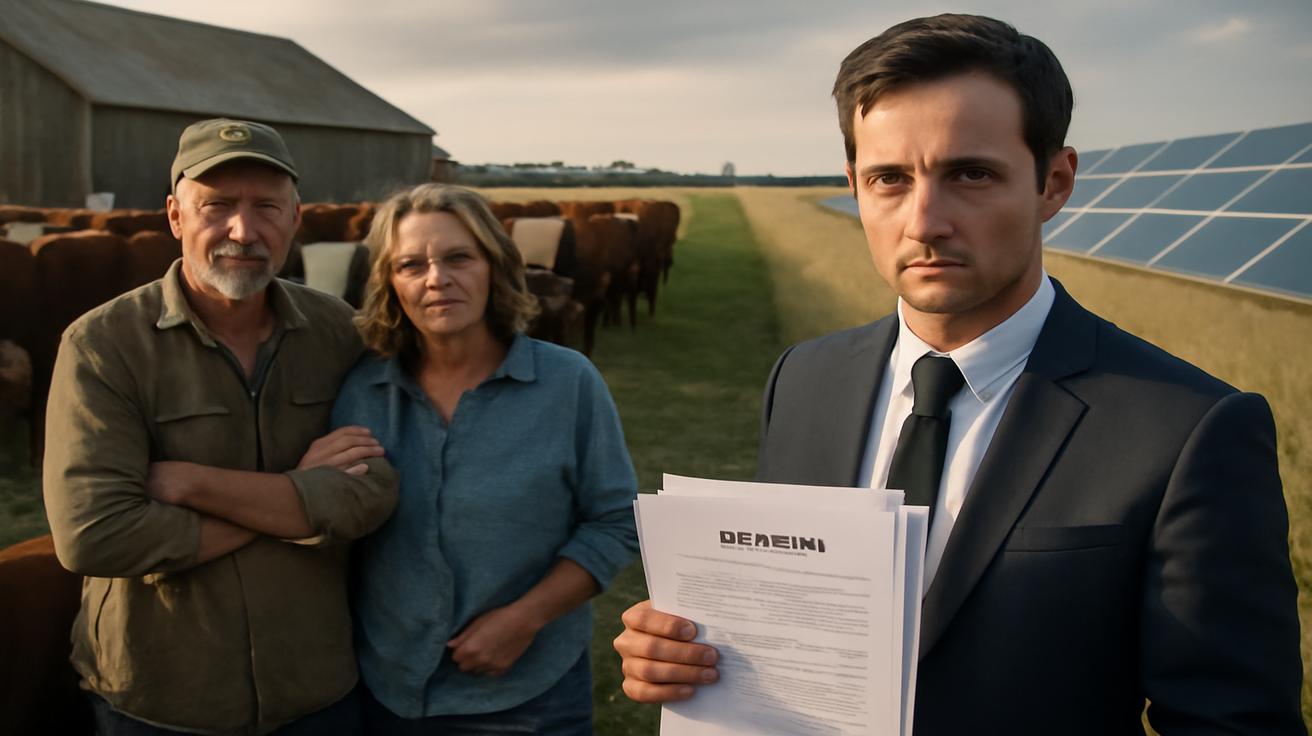
The first letter arrived on a hot wind. It slid through the rusty flap of a weather-beaten farmhouse door, skittered across cracked linoleum, and came to rest beneath a row of mud-caked boots. By the time Thomas Reed, third-generation cattle farmer, bent to pick it up, a thin cloud of dust had already settled on the embossed law firm logo. He wiped his thumb on his jeans, slit the envelope with a calloused nail, and started reading the words that would detonate his world: “Notice of Intent to Commence Legal Proceedings for Ecocide.”
The Farm That Raised a Climate Activist
Long before any lawyer put the word “ecocide” in writing, the Reed farm looked like the picture of rural permanence. Forty-seven hectares of rolling pasture in the English Midlands, stitched together by dry-stone walls and ancient hedgerows. Winters of steaming breath and frozen troughs. Summers of lowing cattle and the sweet, heavy smell of silage. It was the kind of landscape that made politicians talk about “our green and pleasant land” as though it had always been this way.
To young Leo Reed, it was a kingdom. He learned to walk between the legs of Herefords, his tiny hands patting rough hides. He knew the names of all the fields before he could spell his own: Top Yard, Long Meadow, and the oddly named “Canada,” so called because Thomas’ father once joked that it was as far as he ever wanted to travel. Childhood photos show Leo in wellies two sizes too big, brandishing a red plastic bucket as if it were a knight’s shield.
But memory has a way of sifting the golden from the gray. Back then, the farm also meant early winter mornings when the slurry pit smelled so strong it burned the back of his throat. It meant dead calves, quietly buried by torchlight. It meant the coarse cough his father developed each November when they burned heaps of brambles and old fence posts behind the barn. Leo didn’t have the language for emissions or methane yet, but he had a growing sense that something about their way of living felt… off. Like a beloved story with a missing last page.
The missing pages arrived, years later, in the form of climate science. At fourteen, Leo sat in a cramped school classroom watching a documentary that traced our food from farm to plate to atmosphere. A bright animated cow appeared on the screen, then multiplied: one cow became ten, then a hundred, then a thousand, each belching cartoon puffs of methane that rose and thickened into a menacing haze around a pixelated Earth.
In that moment, the gentle animals of his childhood collided with data: livestock responsible for a substantial share of global greenhouse gases; deforestation for grazing; water systems choked with run-off. The numbers were large. The guilt felt larger.
The Oat Milk Empire That Started in a Blender
Years later, London smelled nothing like the farm. Diesel tang, rain on hot tarmac, coffee drifting out of corner cafés. In a tiny flat with mold in the bathroom and hope wedged in every cupboard, Leo stood over a second-hand blender and poured in oats, water, and a pinch of salt. The motor whirred, sputtered, steadied. He strained the mixture through a muslin cloth, watched the pale liquid stream into a jug, and thought: This could be it.
He’d gone vegan at nineteen, after a long, shouting match with his father that ended with a slammed car door and a train ticket to the city. At university, he devoured peer-reviewed papers the way he once devoured roast beef at Sunday lunch. The more he read about livestock emissions, land use, drought, biodiversity loss, the more he felt as though the farm he loved had been quietly complicit in a slow-motion disaster.
But he didn’t want to spend his life only saying no. No meat, no dairy, no compromise. He wanted to build a different kind of yes.
The first batch of his homemade oat milk was terrible: chalky, too thin, vaguely reminiscent of soggy cereal. He tinkered. He tried soaking oats longer, blending in sunflower lecithin, adding a whisper of vanilla. By the third month the taste was smooth, creamy, delicately sweet. Friends began “forgetting” their own milk and raiding his fridge. A barista at the café round the corner asked if she could try it in a latte.
Within a year, “Planet Oatfield” was born: a vegan start-up with a logo featuring a golden field and a rising sun. What began as a side hustle turned into a brand. Pop-up stalls at climate marches, then contracts with indie coffee shops, then a sleek micro-factory on the edge of the city, powered by a rooftop flock of solar panels tilting like obedient mechanical sunflowers. Within five years, Planet Oatfield was on track to be one of the fastest-growing plant-based beverage companies in the country.
Every investor pitch began with the same story: a boy from a cattle farm, building a different future from oats and sunlight. The slides were clean. The numbers glowed. Somewhere, in an old farmhouse miles away, a father stopped taking his son’s calls.
The Proposal: Turn the Herd into Harvesters of Light
It was Leo’s sustainability officer who first suggested it. They were hunched over a spreadsheet, measuring the company’s carbon footprint in scopes and percentages, aiming to go beyond net-zero into something almost mythic: climate-positive. Ironically, their biggest constraint was land. They needed space—lots of it—for solar arrays and oat fields if they wanted to shorten supply chains and truly control their impact.
“You grew up on a farm, didn’t you?” the officer asked casually, not looking up from the laptop.
“Yeah,” Leo said, the word feeling both sharp and distant.
“Still in the family?”
He hesitated, then nodded. And like that, an idea clicked: use the very land once dedicated to methane-producing cattle to grow oats and harvest sun. A living symbol of transition—almost a confession, almost an apology, dressed up as a business plan.
When he returned to the farm for the first time in years, the lane smelled exactly as he remembered: damp earth, wet straw, faint diesel. Progress was visible only in the satellite dish nailed awkwardly to the side of the attic window. His mother met him at the door, arms stiff at her sides. His father remained in the yard, pretending to fuss with a busted water trough.
Over tea brewed too strong, Leo laid it out: Planet Oatfield would lease the farm, repaying debts and guaranteeing his parents a comfortable income. They’d turn the south-facing fields into a solar farm, row upon row of panels shimmering like dark lakes; the north and eastern fields would be planted with regenerative oat crops, interspersed with wildflower margins for pollinators. No cows. No slaughter. No winter feeding bills. No slurry lagoons. A new legacy, he said, voice trembling between pitch and plea.
“You want to turn our home into a factory,” his father said flatly.
“Into a farm,” Leo corrected. “Just a different kind of farm. One that doesn’t cook the planet.”
Silence, thick and hot. His mother stared at her tea. His father’s jaw clenched.
“My father bled for this land,” Thomas said finally. “His father before him. Same herd line, same fields. You think we’re just going to rip it all out because some city investors think oats are fashionable?”
Leo tried to show the numbers: projected income from solar, reduced risk from climate regulations, subsidies for renewable energy. But spreadsheets slippered and fell on the tiled floor of tradition. In the fields outside, the cattle grazed, oblivious.
Ecocide: A Word Sharper Than Disinheritance
“Ecocide” is a heavy word, born in war zones and rainforests. It evokes oil-slicked birds, mangrove forests in flames, poisoned rivers. It is not a word most people expect to find in a letter with their surname on it.
Legally, the concept of ecocide is still emerging—an attempt to treat severe environmental harm as a crime on par with atrocities against humans. In some jurisdictions it is symbolic, in others toothy, with the power to drag corporations, military leaders, and even governments into court. But Leo’s lawyers believed they could push the boundaries of the idea even further: if destructive environmental practices continue in full knowledge of their impact, could an individual—yes, even a parent—be held liable for choosing profit over planetary survival?
The argument hinged on a painful truth: by the mid-2020s, no one could plausibly claim ignorance about the climate impact of industrial livestock. Reports from international panels, independent scientists, and even national farm advisory bodies had laid it bare. Methane from cattle burps, nitrous oxide from fertilized soils, carbon dioxide from diesel tractors and deforestation elsewhere in the supply chain. On paper, the Reed farm was tiny compared to multinationals. In a courtroom, scale and intent might blur in troubling ways.
When his parents refused—again—to consider the solar-and-oats transformation, insisting they would “die as cattle farmers,” Leo made a decision that would spin their private conflict into a public spectacle. He authorized his lawyers to file a lawsuit claiming that his parents’ continued operation of a high-emissions cattle farm, despite a viable and lower-impact alternative being offered, constituted “contributory ecocide.”
The lawsuit did not demand money in the traditional sense. It demanded change: a court-ordered transition of land use and formal recognition that knowingly persisting with high-impact practices in the midst of a declared climate emergency was a form of environmental violence.
When the story hit the press—“Climate War: Vegan Son Sues Cattle-Farming Parents for Ecocide”—it exploded across screens and dinner tables. Talk shows feasted. Comment sections frothed. The case became a mirror in which everyone saw their own anxieties about generational blame, responsibility, and the ethics of family loyalty in a burning world.
Two Futures, One Field
Out on the farm, the land itself didn’t care about newspaper headlines. It only registered change in soil moisture, temperature, species coming and going. In one possible future, the field called Canada would keep hosting cattle until economics or weather broke the cycle. In another, it would become a sea of solar panels, tilting their cool faces to the changing sky.
The contrast between those futures looked something like this:
| Aspect | Current Cattle Farm | Proposed Solar-Oat System |
|---|---|---|
| Primary Output | Beef, limited by herd size | Oats for plant milk + renewable electricity |
| Climate Impact | High methane and nitrous oxide emissions | Greatly reduced emissions; potential net-negative via clean energy |
| Land Use Efficiency | High land per calorie of food produced | More calories and energy per hectare |
| Biodiversity Options | Intensive grazing; hedgerows remain but little habitat diversity | Solar arrays with wildflower corridors; regenerative cropping |
| Farmer Workload | Year-round animal care; vet bills; volatile feed costs | Crop management and maintenance; more predictable schedules |
On paper, the proposed system promised lower emissions, more stable income, and new habitats for insects and birds if designed well. In reality, it also meant uprooting a culture. Cattle farming for the Reeds was not just a job; it was a vocabulary of gestures, a calendar, a way of knowing the world. The particular sound a bull made when a storm was coming. The way frost drew silver veins across the pond in January. To ask them to trade that for inverters and voltage charts felt, to Thomas, like asking a violinist to become an electrician.
Yet for Leo, the same fields carried a different story: every cow an emitter, every winter feed delivery a quiet fossil-fuel transaction, every calving season a fresh tally of lives bred into a system he could no longer defend. Where his father saw continuity, he saw complicity. Where his father saw duty to ancestors, he saw duty to descendants not yet born.
When Love and Planet Collide
The courtroom, when the case finally opened, smelled faintly of paper, old wood, and too many nervous people in one place. Environmental activists filled one side of the gallery, some wearing “Make Ecocide Law” T-shirts under their jackets. Local farmers filled the other, caps in hands, jaws tight.
Reporters zeroed in on the emotional core: How could a son drag his parents to court? How could parents ignore the climate science their own child had thrust before them? On the witness stand, Thomas’ hands shook as he spoke.
“He was a good lad,” he said, voice thick. “Still is, I suppose. This farm put food on his plate, clothes on his back. We did our best. And now he’s calling me a criminal because I do what my father taught me.”
Later, when it was Leo’s turn, he didn’t look at his parents directly. “This isn’t about hating my family,” he said. “It’s about loving the world they helped me love. The streams, the fields, the birds. I’m not suing them because they’re farmers. I’m suing them because we know better now. We know what this industry does. And I offered them a way out.”
The judge’s questions cut to the core: Could a small family farm really be held to the same standard as global corporations? Was there a meaningful distinction between moral responsibility and legal culpability? Could the law demand that tradition step aside for sustainability when a feasible alternative was on the table?
Law, unlike soil, is slow to change. Whatever the verdict, the case had already done something irreversible: it had given a human face—a family’s face—to the abstract struggle over how fast, and how far, we must transform our food systems in a heating world.
Beneath the Headlines, A Quieter Reckoning
Outside the courthouse, far from cameras and placards, other farming families began having their own kitchen-table conversations. Some rolled their eyes at the “vegan city boy” turning on his roots. Others, more quietly, admitted they saw their children in him—the ones who’d moved away, gone to university, come back talking about carbon budgets and biodiversity corridors.
On some farms, small experiments began. A corner of a pasture left to grow wild. A barn roof tiled with solar panels that glittered in the low winter sun. A few cows sold and not replaced, the herd shrinking as its owners quietly moved toward mixed systems, or agroforestry, or leasing a field to a community energy co-op.
In cities, meanwhile, Planet Oatfield’s orders surged as the case dragged across front pages. Some bought the milk out of solidarity with Leo; others, perversely, out of fascination with the scandal. The cartons themselves stayed the same: a stylized sunrise over a field, the slogan “Drink the Future.” Yet now every sip carried an unspoken question: Whose future, and at what personal cost?
The climate crisis has often been framed as a war: battles over pipelines, protests against mines, clashes in parliament. But most of its front lines look less like trenches and more like family dinner tables where one person reaches for oat milk while another sharpens a carving knife. It is, in many ways, a civil war inside our own affections.
What We Owe Each Other in a Warming World
If the earth could testify in court, perhaps it would say nothing, only present its exhibits: rising seas, thinning ice, vanished species, shifting seasons. It would point to fields where cows graze and to fields where steel-framed panels drink sunlight, and let us argue over which is more beautiful, more just, more necessary.
The Reed case—whatever its legal outcome—crystallizes a tension that will only grow sharper: How far are we willing to go, not just politically or economically, but personally, to align our lives with what the climate science demands? Is there a point where loyalty to family traditions becomes disloyalty to the generations who will live with the consequences? Can an act of love for the planet coexist with a rupture in a family, or is that always, by definition, a kind of violence?
It is tempting to cast Leo as a hero or a villain, his parents as villains or victims. Reality resists such easy symmetry. He is both grateful for the childhood his parents gave him and furious about the systems they participated in. They are both proud of the resourceful entrepreneur their son became and heartbroken that his success now threatens to erase the very life that raised him.
Somewhere on a foggy morning, long before the lawyers and headlines, a small boy stood at a fence, watching his breath puff into the cold air as a line of cattle shuffled toward him, curious, warm, alive. That memory is still true for all of them. So is another truth: those same animals, multiplied across millions of farms, help push the climate toward thresholds from which there is no easy return.
Perhaps, in the end, the most unsettling thing about this story is not that a vegan entrepreneur sued his cattle-farming parents for ecocide. It’s that, in quieter ways, many of us are already litigating our own pasts. We look at the lives that shaped us—our diets, jobs, commutes, flights, purchases—and weigh them against the planetary damage they collectively caused. We ask: How could we not have known? And now that we do know, what will we sacrifice, and whom will we disappoint, to live differently?
No judge can fully resolve that question. The verdict, such as it is, will be written instead in the landscapes we choose to shape: in whether cows or solar panels or wildflowers stand in the fields where we once played; in whether family recipes adapt to new ingredients; in whose stories we decide to honor when we talk about “the way things have always been.”
The wind that carried that first legal letter through the farmhouse door is still blowing, stronger each year, warm where it should be cold, erratic where it should be steady. It rattles old windows and whips through new solar arrays alike. It asks, over and over, in every language and every family: If not now, when? If not us, who? And at what cost to the ones we love most?
FAQ
Is “ecocide” a real crime in most countries?
Ecocide is not yet a fully established crime in most legal systems, but the concept is rapidly gaining traction. Some countries recognize severe environmental destruction under existing laws, and there are international campaigns to make ecocide a crime alongside genocide and war crimes. Cases like this one test how far existing frameworks can stretch.
Are cattle farms always worse for the climate than plant-based systems?
In general, livestock—especially cattle—produce far more greenhouse gas emissions per calorie of food than most plant-based alternatives. However, not all cattle systems are equal. Intensive, industrial feedlots have a very different footprint from small, low-input, pasture-based systems. That said, from a strictly climate perspective, shifting toward plant-based agriculture usually reduces emissions.
Can solar farms and agriculture really share the same land?
Yes. A growing practice called “agrivoltaics” combines solar panels with crops or grazing. Panels are raised or spaced to allow light and machinery through, reducing land-use conflicts. Well-designed systems can produce food and electricity while offering shade and microclimate benefits.
Why would a farmer resist switching if the economics look better?
Farming is as much culture and identity as it is business. Livestock skills aren’t always transferable to managing energy infrastructure or new crops. There are emotional ties to animals, community expectations, fears about debt, and distrust of outside investors. Numbers alone rarely capture those complexities.
Does going vegan really make a significant difference to the climate?
Shifting from animal-based to plant-based diets can substantially lower an individual’s climate footprint, particularly in wealthier countries where meat and dairy consumption is high. While systemic changes in policy and industry are crucial, personal dietary choices are one tangible way to reduce demand for high-emission products and support lower-impact food systems.



Leave a Comment