
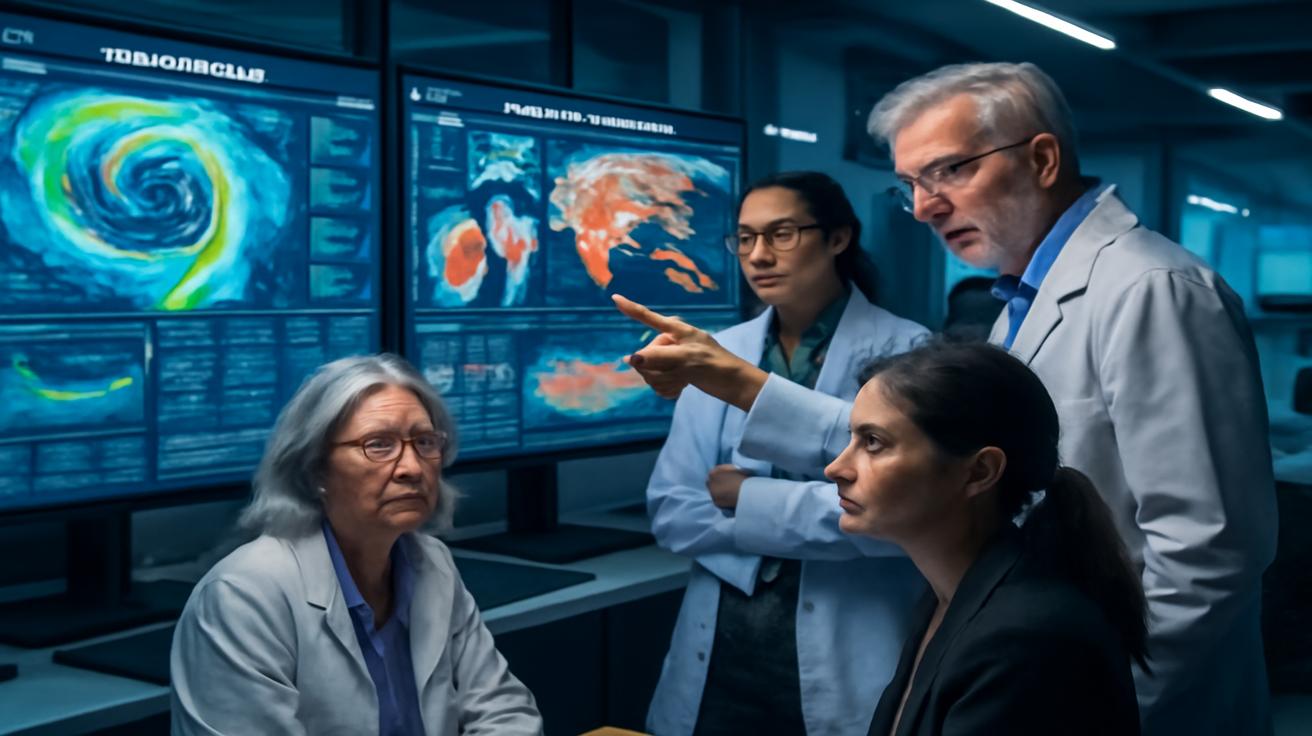
The numbers on the screen didn’t look like much at first—just a few colored lines tilting in odd directions. In a dim office at the edge of a university campus, the hum of the computers was the loudest sound, broken only by the soft, rhythmic tapping of a keyboard. Then one of the lines dropped, sharply, like a cliff. A scientist leaned in, frowned, and called a colleague. Within hours, messages were crossing time zones, subject lines growing more urgent, until one phrase kept repeating in inboxes and chat threads: “Possible polar circulation breakdown.”
A Sky We Thought We Understood
If you step outside on a clear winter night and tilt your head back, the sky looks timeless. Stars stitched across the dark, the faint wash of the Milky Way if you’re lucky, the breath of cold air tightening across your cheeks. It feels ancient, reliable, a ceiling that doesn’t change. But above that calm, invisible to your eyes, there is a restless machinery in the atmosphere that moves vast rivers of air, shapes the jet stream, and holds the coldest air on Earth in place.
That machinery has a name: the polar vortex. It’s not a single storm, not something you can photograph in one snapshot, but a sprawling whirl of frigid air that usually stays politely corralled over the Arctic and Antarctic. Wrapped around it is a high‑altitude band of strong westerly winds known as the polar night jet, spinning like a guardrail in the stratosphere, about 10 to 50 kilometers above your head.
For most of the satellite era, climate scientists have grown used to its seasonal rhythm. In winter, the vortex tightens and deepens. In spring, it weakens and breaks down. Occasionally, it stumbles—a major “sudden stratospheric warming” will flip the winds, spill cold air southward, and deliver brutal winter weather to unlucky regions. Those events are rare but not unheard of.
This time, though, something looks different. The readings aren’t just hinting at the usual wobble. They’re pointing to a rare kind of disruption, a breakdown of the polar circulation so intense that it could twist weather across multiple continents at once, linking the fates of cities and farms and coastlines thousands of kilometers apart.
The Moment the Data Turned Strange
On the screens of atmospheric research centers—in Tokyo, Berlin, Boulder, Melbourne—the story first showed up as anomalies. Stratospheric temperatures over the polar cap were rising faster than seasonal norms. Wind profiles taken from weather balloons and satellites were showing a weakening of those crucial west‑to‑east winds that circle the pole.
A senior researcher in Norway describes it like watching a top start to lose its spin. “You’re used to seeing this very tight circulation,” she explains. “You can almost feel the momentum in the plots. Then over a few days, you see that momentum drain away. The lines get ragged. The circulation begins to split, tilt, or reverse. That’s when the hairs on your arms stand up.”
The models, fed with fresh observational data, began sketching possible paths. In some of them, the polar vortex fractured into two lobes, like a cracked egg, each chunk drifting off over Eurasia and North America. In others, the entire system weakened and slumped, allowing warmer air to surge deep into the Arctic, while bitter cold cascaded south. A third cluster of simulations hinted at something scientists rarely say out loud without double‑checking: a rare breakdown that destabilizes not just local winter weather, but the larger planetary wave patterns that govern storms, heat waves, and rainfall from the subtropics to the mid‑latitudes.
One by one, seasoned experts—people who typically distrust dramatic language—started using words like “unusual,” “unprecedented in the recent record,” and “concerning.” Group calls filled with the glow of faces lit by weather maps. They were not simply debating if this event would be bad. They were trying to understand how far its fingers might reach.
A Planet Connected by Invisible Rivers of Air
The first thing to understand about a polar circulation breakdown is that it doesn’t stay in the polar regions. Our atmosphere is stitched together by invisible, undulating highways of air, often called Rossby waves, that snake around the planet. When the stratosphere over the poles is disturbed, those waves can change shape and speed, like a plucked string humming a different note.
Above the North Atlantic, where planes surf powerful jet streams, a shift in these high‑altitude winds can mean the difference between storm tracks curving harmlessly into the ocean or driving inland, unleashing days of rain and wind. Over Asia, it can flip winter patterns, replacing dry cold with damp snow, or vice versa. In North America, it might pull Arctic air deep into the Midwest while letting the western states bake under unseasonable warmth and dryness.
For farmers, this isn’t an abstract dance of isobars and wind vectors. A sudden cold outbreak after an early warm spell can blacken orchards in a night, destroy emerging shoots, and erase a year’s income. In other regions, an extended failure of rain tied to a jammed jet stream can leave soils powder‑dry, reservoirs shrugging down toward dead levels, and wildfire danger climbing.
As climate change warms the atmosphere from the bottom up and melts sea ice, scientists have been watching the polar vortex with growing suspicion. Some evidence suggests that a reduced contrast between the cold pole and the warming mid‑latitudes may destabilize the vortex more often, allowing these breakdowns or extreme wobbles to become more frequent. The readings flashing across screens now are being interpreted against that uneasy backdrop.
Listening to the Whisper of Instruments
In a way, this story is about trust: trust in instruments, in algorithms, in weather balloons that rise silently through the dark, trailing their sensors, in satellites that sweep over the pole again and again, watching from the cold vacuum of space. The atmosphere doesn’t speak our language, but it leaves patterns, signatures, fingerprints. Scientists have spent decades learning to read them.
This current event emerged first in the stratosphere, that high, dry layer above the weather that most of us never feel. The key signal came from zonal wind speeds—how fast the air was spinning around the planet at roughly 10 hPa pressure, roughly 30 kilometers up. A sudden drop in those winds, especially if they reverse direction from westerly to easterly, is the classic hallmark of a major disruption.
Paired with that were temperature spikes of tens of degrees Celsius in a matter of days at those altitudes, surreal swings in a region usually governed by slow, stately changes. Below that, in the troposphere where clouds form and birds fly, shifts in pressure fields began to show up, hinting that the disturbance aloft was starting to reach downward, like fingers tapping on the weather we feel.
The table below offers a simplified snapshot of what some of the key indicators look like before and during a polar circulation breakdown:
| Indicator | Typical Stable Polar Vortex | During Breakdown Event |
|---|---|---|
| Stratospheric wind speed (10 hPa, 60°N) | Strong westerly, 30–60 m/s | Sharp weakening, can reverse to easterly |
| Polar cap temperature anomaly | Near long‑term average | Rapid warming, +20 °C or more aloft |
| Arctic surface temperature | Seasonally cold, strong sea‑ice cover | Often anomalously mild; sea‑ice loss enhanced |
| Mid‑latitude jet stream pattern | Relatively zonal (west–east) | Highly wavy, increased north–south excursions |
| Weather impacts | Typical seasonal variability | Enhanced risk of cold snaps, floods, heat or drought |
Every line in that table comes from countless launches of balloons that vanish into the blue, from microwave sounders and infrared sensors on satellites, from supercomputers crunching physics equations by the trillion. When those lines start to depart from the familiar, the community that watches them knows something consequential is unfolding, even if the final shape of that consequence is still blurred.
Multi‑Continent Consequences: From Snowfields to Shorelines
To understand why climate experts are alarmed now, picture the planet not as a set of separate weather systems, but as one breathing organism. When the polar circulation stumbles, that breath falters. The exhale and inhale of storms, fronts, and trade winds shifts. Knock‑on effects radiate outward.
In Europe, a disrupted polar vortex has historically been tied to cold outbreaks that creep persistent high‑pressure domes into place, blocking the usual Atlantic storms. That can mean bone‑deep chill for weeks, heavy snow in some regions, and crisp, breath‑taking air in others—but also strain on energy grids as heating demand surges. For countries transitioning to more renewable power, erratic weather can test the resilience and flexibility of their systems.
Across Asia, altered circulation may twist the path of the Siberian High, a powerful wintertime pressure system. This can reshape the East Asian winter monsoon, deciding whether cities like Beijing or Seoul endure piercing dry winds or relatively milder, damp winters. Farther south, even tropical rainfall belts can nudge north or south, altering the timing and intensity of life‑giving rains.
North America, meanwhile, sits under some of the atmosphere’s favorite roller‑coaster tracks. A polar breakdown can send cold air knifing down across the central and eastern United States and Canada, setting the stage for ice storms, blizzards, or simply long, stubborn cold spells. On the flip side, the western states may find themselves on the warm side of the distorted jet, with drying soils, an early thaw, and a wildfire season waiting in the wings.
Farther south still, the tropics respond in more subtle but no less critical ways. A disrupted high‑latitude circulation can change how heat is exported from the tropics, which in turn may tweak hurricane formation, influence where storms intensify, or shift patterns of drought and deluge in places like the Sahel, the Amazon, or Southeast Asia.
The Climate Signal Beneath the Noise
It’s tempting to hang everything on one event: this breakdown, this winter, this storm. But the atmosphere is a noisy place, full of natural ups and downs. What has climate scientists worried is not just the drama of a single disruption, but the pattern these events might form against the backdrop of a warming world.
The Arctic is heating faster than any other region, a phenomenon known as Arctic amplification. Sea ice that once sealed the ocean in white is thinning, shrinking, opening dark water that drinks in sunlight. Snow cover on northern continents melts earlier, revealing darker ground that absorbs more heat. That changes the balance of energy between the pole and the equator, the very gradient that the polar vortex depends on for its strength and stability.
Some research suggests that as this gradient weakens, the polar vortex becomes more prone to lurches and splits, and the jet stream above our heads may become more sinuous, its gentle west‑to‑east flow replaced at times by deep kinks and stuck patterns. Not every scientist agrees on how strong this signal is yet, or how quickly it will grow, but the possibility hangs in the air: that the kind of rare breakdown we’re witnessing could become less rare.
For the experts reading the latest atmospheric diagnostics, this raises a cluster of uncomfortable questions. How do you plan for winters that can oscillate between record‑breaking warmth and brutal cold in a matter of days? How do you design cities—roads, power grids, drainage systems—that can absorb both sudden freezes and freak rains? How do you advise farmers when the “average year” is no longer a useful guide?
Living With a Nervous Sky
There is a quiet kind of grief in many of the people who watch these patterns for a living. They grew up in love with weather—the elegance of equations that describe a swirling storm, the feel of a front arriving like a change of mood. They believed, as many of us did, in a world where the climate, while never static, moved in slow, predictable gestures.
Now they find themselves issuing cautious warnings about a sky that is behaving less like a steady companion and more like someone under stress. A rare polar circulation breakdown with multi‑continent consequences is not an apocalypse. But it is a symptom, a vivid flare in the data that says: the system we thought we understood is being pushed.
That pushing has a source. The greenhouse gases accumulating from burning fossil fuels, cutting forests, and plowing up carbon‑rich soils have added an extra blanket around the planet. That blanket is not evenly woven. It traps heat differently by region, by season, and by altitude. It warms the surface, but also changes circulation higher up. Events like this stratospheric disruption carry that story into the lived experience of millions of people, in the form of odd winters, strange springs, and weather that refuses to stay in its old lanes.
And yet, in the same breath that scientists name their concern, they also point to agency. The physics that connect our emissions to these atmospheric shifts are the very reason that cutting those emissions can help. The sooner the heating slows, the more time the polar vortex—and everything linked to it—has to settle into a new, more predictable rhythm, rather than stumbling from one extreme to another.
Between Data and the Day After Tomorrow
It’s hard, in a world of dramatic headlines and disaster movies, not to imagine a polar circulation breakdown as a cinematic freeze descending overnight. The reality is stranger and less tidy. Its impacts will come in waves and patterns, some obvious, some subtle, some mercifully mild, others painfully sharp.
You might notice it as an oddly warm spell in midwinter, puddles forming where there should be powder, or as a cold that sinks in and lingers. It might arrive as a week of storms tracking along a path that floods one river basin while sparing another, or as a nagging dryness that sets in over a landscape that expected snow. In another part of the world, the same atmospheric rearrangement could tip the scales toward heavy rains that refill reservoirs or toward weather that tests the seams of urban drainage and rural roads.
For the people inside the labs and forecasting centers today, the work is both urgent and careful. They are tuning models, running ensembles of thousands of possible weather futures, cross‑checking observations, looking for where the uncertainty narrows enough to say: prepare here, watch there. They assemble briefing notes for governments, energy planners, emergency managers. They try to balance clarity with humility—strong enough language to be heard, cautious enough not to oversell what the data can’t yet promise.
And outside, beyond the flicker of screens, the atmosphere goes on breathing, adjusting, reshaping. High above you, the winds that once spun neatly around the poles are in turmoil, their usual path disturbed. You may not feel it directly on your skin today. But in the coming weeks and months, as you watch the weather shift, remember that somewhere, a line on a graph bent sharply, and a room full of people who have devoted their lives to understanding the sky felt a jolt of alarm.
They are not alarmed because the world is ending tomorrow. They are alarmed because an ancient pattern is faltering, and because we are the ones who have nudged it. The rare breakdown of the polar circulation unfolding now is a chapter in a larger story—a story about how deeply tied we are to the invisible rivers of air above us, and how the choices we make around energy, land, and carbon ripple all the way to the top of the world.
FAQ
What exactly is the polar vortex?
The polar vortex is a large‑scale circulation of very cold air high above the poles, mainly in the stratosphere. It’s surrounded by strong westerly winds that usually keep this frigid air confined near the Arctic or Antarctic. It’s a normal feature of the atmosphere, strongest in winter.
What does a “polar circulation breakdown” mean?
A polar circulation breakdown occurs when that typically strong, circular flow of winds around the pole weakens dramatically, distorts, splits, or even reverses direction. This disrupts usual weather patterns and can allow cold polar air to spill far into lower latitudes while warmer air moves into the Arctic.
How can a change over the poles affect weather on multiple continents?
The atmosphere is interconnected by large‑scale waves and jet streams. When the polar circulation changes, it alters these global wind patterns. That can shift storm tracks, change where high‑ and low‑pressure systems form, and influence temperature and rainfall patterns across North America, Europe, Asia, and beyond.
Is this event caused directly by climate change?
No single event can be blamed entirely on climate change, but a warming climate is altering the background conditions. Arctic amplification and sea‑ice loss are changing temperature contrasts between the poles and mid‑latitudes, which may be making the polar vortex more unstable and extreme disruptions more likely or more impactful.
Should ordinary people be worried about this breakdown?
Concern is justified, panic is not. A polar circulation breakdown increases the risk of unusual weather—cold snaps, heavy snow, persistent rain or drought—depending on where you live. It’s wise to follow reliable forecasts, prepare for weather extremes typical of your region, and recognize that such events are part of a broader climate shift that we can still influence by reducing emissions and improving resilience.






Leave a Comment