
The morning the new eco-tax rates went live, the frost on the tractor seat looked almost silver. Luke Hart tapped it with his glove, watched the crystals crumble into dust, and tried not to calculate what every turn of the ignition was going to cost him now. Diesel, fertilizer, transport fees, even the plastic wrap for hay bales—each carried its own neat, moral price tag. On paper, it all sounded noble: “polluter pays,” “climate responsibility,” “transition to a green economy.” In Luke’s ledger, it meant the difference between buying feed or skipping his own breakfast.
The Price of Breathing in the Countryside
By eight a.m., the postman’s van rolled up the gravel lane in a cloud of exhaust that felt, in this new reality, almost criminal. He handed Luke a rubber-banded stack of official envelopes: tax breakdowns, policy summaries, a glossy brochure showing a smiling child holding a sapling under the slogan: “Together, We Grow a Greener Future.” The child’s shoes were spotless. Luke’s boots were caked in last year’s mud and this year’s worry.
He tore open the tax letter first. Numbers. Percentages. A new “Climate Impact Levy” on fuel, recalibrated “Environmental Use Charge” on water, an “Emissions Adjustment” baked into every delivery that crossed the farm gate. The language was polite; the total at the bottom was not. It was a figure that lived halfway between a laugh and a panic attack.
“They’re charging us for breathing now,” his neighbor, Marta, had muttered at the café the week before, stirring sugar into her coffee like it was a countdown timer. She ran a small dairy six kilometers down the road and had already let two workers go. “Every cow is an invoice. Every truck is an apology.”
The town’s radio station crackled in the background that morning, a cheerful voice explaining how the new eco-taxes were an “essential step in climate leadership,” how they would “encourage innovation” and “drive sustainable choices.” Between the upbeat segments, Luke listened to the farm next county over announcing a liquidation auction—tractors, seeders, fencing, even the old bell from the barn roof.
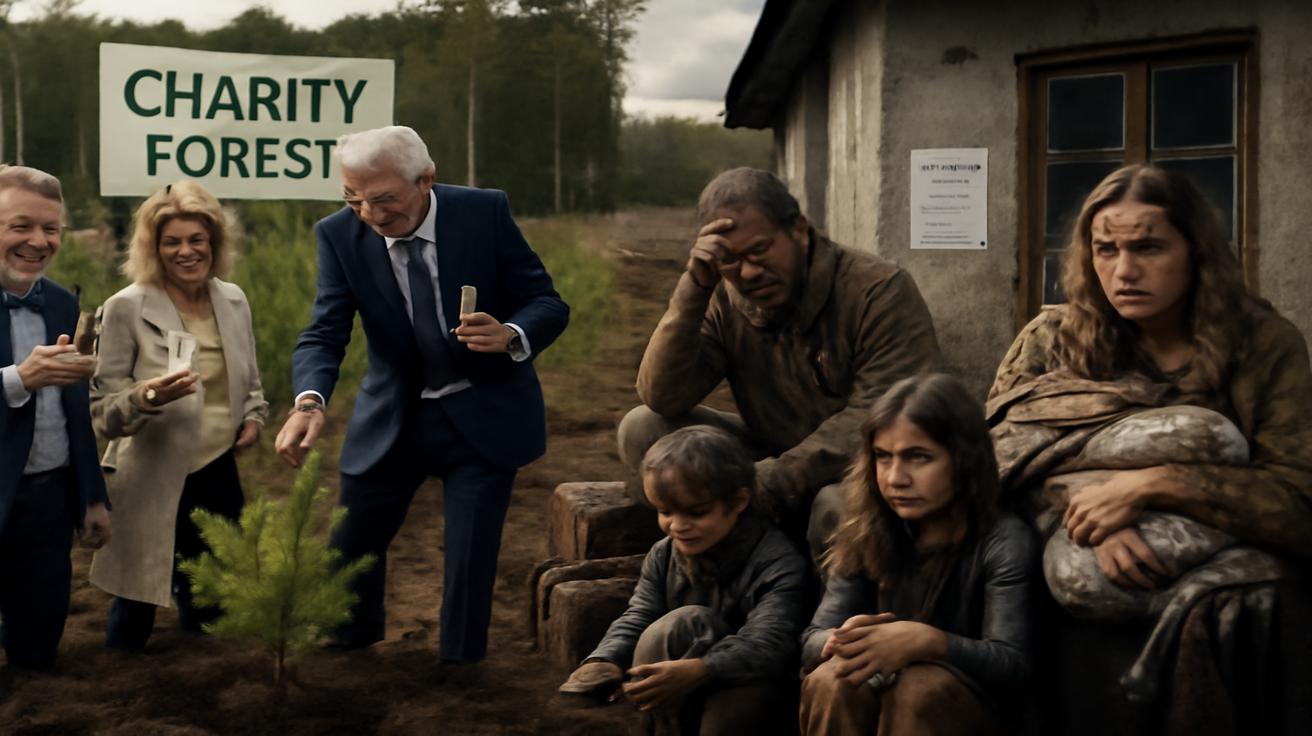
On the same broadcast, a breathless correspondent described a major “philanthropic initiative” in the capital. A billionaire investment mogul, once the largest landowner in the region, had launched a flagship “charity forest” on estates he no longer farmed. Cameras clicked as officials grinned among neatly potted seedlings arranged like a green carpet in front of microphones. The mogul promised “millions of trees” to offset emissions, support biodiversity, and “honor the rural communities that have always fed us.”
No one mentioned he had sold most of that farmland to a shell company just before the tax hikes came into force, turning plowed soil into a carbon credit machine. The charity forest, Luke thought, was simply a second harvest.
When Climate Justice Comes with a Receipt
The thing no one in the glossy brochures ever quite admitted is that climate justice, as implemented by committee and consultancy, often comes with a receipt—itemized, indexed, and optimized. Somewhere in the city, a task force likely worked late over spreadsheets, crunching emissions data and behavioral models, drafting legislation meant to “nudge” people toward better decisions. Their world was charts and scenarios; Luke’s was calves born breech at three in the morning and hailstorms in June.
The new eco-taxes worked like a slow tightening around his days. The fuel surcharge meant he thought twice before taking the truck to town for parts. The fertilizer levy forced him to cut back on inputs, hoping the soil’s memory would carry the crops a little further than last year. Transport fees meant the wholesaler quietly reduced what they’d pay him, blaming “market conditions” with a shrug that smelled of diesel and inevitability.
At night, he sat at the kitchen table, a single bulb burning above the worn wood, and lined up bills in careful rows. Each had a little green leaf icon now, as if the paper itself wanted him to know it was virtuous. Somewhere in those leaves was the line item that would send his youngest to college—or not.
He wasn’t against climate action. He had watched summers grow sharper, the river slim down to a hesitant trickle, storms arrive out of season like angry invitations. He had lost a barley crop three years ago to a heatwave that refused to move on. He knew something was badly wrong.
But the story the policymakers were telling—of “shared sacrifice” and “equitable responsibility”—rang hollow when he looked at who was actually paying. Rural families, small hauliers, village shops heating drafty brick buildings, old people on oil-fired boilers because nobody had bothered to run infrastructure this far out. Meanwhile, carbon markets surged, financial instruments blossomed, and rebranded investment funds sucked up subsidies and tax breaks for “green” projects like bees on spilled syrup.
The eco-taxes, he thought, were less about healing the land and more about pricing it.
The Quiet Arithmetic of a Shrinking Life
In town, the butcher cut his hours. The school announced another fundraising drive to keep the bus service running—fuel levies again. Marta talked about selling half her herd before the next round of regulations made them unaffordable. These weren’t climate-deniers or holdouts. They were people who had always worked with weather as a partner and adversary, suddenly treated as if they were the main villains in a story written far away.
On certain days, Luke felt the narrative tightening like a noose: rural families framed as “inefficient,” “high-emission lifestyles,” while the capital’s glass towers rebranded themselves “net-zero campuses” through accounting sleight of hand. He saw teenagers on social media vilifying “meat eaters” in abstract terms, never having driven past his fields at dawn and watched fog pool low over the clover.
He could feel how easy it would be, if you lived in a clean apartment above a train station, to imagine the countryside as a problem to be solved rather than a living system filled with humans trying to hang on.
Charity Forests and the Art of Looking Good
Two weeks after the eco-taxes came into effect, the first drones buzzed over Luke’s fields. He shaded his eyes against the sharp winter light and followed the tiny blinking shapes toward the horizon, where the boundary of his land once met the estate of the billionaire mogul. Now that estate was fenced off and branded: future site of the “Green Horizon Community Forest.”
Press releases flowed faster than the river. The mogul’s foundation promised jobs in “tree-planting brigades,” school visits to “education glades,” and research partnerships to “monitor ecosystem health.” They would rewild degraded farmland, they said, and gift the planet a new lung of photosynthesizing hope.
It sounded beautiful. And in small, specific ways, it even was. Trees are good. Shade is good. Birds need somewhere to land. The problem wasn’t the existence of the trees. It was the story stapled to them, and what grew in the blind spots between the headlines.
Before climate targets hardened into policy, those same acres had grown wheat, barley, and rapeseed. They had supported seasonal laborers, truck drivers, mechanics, grain merchants, café owners. They had underwritten a messy, interconnected local economy that pulsed to the rhythm of sowing and harvest.
Then came a wave of speculation. Land values rose as wealthy buyers realized that owning soil could generate something new: not just crops, but carbon credits. A hectare of farmland, properly managed, could be worth more as a line in an emissions balance sheet than as the yield of a harvest. Fields became financial instruments. The mogul offloaded his farming operations, pocketed the profit, and set up a “foundation” to buy back portions as a tax-advantaged philanthropic venture.
Now, those charity forests would be tallied against pollution elsewhere: private jets, data centers, shipping fleets. Every sapling was a public-relations halo, every hectare a moral buffer between excess and accountability. It was as if the countryside had been repurposed into an alibi.
What most press releases didn’t highlight: the seasonal jobs created were low-paid, temporary, and far fewer than the livelihoods displaced when farms folded under the combined weight of eco-taxes and market consolidation. The “community” in “community forest” often meant people bused in for photo ops, not the ones who had weathered that land for generations.
| Impact Area | Small Rural Families | Billionaire “Charity Forest” Owners |
|---|---|---|
| Land Use | Working farms producing food and local income | Land optimized for carbon credits and PR value |
| Tax Burden | High eco-taxes on fuel, inputs, and transport | Tax deductions, subsidies, and offset advantages |
| Jobs | Stable but shrinking family and local employment | Short-term, low-paid planting and maintenance gigs |
| Public Image | Portrayed as “high emissions” and resistant to change | Celebrated as climate “heroes” and visionaries |
| Decision Power | Little influence on policy design or markets | Direct lobbying access and policy shaping |
The drones hummed back and forth, mapping every undulation of the future forest. Luke watched them like someone listening to a language he did not speak, but that would still decide his fate.
How Policy Turns Soil into Currency
From a distance, climate policy sounds abstract: emissions caps, trading schemes, net-zero pathways. Up close, on a wet field where your boots suck down into the earth with every step, it’s intensely physical. It’s the decision to skip one more pass with the tractor because fuel is too expensive, and hoping compaction won’t wreck the yield. It’s the choice between the cheap plastic twine that now carries a surcharge and the biodegradable version that costs double.
What has quietly happened, as eco-taxes climbed and carbon markets matured, is a shift in what land is for. Traditionally, it fed people. It provided space for communities, for work, for relationships with more-than-human neighbors: hedgehogs in the hedgerows, barn owls quartering the stubble at dusk, otters slipping back into thick, brown water.
Now, under the glossy narrative of crisis management, soil has been recast as a climate ledger entry. Each hectare can be monetized not just for its output, but for its capacity to absorb or avoid emissions. For people with capital, this has been a revelation: buy land, rebrand it as restoration, claim credits or offsets, market it as virtue.
The irony is vicious. Small farmers like Luke have always been asked to eke out every gram of production from their land, often encouraged—sometimes forced—into intensive practices that degraded soils and watersheds. Now, as the bill for those decades comes due in the form of a destabilized climate, the solution on offer sidelines them in favor of large-scale, investor-led “regeneration.” The people who pushed for maximized yields can buy their absolution by funding tree-planting on what used to be somebody’s livelihood.
Eco-taxes, designed in theory to make polluters pay, end up hammering those least able to adapt quickly: the ones whose tractors can’t just be swapped overnight for electric, whose barns weren’t built with solar panels in mind, whose margins have been thin for years. At the same time, those who contribute disproportionately to emissions can navigate around the harsh edges of the rules with consultants, loopholes, and private forests that double as both offset and branding exercise.
When you treat land as currency, you start to treat the people on it as collateral.
Green Guilt and the Stories We Tell Ourselves
Drive—or take the train—into the city, and climate guilt is everywhere. Posters urge commuters to “choose the planet,” coffee cups declare themselves “carbon neutral,” offices advertise rooftop beehives and low-flow toilets. It feels, at first glance, like an awakening.
But underneath, there’s a more uncomfortable question: who gets to feel virtuous, and at whose expense? It’s easier to ask individuals to sort their recycling than to challenge the structure that rewards extracting value from both atmosphere and agriculture. It’s more photogenic to stage a ribbon-cutting in a charity forest than to sit at a farmhouse kitchen table and ask what would actually make decarbonization fair.
We tell ourselves stories to make sense of crisis. In one popular narrative, rural landscapes are backward and in need of green correction, while high-tech green capital rides in as savior. In another, billionaires are flawed but necessary climate heroes, using market magic and philanthropy to do what governments are too slow or timid to attempt.
In both stories, people like Luke are supporting characters at best. Often, they’re not written in at all—except as a statistic.
Modern nature storytelling sometimes falls into the same pattern. We love the rewilding success story, the abandoned estate that becomes a refuge for rare butterflies and nightingales. We swoon over drone footage of new forests where there used to be “unproductive land.” But unproductive for whom? For what? It’s easier to celebrate the return of wolves than to reckon with the farmer who can’t afford vet bills after a stressed flock breaks through fencing in a panic.
None of this is an argument against protection, or trees, or serious climate action. It’s an argument against amnesia. Against pretending that every green initiative is automatically just, or that suffering can be brushed aside if the metrics look good.
Imagining a Different Kind of Climate Responsibility
So what would a different story look like, one where eco-taxes didn’t crush rural families while billionaires celebrated their charity forests on former farmland?
For one, it would start from the ground up rather than the spreadsheet down. It would recognize that the knowledge of how to work with land already lives in people who have spent lifetimes walking fence lines, reading cloud shapes, and knowing which field holds water three days longer after rain. Climate policy would treat them not as obstacles but as partners—and pay them accordingly for the real public goods they provide: healthy soil, clean water, pollinator habitats, resilient local food.
Instead of punitive eco-taxes applied blanket-style, we’d see graduated systems that hit luxury emissions hardest—the private jet, the superyacht, the speculative air-conditioned penthouse—and recycle that revenue into grants, low-interest loans, and technical support for small producers. We’d see a phase-in of requirements tied to realistic timelines and infrastructure build-out, not overnight changes drafted by people who have never had to fix a broken hydraulic line at midnight in the rain.
Charity forests and rewilded estates could still exist, but they would be subject to community governance: locals on boards, transparency around who benefits from carbon credits, legally binding commitments to decent wages and long-term employment. The story at the ribbon-cutting would include the people who were there before the trees, not just those planting them now.
Fundamentally, we would stop confusing price with value. Right now, climate crisis profiteers thrive because everything is being run through the same narrow tunnel: what can be measured, traded, pledged, offset. But the smell of earth after rain, the way barn swallows stitch the dusk with their swift, low arcs, the rough comfort of a neighbor showing up unasked to help bring the hay in ahead of a storm—these do not exist on any balance sheet. And yet, without them, the whole idea of a future worth saving starts to look a lot thinner.
One evening, months after that first frost on the tractor seat, Luke walked the edge of his field where it met the burgeoning charity forest. Saplings poked up from their plastic guards, leaves trembling like they were not quite convinced of their place. A robin chattered from a half-dead hawthorn. The air smelled of damp soil and distant wood smoke.
He knelt, dug his fingers into his own soil, and broke it apart. Worms writhed, shy of the cold. Above him, another drone passed, its high whine clashing with the low, soft exhale of cattle in the next field over.
Climate crisis, he thought, didn’t care about who paid which tax, or whose name was on a plaque at the edge of the trees. It cared only about molecules and feedback loops, about ice and fire. But humans cared about who got to stay, and who had to leave. About who got to call themselves stewards, and who was pushed toward the exit in the name of progress.
He brushed the soil off his hands and stood. Somewhere between the drones and the worms, between eco-taxes and charity forests, a fairer path had to exist. The work now was to insist on it—to tell the story clearly enough that it couldn’t be ignored, priced, or planted over.
Frequently Asked Questions
Are eco-taxes always bad for rural communities?
Not inherently. Eco-taxes can be useful tools if they are designed carefully, with input from rural stakeholders and protections for low-income households. The problem arises when they are applied uniformly without considering different capacities to adapt. When infrastructure, support, and alternatives are missing, eco-taxes can unfairly burden small farmers and rural families who have fewer options than wealthier urban residents or large corporations.
What is wrong with billionaires funding large tree-planting projects?
Planting trees is not the issue; how and why it is done matters. When large tree-planting schemes are used primarily to generate carbon credits, enhance public image, or access tax advantages, they can displace existing rural livelihoods and concentrate control over land. Without strong community participation, transparent governance, and limits on offset use, these projects risk becoming a way to avoid deeper emissions cuts elsewhere.
Don’t charity forests help fight climate change?
They can, but their impact is often oversold. Young forests take time to store significant carbon, may fail if poorly managed, and can be vulnerable to fire, disease, or future land-use changes. If they are treated as a license to continue high emissions elsewhere, their net effect can be minimal or even negative. Forests are most beneficial when they complement, not replace, rapid reductions in fossil fuel use and when they respect local communities and ecosystems.
How could climate policy better support small farmers?
Policies could prioritize payments for ecological services, such as soil conservation, biodiversity support, and water protection, allowing farmers to earn a stable income for stewardship. Targeted grants and low-interest loans could help them transition to low-emission machinery and practices. Infrastructure investments—like rural public transport, renewable energy grids, and local processing facilities—would reduce dependence on high-emission systems. Most importantly, farmers should have a real voice in policymaking.
Is it possible to tackle the climate crisis without creating new forms of inequality?
Yes, but it requires deliberate choices. Climate action must be tied to social justice, ensuring that those who have contributed most to the crisis bear the greatest responsibility for change. This means progressive taxation on luxury emissions, strong regulations on major polluters, and redistributive mechanisms that shield vulnerable communities. Transparency, democratic oversight, and community-led solutions are key to avoiding a future where some profit from the climate crisis while others are left to pay the bill.







Leave a Comment