
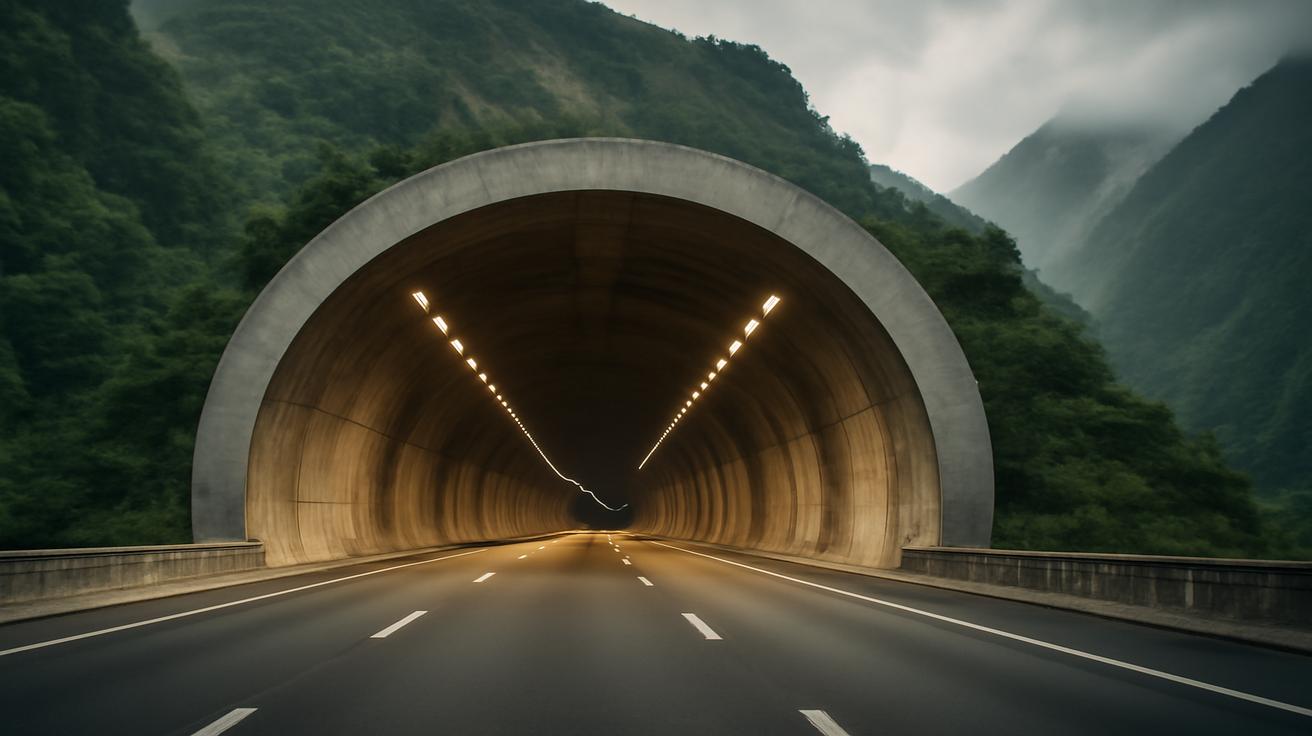
By the time the first car slipped into the tunnel’s mouth, the morning mist still clung to the mountains like a secret the land wasn’t quite ready to give up. Concrete, steel, and human stubbornness had carved a 22-kilometer vein through ancient rock, an impossible line from one valley to another. Headlights floated in the half-dark like fireflies in formation, swallowed whole by the mountain and then reborn in the thin, pale light on the other side. For the drivers easing into that dim-lit throat of stone, it was just a faster route to work, a smoother journey home. But above the tunnel roof, where cold wind knifed across ridgelines and clouds snagged on peaks, the earth held a different story—one of ambition, power, and the uneasy quiet that follows when a landscape is permanently rearranged.
A Mountain Opens Its Eyes
You don’t really feel the length of 22 kilometers until you’re inside it.
The first thing that hits you is the sound. The low, continuous hum of engines is amplified, wrapped in layers of echo that blur one car into another. Your ears adjust, then your eyes: the world shrinks to a ribbon of road and a procession of white lights overhead, spaced like the steady tick of a clock. Every few hundred meters, green emergency exits glow softly, promising escape routes carved sideways into the stone. Cameras blink red; speakers murmur security announcements in a calm, disembodied voice.
In a country that has already built more tunnels than almost any other on Earth, this one still feels different. At 22 kilometers, it stretches like a human-made canyon in reverse—hollow instead of towering, dark instead of sunlit. It connects two regions separated for centuries by mountains that were both blessing and barrier, a rugged spine that kept cultures, dialects, and livelihoods just out of easy reach of one another.
Now, with a single entry on a government project list and years of blasting, drilling, and pouring, that barrier has a door. Official statements call the tunnel a “miracle of engineering,” a “new artery of national rejuvenation,” a “model of high-quality development.” On ribbon-cutting day, the red banners and choreographed applause almost drowned out the quieter questions: At what cost does a mountain open its eyes?
The Anatomy of a 22-Kilometer Gamble
For all its drama, the tunnel’s bones are surprisingly simple: rock, concrete, steel, and an unbroken faith in engineering. Yet each meter carries more complexity than most travelers will ever see.
Engineers began with surveys so detailed they seemed almost intimate—laser scans of the underground, seismic tests that listened to the mountain’s internal chatter. The mountain, of course, did not sit still. It bristled with fault lines and hidden water veins, with pockets of soft rock that could flow like toothpaste under enough pressure. Behind every straight line on a planning document was a mess of geology waiting to misbehave.
Instead of attacking the mountain from one side, crews drilled from both ends and sometimes from intermediate adits, chewing inward like miners chasing a seam of ore. Tunnel-boring machines—cylindrical beasts the size of apartment buildings—worked relentlessly in some sections, while controlled explosions did the rough work elsewhere. The air filled with the chemical tang of explosives, the fine, choking dust of pulverized stone, and the grinding howl of metal against rock. Day and night blurred. Underground, there is no sunrise, only shift changes and the heavy fatigue of fluorescent light.
From the outside, progress looked smooth, even elegant. On national television, animated diagrams showed the tunnel advancing like a bright line through a gray cartoon mountain. Inside, men in mud-splattered helmets tasted the bitter grit in their teeth and learned to read the warning signs of a rock that was about to move the wrong way.
The cost in money was staggering, and yet dwarfed by the political importance of the project. For the state, this wasn’t just a shortcut; it was a symbol. Where older empires built walls, this one builds passageways—fast, straight, and under absolute control.
| Aspect | Details |
|---|---|
| Total Length | 22 km (one of the longest highway tunnels in China) |
| Construction Time | Several years of continuous multi-shift work |
| Primary Purpose | Reduce travel time, boost regional trade, assert strategic connectivity |
| Key Features | Intelligent monitoring, advanced ventilation, fire and evacuation systems |
| Main Controversies | Environmental impact, resettlement, cost, and symbolic role in state power |
Where the Road Meets the Ridge
Stand on a nearby ridgeline, where the tunnel is invisible, and it’s hard to imagine anything could push through this. The wind here smells of pine and cold stone. Birds ride the air currents that slip like invisible rivers between peaks. In the old days—before the maps were redrawn in tarmac and tunnel—you could hike all day along these slopes and never see more than a faint track of hooves and boots.
Villages tucked into high valleys felt the seasons as if they were personality shifts. Winter wasn’t just colder; it was a closing of the world, when passes were snowed in and markets lay days away by foot or mule. Summer brought traders and gossip from beyond the next ridge, new seeds, new tools, the jostling sense of a larger country out there somewhere.
Ask an older farmer what the tunnel means, and you might get a shrug first—the kind that covers both hope and worry. Faster trips to the city, yes. A better price for apples, perhaps. Doctors within a reachable distance when the snow falls. But also: more outsiders, more land bought up for roadside hotels and fuel stations, more sons and daughters who see the lights at the tunnel’s far end as a one-way road out of the valley.
“The mountain kept us poor,” one villager might say. “But it also kept us together.” Now the mountain has a hole, and through it comes not just trade, but a different rhythm of life, pulsing at highway speed.
The Silent Costs Beneath the Concrete
Every major tunnel is also a story of what had to move—or disappear—to make way.
Construction crews cut access roads into slopes that once only knew goat paths. Hillsides were scraped, forests thinned to make staging grounds for equipment. Some residents were relocated, their old homes turned into demolition dust, replaced with new apartment blocks that still smell of fresh plaster and unformed memories. Compensation was paid, often publicly praised as generous. Privately, not everyone agreed.
Under the surface, literally and figuratively, water is always the troublemaker. Tunneling can re-route underground streams, drying some springs and swelling others. That can quietly unbalance a local ecology that depends on certain damp places staying damp, certain roots always finding a drink. Frogs might vanish from one hollow and appear unexpectedly in another; rice paddies may crack or flood in slow, puzzling shifts.
Then there is the wildlife, whose movement across the ridgeline is like a language written in footprints instead of ink. Big infrastructure projects slice through these sentences. An animal that once moved instinctively along a shaded corridor of trees might now find that path broken by access roads, noise, and lights. Scientists know how to count the kilometers of asphalt added; they are still learning how to count the broken connections between den and feeding ground, between winter and summer range.
At night, when the tunnel glows at both ends and trucks move like illuminated beetles through the mountain, there is a different kind of silence above: a hush that follows when places once defined by difficulty become easy to cross. It’s progress, undeniably, but also erasure at a speed the land has rarely had to deal with.
A Monument You Can Drive Through
China has a long history of building at scales that tilt the human imagination: walls that run like stone rivers for thousands of kilometers, canals that knit distant waters together, bridges that stride across valleys wide as villages. The new tunnel joins this lineage, not as something to look up at, but as something to enter.
That is part of its power. You don’t just admire it; you pass through it, participate in it, become briefly part of the system it represents. Cameras log your plate, sensors track the air you breathe, software adjusts ventilation, surveillance, and electronic toll collection in an unseen choreography. State power here is not loud; it is embedded. It hums in the control rooms where operators watch walls of screens, where algorithms flag anomalies, where emergency plans and political expectations share the same fluorescent light.
Infrastructure of this magnitude is never only practical. It sends a message inward to citizens and outward to the world: We can do this. We can make the land itself obey. A mountain that once set the limits of human movement now frames a state narrative about triumph over nature, about unifying dispersed regions into a single, pulsing economic body.
From Beijing’s vantage point, every major tunnel and high-speed rail line is another stitch pulled tight across the fabric of the country—binding restive edges to the center, tying resource-rich hinterlands to manufacturing coasts, making distance feel negotiable and, eventually, irrelevant.
The Politics Inside the Rock
Critics inside and outside China see this not just as engineering, but as architecture of control. When a state can alter geography at will, it redefines what is possible—and what can be demanded.
Routes once determined by rivers, passes, and old trading logic now bend to strategic priorities. Highways and tunnels do not simply follow need; they also create it, guiding where people travel, where businesses bloom, where soldiers and supplies could move in a crisis. The map ceases to be a passive reflection of terrain and becomes an active tool in statecraft.
There is also the question of narrative monopoly. Official media tell the tunnel’s story as an unambiguous victory: heroic workers, grateful villagers, dignitaries in hard hats praising “people-centered development.” The messier parts—labor disputes, environmental warnings, residents who didn’t want to move—rarely make it into the canon. In the absence of competing narratives, concrete hardens not just in the mountain but in the public mind.
For many ordinary people, this tension lives quietly alongside gratitude. The person whose father can now reach a hospital in half the time does not have the luxury of dismissing the tunnel as pure propaganda. But they may also notice who gets to own land near the exits, who wins the contracts, whose slogans adorn the entrance in ten-foot-high characters.
Riding the Future at 80 Kilometers an Hour
On a weekday morning some months after opening, the tunnel feels almost relaxed. The construction drama has faded into memory; the protests, if there were any, are archived in quiet conversations and fading social media posts. The road surface is clean, the paint still bright. Trucks laden with produce and electronics keep a steady pace. Sedans with city plates slip by on their way to business deals in towns that now seem close enough to manage in a day.
Inside the car, you feel an odd dislocation. Your navigation app shows a straight blue line knifing under textured terrain that your eyes can no longer see. The land has been converted into data and distance: 12 kilometers to go, 10, 8. Outside the windshield, the world repeats itself—lights, walls, intermittent emergency bays painted in bright colors.
It’s almost soothing, until you imagine the millions of tons of rock pressing above, the thinness of the engineered shell that holds them back. Under normal circumstances, the structure is secure, overbuilt, a symphony of redundancies. But the psychological pressure remains. Long tunnels have a way of making you aware of how much we’ve come to trust things we don’t fully understand: the engineers, the regulators, the maintenance crews, the algorithms watching for smoke and stalled vehicles.
As you emerge, the transition back to daylight is abrupt and shockingly beautiful. The sky feels larger than before. Mountains jump back into view, their slopes etched with terraces, power lines, faded paths. You squint, not just from the light, but from the feeling of re-entering a world that still resists straight lines.
Somewhere on a rooftop or a hillside, a child might be watching the highway, counting trucks, wondering what lies beyond the next tunnel, the next bridge. For them, the mountain has never been a wall; it’s just part of a landscape already perforated by human desire. The idea that a ridge could once keep people apart belongs to another era, as distant as travel by caravan.
Between Wonder and Unease
It’s tempting to choose a simple stance toward projects like this: to either marvel at the brilliance or condemn the arrogance. The truth sits uneasily between.
On one side, there is genuine awe. The capacity to dig through a mountain with such precision, to design ventilation that can clear smoke in minutes, to monitor structural health with sensors hidden in the concrete—these are not small feats. They represent generations of accumulated knowledge, from geology to computer science, all harnessed toward a single, very physical goal. To deny that wonder is to flatten the story.
On the other side, there is an equally real discomfort. Because the tunnel is not just a technical object; it’s a political one. It tells you who has the power to decide what the landscape should be, whose lives and livelihoods can be rearranged in the name of a “greater good,” whose stories do not make it onto the commemorative plaque.
China’s new 22-kilometer tunnel is both: an engineering miracle and a carefully stage-managed monument to state power. Every time a trucker rolls through in the small hours, radio crackling with late-night chatter, that dual identity travels with him. Every time a villager sells freshly picked fruit at a rest stop near the exit, hoping for a better price from passing travelers, they are participating in an experiment in reshaping not just geography, but society.
After the Blasting Stops
In the end, the tunnel will outlive many of those who built and debated it. Concrete ages slowly; asphalt can be resurfaced; ventilation fans replaced. The state that ordered it into existence may change its slogans and leaders, but the hollow in the mountain will remain, a physical fact that future generations will inherit without remembering the meetings, the surveys, the handshakes that made it possible.
Years from now, a young driver might glide into the tunnel without a moment’s thought, more concerned about a playlist than the geology overhead. Schoolchildren will learn about the project in textbooks as a milestone in national development, illustrated with smiling workers and clean, computer-generated cross sections. The controversies will be a footnote, if they are mentioned at all.
But the land remembers in subtler ways. In altered water flows, in the changed traffic of animals, in the hum of tires where there was once only wind. And people remember too, in stories shared over tea, in the way an older resident’s voice tightens when they describe the house that was, the valley before the access road came.
The tunnel’s legacy will be written in multiple scripts: economic data, political speeches, scientific papers, family photo albums with snapshots at the new scenic overlook by the eastern portal. Like all great works of infrastructure, it is larger than any single meaning. It’s a road, a symbol, a scar, a lifeline.
Somewhere in the middle of its 22 kilometers, where phone signals begin to flicker and the world shrinks to the narrow certainty of headlights and white lane lines, you can feel all those versions pressing close. The miracle and the monument. The convenience and the control. The sense that, in carving into the mountain, we have also carved more deeply into what it means to live together under the shadow—and shelter—of a powerful state.
Frequently Asked Questions
Why is this 22 km tunnel considered an engineering miracle?
Its length, complex geology, and advanced safety systems make it stand out even in a country accustomed to large projects. Engineers had to navigate fault lines, underground water, and high overburden pressure, while integrating intelligent monitoring, ventilation, and emergency response systems that can keep thousands of daily travelers safe.
What are the main benefits of the tunnel for local communities?
It significantly reduces travel time between regions, improving access to hospitals, schools, and markets. Farmers can reach larger urban centers more easily, tourism can expand, and logistics become faster and more predictable, which can attract investment and new jobs.
What environmental concerns are associated with the tunnel?
Concerns include disruption of underground water flows, habitat fragmentation from access roads and construction zones, vegetation loss, and long-term impacts on wildlife movement. Some of these effects are hard to predict and may only become fully visible years after completion.
How does the tunnel relate to state power in China?
Large infrastructure projects are central to China’s strategy for economic integration and political cohesion. By physically reshaping geography—linking remote regions more tightly to the national core—the state reinforces its presence, control, and narrative of progress. The tunnel is both a transport link and a symbol of centralized capacity.
Do local people support the project?
Opinions are mixed. Many appreciate the economic opportunities and improved access to services. Others are uneasy about resettlement, changes to traditional ways of life, and unequal distribution of new wealth. Public narratives emphasize support, but private views can be more ambivalent.
Is this tunnel unique compared to others in China?
While China has many long tunnels, this one stands out for its length, symbolic timing, and location in a strategically important corridor. It is often highlighted in official media as a representative achievement of “new-era” infrastructure development.
Will the tunnel’s impact grow over time?
Yes. As new highways, industrial parks, and logistics hubs connect to it, the tunnel will shape trade routes, migration patterns, and regional economies. Its full significance will unfold over decades, long after the construction dust has settled.






Leave a Comment