
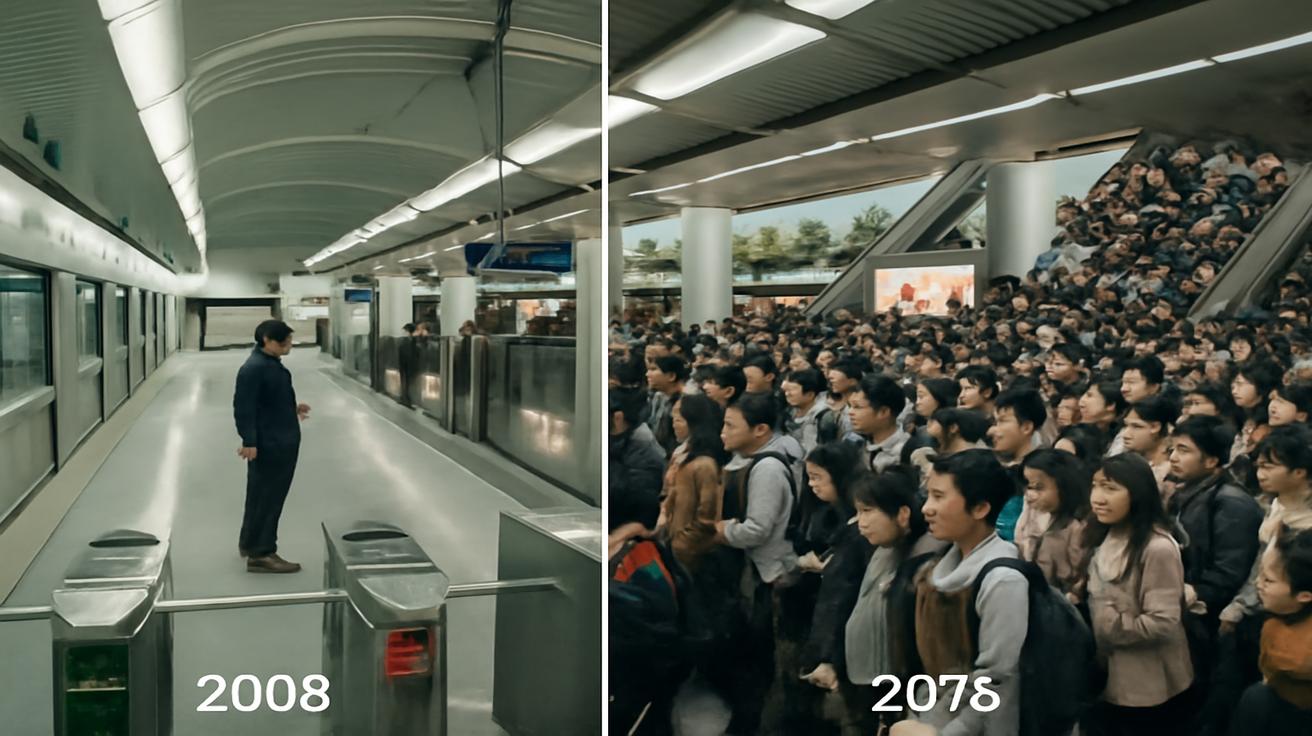
On a winter evening in 2008, a brand-new metro train slid into a spotless underground station on the outskirts of a Chinese city whose name most international newspapers still got wrong. The doors sighed open. No one stepped in. No one stepped out. Fluorescent light hummed against white tiles, advertisements for phones and instant noodles glowed over platforms, and the loudspeakers politely announced the next departure to an audience of almost no one. A British journalist snapped a photo of the emptiness and mailed it home, certain he had captured the perfect symbol of waste: China’s shiny ghost metros, proof that the country was building too fast, too far, for no one at all.
The Joke That Aged Badly
By 2010, those photos had become a genre. Western media loved them: endless escalators leading nowhere, four-lane roads in front of stations with barely a scooter, a single commuter dwarfed by cathedral-like halls of glass and steel. “Vanity projects,” the headlines smirked. “Ghost trains.” At conferences, economists chuckled as slide decks showed aerial shots of brand-new lines spidering out into what looked like empty farmland on the city edge.
I remember one particular clip: a television crew in an almost empty station, their host walking slowly along a platform so long it seemed to warp the camera lens. “Look at this,” he said, echo bouncing down tiles. “Billions of dollars for stations that no one uses. What are they thinking?” He shrugged, as if the answer were obvious: they weren’t thinking at all.
Back then, it felt intuitive to us—watching from London, New York, Sydney—that infrastructure should follow demand, not lead it. We were used to transport coming too late, after decades of traffic jams and housing shortages and policy debates that went nowhere. Universities taught that it was risky, even reckless, to “overbuild” before the crowds arrived. The idea that you would dig tunnels and pour concrete for millions of future riders who didn’t yet live there sounded like magical thinking with a hardhat on.
China, we were told, was building Potemkin networks: showpiece projects meant to impress, not serve. The near-empty platforms and echoing corridors seemed like perfect visual proof. But the problem with snapshots is that they freeze time. And time was the thing China was really building for.
Waiting for People Who Hadn’t Arrived Yet
To understand how wrong we were, you have to go back to the planning offices of Chinese cities in the early 2000s. The numbers they were staring at were breathtaking: tens of millions of people projected to move from countryside to city every year; whole districts planned on rice fields; GDP curves that looked less like lines and more like rockets. Those officials were not, as foreign commentators sometimes imagined, drawing fantasy metro maps on napkins in expensive restaurants. They were trying to solve a brutally practical problem: how do you build a city fast enough without letting it choke itself to death on its own growth?
China made a choice that many places only talk about: it would build the skeleton first, then grow the flesh around it. Rail lines before traffic jams. Stations before high-rises. Depots and maintenance yards while the land was still cheap. It would build knowing that, for a few years, maybe even a decade, those platforms would be almost comically empty.
The early years of those new metros were strange. Conductors would line up on platforms to greet the handful of passengers who trickled in: a university student with a new backpack, a grandmother with a market bag, a bored teenager filming the marble floors with a shaky phone. Trains would pull into silent stations where the loudest sounds were their own squealing brakes and the brushing of cleaning staff polishing handrails that nobody had yet touched.
To foreign eyes, it was absurd. To many Chinese citizens, especially those old enough to remember dusty bus depots and traffic-clogged ring roads, it was something else: a promise. “Give it a few years,” a Chengdu engineer told a visiting reporter in 2009, gesturing at an empty platform. “You won’t believe this place.”
The Slow Filling of Empty Maps
Fast forward to 2015. The map on the wall of that same station looks different now: the lonely single line has become a nervous system, colored veins branching to new districts with names that didn’t exist when the tiles were laid. Aboveground, the land around the station has sprouted malls, apartment towers, glass-fronted offices, rows of electric scooters. The four-lane road outside is suddenly busy. There is a primary school at one exit, a park at another, a new university campus three stops away.
And underground, the air feels different. You can smell it first: perfume and cooking oil and wet jackets when it rains. Then you hear it: the thrum of many voices, the irregular rhythm of footsteps, the sharp whistle of doors closing against a crowd that actually needs to hurry. Those same journalists who once filmed empty platforms return and have to squeeze their cameras between commuters. The echo is gone; the space has been filled by people.
By 2025, the “ghost” metros of 2008 have become something else entirely: the unremarkable daily miracle of millions of trips that simply work. A factory worker in a new industrial zone taps her card at a station whose opening she watched as a child on local television. A young programmer, born in a village now absorbed by suburbia, takes Line 4 to a job in a glass tower thirty kilometers from where his grandparents grew up. A schoolboy with wireless headphones knows nothing of the debates that once swirled about the tunnels he walks through; to him, they are as ordinary as the sky.
How the Numbers Turned the Story Upside Down
In 2008, critics saw empty trains and called them waste. By 2025, the data told a very different story. China’s metro networks had grown from a few showcase systems in Beijing and Shanghai to more than forty cities with rail transit. Daily ridership numbers—hundreds of thousands, then millions, then tens of millions—started to look less like overbuilding and more like life-support.
Cities that once seemed too small or too “provincial” for metros were quietly racking up passenger counts that would make some Western capitals blush. Lines that had been mocked for serving fields and half-built housing tracts were now handling rush hours fierce enough to justify additional trains. The same stations that once appeared in articles about white elephants began appearing in research papers about emissions reduction, transit-oriented development, and urban air quality.
| Aspect | 2008 Perception | 2025 Reality |
|---|---|---|
| Ridership | “Almost no passengers” | Millions of daily riders in many cities |
| Urban Growth | Lines to “nowhere” | Dense districts clustered around stations |
| Policy View | Vanity, overbuilding, white elephants | Backbone of urban planning and mobility |
| Environmental Impact | Rarely mentioned | Key to cutting car use and pollution |
| Global Reputation | Symbol of excess | Case study in building ahead of demand |
The joke had flipped. It was no longer “How silly to build metros nobody uses,” but “How did they manage to be ready in time?” While many countries were still arguing about single extensions or fighting over budgets for modest lines, China had simply laid track, dug stations, and accepted the ridicule as a temporary side effect of long-term thinking.
Of course, not every project was perfect. Some lines took far longer than expected to fill. Some stations did stay oddly quiet, serving industrial parks that never quite boomed or neighborhoods that grew more slowly than their planners had hoped. Debt loads rose; local governments strained. These were not fairy tales but complex, messy human projects. Yet taken as a whole, the system did something rare in modern urban history: it grew faster than demand and then caught demand as it arrived, instead of limping desperately behind it.
The Environmental Plot Twist
There’s another reason we misread those empty metros in 2008: the climate stakes were less visible. We worried about pollution, sure, but the connection between steel rails in a Chinese city and the planet’s fevered atmosphere felt tenuous. By 2025, that illusion is gone. Heatwaves have names now, like hurricanes. Smoke from distant wildfires stains sunsets gray-orange on every continent. Climate models that once seemed theoretical now feel like weather forecasts.
In that context, those “vanity” metros suddenly look like something else: preemptive strikes against the locked-in car dependency that has haunted so many twentieth-century cities. Every family that chose a flat near a station instead of a distant exurb; every commuter who swiped into a platform instead of revving up a scooter; every factory that clustered near rail rather than highways—these decisions ripple outward, shaving edges off emissions curves that people rarely see.
You can smell this shift in the air of some Chinese cities on winter mornings. A decade earlier, the smog sat heavy, thick enough to taste, a reminder of coal boilers and endless exhaust. Today, while the air is far from pristine, there are more mornings when the sky above the station entrance is actually blue. It’s the combined, quiet work of regulations, of cleaner power—and of hundreds of thousands of people disappearing underground instead of idling above it in traffic.
What We Didn’t Understand About Time
Our misunderstanding of China’s empty metros was also a misunderstanding of time itself. We assumed that what we saw was what would be: quiet platforms, sparsely used escalators, trains gliding through half-lit tunnels for no one. But infrastructure lives on a different clock than the news cycle. A metro system is a bet placed decades into the future, not a quarterly earnings report.
Western commentary often reacted as if all projects should prove their worth within a few years, or else be labelled failures. But a train line that takes ten or fifteen years to fully earn its keep is not unusual; it is normal. Especially when it is being laid like a fuse in dry grass, waiting for the spark of new residents, new offices, new schools.
Think of a seed buried before the rainy season. For months, it looks like nothing at all: a patch of dirt, indistinguishable from any other. Only later, often after those who planted it have moved on, does the green break through. China planted rails instead of seeds, and the harvest came in people—not in the phantom metrics of early newspaper columns.
The Human Scale of a Mega-Project
It’s easy to talk about these networks in abstractions: kilometers of track, billions of yuan, ridership per day. But the most compelling proof that we were wrong lives at a smaller scale. Walk into a Chinese metro station at 8:30 on a weekday morning in 2025 and stand near the ticket gates. Watch who passes you.
A teenager yawning into her scarf, clutching an art portfolio. A nurse in white sneakers, earbuds in, eyes already tired. A middle-aged man in a construction helmet, lunch pail swinging. A delivery rider, helmet under his arm, checking route updates on his phone even as he walks toward the escalator. An elderly couple, fingers laced loosely together, reading the line map with the practiced three-second glance of long-time users.
Every one of them is relying on a decision made long before they ever set foot on that platform: the decision to build it before they needed it. For the nurse, it means her commute is thirty minutes instead of ninety. For the construction worker, it means he can take jobs across the city without sleeping in crowded dorms far from home. For the elderly couple, it means they can visit their grandchildren without calculating taxi fares against pensions.
These stories were invisible in 2008, because the people themselves were not yet there. We were judging absence, not presence. Critiquing a story halfway through, mistaking the middle for the end.
Lessons for Cities Still Debating the First Shovel
So what does this reversal mean for everyone else, watching from countries where even modest transit proposals can take decades to negotiate? There is no simple invitation to cut-and-paste China’s model: its political system, land regime, and financial tools are particular, and with them come risks, including high debt and the temptation to build for prestige as much as for need.
But there are quieter lessons worth carrying home.
One is that building slightly ahead of demand is not inherently wasteful; it can be protective. It can shape how a city grows rather than merely follow in its wake. When you open a station on bare ground, you are not indulging a fantasy. You are telling developers, families, and businesses: “Grow here, not there. Grow along the rails, not around another ring road.”
Another is that the most important metrics of success may not be visible for a decade or more. A new metro’s early years can look underwhelming if you stare only at passenger counts. But if you widen the frame to include housing patterns, traffic trends, public health, and emissions, the picture changes. The long shadow of a single line can fall over an entire generation’s choices about where and how to live.
And finally, there is a humbler lesson about narrative itself. The same stations once held up as proof of folly are now case studies in foresight. Our opinions aged faster than the concrete. We were, quite simply, too impatient to understand what we were looking at.
Revisiting the “Vanity Project” Label
The phrase “vanity project” carries a specific accusation: that something exists mainly to flatter its builders. In 2008, China’s metros fit neatly into that script for many outside observers. Futuristic trains and spotless stations made for great photo ops at international conferences. They seemed designed more for the world’s cameras than for the city’s residents.
But vanity doesn’t usually tolerate emptiness for long. A genuinely hollow monument is one that cracks when the spotlight moves on. China’s metro stations did something different: they waited. They weathered the years when only a few thousand people used them daily instead of the hundreds of thousands they were built for. They sat patient while concrete cured, while construction cranes swung overfields, while roads around them filled with trucks and then, eventually, with pedestrians.
By 2025, the stations’ surfaces had dulled, scratched and scuffed by actual use. Benches no longer gleamed; they bore the faint imprint of a thousand mornings. The posters on the wall advertised after-school tutoring and food delivery apps instead of glossy future visions. Whatever else they were, these places were no longer props. They were woven into the fabric of daily necessity.
Remembering How Wrong We Were
There is an image that sometimes returns to me: an old photograph of a nearly empty Chinese metro car, taken around 2008. In the photo, a single passenger sits by the window. Outside, through the glass, you can see the darkness of a tunnel; inside, fluorescent lights paint everything the same flat color. The caption, written at the time, is wry: “Room to spare on China’s new subway.” It invites the viewer to smirk alongside the photographer at this apparently pointless abundance of space.
If you could stand in that same car at the same time of day in 2025, you would need to wedge yourself in between backpacks and winter coats. The poles would be ringed with hands. Children would peer over seats. A recorded voice would politely ask riders to “move toward the center of the car” and, for once, they might actually try.
The space that once looked like waste was, in fact, a margin. A buffer. A decision made not for the comfort of a visiting reporter, but for the unborn commuters who would one day pack that train. What we mistook for arrogance was, in many ways, a rare kind of humility: the willingness to invest in a future you will not personally occupy, to lay foundations whose full benefits will accrue to people you will never meet.
In 2008, we saw emptiness and laughed. In 2025, we ride those same lines and feel something closer to awe—and, if we are honest, a little regret that we did not start digging our own tunnels sooner.
FAQ
Why were China’s metro stations so empty in 2008?
Many lines were built ahead of demand, reaching into areas that were still under development. Housing, offices, schools, and commercial centers had not yet grown up around the stations, so passenger numbers were low in the early years.
Were those early metros really “vanity projects”?
Some commentators used that label, but the long-term outcome suggests otherwise. While there were certainly political and prestige elements, the networks have become essential infrastructure, with high ridership and significant impacts on mobility, development, and pollution reduction.
How did things change by 2025?
Urban growth caught up with the infrastructure. New districts densified around stations, ridership soared, and many of the once-quiet lines became heavily used, especially during rush hours. The metros are now central to daily life in dozens of Chinese cities.
What are the environmental benefits of China’s metro expansion?
The metros help reduce reliance on private cars and motorbikes, which in turn lowers traffic congestion, tailpipe emissions, and local air pollution. When combined with cleaner power generation, they also contribute to lowering overall greenhouse gas emissions.
Can other countries copy China’s approach to building ahead of demand?
Not directly. China’s political system, financing mechanisms, and land policies are unique. However, other countries can learn from the underlying principles: coordinating land use and transit, planning for long-term growth, and accepting that major infrastructure may take years or decades to reach full capacity.






Leave a Comment