
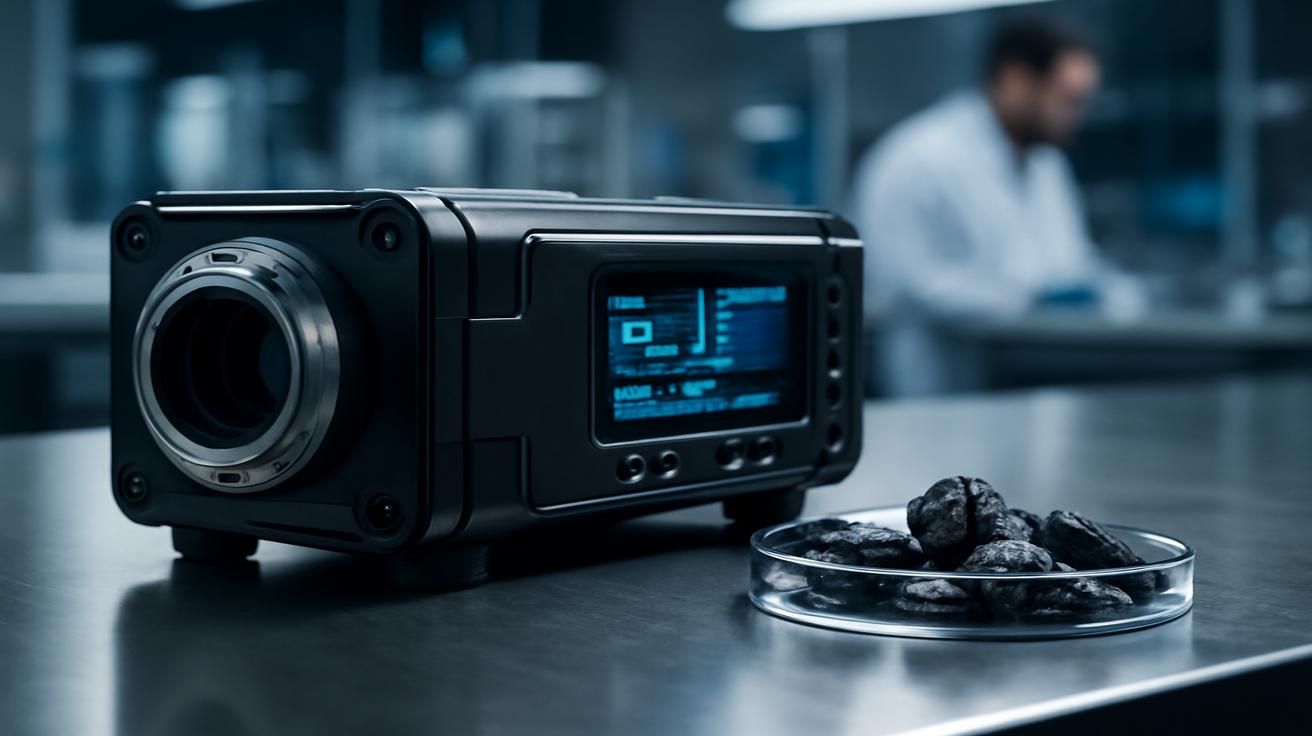
The first time you see it, you don’t quite understand what you’re looking at. It’s the size of a thermos, matte gray, no wild fins or glowing coils like the sci-fi movies promised. Just a compact cylinder resting on a padded case in a windswept test range somewhere in northern China. A technician in a windbreaker taps a tablet. A low hum, a faint, shimmering thread in the air—and then, a metal plate a hundred meters away blooms with a bright white scar as if bitten by invisible fire.
Everyone in the viewing bunker goes very quiet. Not because this is the world’s first laser, or the most powerful. It isn’t. What makes this moment eerie, historic, and faintly unsettling is something else entirely: this laser is portable, rugged, and runs on a rare earth element that barely anyone outside China can currently get enough of.
For years, lasers have lived in laboratories, satellites, and heavily cooled, truck-mounted systems. They’ve guarded military bases and sliced steel in factory halls, but they’ve rarely been truly personal, field-ready tools of precision energy. This new Chinese device—sleek, unassuming, and almost casual in its presence—whispers of a different future. A future in which directed energy tools travel as easily as a camera lens or a drone. A future in which the critical ingredient that makes them work is controlled, mined, refined, and stockpiled mostly in one country.
A Beam That Starts in the Ground
Long before that pale blue beam leaves its aperture, it begins as dust under someone’s fingernails.
Not the dust you imagine when you think of lasers—a sterile sheen of chrome, the bright plastic of safety goggles—but the heavy, damp dust of open pit mines in Inner Mongolia and the mountain folds of southern China. Giant trucks crawl along terraced cuts in the earth. Conveyor belts rattle. Slurry ponds shimmer a strange, chemical green. The air tastes of metallic rain and distant explosives.
Somewhere in that dust is the rare earth element that makes this portable laser possible: a tongue-twisting metal from the lanthanide family, used in specialized crystals at the heart of the device. Chinese state media never quite says the name out loud in their glossy videos. Analysts argue online—is it ytterbium? Neodymium? Thulium? The details are technical, but the pattern is not. This is a story that starts in a hole in the ground and ends in a handheld beam of disciplined light.
Rare earth elements are a paradox. They’re not truly “rare” in the sense of being nearly nonexistent in the Earth’s crust. They’re scattered everywhere, but almost never in concentrations rich enough to mine profitably or safely. Extracting them is part chemistry, part patience, and part willingness to live with environmental damage that many other countries have decided they no longer want in their own backyards.
Over decades, China accepted that bargain, building an empire not just of mines, but of refiners, smelters, and quietly humming separation plants. While other nations outsourced and relaxed, China got very, very good at washing the Earth’s crust for the metals of the future.
The Metal Behind the Mystery
Rare earth elements often play cameo roles in technology stories: a sprinkle here in a smartphone, a dash there in a wind turbine. But in laser physics, some of them get starring roles. The right element, embedded in a carefully grown crystal, can transform messy, chaotic electrical energy into a precise, coherent beam that holds together across distance. It becomes the “gain medium”—the amplifying heart where light is born and shepherded into order.
For years, most practical high-power solid-state lasers relied on a handful of tried-and-true materials: neodymium-doped crystals and glasses, fiber lasers built around ytterbium. They were strong but hungry, picky, and heavy on cooling. To shrink a battlefield-scale laser into something you can carry over your shoulder, you need a gain medium that sips power, handles heat elegantly, and produces a wavelength the optics and air can live with.
That’s where China’s quiet advantage comes in. With near-total command of mining and processing for certain lanthanides, its research labs have had almost unlimited room to experiment with exotic dopants and crystal recipes that are harder for foreign labs to source at scale. When one promising material appears to demand a specific, difficult-to-obtain metal at high purity, many Western labs shrug and move on. Chinese labs can keep going.
In the case of this new portable laser, the secret sauce is a particular rare earth element alloyed into a rugged crystal host, giving the device its odd combination of relatively low power consumption, manageable heat, and enough punch to matter at a distance. It doesn’t shatter mountains. It doesn’t need to. Its power lies in the way it combines capability with convenience—and in the supply chain gravity that pulls that capability toward Beijing.
Inside the Cylinder: Quiet Power in the Palm of a Hand
On the test range, the laser unit settles into an operator’s hands like a high-end camera. There is weight there—metal, glass, battery—but not the clumsy heft of a traditional directed-energy weapon. You could imagine a soldier slipping it into a pack. You could imagine a border guard using it to silently disable a drone’s optics. You could imagine a firefighter wielding a beam to cut a hole through a steel door without striking a spark.
Listen closely and you can hear what this laser is not doing. There is no roaring generator, no crackling arc of power cables, no on-site cooling rig bleeding steam into the cold air. The core crystal, doped with that rare earth element from faraway mines, is efficient enough that the battery pack and a compact thermal management system can keep pace, frame after frame, shot after silent shot.
The designers haven’t built a death ray. What they’ve made is a new kind of tool: one that erases the old tradeoff between mobility and directed energy. And that is precisely what worries Western strategists huddled in windowless offices, peering at grainy screenshots from Chinese state television.
They see, perhaps more clearly than anyone, that the power here isn’t only in the beam. It’s in the quiet, geologic truth behind it: whoever controls the earth that feeds the crystal can choose who gets to copy it—and who doesn’t.
Why the West Can’t Just “Make One Too”
It’s tempting to imagine this as a simple engineering race: China unveils a neat new gadget, so the United States and Europe race to their labs, throw some money at the problem, and emerge six months later with a comparable device. That’s how smartphones leapt oceans. That’s how EVs are going. But lasers live in a different kind of neighborhood—one made of refineries, export licenses, and quiet exceptions to free-market optimism.
To build this portable laser at scale, you need:
- Stable access to the right rare earth element at high purity.
- Refining capacity to separate that element from ore with brutal precision.
- Crystal-growing expertise tuned specifically to that dopant.
- Supply chains that can handle thousands of units, not a handful of prototypes.
China already owns most of this map. For some rare earth elements, it controls well over half of global production and an even larger share of processing capacity. Western nations, facing environmental constraints and decades of offshoring, find themselves rich in ideas but poor in the metals that make those ideas real.
In theory, the West could scramble to reopen old mines, stand up new refineries, and relearn the painful alchemy of rare earth extraction. In practice, that’s a decade-long journey, paved with lawsuits, community pushback, and billions in investment before the first kilogram of useful dopant emerges. Meanwhile, China can decide who receives what, and when—and at what purity level.
Sometimes, control doesn’t look like an embargo. It looks like a polite shrug and a shipping delay; a subtle tweak in pricing; a quiet reclassification of a certain oxide as “strategic.” For a bleeding-edge laser design that demands a precise, reliable feedstock, those small obstacles loom large.
| Factor | China | US & Europe |
|---|---|---|
| Rare Earth Mining | Extensive, long-standing operations | Limited, slowly expanding |
| Refining & Processing | Dominant global capacity | Fragmented, dependent on imports |
| Laser-Grade Materials | Integrated from mine to crystal | Patchwork of suppliers and R&D |
| Regulatory Environment | State-directed, strategic focus | Market-driven, slower alignment |
The New Gravity of Technology
Walk into any defense lab in Washington, Paris, or Berlin, and you’ll find people who know exactly how to design a capable portable laser on paper. Equations won’t be what stops them. Nature, however, is stubborn. Materials science is full of hard limits, and some of them trace quiet circles around the periodic table.
In a sense, this is not just a story about China, or the West, or even lasers. It is about a reversal of technological gravity. For generations, raw materials rushed out of the Global South and East into Western factories. The value piled up in the places where things were designed, not where they were dug up.
Now, increasingly, the value is following the hole in the ground. When the thing you’re mining is not just a bulk commodity but the choke point for turbines, magnets, batteries, and high-end optics, the power to decide who gets how much becomes a quiet form of leverage. You can feel this shift in the nervous cadence of Western policy papers that suddenly sound like geology reports. You can feel it in the urgency with which diplomats utter phrases like “critical minerals” and “supply chain resilience.”
Nature as a Strategic Actor
It’s easy to think of the natural world as quiet background to the drama of human ambition—a mountain is a mountain, a river is a river, and politics happens on top. But in this story, nature is not just scenery. It’s a co-author.
The lanthanides that power this laser were forged in the hearts of dead stars long before any nation drew a flag. They settled into the Earth’s crust in patterns that had nothing to do with ideology or trade theory. Some ended up in the soils of southern China; others in modest seams scattered across the Americas, Africa, and Australia.
China did not choose where the elements lay. But it did choose to pursue them relentlessly, to live with the waste, to pour training and capital into turning those distant star remnants into strategic assets. In that decision, human will met geochemistry—and together they wrote a new kind of power map.
Now, when an engineer in California stares at a concept drawing of a next-generation laser, they are really staring back through time at stellar explosions and plate tectonics, at half-forgotten mining booms, at environmental protests along distant riverbanks. The portable weapon on that northern Chinese test range is the visible tip of an iceberg whose base is as deep as geology itself.
Scenes from a Very Near Future
Imagine a foggy port city a few years from now. A swarm of cheap surveillance drones circles high above a harbor, their tiny rotors lost in the wind. On a patrol boat cutting through the gray water, an officer lifts a compact device to her shoulder. A narrow beam stabs upward—silent, almost invisible. One by one, the cameras on the drones bloom white and die. The aircraft themselves flutter on, blind, like insects with their eyes erased.
Or picture a wildfire moving hungrily toward a power substation in a drought-stricken valley. Fire crews stand in punishing heat, the air thick with smoke and the smell of burning pine. A technician unloads a case, snaps open a portable laser system, and neatly severs overhead lines and metal fixtures before the flames reach them, preventing a catastrophic arc and an even larger blaze. No sparks, no explosives, just clean, concentrated energy guided with surgical precision.
Scenes like these feel uncomfortably close now. Directed energy, once the stuff of grand fleets and static defenses, is slipping into the toolkit of border guards, special forces, firefighters, even industrial workers. Not all of those tools will rely on the specific rare earth dopant that China has leveraged in its latest prototype. But the most compact, most efficient, most easily deployed ones might—and that is where the bottleneck begins to bite.
If you live in a country that doesn’t control that supply, what does it feel like to watch these devices proliferate elsewhere? Perhaps like seeing the early days of GPS or satellite imaging, knowing that someone else holds the keys. Perhaps like watching your own environment, your own skies and coastlines, increasingly watched, shaped, and sometimes disabled by tools whose core ingredients you do not fully command.
The Environmental Echo
Deep in the rare earth mining regions, the story feels different. Here, the laser’s sleek metal body is just an abstraction. What people see are the scars: the open pits, the tailing ponds, the restless worry about water and air. The same metals that now shape military balance sheets and high-tech futures also seep into soil and memory.
Sometimes the wind carries the smell of solvents from a processing plant; sometimes the local river runs a color that does not occur in nature. Residents wonder how long this can last and what it means to be living upstream from the world’s strategic ambitions.
The irony is almost unbearable. The portable laser is, in some ways, a marvel of efficiency. It concentrates power cleanly, without the blunt force of explosives or the collateral fire of traditional munitions. Deployed responsibly, tools like this could reduce the physical footprint of conflict, the stray damage, the burned-out shells of buildings. Yet at the front of its life, in the mines and ponds and piping of rare earth extraction, the cost is written across landscapes that will take generations to heal.
Can the Story Change?
Back in Western capitals, people are trying to sketch out other endings. Seed money flows into new mines in Australia, the United States, and Africa. Startups promise cleaner, more modular refineries. Researchers talk excitedly about alternative materials—lasers built around more common elements, or novel designs that squeeze better performance from what’s easily available.
There is movement, but it is playing catch-up with decades of accumulated experience and infrastructure in China. The race now is not just to find substitutes, but to rethink how much strategic weight any single mineral, any single technology, should carry.
Some defense planners quietly urge a shift in focus: instead of chasing parity in every exotic material, invest in counters and workarounds. If one side has the best portable lasers, the other side might lean into hardened optics, dispersal tactics, or electronic deception. Others argue for greater urgency in building allied mineral networks, sharing refining tech as eagerly as software once was.
Nature will have a say here, too. New deposits will be found; some projects will stall on environmental grounds; others will rise because communities decide the trade-off is worth it, if done right. Somewhere, a child will grow up near a rare earth mine and ask a question that cuts through everyone’s justifications: Is this what it takes to make light that sharp?
Living in the Age of Elemental Power
In the end, the story of China’s portable laser is less about a single device and more about the world we are quietly building, element by element. We are entering an age in which the most consequential technologies are not just lines of code or clever designs, but physical marriages between physics and geology. Quantum computers and their superconducting circuits. Batteries and their cobalt, nickel, and lithium. Magnets and their neodymium. Lasers and the obscure metals that make their hearts glow.
When we talk about who “owns” the future, we are really talking about who is willing to stand at the messy intersection of mining and meaning, of chemistry and consequence. China, for now, has accepted that position with unusual clarity. The West, belatedly, is deciding how much of that burden it is willing to reclaim—and at what cost.
Somewhere tonight, under skies that remember the same ancient starlight that forged the rare earths, a team of Chinese engineers will unpack that cylinder again. The air will be cold. Breath will stream like ghosts in the floodlights. Someone will tap a screen; the device will wake with a soft internal thrum. A beam will flicker across the dark, touching metal, concrete, targets that splinter cleanly at the point of light.
Long after the test range falls silent, the questions remain, humming just below the threshold of hearing. How much of our future are we willing to anchor in the deep past of the planet’s crust? Who gets to decide how those buried stories are brought to the surface, refined into tools, aimed into the night? And what happens when the brightest, sharpest lines we can draw—these narrow paths of laser light—reveal, once again, the oldest and roughest edges of power?
Frequently Asked Questions
Is China’s portable laser a real deployed weapon or just a prototype?
Publicly, it appears as an advanced prototype or limited-deployment system demonstrated in controlled tests. The exact scale of deployment is not disclosed, but the technology is mature enough to attract serious global attention.
Why can’t Western countries simply use a different material?
In theory, they can explore alternative dopants and laser designs, but matching the same combination of power, efficiency, compactness, and cost is difficult. The specific rare earth element used gives this system a performance edge that isn’t easily replicated with more common materials.
Are rare earth elements really rare?
Chemically, they are relatively abundant in the Earth’s crust, but they are rarely found in high concentrations. Extracting and refining them economically—and with acceptable environmental impact—is what makes them effectively “rare.”
Could new mines outside China fix this imbalance?
New mines in places like Australia, the US, and parts of Africa can reduce dependence on Chinese supply, but building full mining-to-refining capacity takes many years, major investment, and environmental approvals. It will help, but it is not an overnight solution.
Does this kind of laser have peaceful uses as well?
Yes. Similar technologies can be used in precision cutting, remote infrastructure maintenance, firefighting, satellite servicing, and scientific research. The same properties that make the device attractive militarily—compact, efficient, controllable power—can support civilian and environmental applications if directed that way.








Leave a Comment