
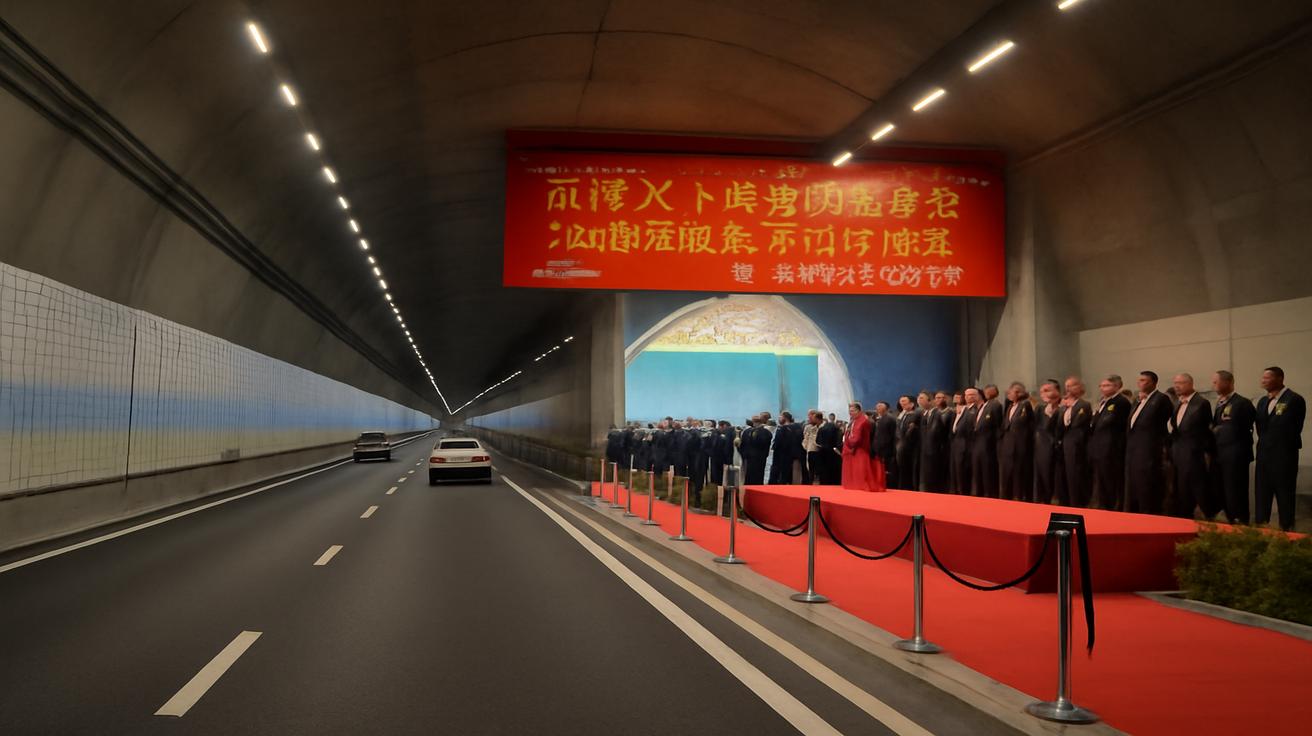
The first thing you notice is the silence. Not the silence above ground, with its wind in the pines and distant truck engines, but the deep, mineral hush that lives inside a mountain. Then, very slowly, that hush fills with the hum of tires, the soft echo of engines, and the faint glow of LED lights running like a silver river into the distance. You are 22.13 kilometers inside the earth, on a Chinese highway that has just broken a world record—and for a moment, it feels less like infrastructure and more like a portal to the future.
A Road Beneath the Mountains
The tunnel does not look like a record-breaker when you first approach its entrance. From a distance, it’s a dark mouth set into the side of a mountain, framed by concrete, steel, and the jagged silhouettes of peaks older than history. Flags snap in the brisk air, construction cranes are frozen mid-gesture like giant mechanical herons, and somewhere beyond the fencing, excavators rest after years of eating rock.
Only as you draw closer does the scale become clearer. This is the newly inaugurated 22.13-kilometer highway tunnel in China—now the longest of its kind anywhere on the planet. A number that looks simple enough on paper suddenly feels immense when you realize what it means in human terms: a drive that will keep you underground long enough for your sense of time, and even of direction, to loosen and blur.
China, in recent decades, has grown accustomed to rewriting the record books of engineering. World’s highest bridges, longest sea crossings, fastest trains—the list has become almost routine. And yet, as officials cut the ribbon on this highway tunnel, there is a different, quieter mood in the mountain air: a blend of local pride, global astonishment, and almost childlike disbelief.
“You tell people it’s over twenty-two kilometers, and they nod,” says one engineer, grinning beneath a yellow helmet, “but they don’t really understand it until they drive it. Then they come out the other side a little bit shocked.”
The Anatomy of an Underground Giant
From the outside, the tunnel is just an opening. From the inside, it is an entire engineered ecosystem, a world carefully designed to keep thousands of people safe as they pass through a space the sun never touches. The air is surprisingly fresh, cool but not cold, threaded with the faint scent of new concrete and stone dust. LED lights wash the interior in a steady, daylight-like brightness that keeps the human body from tensing against the dark.
This is no narrow mountain bore. Two generous lanes stretch ahead in each direction, the white lane markings marching forward until perspective squeezes them into a single glowing line. Overhead, cables, sensors, and ventilation ducts form a kind of technical canopy—unseen by most drivers, yet always at work. Every few hundred meters, electronic signs flicker safety icons, speed limits, or warnings, ready to shift to evacuation messages should anything go wrong.
What astonishes, though, is not only the distance, but the density of planning that makes such a distance survivable. Engineers had to consider what would happen in the absolute worst seconds of a driver’s life: a tire blowout, a fire, an earthquake, a tunnel-wide blackout. For each of these imagined disasters, they built answers, redundancies, escape routes, and layered systems of fail-safe upon fail-safe.
Even in the quiet moments, when traffic is light and the tunnel feels like a private passage, those protections are humming: air quality sensors tasting every breath of exhaust, heat detectors reading the tunnel like a patient, surveillance cameras watching for stopped vehicles or erratic swerves, software learning what “normal” looks like so it can spot trouble before most human eyes would.
| Key Feature | Specification |
|---|---|
| Total Length | 22.13 km (record-breaking highway tunnel) |
| Number of Lanes | 4 lanes (2 in each direction) |
| Construction Period | Multiple years of phased excavation and fitting-out |
| Maximum Overburden | Hundreds of meters of mountain rock overhead |
| Ventilation System | High-capacity, multi-stage jet fans with real-time monitoring |
| Emergency Facilities | Cross passages, safe rooms, fire-resistant shelters, emergency exits |
| Smart Monitoring | AI-based surveillance for traffic flow, incidents, and air quality |
The Long Dark That Brought Light: How It Was Built
To understand why the world is so mesmerized, you have to go back to the beginning—before the ribbon cuttings, before the LED lights and painted lanes, back to the first meter of rock removed. Imagine a line drawn across a map of rugged, mountainous terrain. On paper, it looks clean, elegant, almost effortless. On the ground, that single line crosses cliffs, valleys, unstable slopes, fault zones, and layers of geology with a thousand different moods.
Survey teams walked that landscape long before the first drill bit touched stone. They listened to the mountains with seismographs, radar, and boreholes, mapping what lay hidden inside. That quiet work determined everything: the safest alignment, the best rock to cut, the layers to avoid. Every tweak to the tunnel’s path could save years of work, millions of dollars, or dozens of lives.
When excavation began, it was slow, sweaty, and sometimes, frankly, terrifying. In some sections, the rock was hard, crystalline, eager to break into sharp shards that dulled tools and rattled drill heads. In others, it was soft and treacherous, prone to collapsing like wet sugar if not supported in time. Groundwater seeped from cracks under pressure, turning floors into mud and spraying workers in the face when a drill pierced some invisible vein.
The teams used a mix of methods: drilling and blasting through the hardest sections, giant tunnel boring machines gnawing steadily ahead where conditions allowed, and meticulous handwork around zones of fragile geology. Each meter gained was immediately braced with bolts, mesh, steel arches, and concrete linings, turning raw mountain into stable tunnel.
Conditions varied so much that the tunnel felt, to those who built it, like a journey through different planets. In one stretch, temperatures spiked uncomfortably high; in another, freezing water pooled ankle deep. Some days were measured in steady progress, others in near standstills as crews waited for experts to solve an unexpected geological puzzle. The walls read like a giant, dirty diary of effort: spray markings, chalk lines, dates scrawled by tired hands at the end of a shift.
Layered over the hardship, there was a stubborn sense of purpose. This was not a vanity project. The tunnel would slice precious travel time off routes that previously clung to the edges of cliffs or wound endlessly around mountain passes. It would connect regions that, for generations, had been separated by geography more than distance, making it possible for a truck driver, a nurse, a farmer, or a student to cross mountains in minutes instead of hours.
Where High-Tech Meets Bedrock
Step into this tunnel today, and you will find not only a feat of brute-force excavation, but an encyclopedia of modern engineering. Mountains, after all, are indifferent. They move on geological time, not human schedules, and they shift, crack, and weep water whether or not a country wants a new highway. To hold back those forces for decades, designers turned the tunnel into a kind of living instrument, tuned to the smallest changes in its environment.
Sensors are threaded through the structure like nerves: strain gauges embedded in concrete linings, tiltmeters on critical rock blocks, pressure transducers measuring the push of groundwater. These instruments whisper constantly to a central control system, sending streams of numbers that, when plotted over time, reveal how the tunnel responds to traffic vibrations, seasonal shifts, even distant earthquakes.
On ordinary days, all this data simply confirms that the design is working. But in a world where climate extremes are becoming more frequent, the tunnel’s designers wanted more than reassurance. They wanted foresight. So some of those sensors feed into algorithms that look for subtle patterns—tiny, creeping changes that might hint at a problem long before it becomes visible to the naked eye.
Above ground, the mountains see sun and snow. Below, the tunnel breathes. Ventilation is carefully modulated as traffic peaks and falls, as outside weather pushes air pressure up or down. The system watches exhaust levels, visibility, humidity, and temperature, then adjusts its fans accordingly, not unlike a careful host opening and closing windows to keep a house comfortable.
Even the lighting is adaptive. It may brighten gently at the portals during the day to help drivers’ eyes transition from blistering sunlight to interior glow, then dim a bit at night to reduce glare and save energy. Markings on the walls and road surface subtly change color tones and spacing along the length, a quiet design trick to help drivers judge speed and distance and to combat the disorienting monotony that comes with long stretches underground.
Safety in the Belly of the Earth
There is an ancient fear that clings to tunnels: the fear of being trapped in the dark. This project’s engineers tried to design that fear out, piece by meticulous piece. In the world’s longest highway tunnel, you are never as alone as you might think.
Emergency lay-bys appear at regular intervals—wider sections where a broken-down vehicle can pull aside without blocking traffic. Along the walls, illuminated signs point toward cross passages, those quiet lifelines that connect the two tubes of the tunnel. Every few hundred meters, behind heavy, fire-resistant doors, are safe spaces: protected corridors or rooms where people can gather in an emergency, ventilated separately to stay clear of smoke.
Fire detection is almost obsessive. Heat-sensitive cameras, flame detectors, and optical sensors scan for the earliest hints of trouble: a hot engine, a wisp of smoke, an uneven patch of temperature in the video feed. If something looks wrong, the system does not simply shriek an alarm. It reacts in choreography—slowing traffic, redirecting airflow to push smoke away from people, sending alerts to emergency responders, and flashing precise evacuation instructions on overhead displays.
In training simulations, operators rehearse disasters they hope never to see: multi-vehicle collisions, tanker spills, sudden medical emergencies, pileups in fog. The paradox of such a heavily engineered space is that it can never be made absolutely safe, only increasingly resilient. So the people who run it think constantly about improbabilities, so that the rest of us don’t have to while driving through.
Mountains, People, and the Speed of Change
Outside the tunnel, something quieter but no less profound is happening. In the villages and towns that sit in the shadow of these mountains, the world is, once again, getting smaller. For a long time, geography wrote the rules of life here. Roads meandered, weather dictated schedules, peak-season traffic turned passes into parking lots. A hospital on the other side of the range might as well have been in another province for someone needing urgent care during a snowstorm.
Now, a high-speed shortcut threads unseen beneath the peaks. For a truck driver hauling fruit, every hour trimmed from the journey is more produce that arrives fresh. For a young teacher commuting to a school in a previously remote valley, the tunnel is a kind of quiet promise: you can live here and still remain connected to the broader world. For families separated by work, it is an invisible bridge that makes weekend visits not only possible but commonplace.
There’s a human texture to this change. The roadside stall that once did brisk business selling snacks to drivers crawling up a steep pass may see fewer customers; the village that once felt like the end of the road is now a stop along a larger, faster route. Change ripples, rearranging patterns of trade, tourism, and daily life.
Yet there are benefits that are harder to see but just as real. Fewer vehicles grinding up and down precarious mountain roads means fewer accidents on hairpin bends. It means less rock blasting along open slopes, less noise in valleys where rare birds nest, less diesel smoke hanging in the air at high altitude. Concentrating traffic into a carefully controlled tunnel can, in some ways, be kinder to the mountains than letting a thousand unregulated paths gnaw away at their flanks.
A New Chapter in China’s Infrastructure Story
Worldwide, the reaction to this 22.13-kilometer tunnel has been a mixture of admiration and disbelief. For years, other countries held the crown for record-breaking tunnels—in Europe’s Alps, in Japan’s mountains, beneath seas and straits. China has now stepped firmly into that league, not only matching, but surpassing benchmarks that once seemed untouchable.
But the story does not stop at record lengths. This tunnel is part of a broader narrative about how fast China is rewriting its relationship with space and distance. The same country that stitched its coasts and cities together with high-speed rail is now burrowing through some of its most forbidding inland terrain, drawing remote plateaus, basins, and uplands into the national web of commerce and culture.
There is symbolism here, of course. To drive a road through a mountain is to refuse to accept that geography alone should dictate human possibility. It is a statement about ambition and about confidence in technology. Yet there is also a deep practicality: for a nation with vast interior regions and swelling economic activity, these tunnels are simply necessary arteries. Without them, the heart of the country would beat more slowly.
For those who watch global infrastructure trends, this moment feels like a signpost. If a 22.13-kilometer highway tunnel is possible today, what will be ordinary in twenty years? Deeper urban tunnels braided under megacities, seamless multimodal corridors where cars, freight, and autonomous systems share hidden space beneath our feet, perhaps even cross-border links that ignore old constraints of terrain.
Inside the Longest Drive
What is it actually like to travel through this record-breaking tunnel from end to end? The experience begins with a small intake of breath as you cross the threshold. Daylight hangs behind you like a bright curtain, then pulls away. For the first minute or two, your eyes adjust; the light inside is even, almost comforting, but the mental shift from open sky to overhead rock takes a moment.
Soon, you fall into a rhythm. Vehicles ahead and behind become faint, red and white beads on a string. There is no horizon, only a vanishing point. The walls pass by in a quiet blur, marked with regular recesses, emergency signs, subtle color bands. You glance at your dashboard clock without meaning to. Has it been three minutes, or ten?
Some drivers report a curious sense of calm, as if the tunnel were insulating them from the usual barrage of roadside distractions. No billboards, no side roads, no views tugging at the corner of your eye—just the contained, controlled flow of steel and light. Others describe a momentary claustrophobia at the thought that hundreds of meters of rock sit above them, held back by lining, bolts, and calculation. Both reactions are natural, and both diminish with familiarity.
Halfway through, you might notice a slight variation in wall patterns, a maintenance lay-by, or a roadside sign indicating distance remaining. These small cues are deliberate, a way to break the psychological monotony. Time stretches in tunnels; the mind, robbed of its usual landmarks, needs these breadcrumbs to stay fully alert.
And then, imperceptibly at first, the light begins to change. Ahead, the glow at the far end grows from a pinprick to a halo. The inside lighting gently ramps to help your pupils adjust back to daylight. The sense of enclosure loosens. You cross an invisible line, and suddenly the world returns in full—sky, weather, shapes of trees, maybe even the scent of rain.
Only once you are fully outside again, blinking in the open air, do you realize how far you have traveled under the skin of the earth. The clock confirms it; the map agrees. A journey that once demanded patience and caution has been compressed into a measured, carefully choreographed passage through stone. You are, quite literally, on the other side of the mountain.
When the World Goes Quiet
For a moment after the inaugural ceremony, as the first motorcades cleared the tunnel and everyday traffic began its slow trickle, there was a rare, almost global pause. Pictures raced around the internet—drones sweeping over portals, headlights streaming through the dark, workers in orange vests grinning in group photos caked in dust. Online comments in multiple languages circled the same emotion: astonishment.
In that pause, the world seemed briefly aligned in the face of sheer human audacity. Political debates, economic rivalries, and cultural differences all stepped aside to make room for a simpler reaction: humans did this? We cut a clean, safe, high-speed corridor longer than entire cities, through raw, ancient rock?
And yet, the mountains stay. Outside, the peaks continue to brood, their summits cutting into clouds, their slopes threaded with old paths, terraces, and forests. Above the tunnel, life goes on almost unaware—shepherds tending flocks, birds tracing thermals, snow melting into streams that braid their way down gullies.
That, perhaps, is the enduring paradox of this achievement. A record has been broken; headlines have been written; statistics have been updated. But the tunnel will spend most of its existence not as a spectacle, but as a quiet, everyday miracle. It will be the background to the lives of truckers, families, nurses, delivery drivers, students, all of them passing in and out of its concrete arteries with little ceremony.
Years from now, a child might sit in the back seat of a car, counting seconds as the vehicle enters the tunnel, trying to guess when they will see daylight again. They may not know the countless calculations, the late-night welding, the mud-caked boots, the shattered drill bits, and the exhausted laughter that made this passage possible. They will simply know that the mountain can be crossed in the time it takes to hum their favorite song.
China has made construction history again with this 22.13-kilometer highway tunnel. The world, for a brief, breath-held moment, is left speechless. And deep inside the mountain, beneath strata of stone that predate humanity itself, tiny LED lights hum steadily on, illuminating a road that was once only a line on a map—and before that, only an idea in someone’s mind.
Frequently Asked Questions
Why is this tunnel considered a world record?
This highway tunnel reaches a length of 22.13 kilometers, making it the longest highway tunnel in operation globally. While there are longer rail or mixed-use tunnels elsewhere, no other dedicated highway tunnel currently matches its continuous underground stretch.
How long does it take to drive through the entire tunnel?
The driving time depends on the posted speed limit and traffic, but at typical highway speeds, most vehicles will spend around 15 to 20 minutes inside the tunnel from portal to portal.
Is it safe to travel through such a long tunnel?
Yes. The tunnel incorporates multiple layers of safety features: advanced ventilation, fire detection and suppression systems, emergency lay-bys, clearly marked escape passages, dedicated safe areas, and constant real-time monitoring from a central control center.
What benefits does this tunnel bring to local communities?
It significantly shortens travel times across difficult mountain terrain, improves year-round road reliability, reduces accident risks on older mountain roads, and supports regional trade, tourism, and access to health, education, and services.
How does the tunnel affect the surrounding environment?
By concentrating traffic within a controlled underground corridor, the tunnel reduces the need for extensive road widening on fragile slopes, lowers noise and visual intrusion in mountain valleys, and helps limit pollution along old surface routes. Environmental monitoring continues to track long-term impacts.
What technologies are used to monitor the tunnel?
A network of sensors measures air quality, temperature, structural strain, water seepage, and traffic flow. Cameras and intelligent software watch for incidents, while control systems automatically adjust ventilation, lighting, and safety responses in real time.
Will more tunnels like this be built in the future?
Given China’s vast and varied terrain and its ongoing infrastructure expansion, it is likely that more long, complex tunnels will be built. This project serves as both a benchmark and a testbed, informing future designs in China and around the world.






Leave a Comment