
The first thing you notice is the silence. Morning rush hour in a Chinese megacity used to be a roaring river of engines and exhaust. Now, in places like Shenzhen and Shanghai, it feels more like a soft, rolling tide of motion. Buses hum past with a gentle whirr. Taxis glide, barely audible. Delivery vans slip through side streets like whispered promises. What you’re hearing—or not hearing—is the sound of a country that decided to electrify its roads at breathtaking speed.
But that’s only the first act of the story. The second act is stranger, and far more ambitious: China doesn’t just want millions of electric cars on the road. It wants those cars to become part of the power grid itself—mobile batteries that can charge at night and then, when needed, send electricity back to homes, shops, and even office towers. Cars, in other words, as tiny, roaming power stations.
The Night the Cars Lit Up the City
Picture a muggy summer evening in Nanjing. The air carries the weight of a heatwave, and the city’s towers blink with the soft glow of a hundred thousand air conditioners trying to push back the heavy air. In the past, that kind of night could stretch the grid to its limit. Lights might flicker, alerts might flash in control rooms—a warning that demand is inching too close to disaster.
Now imagine the same evening, but thousands of high-rise parking garages become quiet reservoirs of energy. In the shadowed corners of these garages, electric vehicles—sedans, SUVs, rideshare cars, even last-mile delivery vans—are plugged into smart chargers. Most of their owners are upstairs, eating dinner or scrolling through their phones. Their cars, meanwhile, are listening.
Somewhere in a grid control center, a signal is sent. The system has noticed a spike in demand: too many air conditioners, too many lights, too many elevators running at once. Electricity demand is peaking.
The cars respond. Instead of only pulling power, a portion of them begin to push it back. Through bidirectional chargers, electrons flow from batteries into the building’s circuits, then out to the local grid. The effect is subtle, invisible. No one’s apartment goes dark to pay for someone else’s cool air. But the collective push from tens of thousands of vehicles takes the edge off the spike, smoothing it into something the grid can handle without panic.
On this imaginary—but increasingly plausible—night, the city is literally stabilized by the cars parked beneath it.
How China Built a Sea of Rolling Batteries
What makes this vision more than science fiction is the sheer number of electric vehicles already on China’s roads. Over the past decade, China has become the global epicenter of the EV revolution. In major cities, electric taxis are the default. Bus depots are forests of charging cables. Highway rest stops bristle with fast chargers instead of gas pumps. Entire fleets of delivery vehicles buzz from warehouse to doorstep, powered by batteries instead of gasoline.
A mix of policy, industrial strategy, and urgency pushed this into motion. Generous subsidies sparked early adoption. Strict air-quality goals and emissions standards turned EVs from “nice-to-have” into “must-do” for cities choking on smog. Domestic automakers raced to out-innovate each other with cheaper, longer-range models—compact city runabouts, family SUVs, premium sedans—and prices fell faster than many analysts predicted.
The result is not just a lot of new cars, but a massive new layer of battery capacity embedded in daily life. Every vehicle is, in essence, a giant power bank on wheels. Add them all together, and you have a national resource measured in gigawatt-hours, not just a collection of vehicles.
Until recently, most of that potential sat idle whenever cars were parked, which—like all cars—they are for the vast majority of the day. China is now asking an audacious question: what if those resting hours became working hours, not for drivers, but for the power grid?
V2G: When the Grid Starts Talking to Your Car
At the heart of this idea is a deceptively simple concept: two-way energy flows. Traditional charging is one-directional—grid to car. But with technologies known as V2G (vehicle-to-grid) and V2H (vehicle-to-home), electricity can move both ways. Your car doesn’t just receive energy; it can give it back.
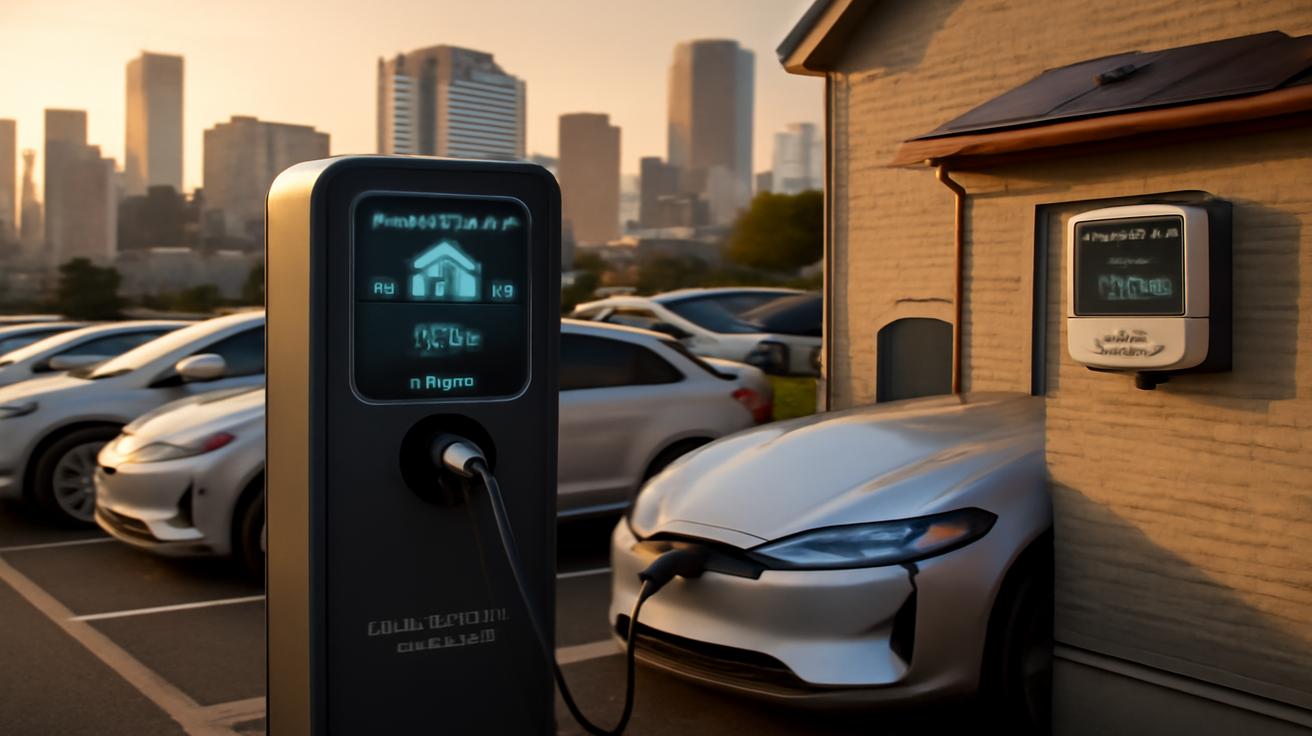
Walk into a newly built residential complex on the outskirts of a Chinese coastal city, and you might see the next generation of chargers lined neatly along the parking bays. They look familiar enough—sleek, compact, with bright status lights—but inside, they’re far more capable. With the right software and permissions, they can send electricity from your car’s battery into your apartment during a blackout, or back to the grid when the utility company needs extra supply.
Here’s the rhythm that could underpin an entire power system:
- Overnight, when demand is low and renewable power—especially wind—can be plentiful, EVs charge at cheaper rates.
- In the middle of the day, when office buildings are buzzing and the grid feels the strain, some vehicles discharge a slice of their stored energy back into the system.
- Owners are compensated automatically; the stresses on power plants and transmission lines are reduced; fewer backup fossil fuel plants need to fire up in a rush.
Instead of building more “just in case” power plants, China can use millions of cars as a flexible buffer between supply and demand.
The Numbers Behind the Vision
Think of it like this: a typical modern electric car might carry a 60–80 kWh battery. Not all of that should ever be used for the grid—drivers need to drive, after all—but even a fraction adds up quickly.
Here is a simplified illustration:
| Item | Example Value | What It Means |
|---|---|---|
| Average EV battery size | 70 kWh | Enough to power a typical apartment for several days. |
| Number of EVs participating | 1,000,000 | A small slice of the national fleet. |
| Share of battery used for grid | 20% | Leaving most capacity for driving. |
| Total energy available | 14 GWh | A powerful “virtual battery” for peak hours. |
Turn that million into several million, and the scale of potential grid support becomes hard to ignore.
Homes That Sip Power From Cars
Now zoom in from the grid to a single apartment. A young designer in Guangzhou rides home in her compact electric hatchback as dusk settles between the high-rises. When she parks, her building’s smart system already knows roughly how much charge her car has and what her usual driving habits look like. An app on her phone confirms it: she drove less than usual today. She sets a limit: “Use up to 15% of my battery for the building if needed, but make sure I have enough to commute tomorrow.”
Later that evening, a storm lashes the city. Somewhere upstream, a transmission line goes down. Power flickers in the neighborhood—a hint of chaos. Only this time, the chaos is cushioned. The building’s management system automatically shifts into backup mode. Instead of every apartment staring into the dark, the building quietly starts drawing power from EVs in the garage. Lights stay on, elevators keep working at reduced capacity, the internet hums. The storm is still violent, but the building has become its own little island of resilience.
This is V2H in action: vehicle-to-home power. It doesn’t just promise comfort during outages—it promises a more resilient everyday life. For families, the electric car in the garage is no longer just transport; it’s a safety net.
In some pilot projects across China, this is transitioning from thought experiment to early reality. Backup diesel generators in residential compounds and commercial centers—noisy, smoky, expensive—could eventually be replaced by silent cars and vans that were already there, parked and waiting.
The Invisible Choreography of a Smart Grid
Of course, none of this works if each car is an island. The real magic is in coordination—millions of small decisions, orchestrated by software that never sleeps. That’s where China’s experiments in smart grids and digital infrastructure come in.
Utilities can’t phone every driver and ask, “Can we borrow a bit of your battery tonight?” Instead, algorithms learn patterns. They study how people drive, charge, and commute. They track when wind farms in the north and west are spinning hardest, and when solar fields in the south are flooding the system with daytime power. They notice how city centers pulse with demand at 9 AM and 6 PM, and how residential districts brighten in the evening.
On top of this, price signals and incentives nudge behavior. A driver might open their EV app and see something like: “Tonight, if you allow the grid to use up to 10 kWh from your car between 7 PM and 9 PM, you can earn a small payment or receive free charging tomorrow morning.” For some, that’s an easy yes—especially if their usual commute is short.
This isn’t just about energy; it’s about choreography. Thousands of vehicles in one district could help smooth out a local evening peak. In another, EVs might soak up surplus power at noon when solar production is strong. From the outside, the city looks the same: streets, lights, people, motion. But underneath, a quiet digital ballet is keeping everything in balance.
From Pollution to Participation
There’s something almost poetic in the shift. For decades, cars were seen as a kind of necessary harm: they clogged roads, fouled the air, demanded endless rivers of fuel. Now, in China’s emerging model, a car is not only cleaner to drive; it becomes a citizen of the grid—participating, contributing, stabilizing.
That’s a profound change in how we think about our machines. A vehicle isn’t just an energy consumer anymore. It can be an energy asset.
The Challenges Hidden Under the Hood
None of this, of course, is simple. The story of using EVs to power homes and cities is full of grit as well as glory.
Battery wear is one concern. Every charge and discharge cycle gradually ages a battery. If your car is being tapped regularly to support the grid, is its lifetime shrinking? Engineers and policymakers are wrestling with this. Some argue that the added wear is modest if managed correctly. Others say the economics will need to compensate owners clearly and generously.
Then there’s trust. Are drivers comfortable handing partial control of their car battery to an invisible system? What happens if someone wakes early for an unexpected trip and finds their car less charged than they wanted? Smart contracts and strict minimum-charge settings can help, but cultural comfort takes time.
Standards are another barrier. Different automakers, different chargers, different software layers—each one a potential point of friction. For EVs to flow energy as easily as they now flow through traffic, China will need a fairly unified language for cars and grids to talk to each other.
And there’s the question of equity: Will the benefits of this system—lower power costs, better reliability, new income streams—reach across all neighborhoods, or just the affluent compounds with underground garages and sleek chargers?
A System Learning in Real Time
China’s advantage lies in its willingness to test ideas at scale. Pilot neighborhoods where EVs routinely support buildings. Industrial parks where electric trucks back up factory power. City districts where utilities and carmakers share data in near real time.
Each experiment feeds lessons into the next. How often can you safely discharge a typical EV battery without scaring off drivers? At what price point do people gladly opt in? How quickly can software ramp thousands of cars up or down when the grid hiccups?
Bit by bit, a picture emerges—not of a perfectly tidy, flawless transition, but of a living system that’s learning how to use mobility as a backbone for energy security.
China’s Electric Cars as a Glimpse of Our Future
Stand at the edge of a Chinese city highway at dusk and let your eyes blur a little. The stream of vehicles is constant—white LEDs, red taillights, the neon reflection off polished metal. It’s not obvious, from that vantage point, that you’re looking at anything more than traffic.
But behind those windshields and dashboards are batteries powerful enough to light entire apartment blocks. When they plug in at night, they’re not simply refueling. Increasingly, they’re joining something bigger: a nationwide conversation between cars, wires, substations, solar fields, wind farms, and countless homes like yours.
On still winter nights, when wind turbines stand motionless, fleets of charged cars could step in, shaving peaks and filling gaps. On summer afternoons, when solar panels blaze but offices still demand more, EVs can smooth the spikes. During storms or outages, they can hold neighborhoods together when the grid wavers.
China didn’t set out merely to put electric cars on every road. In this next chapter, it’s trying to weave those cars into the heart of its energy system—turning drivers into quiet grid partners and parking lots into reservoirs of resilience.
If it works, the streets of Beijing, Chengdu, or Hangzhou at rush hour will still look like ordinary traffic jams to the naked eye. But hidden inside every parked sedan, every delivery van, every rideshare car, there will be a little piece of the power system, waiting to help light someone’s home.
FAQ
Can an electric car really power a home?
Yes. With the right bidirectional charger (V2H technology), an EV can send electricity from its battery into a house or apartment. In practice, this can keep essential loads—lights, fridge, internet, some outlets—running for many hours or even days, depending on battery size and usage.
Will using my car to power the grid damage the battery?
Frequent deep discharges can reduce battery life, but controlled, partial discharges—like using 10–20% of capacity—have a much smaller impact. China’s pilots are focused on managing this carefully and compensating owners so the financial and practical benefits outweigh any added wear.
How do car owners get paid for supplying power back to the grid?
In test projects, owners usually opt in through an app or contract. When their car provides energy or grid services (like helping balance demand), they receive credits, discounts on charging, or direct payments from utilities or aggregators.
Do all EVs support vehicle-to-grid (V2G) technology?
No. Only EVs designed with bidirectional charging hardware and compatible software can send power back to the grid or home. However, more new models in China and elsewhere are being built with this capability in mind.
Why is China so far ahead on this idea?
China has combined aggressive EV adoption, strong government support, fast infrastructure build-out, and large-scale grid modernization. That mix creates an ideal environment to experiment with turning millions of EVs into a flexible energy resource for homes and cities.






Leave a Comment