
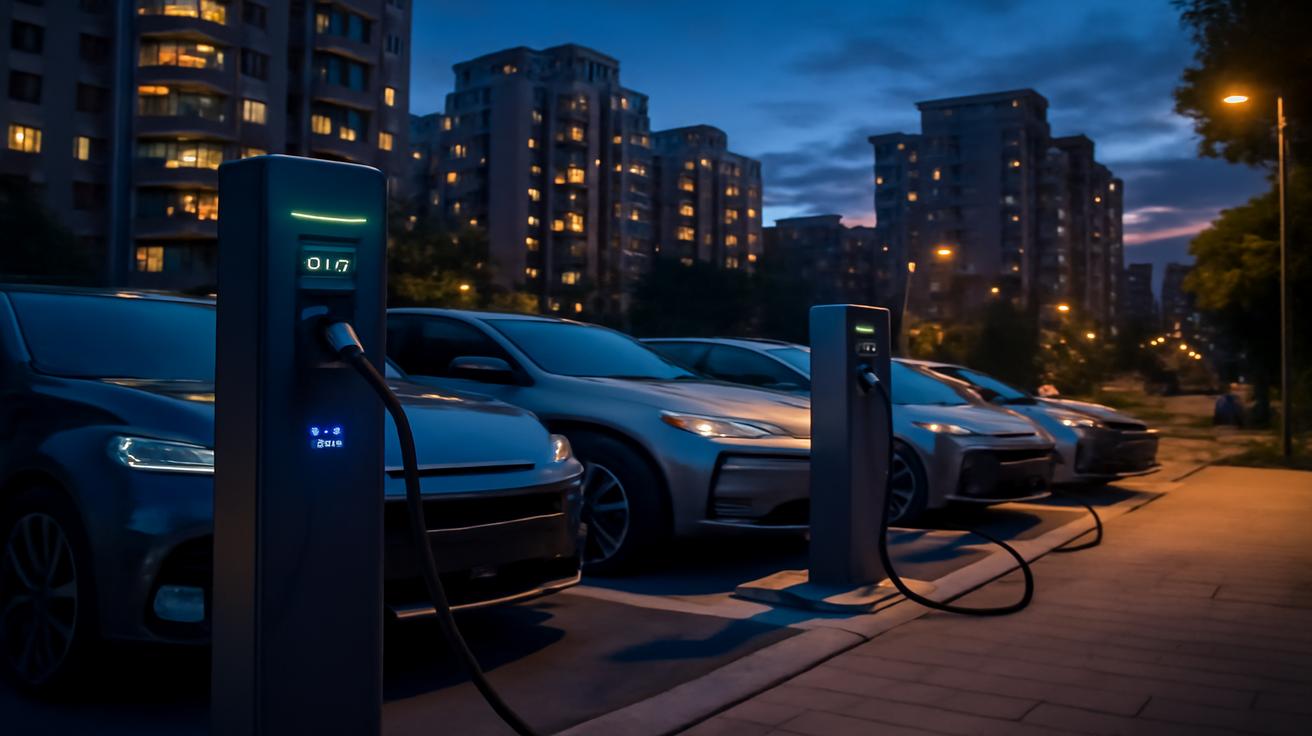
The first thing you notice isn’t the silence. It’s the hum—low, velvety, almost alive—rising from an underground parking garage in a southern Chinese city just after sunset. Cars, hundreds of them, sit in neat rows like sleeping animals. But they are not sleeping. Tiny green icons pulse on dashboards. Charging cables drape from polished EVs to wall units that blink in soft, synchronized rhythm. Somewhere above, in the apartment towers, families are cooking dinner, kettles are boiling, air conditioners are pushing back the humid evening. And down here, beneath it all, the cars are not just drawing power. They are getting ready to give it back.
The Night the Cars Became the Grid
On an ordinary Wednesday in Shenzhen, a summer storm muscles in off the South China Sea. Lightning spiderwebs across the sky, and for a few seconds the city feels like it’s been placed inside a giant flashbulb. The power demand spikes the way it always does when the heat clings and people slam their AC units down to “arctic.” In older times, the city’s grid might have groaned at the strain. Tonight, though, something unusual happens.
In a control room packed with screens and quiet, watchful engineers, a graph on the central display shows demand curving upward. Almost on cue, another line begins to rise to meet it—the electric cars. Not moving, not driving, just sitting in garages and parking lots, connected to bidirectional chargers that can sip energy one way and pour it back the other.
Outside, drivers eating dinner have no idea their parked sedans and SUVs are quietly sending electricity back through thick bundles of cable, stabilizing the local grid. The living room lights don’t flicker. The elevators keep running. The storm passes, and the city barely notices. But on the grid, a quiet revolution has just unfolded: thousands of vehicles acting as one giant, distributed battery.
A Country That Fell in Love with Electric Wheels
A decade ago, this scene would’ve felt like something out of science fiction. Today, in China, it feels like the obvious next step. This is a country that didn’t just “adopt” electric vehicles; it devoured them.
You see it in the street scenes from Guangzhou to Xi’an: compact city EVs slipping through traffic like colorful fish; futuristic sedans gliding past taxi ranks; delivery vans humming along side roads at dawn. There are provinces where the majority of new cars sold are electric or plug-in hybrids. Charging stations bloom beside highways like a new kind of roadside flora—sleek white pillars under minimal canopies, some shaded with solar panels.
China has more electric cars on its roads than any other place on Earth—by a long distance. These vehicles were originally seen as a way to clean up choked city air and loosen the country’s dependence on imported oil. But somewhere along the way, engineers, policymakers, and grid planners began to see them as something else as well: moving, rechargeable batteries that spend most of their lives parked.
Think about it. For 22 or 23 hours of the day, your car doesn’t move. It sits at home, at the office, in a shopping center, silently doing nothing. In a world struggling to store renewable energy from the sun and wind, this idle time starts to look like a colossal waste—and an enticing opportunity.
From Car to Power Plant: The Quiet Rise of V2G
In China, that opportunity has a name whispered often in labs, boardrooms, and government offices: vehicle-to-grid, or V2G. The idea is simple enough: if an electric car can accept charge, why can’t it send charge back, too? But behind that simplicity sits a labyrinth of technology, standards, market rules, and human behavior.
Walk into a modern EV charging lot on the edge of a Chinese city late at night, and the future feels almost tangible. Sleek fast chargers display not only how many kilowatt-hours they’ve delivered today, but how many they’ve sent back. Some display real-time prices, tiny green arrows pointing either “Grid → Car” or “Car → Grid” depending on what’s needed.
Engineers like to explain it this way: the power grid is a living thing. It must constantly balance supply and demand. Solar farms on the outskirts of Lanzhou pour electricity into the system when the sun is high, but fade when clouds roll in. Wind turbines in Inner Mongolia spin like mad on some nights and stand nearly still on others. Traditionally, power companies relied on big coal and gas plants to fill the gaps in this dance. Now, imagine supplementing those with millions of batteries on wheels—batteries that are already paid for, already distributed across every neighborhood, and already connected to people’s daily routines.
To make this real, China has been quietly building a technical scaffolding: smart meters that speak the same language as car chargers, national standards for how EVs talk to the grid, and pilot projects in cities where people sign up to let their cars step into the role of mini power stations. Many drivers are lured by money: charge when electricity is cheap, sell it back when it’s expensive, watch the monthly bill shrink.
The Daily Rhythm of a Battery on Wheels
By midmorning in a Shanghai office district, electric sedans and crossovers have all settled into their parking spots, cables attached. Above, the sky is pale and bright. Solar panels on nearby rooftops stir with photons, and the grid starts to swell with clean midday power. The system does something clever. Instead of wasting this surplus or throttling back solar plants, it feeds it into those stationary cars, gently filling their packs.
Inside the building, workers sit in meetings, their laptops plugged into wall sockets powered partly by the same sun that is also topping off their vehicles. By late afternoon, as people begin to head home and residential demand ramps up, the grid may dip into that surplus again. For some vehicles, a small percentage of their stored energy seeps back out to steady the system.
To a driver, the experience can be almost invisible. You arrive with 45% battery, go up to work, come down at 6 p.m. and your dashboard shows 80%. Somewhere in that time, you may have helped the grid shave off a surge in demand or cushion a sudden shortfall in renewable generation. Your car has not just been a passenger in the energy system; it’s been a quiet actor.
When Cars Power Homes: A New Kind of Security
What makes this story especially vivid isn’t just the citywide systems and aggregate statistics; it’s the small, personal moments when the line between vehicle and home blurs.
In a suburb on the outskirts of Beijing, a family sits in a townhouse painted a soft, dusty beige. They have a compact Chinese EV in the driveway—a boxy, cheerful vehicle that looks like it was sketched with thick crayons. One winter evening, a transmission line outside the neighborhood trips. Streetlights go dark, and apartment windows blink out like extinguished candles.
Inside the townhouse, the living room dims for a moment, then steadies. In the hallway, a small black box—an inverter connected to a home charging unit—switches over seamlessly. Now, instead of the grid feeding the car, the car is powering the home. The child in the living room barely looks up from his homework. The parents light a single candle—not for necessity, but for atmosphere.
For hours, the little EV functions as a quiet backup generator. The fridge hums on. The heater ticks. A pot boils on an induction stove, dinner goes on as planned, and the family sends a quick message to grandparents: “We’re okay. House is on car power.” When the grid returns, the car automatically begins recharging, ready to do it again.
Scenes like this—once rare demo-day spectacles—are becoming more common as vehicle-to-home and vehicle-to-building systems spread. Chinese automakers have begun marketing certain models with V2H features front and center: power your camping trip, keep your home lit, run a food stall from your trunk. The pitch is less about saving the planet and more about freedom and resilience. The fact that it also helps make renewable energy more practical is a powerful side effect.
A Glimpse into the Numbers
The scale of this is easiest to feel through rough comparison, imagined for a single city. The numbers here are illustrative, but they sketch a world that’s fast becoming real in parts of China:
| Scenario | Assumption | Impact |
|---|---|---|
| Number of EVs in one large city | 2 million vehicles | Massive distributed battery network |
| Average usable battery capacity per EV | 50 kWh | Total potential: 100 GWh |
| Share of capacity available to grid at a time | 20% (drivers keep most for trips) | Usable for grid: 20 GWh |
| Equivalent homes that could be powered for one day | Average 10 kWh per home per day | Roughly 2 million homes for 1 day |
Numbers like those are why Chinese planners talk about EVs not just as a transport revolution, but as a backbone for a different kind of grid. It’s not about disconnecting from power stations overnight. It’s about giving the whole system more flexibility, more shock absorbers, more ways to weave clean but unpredictable energy sources into everyday life.
Drivers, Data, and the Dance of Trust
Of course, cars don’t feed power back into the grid just because someone in a control room decides they should. There’s a more intimate layer at work here: the small screen in the driver’s hand, the app that mediates between personal needs and public demand.
On a Shanghai metro platform, a woman glances at her phone while waiting for her train. Her EV app has just pinged: “Peak pricing window approaching. Allow your vehicle to discharge 10% to support the grid and earn rewards?” There’s a slider bar, a simple visualization showing how much driving range she’ll have left afterward, along with the credits she’ll earn.
Maybe she has a long highway trip tomorrow and taps “decline.” Maybe her next few days are light, and she slides the bar a bit to the right and hits “accept.” Multiply that decision by thousands, then millions, and you can almost see the invisible hands of the grid and its drivers weaving together in real time.
That dance is built on trust. Drivers need to know they won’t wake up to a half-empty battery when they were promised 80%. They need clear, simple assurances: “We will never use more than this much; we will always ensure at least this much remains.” In return, the grid gets what it craves most: predictable, reliable resources that can be tapped when things get rough.
Chinese companies are experimenting with different forms of value for this trust—discounted electricity, cash payouts, free parking time, loyalty points that translate into maintenance discounts. The incentives may evolve, but the underlying relationship remains the same: your car becomes a tiny utility, and you become, in a way, a micro–power company.
The Challenges Beneath the Shine
Listen closely in those same control rooms and research centers, and you’ll hear a more cautious tone as well. How fast can the grid really lean on these vehicles without wearing out their batteries prematurely? What happens in a winter cold snap when everyone wants both range and heating? How do you set prices so the system is fair, not just to affluent EV owners but also to people who can’t yet afford one?
There are technical puzzles too. Bidirectional charging hardware costs more than a regular charger. Charging standards, while more unified in China than in many places, still need constant refinement. Cybersecurity experts fret over the idea of thousands of grid-connected devices becoming potential points of vulnerability. Regulators walk a tightrope, keen to encourage innovation without letting speculation run wild.
Yet the momentum is unmistakable. Each pilot project that succeeds makes the next one easier. Each neighborhood that rides out a power blip thanks to cars in driveways gives regulators one more real-world data point, one more story they can point to in internal meetings.
A Different Picture of the Future Grid
If you step back from the details and watch the whole story unfold, China’s experiment with turning electric cars into power for homes hints at a different mental image of what a “grid” is.
Not a one-way highway where power flows from faraway plants to passive consumers, but a living mesh where everything with a battery is both user and helper. Your rooftop solar panels feed your neighbor’s kettle. Their car stabilizes the local substation. A cluster of vehicles in a company lot prevents a blackout three districts away. A row of buses parked for the night helps absorb a surge of overnight wind power from turbines hundreds of kilometers distant.
In this world, an electric car is no longer just a cleaner version of a gasoline vehicle. It’s a citizen of the energy system. And China, with its crowded cities, its assertive industrial policy, and its global lead in both EV manufacturing and grid-scale engineering, has stepped into the role of unlikely pioneer.
Back in that first parking garage, the one humming softly under an ordinary apartment complex, it’s late now. The storm is long gone. Up above, people are rinsing dishes, queuing up dramas on their TVs, drawing curtains against the night. Down below, the cars rest. Some are almost full, some half. Overnight, a few may give back a bit more when wind farms along the coast suddenly overproduce and need a friendly place to stash the excess.
In the morning, their owners will descend the concrete ramps, unplug the thick cables, and drive away, oblivious to the delicate ballet their vehicles performed in the dark hours. They will merge into traffic, another day in a nation of quiet revolutions. And the grid, a little more flexible, a little more resilient, will hum on, supported by a fleet of batteries on wheels that, one night at a time, are teaching a vast country how to live differently with electricity.
FAQ
Can an electric car really power a whole home?
Yes, in many cases. Modern EVs often have batteries between 40–100 kWh. A typical home might use around 10 kWh per day, depending on appliances and climate. With the right vehicle-to-home (V2H) setup, a fully charged car can power essential household loads for one to several days.
Does using my car to supply power damage the battery?
Battery wear is affected by how deeply and how often you charge and discharge it. V2G and V2H programs are usually designed to cycle only a modest portion of the battery (for example 10–20%) to limit extra wear. Smart systems can manage this carefully so the additional impact is relatively small compared to normal driving use.
Will I still have enough range if my car sends power back to the grid?
Programs in China and elsewhere typically let drivers set a minimum state of charge—say 60% or 70%—below which the system won’t discharge. Apps show expected remaining range before you agree, so you stay in control and can always ensure enough energy for your daily trips.
What kind of equipment is needed to make this work?
Beyond the EV itself, you need a bidirectional charger and compatible software or an energy management system. For powering a home, an inverter and proper safety switches are also required so the car and the grid or home wiring interact safely and automatically.
Is this only happening in China?
China is pushing it at very large scale and integrating it closely with its national grid and EV industry, which makes its story especially striking. But similar vehicle-to-grid and vehicle-to-home projects are underway in other regions as well. China’s size and speed simply make it one of the clearest windows into what this future could look like.








Leave a Comment