
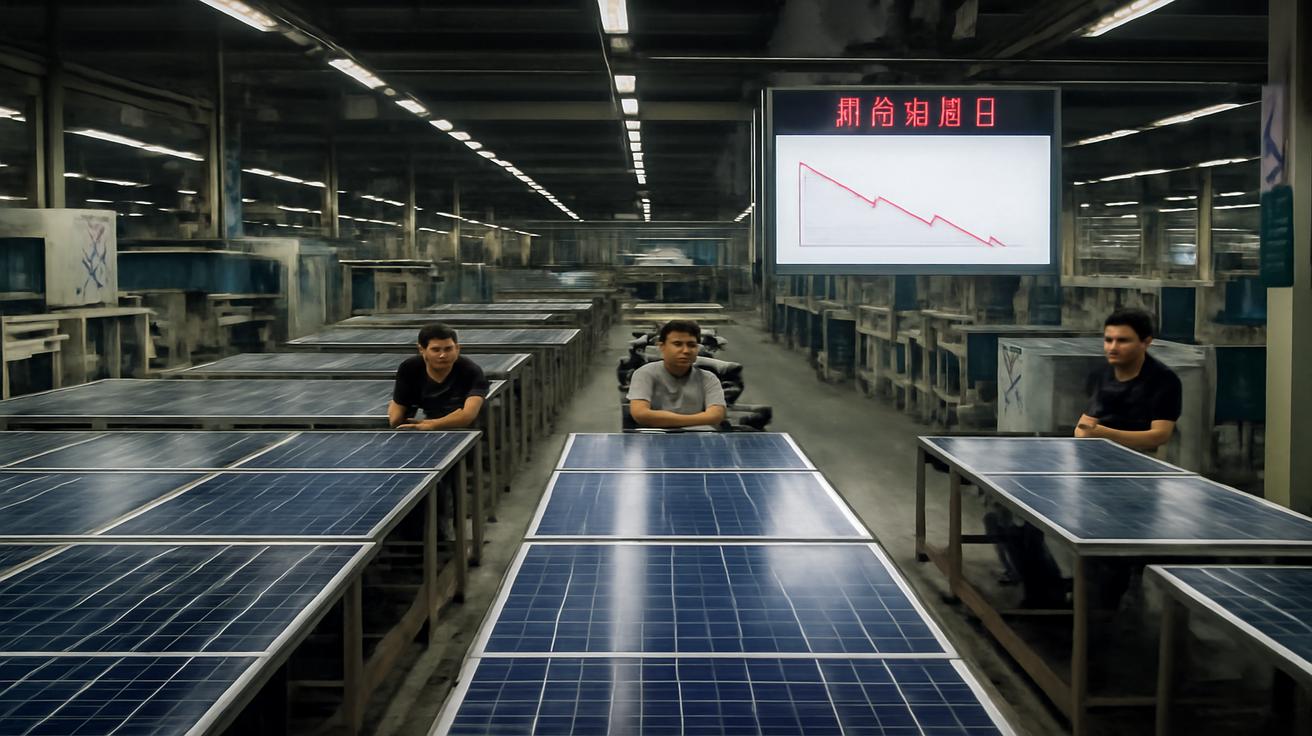
The morning sun over eastern China does not feel like an economic problem. It rises soft and pale through a moist haze, turning factory roofs into glowing rectangles. From the air, they look like lakes of glass and metal—acres and acres of solar panels laid out with geometric precision, following the sky like a fleet of silent, patient ships. Somewhere down in those shimmering fields of silicon, workers in blue uniforms are stepping into echoing factory halls, past posters about green dreams, national pride, and the promise of cheap, clean power for the world.
The Country That Tried to Harness the Sun
For years, China’s solar story sounded almost mythic—an industrial epic told in numbers so big they felt unreal. Vast factories rising out of muddy fields in a matter of months. Production lines humming around the clock. Ship after ship leaving ports loaded down with the future: gleaming rectangles destined for rooftops in Europe, deserts in the Middle East, and open plains across North America.
It was as if a single country had decided not just to join the solar revolution, but to build the entire thing—panels, cells, wafers, glass, the heavy metal frames, even the machines that make the machines. Policy planners in Beijing encouraged it. Local officials showered companies with cheap land, loans, and tax breaks. Entrepreneurs saw a once-in-a-century chance and raced to build ever bigger factories, chasing economies of scale with near-religious zeal.
This industrial surge worked. Solar panel prices plummeted. What once was a niche technology—something reserved for eco-pioneers and wealthy early adopters—suddenly became practical, accessible, normal. A farmer in Pakistan, a homeowner in Brazil, a school in Kenya—solar moved from dream to option, to no-brainer.
But there’s a shadow that falls behind every bright story, and in China’s case, it crept in the moment supply outpaced demand by more than just a little. Factories kept expanding as if the world’s hunger for panels could never stop. Production lines were upgraded, duplicated, cloned in new industrial parks. And then, almost quietly, the numbers broke.
The Price of Flooding the World With Solar
Walk into a Chinese solar manufacturing hub today and the first thing you might notice is how quiet some sections have become. Conveyors that once rattled with the constant shuffle of glass and silicon now stand still. Stacks of unshipped panels wait under plastic covers, like books no one is around to read.
China now accounts for the vast majority of global manufacturing capacity in key solar components—often more than 80% in areas like wafers and cells. For a while, that dominance looked like a triumph of planning and scale. But when almost every major producer in the world is inside your borders, market cycles hit differently. There is no “somewhere else” for the excess to go.
Global demand for solar is still growing, and fast. Yet the supply pouring out of Chinese factories has grown even faster, washing over the market like a spring flood. The result: prices crashed. In a single year, average module prices fell by more than a quarter in some regions. Good for buyers, incredible for project developers, amazing for climate goals—but brutal for the people actually making the panels.
Profits in many Chinese solar companies have shrunk to razor-thin margins or vanished entirely. Some producers sell panels at or below cost simply to keep factories running, hoping that shutting down would be worse. When your brand-new, billion-dollar facility is suddenly churning out unprofitable products, “business strategy” becomes a conversation about survival.
The Numbers Behind the Glare
If you zoom out and compress this complex crisis into a simple snapshot, it looks something like this:
| Aspect | Recent Reality |
|---|---|
| China’s share of global solar manufacturing | Dominant in most stages, often above 80% |
| Panel prices | Fallen dramatically, in some cases over 25% in a year |
| Profit margins | Shrinking or turning negative for many producers |
| Factory utilization | Many plants running below capacity or idled |
| Government response | Considering or encouraging closures, consolidation, and restructuring |
In the language of policy papers, this is called “overcapacity.” In human terms, it’s something more visceral: uncertainty, layoffs, the hollow sound of a factory floor after the machines are powered down.
Factories Built for Forever That May Not See Next Year
China’s solar surge wasn’t only numbers on export charts; it was neighborhoods growing around new jobs, dormitories filling with young workers from distant provinces, local restaurants opening to feed the night shift. When a solar factory breaks ground in a city, the community around it reshapes itself—buses reroute, schools expand, small shops spring up. The factory isn’t just a building; it’s a pulse.
Now, some of those pulses are weakening. Rumors travel quickly along production lines: this plant might close one wing, that one might rotate shutdown weeks, another might merge with a bigger player. Workers worry about being sent home with a fraction of their usual pay, or about returning to older, dirtier industries they thought they had left behind.
From Beijing’s perspective, the problem isn’t that China went big on solar. The deeper concern is that it went too big, too fast, and too often in the same direction: more capacity, more lines, more panels, regardless of how many the world could realistically absorb each year. Left alone, this kind of glut can hollow out even the strongest companies. Firms slash prices to survive, drag each other down, and starve themselves of the money needed for the next wave of innovation.
So now, after years of encouraging growth, the Chinese government is signaling something close to the opposite: it may be time to slow down, to shut some doors so others can stay open. Officials are talking about “orderly development,” “avoiding blind expansion,” and “preventing vicious competition.” Underneath the bland language is a hard reality—some factories will close so that others can live.
Closing Doors to Save the House
This turn toward consolidation isn’t purely about economics; it’s also about global politics. Trading partners from Europe to the United States have grown uneasy with just how dominant China has become in solar manufacturing. They worry about dependence on a single country for critical clean energy infrastructure. They worry about their own struggling domestic plants. They worry about accusations of dumping—selling goods abroad below cost.
As these concerns sharpen into tariffs, investigations, and new industrial policies, China faces a more complicated landscape. It can no longer assume that the world will simply absorb whatever its factories can produce. Closing some plants, merging others, and focusing on fewer, more advanced facilities becomes a way not just to stabilize prices at home, but to send a message abroad: that this isn’t a runaway, out-of-control expansion, but an industry trying to mature, to get smarter, leaner, and perhaps a little less threatening.
The Strange Paradox of Cheap, Painful Success
There’s a quiet irony at the heart of this story. By almost any environmental measure, the collapse in solar prices has been a blessing. Every dollar shaved off the cost of a panel makes it easier to build more solar farms, electrify more remote villages, tilt more power grids away from coal, oil, and gas. Cheaper panels mean more installations, more carbon avoided, more smog-free days in growing cities, more resilience on a warming planet.
And yet, the people who made that possible—the workers in those echoing Chinese factories, the engineers who squeezed yet another percent of efficiency from a thin silver line on a cell—are now among those paying the price for that success. When panels become too cheap, too quickly, the system that created them starts eating itself.
The paradox is harsh: the world needs more solar, but the producers are suffering because they built too much, too fast. Climate urgency demands acceleration, but economic sustainability requires restraint. In between those two forces are human lives: the mid-level manager trying to reassure her team while secretly updating her résumé, the technician who trained on highly specialized equipment that might now stand idle, the local businesses wondering how long they can survive on reduced lunch orders.
Innovation at the Edge of a Cliff
Overcapacity doesn’t stop innovation—it can even spur it. Under intense price pressure, companies race to find cheaper materials, more efficient designs, smarter manufacturing processes. Some of the most cutting-edge solar tech in the world is still coming out of Chinese labs and assembly lines, even as the industry trembles.
Yet innovation needs breathing room, and that’s hard to find when losses pile up. The risk is that the industry freezes at “good enough” just when the world needs “even better.” Next-generation solar—more efficient, more durable, lighter, able to be printed on flexible surfaces, integrated into windows and walls—depends on people and companies that can afford to take risks. If they are busy just trying not to drown in a sea of underpriced panels, the future slows down.
What Happens When the World’s Solar Engine Slows?
Imagine, for a moment, a world where some of those factories do indeed go dark. Not just for a season, but for good. The lights turned off, the machines mothballed or sold, the dust beginning to settle on silent production lines. At first, nothing obvious changes for a homeowner in Spain or a utility planner in India. Panels already ordered will still be delivered. Projects already financed will still be built.
But over time, as capacity shrinks, the frantic downward pressure on prices eases. Modules may stop getting cheaper every quarter. Some may even tick slightly upward in cost. The era of wildly cheap solar might give way to one of merely affordable solar. For the planet, that’s still a win—solar would remain one of the cheapest sources of new electricity in many places. But the dizzying, unsustainable discounts might fade.
For companies in other countries, though, a pause in China’s expansion could feel like a long-awaited opening. European and American and Indian manufacturers—who’ve spent years trying to survive in the shadow of Chinese giants—might suddenly see room to breathe. Governments outside China, increasingly keen to build their own green industries, would welcome it.
China, in turn, would be trying to thread a needle: protect its domestic industry from self-inflicted damage while retaining enough scale and strength to remain the world’s solar engine. It’s a delicate balancing act—slow down too little, and the industry continues to burn itself out. Slow down too much, and Beijing risks losing the strategic advantage it spent decades and billions of dollars building.
A Global Industry With One Weather System
Solar, like the climate it aims to protect, is a global system now. When a policy shifts in Beijing, you can feel the ripple in Berlin, in Sacramento, in Johannesburg. When a factory idles in one Chinese province, an installer half a world away might find that next season’s price list contains a surprise. It is as if the world entrusted one country with building much of the hardware for its energy transition—and is now watching nervously as that country adjusts its grip.
There’s no easy villain in this story, and no pure hero either. China’s solar boom accelerated the clean energy transition in a way few thought possible so quickly. At the same time, its relentless expansion helped create an instability that now threatens the workers and companies at the heart of that transition. Other nations talk about green industrial strategy; China lived it, aggressively and at massive scale, and is now wrestling with the consequences.
Between Sunlight and Shadow
If you return, in your mind, to that misty morning over the solar roofs of eastern China, you can picture a worker stepping outside on a short break. The air smells faintly of metal, dust, maybe the kitchen of a nearby canteen getting ready for the lunch rush. Above, row upon row of panels soak in the light that slips through the thin cloud, transforming photons into electrons in a quiet, constant alchemy.
Some of those panels were built in factories that may not survive the next few years. Some came off lines that were spinning at full speed even as their owners quietly wondered how long they could afford to keep them running. Others are products of plants that will endure—bigger, more automated, better capitalized, favored by policy and markets.
In that single rooftop, you can see the whole contradiction: the most hopeful technology of our age, made in a way that is at once visionary and bruising; an industry that has succeeded so ferociously it is now forced to shrink to save itself.
We often talk about solar power in abstract terms: megawatts, gigawatts, targets, timelines. But behind those numbers are places and people, bets that paid off and bets that went too far, dreams that cleared the smog and dreams that will end with a locked gate and a handwritten sign. The panels themselves, silent and patient, don’t carry that story on their surfaces. They simply sit, warming in the sun, generating electricity for strangers who will never know the name of the factory where they were born.
And yet, if you listen carefully—to policy debates in Beijing, to murmurs in industrial towns across China, to the shifting strategies of overseas buyers—you can hear an entire global industry trying to recalibrate. The country that flooded the world with cheap solar is now reaching for the brake pedal, hoping to reduce speed without crashing the vehicle. Somewhere in that tension, between sunlight and shadow, lies the next chapter of how humanity powers itself.
FAQs
Why did China build so many solar panel factories in the first place?
China saw solar as a strategic industry—good for energy security, economic growth, and global influence. Generous policies, cheap financing, and supportive local governments encouraged companies to build large-scale factories quickly. The idea was to dominate the global supply chain and drive costs down through sheer scale.
Isn’t cheaper solar a good thing for the world?
Yes, lower solar prices have made clean energy more accessible and helped accelerate the shift away from fossil fuels. But when prices fall too fast and too far, manufacturers struggle to survive. That can reduce investment in innovation, lead to factory closures, and create instability that ultimately harms the long-term growth of the industry.
Why is China now talking about closing or consolidating factories?
Because there is more production capacity than the market can absorb profitably. Too many factories are chasing the same orders, which pushes prices below sustainable levels. By encouraging closures or mergers, Chinese authorities hope to stabilize the industry, protect key players, and avoid a widespread wave of bankruptcies.
How does this affect people outside China?
Global buyers have been enjoying very low prices for solar panels thanks to Chinese overcapacity. If factories close and capacity tightens, prices may stop falling or could even rise slightly. However, a more stable industry could be healthier in the long run, and other countries may have more room to develop their own solar manufacturing.
Does this mean the solar transition is in danger?
Not in the sense of reversing course. Solar is already one of the cheapest sources of new electricity in many regions, and global demand remains strong. The risk lies more in how smoothly the industry can adjust: if too many companies fail too quickly, or if trade tensions escalate further, it could slow the pace of deployment or limit innovation in the short to medium term.








Leave a Comment