
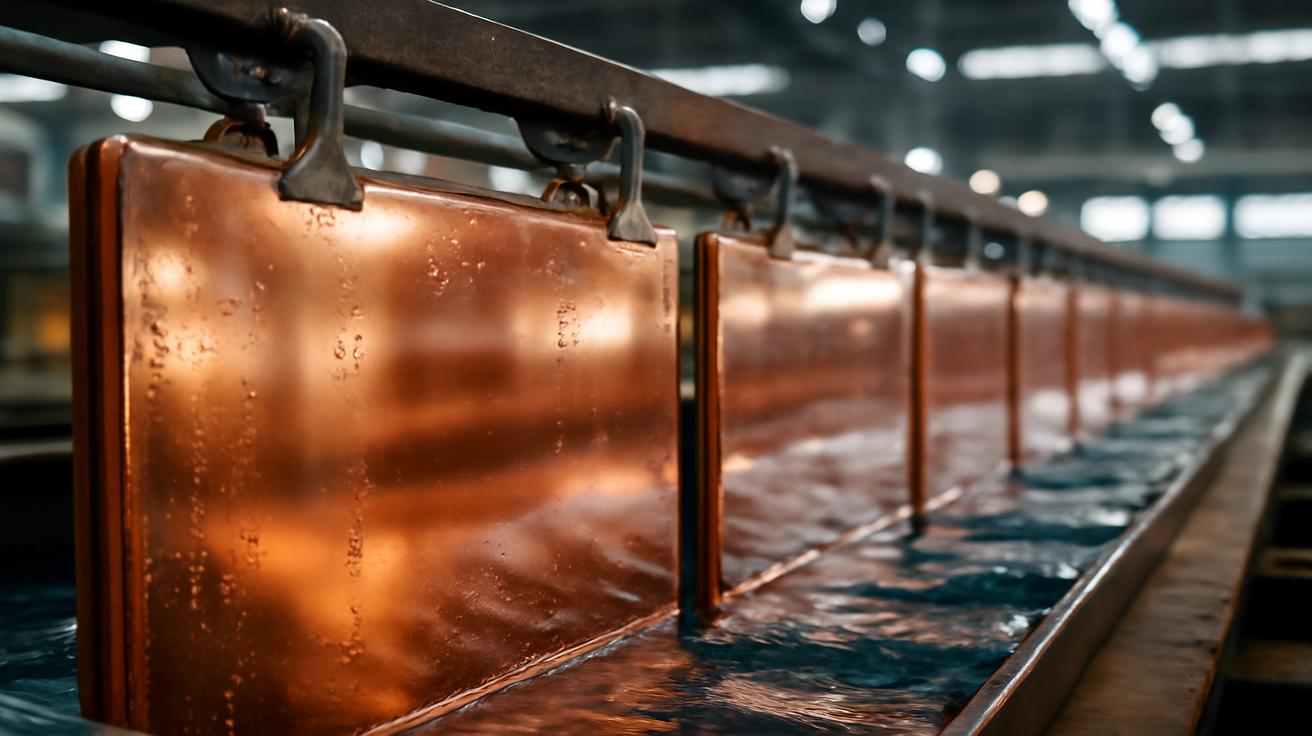
The first time you see a copper refinery, it feels less like a factory and more like a cathedral to modern civilization. Great concrete halls echo with the hum of electricity. Long, shimmering rows of metal plates hang in turquoise pools, quietly transforming from dull, blistered slabs into gleaming sheets of copper so pure it could carry the heartbeat of the internet. The air bites at your nose: sharp, a little metallic, laced with the faint, sour ghost of sulfur. It is not a beautiful place in any obvious way, but it is the kind of beauty that underpins everything else—our phones, our cars, our power lines, even the quiet charge slipping into the battery of an electric scooter outside.
Now imagine that most of the world’s ability to do this—to take raw, dirty copper and turn it into the ultra-pure metal our technologies demand—is concentrated in one country. Not the one with the most mines. Not necessarily the one with the largest copper deposits. But the one that spent decades building smelters, refineries, and chemical plants while much of the rest of the world looked away.
We’ve already lived through this story once, with rare earth elements. Few people paid attention until supply shocks and geopolitical tension made the world realize how dependent it had become on China’s dominance in rare earth mining and processing. But there is a quieter, larger, copper-colored version of that story unfolding now—a story in which China does not just refine a lot of copper. It becomes the beating heart of copper refining for everyone else.
From Rock to Wire: The Hidden Journey of Copper
Before copper glows inside the coils of a motor or carries signals along a circuit board, it lives another, harsher life. It begins as rock—vast volumes of crumbled stone hauled out of open pits in Chile, the Andes dust caking men’s boots and trucks’ axles. Or in the Congo, where red earth stains the hands of workers and rain carves bright scars through tailings piles. Or in the Australian Outback, where heat swallows sound and everything feels very far away.
From there, copper follows an arduous path. The ore is crushed and concentrated. Chemical reactions tease out copper from the waste. Then comes smelting: fiery furnaces that push temperatures above 1,200 degrees Celsius to produce what’s called “blister copper”—about 98–99% pure but still dirty from the perspective of modern electronics. This is not yet the copper that will carry billions of bytes or serve as the nervous system of an electric vehicle.
To become that copper, the metal goes to a refinery, where electrochemistry does its quiet, dazzling work. Giant tanks are filled with acidic electrolytes. On one side, thick, crude slabs of copper (anodes); on the other, thin starter sheets (cathodes). Electric current flows, and over days and weeks, atoms migrate, leaving behind impurities and depositing themselves into shining, high-purity plates.
This step—refining—is where China has, almost unnoticed by the general public, become indispensable. The trucks and ships carrying raw copper concentrates may depart mines in South America or Africa, but a growing share of them have the same destination stamped on their bills of lading: Chinese ports, Chinese smelters, Chinese refineries.
The World Dug the Mines. China Built the Refineries.
If you follow the copper supply chain on a map, a pattern emerges that looks almost like a sleight of hand. Countries like Chile, Peru, the Democratic Republic of Congo, and Australia dominate copper mining. Their landscapes bear the open scars of open-pit mines, and their economies live and die by the commodity cycles of copper prices. But once the ore leaves their borders, much of the value-added work—smelting and refining—is no longer in their hands.
Over the past two to three decades, China made a deliberate choice: if it couldn’t always control the ore in the ground, it would control what happens after the ore leaves it. That meant pouring investment into copper smelting and refining capacity at a scale that, at first, seemed almost excessive.
New smelters rose along China’s coasts and river systems, quietly knitting themselves into industrial clusters: smelters beside chemical plants, refineries beside ports, processing hubs beside battery and electronics factories. The logic was simple but powerful. Copper refining is messy, energy-intensive, and heavily regulated in many places. China’s combination of lower costs, industrial planning, and willingness to handle “dirty” steps of the supply chain made it the natural place for this work to happen.
By the time much of the world realized what was occurring, the numbers told the story with stark clarity. China was no longer just a big player; it was the center of gravity. The world’s mines might be scattered across continents, but more and more of the planet’s clean, ready-to-use copper passed through one set of gates.
| Stage in Copper Chain | Key Regions | China's Role |
|---|---|---|
| Mining (Ore Extraction) | Chile, Peru, DRC, USA, Australia | Relatively minor producer of ore compared with global leaders. |
| Concentrate Production | South America, Africa, Asia-Pacific | Massive importer of concentrates for domestic smelters. |
| Smelting | China, Japan, Korea, Europe | Largest global smelting capacity; anchor for concentrate demand. |
| Refining (High-Purity Copper) | China, some in Europe and Americas | Dominant refiner feeding global wire, cable, and electronics industries. |
In a sense, the planet outsourced not just cheap manufacturing to China, but the alchemy that turns dull rock into the bright metal threads of the modern world. And it did so willingly, because the system seemed to work—until it suddenly mattered who held the chokepoints.
Echoes of Rare Earths: A Familiar Dependency
If this sounds a little like déjà vu, that’s because it is. The rare earth story followed a similar script. For years, rare earths—those obscure elements with names like neodymium, dysprosium, and terbium—were an invisible backbone of modern tech: critical for wind turbines, electric motors, smartphones, and missile systems. Mining was scattered, but processing, once again, became heavily concentrated in China.
When geopolitical tensions spiked and exports were restricted, the world discovered the cost of concentrating so much value-adding capacity in one place. Rare earths were not rare in the earth’s crust; they were rare in usable, refined form. The bottleneck wasn’t the rock. It was the refinery gate.
Copper, of course, is far more abundant and globally traded than rare earths. It has a deep, liquid market and a long, industrial history. No single actor can simply “turn off” copper for the world without also injuring themselves. But the parallels are still striking: a critical material at the center of the energy transition and digital economy, whose refining and processing have become disproportionately clustered in one country.
The risk is not just an abrupt cutoff—an unlikely but often imagined scenario. The risk is subtler: price influence, priority access, preferential supply, and the ability to lean on a structural advantage in negotiations. When your solar panels, EV charging networks, power grids, and data centers all hinge on a metal that increasingly passes through the same refining ecosystem, the map of copper flows begins to look a lot like a map of leverage.
Why Copper Matters More in a Warming, Wired World
Walk down a city street and you’re likely surrounded by copper without seeing it. It runs overhead in power lines, buried in walls, coiled inside transformers, woven into cables under sidewalks and along subway tunnels. It is in air conditioners, heat pumps, routers, chargers, and LED lights. But the places where copper’s importance is rising fastest are the ones reshaping our future: clean energy and electrified transport.
Every megawatt of solar panels or wind turbines needs copper—about two to five times as much, per unit of power, as conventional fossil fuel plants. High-voltage transmission lines that stitch together renewable-heavy power grids are, at their core, long rivers of copper. Electric vehicles are copper gluttons compared to gasoline cars: motors, inverters, battery connections, wiring harnesses—they all sip from the same copper pool.
The green transition is, in many ways, a copper transition. As countries commit to decarbonize, the world’s appetite for copper surges. That appetite doesn’t care whether the ore comes from deserts, jungles, or mountains. But it absolutely cares whether someone can refine that copper cheaply, reliably, and in staggering quantities.
This is where China’s quiet investment spree over the past decades begins to look less like a narrow industrial choice and more like long-term strategic positioning. While others debated climate policy and supply-chain ethics, China laid down the smelters that would turn anyone’s rock into everyone’s copper. It anchored entire ecosystems of fabricators and manufacturers around those smelters: wire and cable makers, coil winders, motor producers, electronics assemblers. The result is not just refining dominance but integration—copper enters as concentrate, leaves as products, and much of the value is captured locally.
Smelters, Smog, and Strategy: Why Others Backed Away
It’s easy to ask, “Why didn’t other countries do the same?” The answer lies in a messy tangle of economics, politics, and air.
Copper smelting and refining are capital-intensive. Plants cost billions and demand steady streams of ore and power. They operate on thin margins, constantly squeezed between volatile commodity prices and environmental constraints. Building new capacity in high-cost, tightly regulated economies can feel like an act of political bravery—and sometimes, political suicide.
Refineries are also dirty, especially if not built with the latest controls. They release sulfur dioxide and other pollutants, contribute to local smog, and often face ferocious opposition from nearby communities. Over time, many countries that once welcomed heavy industry began to shut the door, outsourcing not just smoked stack emissions but entire layers of the value chain. Environmental standards tightened. Investors grew skittish. “Not in my backyard” became “not in my postal code” and eventually “not in my country.”
China, by contrast, leaned in. It accepted the tradeoffs—sometimes with devastating local consequences—to secure industrial capacity. It coupled environmental regulation with expansion rather than retreat, closing some outdated plants while building more efficient, larger ones. It used state support and long-term planning to weather the boom-bust cycles of commodity markets.
The result was a gravitational pull. Copper concentrates flowed to where the smelters were. Electronics and manufacturing set up shop near cheap, refined copper. And over time, a feedback loop emerged: more refining capacity meant more demand for raw material; more demand justified more capacity. Other regions, watching costs and regulatory hurdles mount, found themselves drifting further from the center of the copper universe.
Can the World Rebalance Copper’s Center of Gravity?
Once a supply chain hardens into place, it is difficult to reshape. You can’t just flip a switch and conjure refineries out of thin air. They take years to plan, finance, permit, and build. They require technical know-how, stable policies, and patient capital—not things the world is overflowing with at the moment.
Yet the same anxieties that flared over rare earths are now pushing governments and companies to look hard at copper. The question isn’t whether China will remain a dominant refiner—it almost certainly will—but whether others can build enough parallel capacity to avoid dangerous overdependence.
Some countries are already moving, often nudged by a mix of climate policy, industrial strategy, and national security concerns. Copper producers are exploring more domestic smelting and refining. Alliances are being discussed, incentives drafted, feasibility studies commissioned. In theory, decarbonization provides a narrative and economic case: “green” refineries powered by renewables, with lower emissions and greater transparency, becoming a selling point to manufacturers worried about their own climate footprints.
But intentions run into reality. Communities still worry about pollution. Energy prices in many regions remain high. Investors, burned by previous commodity cycles, approach with caution. Meanwhile, China isn’t standing still. It continues to upgrade and expand, moving up the technological ladder toward cleaner, more efficient plants even as others are still debating whether to build at all.
That tension—between a world seeking resilience and a system that has already centralized—is where copper’s next chapter will unfold. It’s unlikely that we’ll see a sudden fracture. Far more likely is a slow, uneven attempt at diversification, haunted by the knowledge that for years to come, the quickest route from ore to ultra-pure copper will still pass through Chinese ports.
Living in a World of Copper Chokepoints
Stand again inside that refinery hall. Listen to the low electric thrum, the drip and hiss of liquids moving through pipes, the distant clang of metal against metal. Every plate of newly purified copper that workers hoist from the tanks is a quiet reminder: this is where the abstract language of “supply chains” and “strategic materials” becomes very tangible.
The smartphones in our pockets, the fast chargers in parking lots, the offshore wind farms beyond the horizon, the buried cables that make a video call feel instantaneous—all of them depend on this kind of place. When dominance in such a crucial step of the process tilts heavily toward one country, the world feels it, even if it doesn’t yet have the vocabulary to describe that unease.
China does not just dominate rare earths. It has, slowly and strategically, become the indispensable factory floor for copper refining as well—turning other nations’ ore into everyone’s infrastructure. That reality doesn’t lend itself to easy villains or simple solutions. It’s the product of decades of choices: who built and who outsourced, who accepted smog for steel and copper, who prioritized short-term cleanliness over long-term control.
As the energy transition accelerates and demand for copper swells, we will spend a lot of time talking about new mines, recycling, and circular economies. But the real leverage may sit in less romantic places: in chemical tanks and casting lines, in wires and busbars, in the industrial guts of refineries that most people will never see.
Somewhere today, a ship laden with copper concentrate is slipping into a Chinese harbor at dawn. Cranes will arc against a hazy sky. Dust will rise as ore is unloaded. Days or weeks from now, part of that cargo will quietly reappear as bright copper wire inside a motor, maybe thousands of miles away. The journey from rock to wire, from mountain to microchip, now runs more than ever through one country’s refineries.
Whether that makes us uneasy or simply grateful that the system still works depends on where we stand—and how clearly we’re willing to see the copper threads tying the world together.
Frequently Asked Questions
Why is copper refining so important compared to mining?
Mining produces copper ore and concentrates, but these are not directly useful for most technologies. Refining turns copper into high-purity metal suitable for electrical wiring, electronics, motors, and power infrastructure. Control over refining means influence over the form of copper that industry actually needs.
Does China control most of the world’s copper mines?
No. Major copper mines are located in countries like Chile, Peru, the Democratic Republic of Congo, the United States, and Australia. China’s real strength lies in smelting and refining capacity, and in its role as a huge buyer of global concentrates.
How is this similar to China’s role in rare earths?
In both cases, China invested heavily in processing and refining rather than just raw resource extraction. With rare earths, mining is more geographically distributed, but China dominates refining and separation. Copper is following a similar pattern: mines abroad, a large share of refining capacity in China.
Can other countries reduce their dependence on Chinese copper refining?
Yes, but it will take time, money, and political will. Building new smelters and refineries involves large capital costs, strict environmental standards, and long lead times. Some regions are exploring new projects and partnerships, but rebalancing the system is a decade-scale effort, not a quick fix.
What role does copper play in the energy transition?
Copper is essential for renewable energy and electrification. Solar farms, wind turbines, electric vehicles, charging networks, and upgraded power grids all use significantly more copper than the fossil-fuel systems they replace. As countries decarbonize, demand for refined copper is expected to climb sharply.








Leave a Comment