
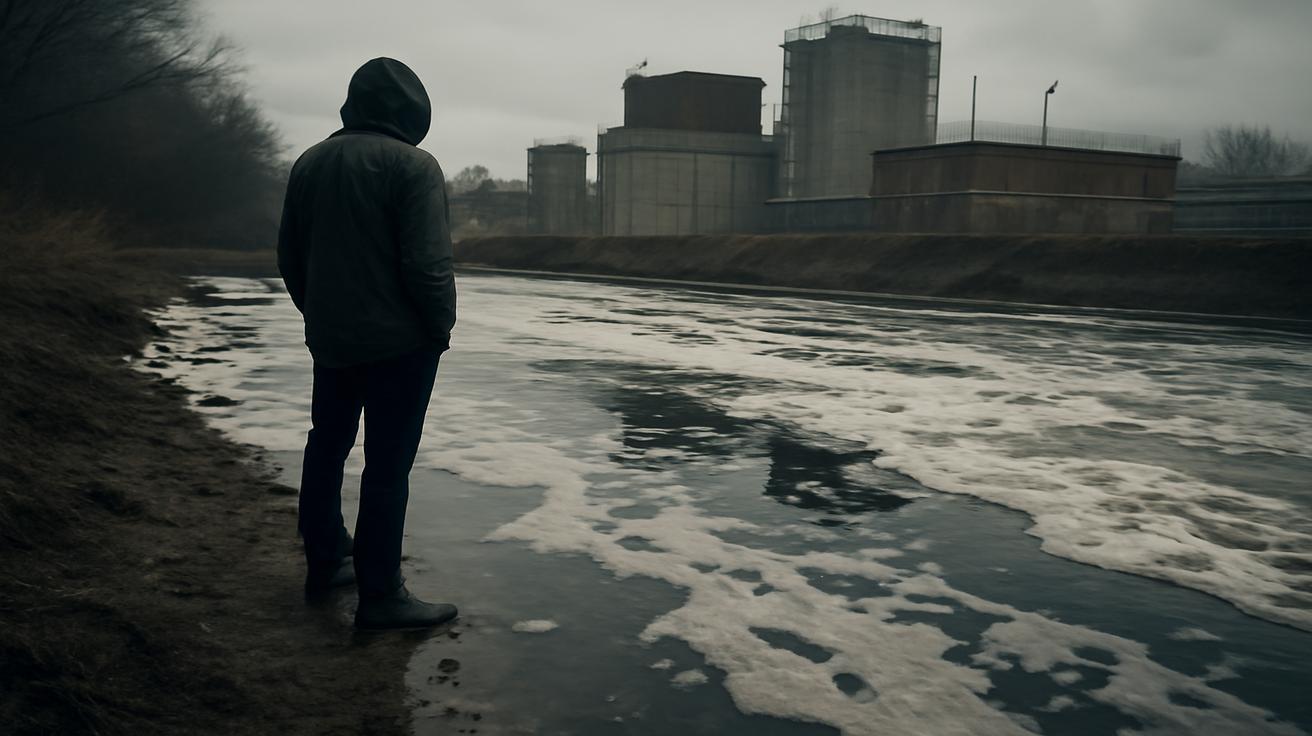
The river looks harmless at first. On screen, it’s all soft morning light and slow-moving silver, reeds nodding in a breeze you can almost feel through the television. Birds sketch lazy arcs overhead. The water surface breaks occasionally with the quiet plop of a fish, or maybe just a drifting leaf. It could be any English river you’ve picnicked beside or walked your dog along, a place where kids skim stones and couples spread blankets. But the longer the Channel 4 documentary rolls, the more that illusion falls away—like a film of scum peeling back to reveal something rotten underneath.
The Day the River Changed
The camera follows a local angler named Dan as he walks along what used to be his “home water”—a bend of river he’s fished since childhood. His boots crunch on gravel, then sink into something softer, darker. He stops, looks down, and the lens tightens: not mud. Not just mud, anyway. A slick mix of toilet paper, wet wipes, and a grey-brown jelly that clings to his laces like it’s alive.
“It didn’t used to smell like this,” he says quietly. The microphone picks up the river’s gurgle and a faint, sickly sweetness in the air seems almost audible. He kneels, pulling on a pair of gloves, and dips a plastic bottle just beneath the surface. When he lifts it back out, the water inside is cloudy, tinged with a yellow-brown that makes you want to put the TV remote down and wash your hands.
Channel 4’s documentary on the sewage crisis doesn’t bother with coyness. It starts where many of us start our relationship with nature: on a familiar riverbank, on a weekend, under supposedly clean skies. Then it steadily strips bare the comfortable fiction that this is still the countryside we imagine—untouched, benign, self-healing. What emerges instead is a portrait of a country quietly marinating in its own waste, and of the people who live, swim, work, and get sick in its shadow.
The Hidden Overflow
The story turns from river to pipes with the blunt inevitability of gravity. We meet a wastewater engineer, Emma, standing beside an innocuous metal hatch half concealed by nettles. It doesn’t look like the portal to a crisis. It looks like the sort of thing you’d barely notice on a dog walk. But this is an overflow point—part of the sprawling network of “combined sewer overflows” designed, decades ago, as emergency valves for heavy storms.
Only now, as the documentary patiently uncovers, “emergency” has drifted into “routine.” The team overlays drone footage with data supplied by citizen watchdogs: dozens, then hundreds, of these overflow points lighting up across maps of Britain like a rash. Instead of a rare fail-safe, raw or partially treated sewage is being released into rivers and coastal waters for hours, sometimes days, at a time. Not just in catastrophic downpours, but during perfectly ordinary rain. Sometimes with no rain at all.
In a dim council office, a river campaigner, Sarah, spreads out printouts of official discharge records. The spreadsheets look dry, almost boring—until you understand what each line represents. Hours of sewage pouring into a living river. Weeks when a beach quietly became unsafe for swimming. The ink under her fingertips is the paper trail of a system creaking and coughing, then shrugging and carrying on.
Outside, her river still looks beautiful, if you don’t look too closely. That’s the trick of this crisis: the damage is often invisible until it’s not. Until there’s a fish kill, or a swimmer falls ill, or the smell hits you on a warm day. The documentary lingers on that quiet dissonance: the loveliness of a glinting river overlaid with the knowledge of what runs unseen beneath.
When “Out of Sight” Becomes “In Our Bodies”
About halfway through, the film takes a turn that makes the issue brutally, personally real. We meet people whose bodies have become the final downstream destination of sewage-borne bacteria.
There’s a triathlete, Carla, who once trained year-round in open water. We watch home footage of her slicing through a lake at sunrise, breath fogging in the cold, her head lifting rhythmically with each stroke. Cut to present day: she’s on her sofa, a blanket around her shoulders though it’s not cold. She scrolls through hospital test results on her phone. E. coli. Campylobacter. Recurrent infections. Months of unexplained exhaustion. Each medical term lands with the weight of something that should never have entered a human body through a morning swim.
Doctors initially shrugged. Stomach bug. Maybe food poisoning. Maybe stress. It was only when more river swimmers and paddleboarders started telling similar stories that patterns emerged. The documentary speaks with a GP who has quietly begun asking a new question when patients come in with persistent gut issues or mystery rashes: “Have you been swimming outdoors? Where?”
The answers draw a map that looks eerily similar to the one marked with sewer overflows. The dots connect not in an activist report or a campaign leaflet, but in appointment rooms, in late-night A&E visits, in parents’ WhatsApp chats after a birthday party at the local lido ends with several kids violently ill.
One mother, voice wavering between anger and disbelief, recounts how her six-year-old spent two days on a drip after paddling in what they thought was a safe stretch of river. “If someone had put a sign up saying ‘Contaminated,’ we’d never have gone near it,” she says. “But there was nothing. Nobody told us.”
Numbers, Names, and the Price of Looking Away
The journalists behind the documentary are careful with statistics, not because there are too few, but because there are so many, and they risk becoming numbing. Instead, they pace them like quiet thuds in the narrative, each one landing alongside a face, a place, a moment.
In one scene, they sit across from a softly spoken academic whose job is sampling river water. On her laptop, columns of results: phosphate, nitrates, bacterial counts. She points to a line that’s off the charts, explains in plain language what it means. Not theoretical harm. Not someday. Right now. The water is, by any reasonable measure, unsafe.
To make the scale more graspable, the film pauses on a simple comparison—how the crisis looks when you reduce it to everyday terms:
| Aspect | What Should Happen | What the Documentary Shows |
|---|---|---|
| Sewage Overflows | Used rarely, only in extreme storms | Discharging regularly, even in light rain |
| Water Users | Swim and paddle without health fears | Growing reports of illness after river and sea use |
| Local Wildlife | Stable fish, insects, and bird populations | Fish kills, declining biodiversity, algal blooms |
| Transparency | Clear, timely pollution alerts | Patchy warnings; citizens discover discharges after the fact |
These rows are deliberately spare, almost clinical. Against them, the documentary sets voices: a kayaker who now carries antibacterial wipes in his kit; a cafe owner by a once-busy riverside path who’s watched custom slip away with each news story about pollution; a retired teacher whose dog fell ill after chasing sticks into a favourite swimming spot.
Numbers answer one kind of question—how bad, how often, how many. But the documentary insists on another: who. Who lives with this, who profits from it, and who is allowed to look away.
Voices from the Water’s Edge
The film spends long, quiet time with people whose lives are braided into rivers and seas in ways that aren’t easily severed. Not environmentalists in fleece and technical gear, but ordinary residents in faded hoodies and work boots; people with mud under their nails, not slogans on placards.
We meet a shellfish farmer on an estuary whose livelihood, once as predictable as the tides, now feels like a bet. He talks while sorting through a crate of oysters, discarding the dead ones with a practised flick of the hand. Each bad harvest is money lost, yes, but also something deeper—a trust broken between human, water, and the creatures that filter it. His grandfather worked these same beds. He wonders, half to the camera, half to the birds, whether his children will want to.
Downstream, a group of teenage surfers huddle around a van, steam rising from their wetsuits in the cold air. They speak the wary, half-joking language of people who love something that can hurt them. “You check the sewage alerts before the surf forecast now,” one laughs, but his eyes don’t join in. They trade stories of sore throats, ear infections, weekends lost to bed. Still, they paddle out. “It’s our sea,” another shrugs. “We’re not giving it up.”
That repeated phrase—our river, our sea, our beach—threads through the documentary like a quiet rebellion. Ownership not in the legal sense, but in the intimate, every-day sense. The right to let your dog splash in the shallows without fear. The right to watch a child build sandcastles without calculating the risk of them falling face-first into contaminated foam. The right, simply, to be near water without reading it as a hazard.
The Corporate Distance
When the documentary finally turns its lens toward the boardrooms of water companies, the contrast is almost jarring. Gone are the windswept banks and gull cries, replaced by glass facades, carpeted corridors, the soft hum of climate control. Here, water is numbers on a screen, charts in a presentation, a line in an annual report.
In interviews, executives talk of “unprecedented weather patterns,” “legacy infrastructure,” “the complexity of upgrading Victorian systems.” They speak of “balancing investment with affordability,” of “regulatory frameworks” and “long-term strategies.” Their language is precise, polished, lacquered with legal caution.
What’s missing, conspicuously, are words like “shit,” “vomit,” “sanitary towels,” “baby wipes”—the everyday reality of what is actually in the water that overflows into rivers. The documentary doesn’t need to force the point. It simply cuts from a description of “exceptional discharge events” to slow shots of a riverbank after one such event: plastic clinging to branches, brown froth eddying in quiet corners, a dog nosing curiously at something its owner pulls it away from, too late.
The human cost remains largely absent from these corporate conversations, except as “customer confidence” or “reputational impact.” When asked, on camera, how they would feel about their own children swimming below a regular overflow point, the executives choose their words with exquisite care. One smiles, thinly, and says, “I’d always advise people to follow official guidance.”
Regulators, Rules, and the Quiet Shrug
Unease needs an address, and for many viewers, it settles on the bodies meant to stand between rivers and ruin: the regulators and politicians. The documentary moves into committee rooms and parliamentary corridors, places where the air is less raw but the stakes no lower.
A retired environment officer, now free from the need to toe any particular line, sits at his kitchen table and speaks with a kind of weary candour. Years of underfunding. Staff cuts. Monitoring programmes scaled back. Each change small enough, at the time, to justify. Together, they hollowed out the system’s ability—or appetite—to police the very companies entrusted with keeping sewage where it belongs.
Another segment unpicks how fines, when they do come, often amount to less than a year’s profit for a water company—recorded as a one-off cost of doing business. The camera lingers on graphs showing rising dividends and executive bonuses in the same years that overflow hours soared. It’s not framed as a villain’s conspiracy, more as a slow drift of priorities, the incremental normalisation of something unthinkable.
This, perhaps, is where the documentary is at its most quietly devastating: not in exposing one dramatic scandal, but in showing the drip-drip of compromises, excuses, and shrugged shoulders that accumulated into a national crisis. There is no single smoking gun, just a long line of people who looked at a dirty river and thought, “It’s not my job,” or, worse, “It’s not that bad.”
What It Does to the Spirit
It would be easy, at this point, for the film to sink into pure anger. Instead, it pauses on something subtler: the psychic weight of loving places that are being harmed.
We watch a birdwatcher, binoculars dangling unused, standing on a hide overlooking a wetland. He’s been coming here since he was a boy, he says. He knows the pattern of seasons not from calendars but from which birds arrive when, what calls echo at dusk. In recent years, he’s noticed changes that are hard to quantify but impossible to ignore. Fewer mayflies. Odd algal blooms. Smells that don’t belong.
“You start to doubt your own memory,” he confesses. “Was it always like this and I just didn’t notice? Or is something really going wrong?” The documentary doesn’t answer for him. Instead, it lets the camera linger on his face as he looks out over water that is both beloved and suspected.
This erosion of trust—in rivers, in institutions, in the idea that someone, somewhere, is making sure things don’t fall apart—is its own kind of cost. Hard to measure, but heavy.
After the Credits: What We Do with What We Now Know
By the time the Channel 4 documentary edges toward its end, viewers have been led from living rooms to riverbanks, laboratories to boardrooms, hospital wards to protest lines. They have seen people fall sick, businesses falter, wildlife struggle. They have also seen something else: a rising, stubborn refusal to accept the situation as unchangeable.
There are scenes of citizen scientists dipping bottles into streams at dawn, logging results late into the night. There are local groups pinning homemade warning signs to fences when official notices fail to appear. There are paddlers and anglers, surfers and sailors, parents with prams, all showing up at town halls and consultations, sometimes for the first time in their lives.
The documentary doesn’t end with a neat solution. There is no final, triumphant claim that “the tide is turning.” That would ring false. Instead, it offers something messier and more honest: a portrait of a country waking up to what’s being done to its waters, and beginning, in fits and starts, to push back.
It leaves lingering questions in its wake—questions that sit with you long after the credits roll. What does it mean to keep using words like “natural beauty” when the rivers we photograph are laced with sewage? What does it say about a society that tolerates sickness as collateral damage for profit? And, perhaps most uncomfortably: now that we know, what do we do?
Because awareness is like opening a window. Once you’ve seen the toilet paper snagged in riverside branches, once you’ve heard a child describe the ache of a gut infection caught from “a fun day at the beach,” it’s hard to go back to scrolling past headlines about “overflow incidents” as if they were abstract nuisances.
The next time you walk by water—any water—you might find yourself looking a little more closely. You may notice a faint odour on a warm afternoon, a discoloured trickle from a pipe, foam that lingers too long on the surface. You might feel a twitch of unease when your dog bounds toward the shallows, a hesitation when a friend suggests wild swimming.
And perhaps, if the documentary has done its deeper work, that unease won’t curdle into resignation. Instead, it may become a quiet, insistent question you carry: Who is this river for? Who is this sea for? Who gets to decide whether they are treated as dumps or as lifelines?
The Channel 4 team set out to expose the human cost of the sewage crisis, and they have. But they have also done something else, harder to quantify: they have re-threaded the crisis through stories, bodies, homes and hopes. They have reminded us that what flows out of unseen pipes does not vanish into an “away.” It circles back, into our food, our play, our health, our sense of what kind of place we live in.
Standing on a final riverbank, as dusk folds the world into shades of blue and grey, the camera watches the water slip past. On the surface, all looks calm. Beneath, invisible currents carry the day’s secrets seawards. The film leaves us there, on that edge: between beauty and contamination, between despair and action. The river moves on. The question is whether we will.
Frequently Asked Questions
Is it still safe to swim in UK rivers and seas?
Safety varies widely by location and weather. Some stretches remain relatively clean, especially after dry periods. Risk rises significantly near sewage overflows, after rainfall, and in poorly monitored areas. Always check local water quality information where available and avoid swimming after heavy rain or near visible outfalls.
What kind of health problems are linked to sewage pollution?
Exposure can lead to gastrointestinal illnesses (stomach cramps, diarrhoea, vomiting), ear, nose and throat infections, skin rashes, and, in vulnerable people, more serious complications. Repeated exposure may increase the chance of persistent gut issues or antibiotic-resistant infections.
Why are sewage overflows happening so often now?
Many UK sewers are old “combined” systems that carry both rainwater and wastewater. Population growth, more paved surfaces, underinvestment in upgrades, and heavier rainfall have pushed them beyond capacity. Instead of rare emergencies, overflows have become routine pressure valves.
Who is responsible for fixing the sewage crisis?
Responsibility is shared between privatised water companies (who operate sewers and treatment works), government (which sets laws and investment frameworks), regulators (who enforce standards), and, indirectly, all of us as bill payers and voters. Real change will require pressure and accountability at each of these levels.
What can ordinary people do in response?
People can join or support local river and beach groups, report pollution incidents to regulators, reduce what they flush or pour down drains, participate in citizen science monitoring, respond to public consultations, and press elected representatives for stronger enforcement and investment in wastewater infrastructure.


Leave a Comment