
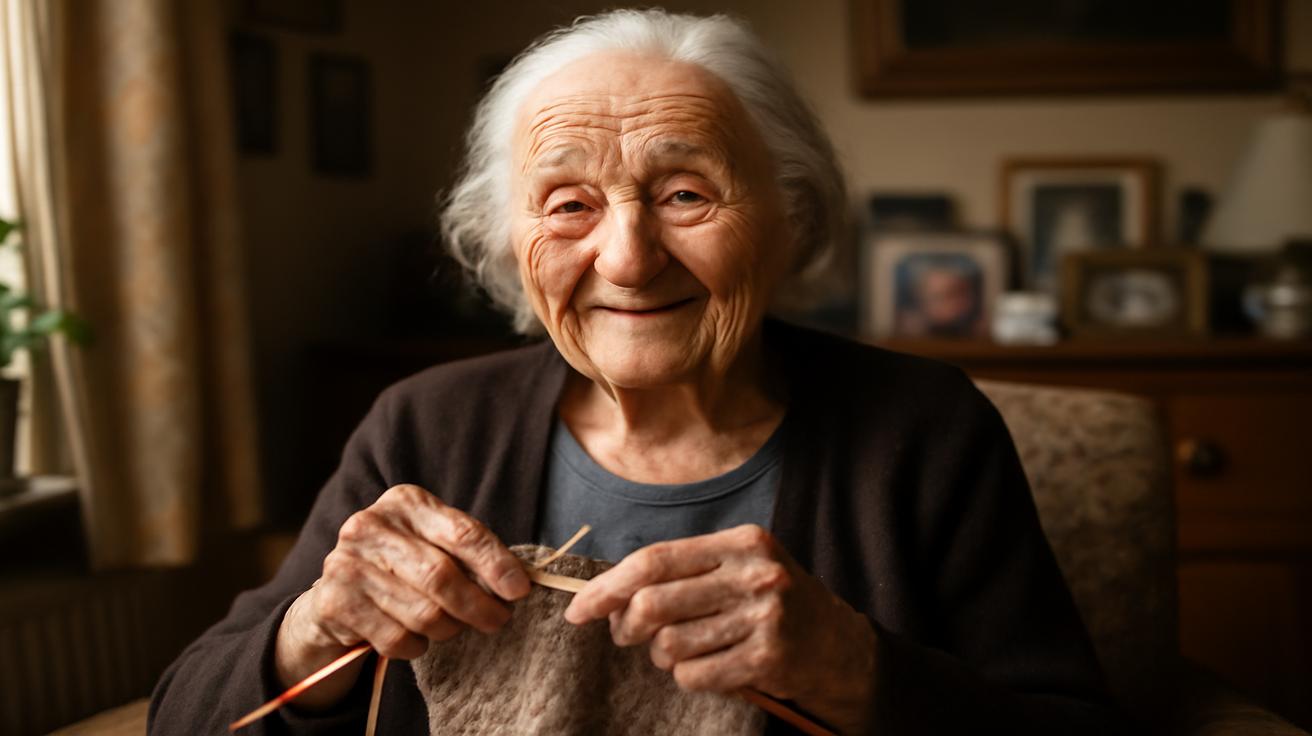
The first thing you notice is her hands. Not the frailty you expect from someone approaching 101, but a sure, practical steadiness, like a woman halfway through a workday, not a life. They move with intent as she presses a thumb into the soil of a terracotta pot on her windowsill, checking for moisture. “Too many people my age are watered like houseplants,” she says, lips twitching. “I prefer to do the tending, not be tended.”
Her name is Elsie. She was born before television, before antibiotics were routine, before most people believed a woman could live alone past seventy. She has outlived two brothers, one husband, three housing estates, and more prime ministers than she cares to count. She walks without a cane. She cooks her own meals. She knows exactly where her important papers are. And she is adamant about one thing: “I refuse to end up in care.”
She does not say it with bitterness. It’s more like a vow. A pact with herself that began, she explains, on a rain-glossed autumn evening twenty-odd years ago, watching her older sister fold into a beige recliner in a nursing home, the television looping game shows no one was listening to. The room smelled of boiled cabbage and disinfectant. “She was smaller every time I visited,” Elsie recalls. “Not in inches, in spirit.” On her bus ride home that day, Elsie made a quiet decision. If there was anything she could do to avoid that soft, padded surrender, she would do it. Every single day.
The Quiet Rules She Lives By
Elsie doesn’t have a miracle diet or a secret supplement stash. What she has is a collection of modest, almost unremarkable daily rituals that, woven together, form a safety net subtle as spider silk and just as strong. She calls them her “quiet rules.”
“Everyone wants to know the one big thing,” she tells me, leaning back in her chair. The afternoon light combs soft lines of gold across her living room, catching in the wisps of hair she pins back with unapologetically bright barrettes. “But it’s the little boring things. The things you do when no one’s looking, on the days you don’t feel like it. That’s what keeps you out of the padded chairs.”
Her day is an intricate choreography of movement, food, rest, connection, and a certain sharp-edged stubbornness. And while she insists she’s “no guru,” watching her move through an ordinary Tuesday feels like watching a how-to guide in human form—not for avoiding old age, but for inhabiting it on her own terms.
The Morning Deal She Makes With Her Body
Her day starts with a negotiation. “We have a deal, my body and I,” she laughs, swinging her legs out of bed before the clock hits seven. “I get you moving, you get me another day at home.”
The room is cool, a soft chill pressing against bare skin as she sits on the edge of the bed. Before her feet touch the floor, she rolls her ankles, ten circles each way. Her toes flex and point as if remembering a dance from a lifetime ago. Knees straighten and bend, slow and deliberate. “People jump out of bed like they’re twenty, then wonder why their bones complain,” she says. “I wake mine up politely.”
Her “exercise routine” is nothing you’d find on a glossy poster, but it has the quiet discipline of someone who learned long ago that strength is less about dumbbells and more about never entirely giving up.
| Time | Habit | Purpose |
|---|---|---|
| 7:00–7:15 | Bedside stretches & ankle circles | Wake joints gently, prevent stiffness |
| 7:15–7:30 | Make bed, open curtains, deep breaths | Signal “day has begun”, mood reset |
| 7:30–8:00 | Simple breakfast & glass of water | Gentle fuel, hydration |
| 8:00–9:00 | Walk indoors or to nearby park | Balance, circulation, sunlight |
“No sitting straight away. That’s the rule,” she says, fingers smoothing the crumpled duvet into neat planes. Making the bed is not about tidiness; it is, in her words, “a promise that I’m not going back there until bedtime.” She walks slowly to the window, pulls the curtains wide. Morning spills in—birds stitching sound through the air, a dog barking somewhere three floors down, a bus groaning into motion. She stands with her hands on the sill, and inhales deeply. Three long breaths. In. Out. Again.
“Some people pray,” she says. “I breathe. Same thing, really. A way of saying: I’m still here, then?”
Breakfast is plain but intentional: porridge with a scattering of chopped apple, sometimes a spoonful of sunflower seeds if her fingers aren’t too stiff, and always a glass of water. “You dry out like a houseplant in a sunny window if you’re not careful,” she says. She keeps her mug of tea for later, a small pleasure she refuses to rush.
Movement: “I Walk My Future Every Morning”
By eight, shoes are on. Sensible, yes, but bright red—“so I can see my feet and so can the drivers,” she winks. On good days, she takes the stairs down from her second-floor flat, one hand on the rail, one foot placed with almost ceremonial care. On unsteady days, she takes the lift but walks the length of the corridor back and forth “until my legs remember what they’re for.”
Her walk is not fast. That isn’t the point. She circles the small park at the end of her street, nodding to the same dog walkers, the same woman who smokes on the bench by the gate, the same teenagers half-awake over takeaway coffee. The air is often damp, the kind of English moisture that clings to eyelashes and softens the edges of everything. “I walk my future every morning,” she says. “Every step is me choosing where I end up. Or where I don’t.”
There is purpose in the uneven rhythm of her feet on the path. Studies will tell you about the benefits of 30 minutes of moderate exercise, about reduced risks of heart disease, better balance, sharper cognition. Elsie doesn’t quote studies. She quotes her own anatomy. “If I can get there myself, I don’t have to ask anyone to get it for me. That’s the real fitness test at my age.”
On rainy days, when the park is more mud than grass, she marches the perimeter of her living room, one hand brushing the back of the sofa, turning every few minutes. It looks almost comical—this tiny woman circling her coffee table—but the seriousness in her posture makes it anything but. “I don’t negotiate with the weather,” she shrugs. “It doesn’t care if I end up in a care home. I do.”
How She Eats for Clarity, Not Perfection
At midday, her kitchen smells of onions softening in a pan, a gentle, homely sweetness that fills the flat. Lunch is her main meal. “Evenings are for unwinding, not digesting a three-course feast,” she jokes. Today, it’s vegetable soup—carrots, celery, potatoes, a handful of lentils—left to simmer until it thickens into something both simple and strangely luxurious.
“Food is not entertainment for me,” she says, laying out a slice of wholegrain bread as carefully as if setting a place for a guest. “It’s maintenance. Like oiling the hinges.” But there is still pleasure in the ritual: the clink of the spoon against the bowl, the curl of steam against her face, the warmth moving outward from her stomach, into chilly fingers, into the ache in her knees.
She does not diet. She does not “cut out” entire food groups or track calories. What she does, relentlessly, is ask one question: “Will this help me stay clear in the head and steady on the feet?” If the answer is no, it becomes an exception, not the norm.
The Small Rules on Her Plate
Her meals are built around patterns, not restrictions. Vegetables at least twice a day, often three. Some sort of protein—beans, eggs, a little fish, chicken now and then. White sugar appears only rarely, in the occasional biscuit offered by a neighbor. “One’s a treat, three is sabotage,” she says, matter-of-fact.
“People act like old age is an accident,” she continues, spoon hovering mid-air. “But it’s a collection of invoices your body sends you for how you’ve treated it. I try to keep my invoices small.”
She keeps a bottle of water on the kitchen table and another by her armchair, a quiet guard against the dehydration that so often masquerades as confusion in the elderly. “I drink before I’m thirsty,” she explains. “Thirst is your body being polite. By my age, you can’t rely on politeness.”
Her one hard line? Alcohol. She stopped at sixty. “It wasn’t dramatic,” she shrugs. “I just realized I couldn’t afford to give my brain anything else to fight. It’s busy enough keeping me upright.”
The Housework That’s Really Strength Training
Afternoons are when her flat becomes a gym disguised as a home. She has never once lifted a weight in the traditional sense, but she will carry laundry in small batches, climb her step-stool to reach the top cupboard, and vacuum in short, deliberate bursts. “I don’t call it cleaning,” she smiles. “I call it resistance training.”
There is rhythm in it. Dishes washed and rinsed, hands dipping into warm, soapy water. Tea towels folded with the kind of precision you’d expect from a contest, not a one-woman kitchen. The broom moving across the floor in slow, purposeful arcs. Every movement a double act: the house gets tidier; her muscles remember their job.
Refusing to Sit All Day
“Chairs are sneaky,” she warns, lowering herself into hers only after a gentle stretch that looks like a modest version of a yoga pose. “They hold you longer than they should. Then one day, you forget how to get out of them without help.”
So she has rules. Never more than 30–40 minutes of sitting without standing up, even if it’s just to walk to the window and back. The television, when it’s on, is background to something she’s doing with her hands—darning a sock, peeling potatoes, writing a birthday card. “If my body’s still, my mind has to be doing something,” she says. “If we both go quiet, that’s when the dark thoughts sneak in.”
She’s pragmatic about pain. Aching joints don’t signal rest; they signal adjustment. She might swap vacuuming for dusting, a walk for some gentle leg lifts at the kitchen counter. “Pain is a message, not a command,” she says. “I listen. But I don’t always obey.”
The Invisible Web of People Who Keep Her Standing
In between tasks, her flat hums with small human connections. The phone rings—her neighbor on the third floor checking whether she needs anything from the shop. Later, a grandchild video-calls, their face framed in a cluttered student kitchen miles away. A handwritten letter lies open on the coffee table, words slanting in blue ink from a friend she’s had since 1954.
“Living alone doesn’t mean living without people,” she says firmly. “That’s another choice you have to keep making.”
On Asking for Help Without Giving Up Control
She has negotiated a delicate balance between independence and support. Her daughter visits once a week to help with the “heavy bits”—changing curtains, lifting boxes, checking the smoke alarm. But the day-to-day is fiercely, carefully, Elsie’s domain.
“There’s this fear,” she says, “that if you admit you need help with one thing, they’ll take everything away. Your keys, your decisions, your dignity. So people hide their struggles. Then one fall, one infection, and suddenly they’re in a home.” She shakes her head. “I’d rather choose my help, bit by bit, than have it all forced on me at once.”
So she is honest—with her doctor, with her family, with herself. She wears her hearing aids, though she hates how they pinch. She uses a grabber tool for low cupboards, a shower stool on days her legs feel untrustworthy. These are not admissions of defeat to her; they are tools that buy her more time in her own home.
“Stubbornness is no good if you’re stubborn about the wrong things,” she says. “I’m not too proud for gadgets. I’m just too proud to give away decisions I can still make.”
The Mind Games She Plays With Time
Evenings are softer. The light in her flat turns honeyed, pooling on the framed photographs that line her hallway. Her husband in black-and-white, grinning at a beach somewhere that no longer exists in that form. Her children at various ages, her grandchildren in their graduation robes, her sister on a picnic blanket in 1962, hair a defiant wave in the wind.
This is the time of day, she admits, when loneliness circles closest. “The world shrinks at night,” she says quietly. “Shops close, buses thin out, everyone pulls their curtains. You feel your age more when you can see it in the dark glass.”
So she plays what she calls “mind games with time.” She keeps small projects—crosswords, a half-finished scarf, a shoebox of old letters she’s slowly sorting. She reads, but never only novels. There are library books on birds, on local history, on how the brain changes with age. “If I treat my brain like an old storage room,” she says, “it will start acting like one—dusty and hard to find things in.”
Rewriting the Story of Old Age
Story, for her, is everything. The story she tells herself when her knee hurts stepping off the curb: “This is practice, not punishment.” The story she repeats when she forgets a name: “I am sorting files, not losing them.” The story behind her refusal to “end up in care”: not a rejection of help, but a determination to remain the main character in her own life, not an extra in someone else’s system.
She avoids phrases like “I’m just old” or “I can’t do anything anymore” the way some people avoid sugar. “Words sink in,” she says. “Say something often enough, your body starts believing you’re giving it instructions.”
Before bed, she has a small ritual. She writes down three things she managed that day—never big achievements, always specific acts of agency. “Walked to the park despite the wind.” “Cooked my own lunch.” “Phoned Linda, made her laugh.” It takes her less than five minutes. It is, she believes, one of the strongest medicines she has.
“You have to keep proving to yourself that you’re still in the game,” she says, smoothing the notebook’s cover. “Once you start seeing yourself as a burden, you start behaving like one. And then other people follow.”
“I Refuse to End Up in Care” — What She Really Means
When Elsie says she refuses to end up in care, she knows as well as anyone that life can be brutal and unpredictable. She has seen strokes flatten the strongest men she’s known, watched infection turn quick minds cloudy almost overnight. “You don’t always get a choice,” she says. “Illness doesn’t care how many vegetables you’ve eaten.”
What she’s rejecting is not the concept of professional care itself, but the slow, avoidable collapse of everyday power that sends so many people there earlier than they might have needed to go.
“Care homes aren’t evil,” she says. “Some are kind, some are necessary. But I see women younger than me sitting all day, waiting for someone to tell them when to eat, when to bathe, when to go outside. I won’t queue for that. Not if I can help it.”
So she fights, in the only way any of us can fight the erosion of time: not with grand gestures, but through a thousand small choices stitched into the fabric of ordinary days. Stand instead of sit. Walk instead of waiting. Cook instead of dialing a number. Ask for a bit of help instead of hiding a growing weakness. Drink the water. Do the stretches. Talk to someone. Learn something new. Write down the proof that you are, still, here.
Before I leave, she stands to walk me to the door. No one would blame her if she stayed seated and waved from the armchair, but she doesn’t. Her hand brushes the wall lightly as she moves down the hallway, feet in those bright red shoes. At the door, she gives a small, satisfied nod, as if checking off another quiet victory.
“Old age isn’t the enemy,” she says, fingers resting on the latch. “Drifting is. If you let yourself drift, other people will decide where you land. I intend to steer, as long as I can.”
Outside, the air has sharpened. Somewhere, a siren wails, a bus sighs to a halt, a child laughs. Behind me, I hear the soft click of her lock, the sound of a woman sealing, for one more night, the life she has worked so deliberately to keep as her own.
Frequently Asked Questions
Does Elsie follow a specific diet plan?
No. She doesn’t follow any branded diet. She focuses on simple, home-cooked meals with plenty of vegetables, modest portions of protein, whole grains, and very little added sugar or alcohol. Her guiding question is: “Will this help me stay clear in the head and steady on the feet?”
How much exercise does she actually get each day?
Most days, she moves intentionally for at least 30–60 minutes, broken into small chunks: morning stretches, a slow walk indoors or to the park, and light housework that doubles as strength and balance training. She avoids long periods of sitting by standing up and walking briefly every 30–40 minutes.
Is it realistic for everyone to live independently at her age?
No. Genetics, serious illnesses, accidents, and access to healthcare all play major roles. Elsie is the first to admit that some people need care through no fault of their own. Her story shows what’s possible when daily habits support independence, but it’s not a guarantee or a standard to judge others against.
What is her attitude toward asking for help?
She sees asking for help as a strategy, not a failure. She uses tools like grabbers and shower stools, and accepts weekly help with heavy tasks. For her, small, chosen supports are a way to avoid a larger loss of independence later.
What habits does she consider most important for staying out of a care home?
She highlights four: regular movement (especially walking), eating simply but thoughtfully, staying mentally engaged and socially connected, and refusing to see herself as “just old.” Above all, she believes in making small, consistent choices that keep her an active participant in her own life.






Leave a Comment