
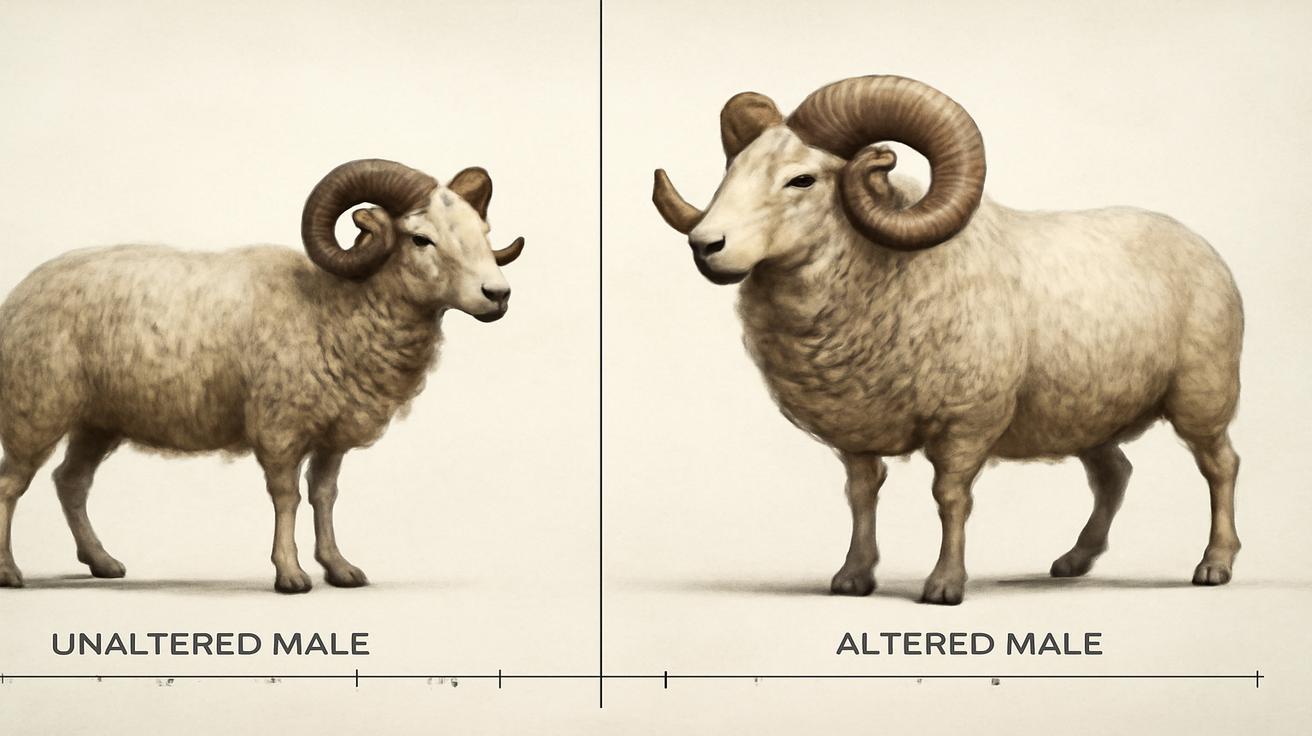
The ram stood in the late-afternoon light, breath steaming in the cool air, a small constellation of dust turning gold around his flanks. On the other side of the fence, a group of wethers—castrated males—grazed with a slow, unhurried purpose, ribs well-covered, coats thick and glossy. The ram paced, shoulders tight with muscle, eyes sharp, nostrils flaring at every passing scent. He looked like everything a wild animal should be: charged, restless, burning life fast and bright. The wethers looked like the opposite—soft, almost placid, their bodies shaped by a different bargain with biology. In that field, under the folding sky, you could almost see a question hanging in the air: what if giving up reproduction meant gaining more time?
When Life Trades Passion for Time
For much of our history, the idea that castration—removal of the testes in males—could extend life has floated at the uneasy edges of science and culture. It sounds like something out of a grim folktale, a twisted bargain with a witch in the woods: surrender your fertility, win extra years.
And yet, beneath the folklore, there is biology—strange, sometimes unsettling biology. In mammal after mammal, patterns emerge: castrated males, from farm animals to lab rodents, often live longer than their intact counterparts. Not always. Not everywhere. But often enough that biologists have stopped shrugging and started leaning in more closely.
Imagine the body as a country with limited resources. Hormones are its policy makers, shouting priorities over the noise of survival. Testosterone, one of the main sex hormones in males, is like a political faction demanding: grow faster, fight harder, mate now. The cost of that intensity is hidden in small, accumulating compromises—wear on the heart, strain on the immune system, a body tuned for the urgent present rather than the distant future.
The Quiet Longevity of the Barnyard
Most of the evidence linking castration with lifespan doesn’t come from sleek high-tech labs but from quieter places: barns, pastures, long-running breeding records. Farmers and veterinarians have noticed for generations that castrated males—steers instead of bulls, wethers instead of rams, geldings instead of stallions—often live longer, steadier lives.
On a small farm, the difference is not just in years but in how those years feel. An intact bull charges fences, battles rivals, tears muscles in frantic sprints toward a rival herd. A steer, by contrast, grazes like the day is a long ribbon of sunlight. The bull packs his time with risk and contest; the steer saves his energy, quite literally, for living.
Researchers, guided by observations like these, have dug through historical records and experimental data. In several controlled studies, castrated male rats and mice have lived noticeably longer than intact males, sometimes approaching the lifespans of females, who generally outlive males in many mammal species. In some domestic animals, castrated males are less likely to die of injuries, infections, or hormone-fueled diseases such as certain cancers.
Of course, the barnyard is also shaped by human decisions. A castrated working horse might be allowed to retire peacefully, while a powerful breeding stallion could be run hard until his body fails. But even stripping away these cultural layers, a biological pattern persists that cannot be ignored.
The Strange History of Eunuchs and Longevity
If the barnyard gives us one line of evidence, human history gives us another—sparser, more haunting. For centuries, in some cultures, young boys were castrated to serve as eunuchs in royal courts, religious choirs, or harems. This practice, now broadly condemned and illegal in most of the world, left behind a grim but scientifically intriguing legacy: records of lives lived with dramatically reduced testosterone.
In one analysis of historical data, Korean court eunuchs from the Chosun dynasty were found to have lived, on average, many years longer than other high-status men of their time. Their lives were in no way easy; they navigated palace intrigues and social stigma. Yet, as a group, they seemed to outlast the kings and warriors they served.
This doesn’t mean castration is some hidden secret to human longevity—far from it. The data are imperfect, entangled with differences in diet, status, and the simple fact that eunuchs were often carefully protected once they became valuable to the court. Still, when biologists compare these stories with animal experiments, the idea starts to feel less like myth and more like a puzzle the body is quietly asking us to solve.
| Species / Context | Effect of Castration on Lifespan | Key Notes |
|---|---|---|
| Laboratory rats & mice | Often increased | Reduced testosterone frequently linked to longer life in males. |
| Farm animals (cattle, sheep, pigs) | Commonly increased | Castrated males show lower trauma and some disease risks. |
| Companion animals (dogs, cats) | Often increased, but variable | Neutered animals may live longer; timing and breed matter. |
| Historical human eunuchs | Some evidence of increased lifespan | Confounded by social status, protection, and record quality. |
Inside the Body’s Trade-Offs
To understand how castration could be linked to increased lifespan, you have to step inside the body’s noisy biochemical marketplace. Here, everything is a trade: energy for growth, growth for repair, reproduction for resilience. Hormones are the currency and the negotiators.
In many mammals, testosterone surges drive a familiar suite of traits: bigger muscles, thicker necks, aggressive behavior, higher risk-taking. The hormone reshapes not just bodies but strategies. A young male elk full of testosterone throws himself into brutal autumn battles; a castrated male would never even feel the urge to lock antlers.
The cost of this hormonal bravado shows up in several ways:
- Immune function: High testosterone can dampen some immune responses, potentially making males more vulnerable to infections.
- Metabolic strain: Building and maintaining extra muscle and reproductive tissues costs energy that might otherwise go to repair and maintenance.
- Behavioral risk: Testosterone encourages aggression and competition, which in the wild often means injuries, infections, and early death.
When an animal is castrated, testosterone levels plummet. The body seems to pivot. Instead of betting everything on a high-stakes, short-term reproductive sprint, it slows the game down. Energy that once went to mating displays or territorial battles can be rerouted toward long-term maintenance—repairing DNA damage, supporting the immune system, keeping organs functioning smoothly.
Some researchers frame this in terms of an ancient evolutionary concept called the “disposable soma” theory. In this view, the body (the soma) is, to some degree, expendable compared to genes. When the drive to reproduce is intense and urgent, the body can afford to invest less in long-term durability. But dampen that reproductive drive, and suddenly there’s more value in keeping the machinery running well for longer.
The Subtle Shifts You Don’t See
There are quieter, microscopic benefits as well. Lower testosterone can reduce certain forms of oxidative stress—those tiny chemical sparks that damage proteins and DNA over time. It can alter levels of growth factors and inflammatory molecules, nudging the body into a less inflammatory state.
In some studies, castrated male mammals show slower age-related deterioration in tissues like the heart and blood vessels. Their arteries, for example, may accumulate damage more slowly than those of intact males. This doesn’t mean castration is some magical shield against aging—it doesn’t stop the clock. But it appears to adjust the slope of the line, changing how steeply the body descends into frailty.
The Complicated Case of Pets and People
Step into a veterinary clinic on any busy afternoon and you’ll see another chapter of this story unfolding: dogs waiting for neutering, cats recovering from spay and castration surgeries. Here, the motivations are more practical than philosophical—controlling population, reducing roaming and fighting, lowering certain cancer risks.
Over the years, studies have suggested that neutered dogs and cats often live longer than their intact companions. They’re less likely to die from trauma like car accidents or fights. They have lower risks of reproductive organ diseases, such as testicular cancer or uterine infections.
But the picture isn’t simple. As veterinary science looks more closely, it finds nuance. In some dog breeds, early neutering (especially before puberty) may be linked to higher risks of orthopedic problems or certain cancers. In others, neutering still seems clearly beneficial. Timing, breed, size, and environment all braid together to create different outcomes.
In humans, the question becomes thornier still. Modern medicine rarely performs castration for non-medical reasons, and when it does, it’s usually in the context of treating diseases like prostate cancer. These individuals already face complex health challenges, making it difficult to isolate the pure effect of hormone loss on lifespan.
And then there is the question of what life means, beyond its sheer number of years. Reproductive capacity is deeply intertwined with identity, relationships, and culture. Even if castration did offer a clear longevity boost—something science has not proven for the general human population—the cost to psychological and social well-being would be enormous.
Evolution’s Ruthless Math
Standing back from the barnyard, the palace records, and the lab cages, a blunt pattern emerges: evolution doesn’t care how long an individual lives; it cares how effectively that individual passes on genes. From this cold vantage point, a short, vivid life bursting with reproductive success can be “better,” in evolutionary terms, than a long, quiet one with no offspring.
Male mammals are often the shock troops of reproduction. Their biology is tuned for risk: leave the safety of the group, range far, fight hard, mate often. If they die young but leave many offspring, their genes still win. The cost—to the body, to the individual—can be staggering.
Castration, in this brutal arithmetic, is like ripping out a page of the rule book. Remove the drive and capacity for reproduction, and the whole calculation shifts. Suddenly, there’s no evolutionary incentive to burn through life so quickly. The body, no longer driven to spend itself in mating battles, behaves differently. It becomes, in a sense, more conservative with its resources.
This does not mean evolution ever “designed” castration as a path to longevity. Rather, it reveals something about the levers hidden inside mammalian biology. By altering hormones and reproductive potential, we can change how the body balances speed versus endurance, reproduction versus repair.
What This Teaches Us About Aging
To scientists who study aging, this link between castration and lifespan is not a prescription but a clue. It points toward molecular pathways that might also be modulated in gentler ways: balancing hormones, adjusting diet, targeting specific signaling molecules involved in growth and reproduction.
For example, pathways like mTOR and IGF-1, which help govern growth and metabolism, are influenced by sex hormones. Drugs or diets that dial these pathways down slightly—without the drastic step of removing reproductive organs—may mimic some longevity benefits seen in castrated animals. It’s a bit like taking the foot off the accelerator without ripping out the engine.
Ethics, Emotion, and the Edges of Science
It’s tempting, when confronted with a story like this, to leap toward extremes: to imagine a future where people opt for radical bodily changes in pursuit of a few extra years, or to recoil and declare the whole line of research too disturbing to follow. But the real work happens in the middle ground, where curiosity and ethics sit uneasily side by side.
Castration has a dark and painful human history, from court eunuchs to forced sterilizations. Any discussion of its biological consequences must carry that shadow carefully. The idea that we might learn from these histories—to uncover new ways of understanding aging—does not erase the suffering that produced the data.
In animals, too, the ethics are complex. Neutering pets has clear benefits for population control and can prevent terrible diseases. Yet scientists and veterinarians are increasingly aware that there may not be a one-size-fits-all approach, especially when it comes to timing and breed-specific risks. The goal is no longer just “neuter everything, early and always,” but to make decisions grounded in evolving evidence and compassion.
What remains most striking, perhaps, is how profoundly intertwined reproduction and aging are. To tweak one is to jostle the other. When we look at a castrated animal living a quieter, longer life, we’re seeing not a bizarre exception but a vivid illustration of the trade-offs that shape every mammal.
Out in that pasture, as the last light faded, the ram finally stopped pacing. He stood at the fence, chest heaving, eyes fixed on a point far beyond the field. The wethers, bellies full, lay down in the grass, chewing slowly, untroubled. Two versions of mammalian life, written by the same genes but edited by a single, brutal intervention. One body tuned for urgency, the other for endurance.
Between them stretches a question that science is still learning how to answer: how much of our lifespan is the echo of ancient reproductive imperatives—and how much might be ours to rewrite, more gently, in the future?
Frequently Asked Questions
Does castration always increase lifespan in mammals?
No. While many studies show that castration can extend lifespan in some mammals, especially males, the effect is not universal. It varies by species, environment, timing of castration, and even genetic background. In some cases, there may be no clear benefit, or different health risks can emerge.
Is the lifespan effect mainly biological or behavioral?
Both. Biologically, reduced testosterone can shift energy toward maintenance and repair, potentially slowing some aging processes. Behaviorally, castrated animals tend to take fewer risks—less roaming, fighting, and mating competition—leading to fewer injuries and trauma-related deaths.
Do female mammals gain extra lifespan from similar procedures?
The picture is more complex in females. Spaying removes ovaries and often the uterus, changing estrogen and progesterone levels. This can reduce the risk of serious reproductive diseases but may alter other health risks. Some studies show increased lifespan; others show more mixed outcomes. The mechanisms and trade-offs are not identical to those seen in males.
Does this mean castration could be a longevity strategy for humans?
There is no scientific or ethical basis for promoting castration as a longevity strategy in humans. Modern evidence in people is limited and heavily confounded, and the physical, psychological, and social costs would be profound. Instead, researchers use these findings to understand aging pathways and search for less drastic interventions.
What can we learn from this research without resorting to extreme measures?
The castration–lifespan link highlights how deeply growth, reproduction, and aging are interwoven. By studying these connections, scientists hope to identify molecular targets—such as hormone signaling or metabolic pathways—that can be modulated with drugs, lifestyle changes, or diet to support healthier aging without sacrificing reproductive health or bodily integrity.








Leave a Comment