
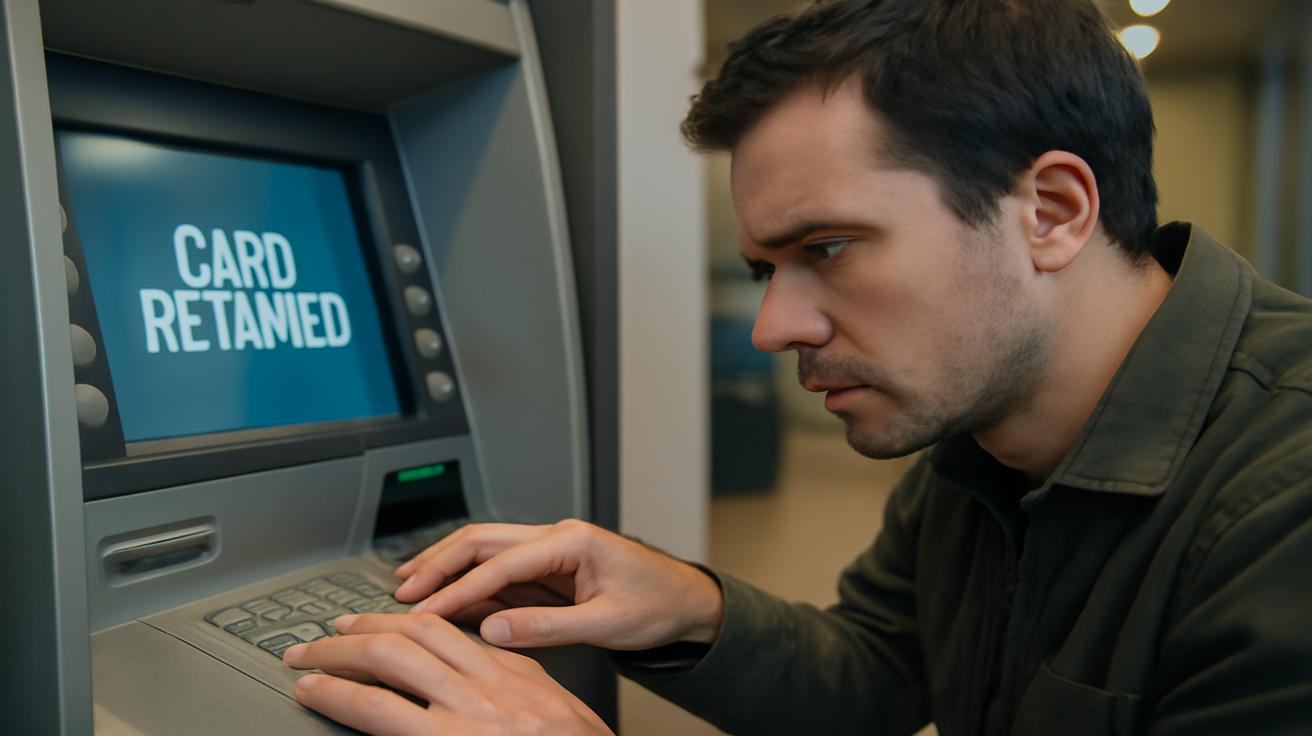
The first time a cash machine swallowed my card, the world around me kept moving as if nothing had happened. A bus sighed at the curb. Someone behind me shuffled impatiently, their plastic shopping bags brushing my leg. A pigeon hopped close to my shoe, hopeful, as though I might spill a crumb of certainty onto the pavement. Inside the slot, the last visible edge of my card slid away with a quiet, indifferent click. The screen blinked, hummed, and then went politely blank—like a door closing in my face.
The Moment the Machine Turns on You
If you’ve ever felt that slow throb of panic as an ATM holds your card a beat too long, you know how strangely alive these machines can seem. There you are, fingers hovering in that thin slice of air between you and the slot, watching. Waiting. Listening to the gears whir with their own private logic.
Maybe the air is cool against your wrist, maybe it’s humid and sticky with city heat. Traffic pushes past, a busker somewhere is trying to wrestle a melody out of a guitar, and your brain is suddenly doing frantic math: That’s my only card. My rent is due. My train leaves in an hour. Did I press something wrong? Did I take too long?
Most days, the ritual is boringly smooth. Card in. Code in. Cash out. Card back. The modern urban handshake between you and your money. But built deep into that ritual is a hidden timer and a quiet rule: if you don’t move in time, the machine gets to keep what’s yours.
What almost nobody tells you—until the day you need it—is that there’s a particular quick move and one simple button that can change how this story ends.
The Quiet Countdown You Never See
Every cash machine runs on little invisible countdowns. Not on the screen, not announced by a warning bell, just silent numbers slipping away behind the glass while you decide whether you need another twenty, or you tug your wallet out of the tangle of receipts in your bag.
Once the machine finishes your transaction, it usually spits out your card before anything else. At that moment, a timer starts. In many places, it’s about 20 to 30 seconds. If you don’t take the card in that window, the system assumes you have walked away and quietly pulls it back in for “security.”
Security for whom, you might ask, as you stand there looking at a blank screen and an empty slot. It’s a safety design meant to stop strangers from walking up behind you and snatching your forgotten card. Fair enough. But in real life, the machine doesn’t see your fumbling hands, the baby stroller you’re trying to steer, or the text message that’s just lit up your screen. It only sees the timer.
That’s why the first rule of surviving a stubborn ATM sounds almost too simple:
Always think: card first, cash second.
That small shift changes everything. Your brain is wired to focus on what you came for—the notes flickering into the tray, crisp or crumpled, the physical sign that your account is still alive. But the machine is designed the other way around: card, then cash. If you train your body to mirror that order, you cut the risk of losing your card dramatically.
| Scenario | What Most People Do | Safer Quick Move |
|---|---|---|
| Cash and card appear almost together | Grab the cash first, check amount | Take the card first, slide it straight into wallet, then pick up the cash |
| Card delays a few seconds | Glare at screen, look around, get distracted | Keep hand ready near the slot, eyes on card reader, ignore distractions until card is back |
| You’re in a hurry or under pressure | Check phone, talk, juggle bags while machine processes | Pause everything for 30 seconds; treat card retrieval as the only task |
The One Button Nobody Talks About
There is, hidden in plain sight on almost every machine, a quiet ally: the Cancel button.
It’s rarely glamorous—often a red or yellow key with a small label, sometimes half worn off by thousands of nervous fingers. But when a transaction starts to feel wrong, or the machine is taking too long, or a stranger behind you is getting too close, that button is your emergency exit.
The job of the Cancel button is simple: stop what’s happening and give the card back, if it can. Pressing it before you enter your PIN, or before you confirm an amount, or when the machine glitches and hesitates, often triggers the system to abort and eject the card.
Think of it this way: you wouldn’t stay in a train that keeps lurching and stalling and filling with smoke just because the doors haven’t opened yet. The Cancel button is you saying, as calmly as possible, “I’m getting off here, thanks.”
Of course, there are moments when even Cancel can’t help—the network might already be frozen, the power might have died, or the internal system might have locked the card for suspicion of fraud. But using Cancel early, before things go very wrong, can be the difference between walking away with your card or watching the slot swallow the last sliver of plastic you own.
When the Card Disappears Anyway
Let’s say it’s too late. You reached, but not fast enough. You pressed Cancel, but the screen went dark and stayed dark. The card is gone, and so is the feeling that someone, somewhere, is quietly in charge of things.
The world around you probably still looks the same: the queue behind you shifting their weight from one foot to the other, someone tapping a phone against their thigh, a breeze tugging a stray receipt along the ground. But your mind is now a narrow tunnel of questions.
Did the machine just eat it for nothing? Is it still inside? Can someone else get it out? Is my account safe while my card is locked away in that metal box?
Here is where the second quiet rule begins: freeze the card in your head before you freeze it in the world.
Take a breath, just one, and run through three quick steps like you’re checking pockets before leaving home:
- Is there a bank name on the machine?
- Is there a phone number on the screen sticker or near the keypad?
- Do you know your bank’s emergency line by memory or phone contact?
Most ATMs, even the lonely ones perched at the edge of supermarket walls or petrol stations, carry some small label of responsibility. A bank logo. A service hotline. A little line that says, “For assistance, call…” That’s who holds the keys to the box that now holds your card.
If the ATM belongs to your own bank, you’re in the simplest possible version of this story. You can often walk into the nearest branch during business hours, explain what happened, and—after a few ID checks and a patient wait—get clarity on whether the card was captured for safety or something more serious triggered it.
If it’s a different bank’s machine, your first call should almost always be to your bank, not theirs. Ask them to block or freeze the card immediately, then note the time, location, and name of the other bank. The inward world of your account needs to be sealed before you worry about the outward world of metal boxes and maintenance crews.
The Scene Right After: Staying Present, Staying Smart
Stand there a moment longer than feels comfortable. Look carefully at the machine. The card slot. The keypad. The screen. You’re not just staring in shock—you’re noticing. Because if anything about this machine felt off before it kept your card, that detail matters now.
Did the slot look crooked, like a second piece of plastic was glued over it? Was there a flimsy extra frame sliding around the edges where you inserted your card? Did the keypad feel spongy, like a rubber mat placed on top rather than solid keys beneath your fingers?
These are signs of something far less mechanical and far more human: card skimming or trapping devices. In some cases, criminals attach thin plastic sleeves or fake fascias designed to hold your card hostage, making it look like the ATM itself ate it.
If you have even a whisper of suspicion, do two things while you’re still physically there:
- Use another device or pen to gently tap the card slot and keypad frame—without forcing anything. If pieces shift or feel loose, you may be looking at a fake overlay.
- Call your bank on the spot, tell them you fear the machine may be compromised, and block the card immediately.
Then, if it feels safe and possible, alert the nearby business (if it’s attached to a store or petrol station) or contact the bank that owns the ATM to report what you’ve seen.
How to Dance with the Machine Safely Next Time
There’s a certain choreography to using cash machines that only reveals itself after something goes wrong. After your first card is taken, you start to notice things: the posture of people in front of you, the ones who linger too close, the glance over the shoulder at the screen, the way fingers hover ready near the slot, as if preparing to pluck a dragonfly from the air.
On your next visit to an ATM, try moving through this small, quiet ritual:
- Choose the right stage. When you can, use machines fixed to bank branches or in well-lit, busy areas. They’re not perfect, but they tend to be better monitored and more quickly serviced.
- Scan the machine. Before you even pull out your wallet, run your eyes along the card slot and keypad. Anything wobbly, mismatched in color, or sticking out more than a few millimeters is a red flag.
- Shield your actions. Use your free hand or body to shield your PIN, even if no one seems close. It’s a habit that costs nothing and protects a lot.
- Remember the quick move. As soon as your transaction ends, reach for the card first. Touch the edge of the slot lightly as you wait, so your hand is already in place when the card appears.
- Use the button you know. If the machine glitches, stalls, or makes you uneasy, hit Cancel. If it doesn’t respond within a few seconds, prepare for the possibility of calling your bank.
- Leave with clarity. Before stepping away, pause just long enough to confirm: card back in wallet, cash in hand, screen returned to its idle state.
This isn’t about living in fear of every piece of banking hardware you meet. It’s about treating the machine not as a magical wall that simply gives you money, but as a system with rules and vulnerabilities you can learn to navigate.
The Small Stories We Carry in Our Wallets
Our bank cards aren’t just plastic rectangles. They hold the quiet geography of our lives: the café where you tap for breakfast every Monday, the train tickets booked in a rush at midnight, the emergency cab ride home when the rain caught you unprepared. When a machine keeps your card, it doesn’t just trap a tool; it snags a thread in the weave of your days.
Walking away from an ATM without your card can feel like walking away from a part of your identity, however briefly. But it’s also one of those odd, modern moments where a little knowledge replaces a lot of fear.
Knowing that there’s a hidden countdown makes you quicker. Knowing there’s a Cancel button gives you control. Knowing how to respond calmly when the slot goes silent turns a minor urban crisis into an inconvenience you can manage.
And maybe, in some small way, it makes you more present. Less on autopilot. More aware of your fingers on the keys, the hum of the machine, the way your own breath sounds in the echo of a bank lobby at dusk.
The next time you stand before a cash machine and slide your card into that lit-up, rectangular mouth, remember this:
Your best ally is not the machine at all. It’s the way you move.
The quick reach for your card before the notes. The thumb that hovers over Cancel when something doesn’t feel right. The calm, practiced steps you take if the machine decides it wants to keep what’s yours.
The bus will still sigh at the curb. Someone will still shuffle impatiently behind you. The pigeon will still be looking for crumbs. But you’ll know the quiet rules now, and that’s often all it takes to walk away with both your money and your peace of mind intact.
Frequently Asked Questions
Why do ATMs keep cards in the first place?
ATMs are programmed to capture cards mainly for security reasons. If you enter the wrong PIN too many times, if the system suspects fraud, or if you don’t remove your card within the set time after a transaction, the machine may keep it to prevent anyone else from using it.
How long do I have to take my card before the ATM swallows it?
The exact timing varies, but most ATMs allow around 20–30 seconds after ejecting your card. If you don’t take it within that window, the machine will usually retract the card automatically.
Should I press Cancel if I feel something is wrong?
Yes. The Cancel button is there to stop the transaction. If the machine is acting strangely, freezing, or making you uncomfortable, pressing Cancel early often prompts the ATM to eject your card and end the process safely.
Can someone else retrieve my card from the machine after it’s been kept?
Under normal conditions, no. Once the card has been pulled inside the machine, only authorized bank or service staff can access it. If you suspect a criminal device is attached to the ATM, contact your bank immediately and avoid letting anyone “help” by opening or forcing the machine.
What should I do right away if the ATM keeps my card?
Stay calm, note the time and location, and call your bank as soon as possible to block or freeze the card. If the ATM belongs to another bank, your own bank should still be your first contact. If it’s a branch ATM and the bank is open, speak to staff directly and follow their instructions.
Is it safe to keep using ATMs after this happens once?
Yes, as long as you adopt safer habits: use reputable machines, scan for signs of tampering, shield your PIN, and remember to take your card before your cash. An incident can actually make you more aware and careful, reducing your chances of future problems.
Can I get my captured card back, or will I need a new one?
This depends on the bank and the situation. Sometimes the bank will retrieve and return a captured card after verifying your identity. In many cases, especially if there’s any suspicion of fraud, the card will be destroyed and a new one issued. Your bank will explain their policy when you contact them.







Leave a Comment