
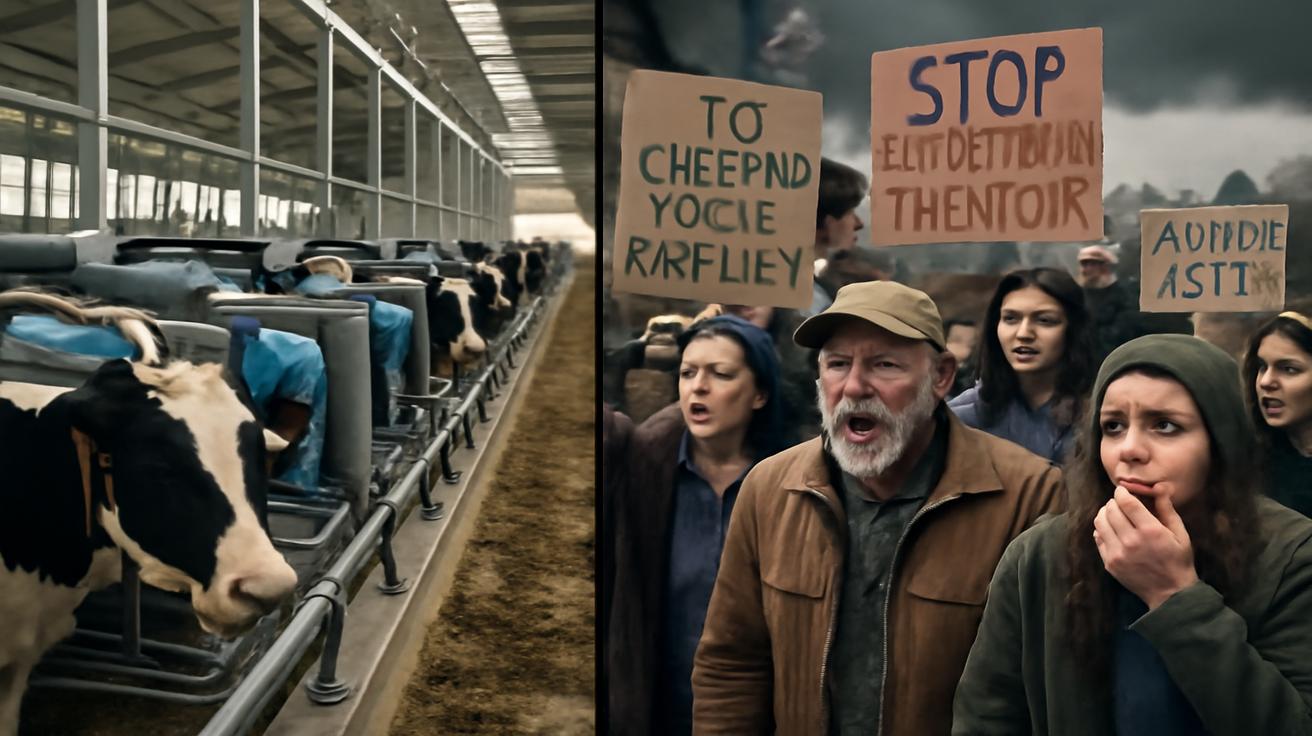
The calf is smaller than you expect. She blinks, damp lashes catching the light from the fluorescent barn lamps, her breath a pale ghost in the prairie chill. Someone’s taped a laminated card to her pen: “Lot 12, Line B – low-emissions family.” A graduate student in a blue toque scratches her chin with a gloved hand and says, almost proudly, “She’ll probably burp 30 to 40 percent less methane than a normal calf.” Then he pauses, as if realizing how strange that sentence sounds out loud. Somewhere between the hum of the ventilation fans and the shuffle of hooves, you can feel it: this is not just a barn. It’s a climate laboratory. And this calf, wrapped in the faint smell of hay and disinfectant, is one tiny piece of Canada’s most divisive new climate gamble – the hush-hush “carbon cow.”
The Barn at the End of the World
They don’t call them carbon cows here, not officially. On paper, this is a federally funded research herd dedicated to “methane mitigation in ruminant livestock.” In conversation, scientists at the facility – tucked behind a line of shelterbelt trees somewhere on the Canadian Prairies – talk about “low-emission lines,” “feed-conversion efficiency,” and “microbial optimization.” But outside these gates, the nickname has already stuck.
In the popular imagination, the carbon cow is a kind of climate superhero: engineered, bred, or otherwise tweaked to stay mostly silent in the atmospheric conversation. Less burping, less methane, less warming. A way, perhaps, to keep our burgers and our butter while also pretending to be responsible tenants of a heating planet.
Except, as always, the story is messier up close.
To get here, you turn off a highway lined with billboards of smiling maple leaves and cooperative slogans about “growing together.” Then the road narrows, wheat fields give way to research plots, and the air takes on that unmistakable farmyard density: manure, wet straw, and something metallic. Beyond the security gate, the barns look unremarkable – sheet metal sides, sliding doors, a tractor idling by the loading dock. But walk inside, and the details begin to tilt the world sideways.
On one wall, a screen scrolls live data: “Average CH₄/animal/day,” “Feed intake (kg),” “Rumen pH.” At regular intervals, cows line up at robotic feeding stations that look eerily like futuristic phone booths. As they eat, a hood descends, briefly capturing the air they exhale. The methane in their breath is measured in real time, each animal a living experiment.
“It’s like a Fitbit for farts,” one technician jokes, though the humor doesn’t quite mask the stakes. Agriculture is responsible for roughly 10 percent of Canada’s greenhouse gas emissions, and about a third of that comes from enteric methane – the gas that bubbles out of a cow’s complex, four-chambered stomach. Methane is a potent greenhouse gas: over 20 years, one tonne of methane can warm the planet more than eighty tonnes of carbon dioxide. In climate math, each quieted burp matters.
The Science of a Quieter Burp
Ask the lead researcher – we’ll call her Dr. Singh – how a cow becomes “low emission,” and she doesn’t start with some glowing GMO narrative. Instead, she talks about microbes.
“A cow is basically a fermentation tank on legs,” she says, leaning against a pen rail while a heifer noses inquisitively at her sleeve. “What we call a cow is really a cow plus an entire universe of bacteria, protozoa, and archaea living in her rumen. Change the community, and you change the gas.”
In practice, that means three overlapping strategies:
- Breeding: Selecting animals that naturally produce less methane per kilogram of milk or meat, and breeding them over generations.
- Feeding: Tweaking their diets with additives – from seaweed extracts to specialized oils – and high-sugar grasses that shift rumen chemistry.
- Microbial medicine: Experimenting with vaccines and microbial “cocktails” that discourage methane-producing microbes and favor more efficient ones.
Most of the cows here are not visibly different: same soft brown eyes, same heavy flank, same flicking tails. What’s different is happening invisibly inside them, in the molecular gossip between microbe and methane.
“People imagine franken-cows,” says Dr. Singh. “We’re really just leaning on natural variation and a very old technology: selective breeding. We’ve bred for milk yield, growth rate, horn shape – now we’re adding emissions to the list.”
But before the calves of this superherd have even grown into their bones, the outside world has already chosen sides.
Table: What Makes a “Carbon Cow” Different?
Here’s a quick look at how these experimental animals compare to conventional cattle.
| Feature | Conventional Cattle | “Carbon Cow” Superherd |
|---|---|---|
| Methane Emissions | Baseline; high variability between animals | Targeted 20–45% reduction per animal |
| Breeding Focus | Milk/meat yield, growth, conformation | Yield + emissions + feed efficiency |
| Diet | Standard forage and grain rations | Rations with methane-reducing additives |
| Monitoring | Basic herd records, occasional sampling | Continuous gas, feed, and health tracking |
| Policy Role | Status quo food production | Potential pillar of climate policy |
Why Small Farmers Are Furious
Drive an hour from the research barns, and you’ll find a different kind of cattle operation: a family farm with a sagging red barn, a kitchen that smells like coffee and mud, and a calendar on the fridge marked with vet visits and 4-H meetings. Here, the term “superherd” lands like a threat.
“We’ve been cutting emissions for years,” says Marie, who runs a mixed cattle-and-grain farm with her partner and two kids. “Nobody called my cows superheroes when I planted shelterbelts, switched to rotational grazing, and cut my fertilizer use.”
She stirs a pot of soup with the calm impatience of someone who cannot afford long, philosophical fights. Her issue is not with science, exactly. It’s with power.
“You know who can afford these low-methane genetics, the special feed, the monitoring tech?” she asks. “Big guys. Corporations. Feedlots with their own data teams. If climate money and subsidies chase the ‘carbon cow,’ we get left behind – or told our herds are dirty.”
The Canadian government, eager to showcase climate leadership, has poured millions into research on methane-reduced livestock. There’s talk of future tax credits for “verified low-emission beef” and procurement programs that favor products from low-methane herds.
On paper, that looks like progress. On Marie’s kitchen table, it looks like a knife edge.
“We’re already on thin margins,” she says. “If the market starts paying a premium for ‘clean cows’ bred in some lab-backed program, or if regulators set emission benchmarks we can’t meet without buying that genetic package, what happens to people like us? What happens to these animals, on these land bases, that have been part of our communities for generations?”
Her worry is quietly shared in coffee shops and auction yards across rural Canada. Will low-emission genetics become another patented, corporate-controlled input – like certain seeds – locking small farmers into dependency? Will carbon-cow metrics become yet another paperwork burden that nudges the middle-sized family farm closer to extinction?
“Climate policy always finds a way to land hardest on the people with the least cushion,” Marie says. “Don’t tell me you’re saving the planet if you wipe out the farms that actually know these landscapes.”
When Climate Tech Meets Animal Souls
If small farmers see carbon cows as an economic threat, animal-rights activists see something deeper: a moral trap.
At a vegan café in downtown Vancouver, far from the lowing of cattle and the smell of silage, a young organizer named Leila scrolls through her phone until she finds a photo from inside a research barn – not this one, but similar. A cow in a respiration chamber stands with her head locked into a feeding harness, hoses overhead, sensors taped to her hide.
“They call this climate justice?” Leila asks. “We’re strapping machines to animals we breed into existence, taking measurements of the gases from their bodies, and congratulating ourselves because we shaved a few grams of methane off each burp.”
For activists like Leila, the entire premise is backwards. In their view, there is no ethical version of engineering livestock for marginally less harm when the harm – confinement, slaughter, the turning of sentient beings into protein units – is built into the system.
“The science is clear,” she says. “We could cut agricultural emissions dramatically by shifting diets away from animal products. We don’t need carbon cows; we need fewer cows, period – and more beans and lentils and oats. We are using public money to prolong an industry that should be shrinking.”
She acknowledges that not everyone can go vegan tomorrow, that rural livelihoods matter, that cultural ties to cattle run deep in many communities, including some Indigenous ones. But she bristles at what she sees as a dangerous illusion.
“Tech fixes like this offer people a way to keep eating steak and telling themselves they’re part of the solution. It’s climate delay dressed up as innovation. It’s like putting a slightly smaller exhaust pipe on a car and calling it green, instead of building trains.”
Some animal-rights groups have gone further, calling the research barns “methane gulags” and staging small protests outside government offices. A leaked memo from a policy briefing – describing animals as “biological emission units” – has become a rallying cry online.
In this framing, the carbon cow is not a superhero, but a scapegoat: an animal we ask to change so we don’t have to.
Engineered Herds or Empty Pastures?
Back in the barns, Dr. Singh has heard all of this. Her inbox is filled with polite questions from farm groups, sharp critiques from activists, and wary inquiries from government departments looking for quick wins.
“It can feel like everyone is shouting past each other,” she says. “Either we’re villains propping up Big Beef, or naïve nerds who don’t understand farmers, or magical fixers who will let everyone keep living exactly as they do now.”
The reality – as usual – lives in the uncomfortable middle.
“Globally, billions of people rely on livestock, not just for food but for culture, livelihoods, and land management,” she continues. “In some places, grazing animals maintain grasslands that store carbon and support biodiversity. In others, industrial feedlots are indeed environmental disasters. Agriculture isn’t one thing.”
From a climate perspective, the numbers are stark but nuanced. Cutting global beef and dairy consumption, particularly in wealthy countries, would free up land and reduce emissions more dramatically than any breeding program could. That’s the argument abolitionists make: fewer cows, more climate wins.
Yet even under the most ambitious dietary-shift scenarios, climate models still show hundreds of millions of cattle on the landscape for decades to come. Herds shrink; they don’t vanish overnight.
“So the question becomes: what do we do with the animals we do have?” says Dr. Singh. “Do we shrug and say, ‘Well, they’ll be gone in fifty years anyway, no point trying to reduce emissions now’? Or do we do what we can to make current systems less harmful, while also working on broader transitions – plant-based diets, rewilding, support for farmers to change?”
Her team likes to talk about “multi-scenario responsibility”: designing solutions that make sense in several possible futures. In one, cattle numbers fall sharply and low-methane genetics become a niche tool. In another, political will falters, meat demand stays high, and these superherds become a crucial lever for meeting climate targets at all.
Neither scenario is tidy. A world of engineered herds raises its own alarms – about corporate control of genetics, about animal welfare in hyper-optimized systems, about the temptation to use climate as a cover for intensification. A world of empty pastures and shuttered barns is hardly simple either – especially if transitions are rapid, unjust, and leave rural communities in the dust.
“It’s a false choice to say ‘engineer or abolish,’” Dr. Singh says softly, watching a cow shift her weight and settle into straw. “Right now, we’re living in the messy in-between. Our decisions today shape how big that in-between is, and who bears its costs.”
Who Gets to Decide the Future of the Herd?
As the controversy spreads, another layer of tension surfaces: democracy. Who actually gets to decide whether Canada doubles down on methane-neutral superherds or starts planning for a slow cattle fade-out?
So far, the conversation has largely unfolded in three parallel rooms: research labs, government offices, and activist circles. Farm kitchens, supermarket aisles, and community halls have rarely been invited in.
“People talk about our cows like they’re chess pieces,” Marie says. “Nobody comes here to ask what cattle mean to us beyond the emissions.”
Meanwhile, Leila’s group struggles to get plant-based transition policies taken seriously in Ottawa. “We get five minutes on a Zoom call while the carbon-cow breeding consortium gets a whole afternoon,” she says. “Follow the funding.”
Inside government, the appeal of the superherd is undeniable. It fits a familiar storyline: Canadian science, Canadian know-how, Canadian leadership. It offers measurable metrics and photogenic barns. A minister can stand next to a sleek Holstein, talk about “world-leading low-emission beef,” and cut a ribbon. Asking people to eat fewer cheeseburgers? That’s harder to put on a podium.
Yet public opinion is more fluid than politicians assume. Surveys suggest many Canadians are open to eating less meat, especially if alternatives are accessible, affordable, and delicious. At the same time, rural residents worry their perspectives are caricatured in urban debates – reduced to “cow people” standing in the way of progress.
Some advocates are pushing for something rare in climate policy: deliberation that starts with the people most affected. Citizens’ assemblies that bring farmers, Indigenous communities, nutrition experts, environmental scientists, animal ethicists, and ordinary eaters into the same room to wrestle, slowly, with the future of food.
In those spaces, the carbon cow might show up not as hero or villain, but as one controversial character in a larger, more complicated story: How do we feed ourselves on a hotter planet without losing our collective soul?
Living with the Questions
As evening falls on the research farm, the barn air grows warmer, richer. Cows shuffle and snort. Somewhere, a door slams; a dog barks; the data screens keep glowing. Lot 12, Line B – the low-emissions calf – curls down into straw, tucking her legs with the practiced awkwardness of her species. She does not know she’s part of a national argument.
She does not know that far away, activists will hold her up as a symbol of hubris, or that small farmers will mutter about policies built on her biogas profile. She does not know that, in a briefing note, she’s being penciled into charts as a “climate solution pathway.”
Standing at the pen rail, you can feel the seduction of technological hope. If we can tweak biology, adjust diets, measure every breath – maybe we can buy time. Maybe we can keep some pieces of our world, our food, our traditions, as the atmosphere crowds in.
You can also feel the anxiety of half-measures. What if the comfort of a “cleaner cow” delays the harder work – of changing what’s on our plates, of shrinking herds where they do more harm than good, of listening to animals not as data points but as creatures whose lives we control, utterly?
Canada’s hush-hush carbon cow controversy sits right at that fault line. It asks questions that feel less like policy puzzles and more like personal ones:
- Is it better to reduce harm in a system you believe is unjust, or to refuse to touch it at all?
- Who gets to decide which traditions are worth preserving when the planet is at stake?
- When does innovation become an excuse not to change ourselves?
There are no easy answers in this barn, or in the fields beyond it, or in the cities where people bite into anonymous burgers under bright fluorescent lights.
There is only this: a young calf breathing clouds into the cooling air, surrounded by instruments and intentions. A country trying to decide whether to engineer its way toward a slightly better version of the present, or to imagine a future where these barns fall quiet and the pastures grow wilder and the word “cow” means something entirely different than it does today.
Between those futures lies a narrow path, trodden by scientists in rubber boots, by farmers with chapped hands, by activists with hand-painted signs, by all of us who eat. The carbon cow is already on that path, walking ahead of us. The real question is whether we will follow her, turn back, or find another way entirely, across fields we have not yet learned to see.
Frequently Asked Questions
What exactly is a “carbon cow”?
“Carbon cow” is an informal term for cattle bred, fed, or otherwise managed to produce significantly less methane – a powerful greenhouse gas – while still producing milk or meat. In Canada, it often refers to government-funded research herds focused on reducing enteric methane emissions through selective breeding and specialized diets.
Are these cows genetically modified?
Most current projects rely on selective breeding, not direct genetic modification. Researchers identify animals that naturally emit less methane per unit of product and breed them over generations. Some programs also use feed additives and microbial interventions. Gene editing is being discussed for the future but is not yet widely deployed.
How much can methane-neutral or low-methane cows actually help the climate?
Estimates vary, but many projects aim for 20–45 percent lower methane emissions per animal. At scale, this could significantly reduce agricultural greenhouse gases, especially if combined with better manure management and land practices. However, most experts agree that demand-side changes – like eating less beef and dairy in wealthy countries – would have a larger overall impact.
Why are small farmers worried about this research?
Small and family farmers fear that low-methane genetics and technologies will be expensive, patented, or tied to large corporations, reinforcing existing inequalities. They worry that future subsidies, market premiums, or regulations might favor “high-tech” herds and push traditional operations out of business.
Why do some animal-rights activists oppose carbon cows?
Animal-rights activists argue that engineering animals to be “less harmful” avoids the core ethical issue: raising and killing sentient beings for food. They also worry that climate-friendly branding will extend the life of industrial livestock systems and delay plant-based transitions that could reduce both emissions and animal suffering.
Does Canada plan to abolish livestock altogether?
No. There is no official plan to abolish livestock in Canada. Government strategies focus on making existing livestock systems more efficient and less polluting. Some academics and advocates call for reduced herd sizes and dietary shifts, but the debate over how far and how fast to go is ongoing.
What can individual eaters do in the middle of this controversy?
Individuals can reduce their climate impact by eating less beef and dairy, choosing higher-welfare or pasture-based products when possible, and supporting policies that help farmers transition to more sustainable practices. Staying informed and participating in local and national food-policy discussions also helps ensure that the future of livestock isn’t decided without public input.






Leave a Comment