
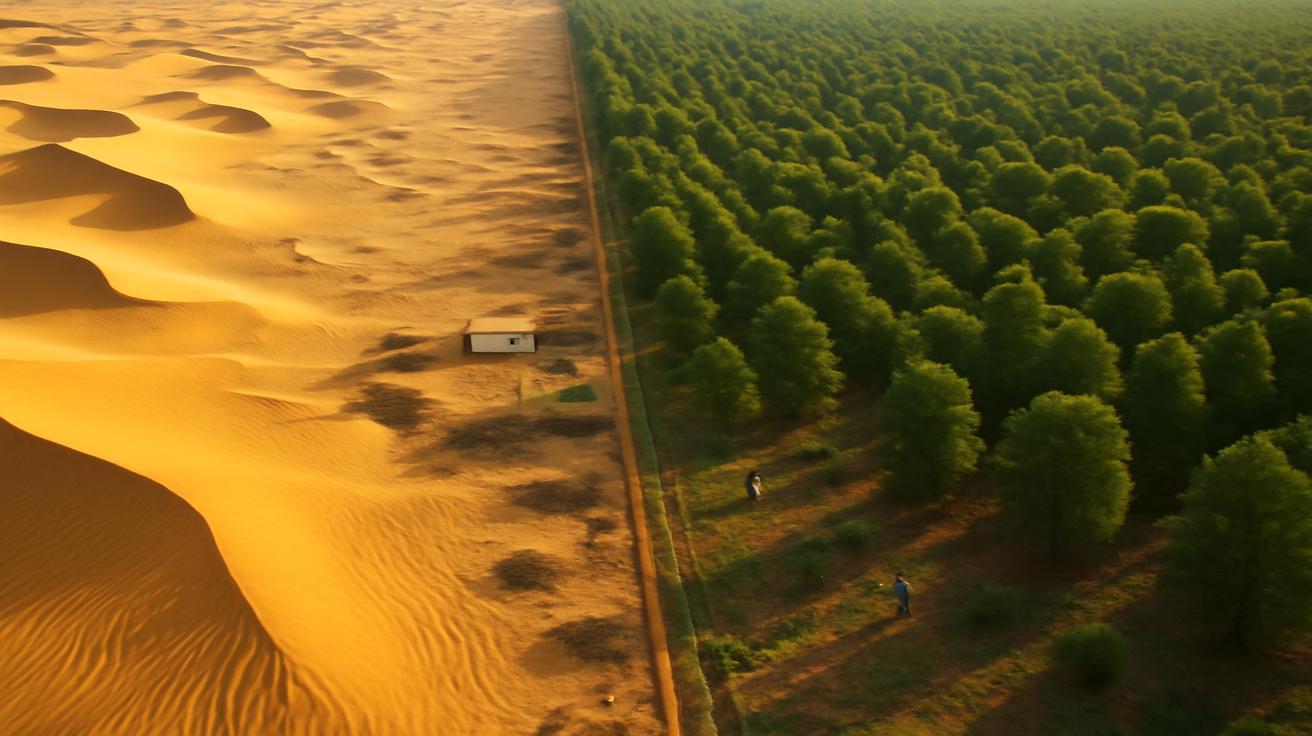
The wind arrives first—thin and high, a whistle running over bare sand. Then comes the dust, fine as flour, slipping into eyes, houses, lungs. For decades, this was the language of spring in northern China: skies turning sepia, the sun smudged behind a veil of grit, entire cities wrapped in the breath of distant deserts. Yet today, in some of those same places, that wind now brushes through something else: the rustle of poplar leaves, the scratch of young pines, the soft unfolding of new green. Where once there was only sand, there are now lines of trees—millions of them, then hundreds of millions, and now more than a billion—stitched across the land in a living, growing attempt to hold the desert at bay.
The Day the Sky Turned Yellow
If you were in Beijing in the early 1990s, you might remember those days when the sky went the color of old paper. People would tie cloths over their mouths, traffic lights blinked through an orange haze, and dust settled on desks, plants, and windowsills like a second skin. The storms didn’t start in the city. They were born hundreds of kilometers away, in the dry expanses of Inner Mongolia, Gansu, Ningxia, and beyond—regions where the grasslands had been overgrazed, forests cleared, and soil left exposed to the wind.
Each spring, powerful gusts scraped that land bare, lifting sand and dust high into the atmosphere and carrying it eastward. Villagers watched their fields get stripped, their wells choked, their livestock struggle. What had once been patchy degradation began to resemble something more ominous: deserts slowly expanding, chewing at the edges of farms, roads, and towns. By some estimates, China was losing thousands of square kilometers of land to desertification each year by the late 20th century.
Then, in a move as bold as it was uncertain, the country decided to try something extraordinary: to plant trees—so many trees that they might physically slow the advance of the desert. Over the next three decades, that idea grew into one of the largest ecological engineering efforts the planet has ever seen.
The Great Green Wall That Isn’t a Wall
People often call it “the Great Green Wall of China,” a phrase that conjures an image of a solid, unbroken forest running across the north of the country. The reality is at once less tidy and more interesting. Instead of a single line of trees, it’s a mosaic: bands of shelterbelts cutting across fields, triangular wedges of forest at the edges of towns, checkerboards of shrubs and grasses on dunes, restored natural woodland in mountain valleys, and carefully tended orchards rooted in once-barren soil.
Since the 1990s, China has planted well over a billion trees as part of a suite of large-scale programs aimed at slowing desert expansion and bringing degraded land back to life. The most famous of these, the “Three-North Shelterbelt Program,” began in the late 1970s and ramped up significantly in the 1990s and 2000s. But it’s joined by others: the “Grain for Green” project that pays farmers to plant trees on steep or fragile land; efforts to stabilize sand dunes with shrubs and grasses; community-level campaigns to plant windbreaks around villages.
Walk through one of these new forests and it doesn’t feel like a grand geopolitical project. It feels like a human place: a man on a motorbike hauling saplings in a trailer; schoolchildren pressing light green seedlings into dusty soil; an elderly woman straightening the protective plastic wrapping around a young tree’s trunk. In many regions, planting and maintaining trees has become a seasonal rhythm woven into local life—part job, part duty, part hope.
The Quiet Return of Green
From space, the impact is striking. Satellite images taken over the last few decades reveal an unexpected trend in parts of northern China: where once the colors were light and bare, they’ve shifted steadily toward deeper shades of green. Research using long-term vegetation indices has shown that tree cover and biomass have increased significantly in many of the country’s dry and semi-dry regions.
On the ground, that greening is anything but abstract. In sections of Inner Mongolia where shrubs and trees have been carefully planted and protected, sand dunes that once wandered with the wind now sit more quietly, pinned in place by roots. In Gansu, terraced hillsides once carved into thinly cropped fields have been re-clothed with trees and grasses. In some counties, local officials report fewer sandstorms and better air quality; farmers talk about improved soil moisture and the return of insects and birds that had disappeared.
To understand the scale and shape of this transformation, it helps to see a snapshot of how tree planting fits into the broader story of land restoration and desert control. The picture is not simple, but a pattern emerges.
| Aspect | Before Large-Scale Planting | After Decades of Effort |
|---|---|---|
| Land Condition | Expanding deserts, degraded grasslands, exposed soil | Stabilized dunes, recovering grasslands, growing tree belts |
| Dust Storm Frequency in Many Areas | Frequent, intense spring storms affecting cities and villages | Reduced frequency and severity in several regions |
| Local Livelihoods | Soil loss, poor yields, pressure on marginal land | New income from tree planting, fruit, nuts, and eco-tourism in some areas |
| Vegetation Cover | Sparse, fragmented, dominated by hardy shrubs or bare ground | More continuous belts of trees, shrubs, and grasses |
| Ecological Stability | High erosion risk, frequent land degradation | Improved soil stability, better microclimate in restored zones |
What It Feels Like When a Desert Backs Off
Statistics can tell you how many trees were planted, how many hectares of dunes have been stabilized, how many tons of topsoil were spared from the wind. But it is the small, human-scale changes that make the story come alive.
Imagine a village in Ningxia at the edge of a once-restless desert. Years ago, parents walked their children to school against a constant grainy wind. Sand piled up against courtyard walls; it found its way under doors, onto pillows, into rice bowls. People remembered waking at night to a strange creaking sound: the wind reshaping the dunes nearby.
Now, after years of planting and fencing off fragile land from grazing, a young boy walks the same route to school beneath a row of poplars. Their trunks are still thin, but their shadows fall in gentle stripes across the dusty path. You can hear the wind, but you can also hear leaves, a soft clapping sound that didn’t exist here before. Behind the village, low dunes are netted with hardy shrubs arranged in precise, geometric patterns—living stitches that keep the sand where it lies.
For farmers, the difference isn’t romantic; it’s practical. With windbreaks in place, less soil is blown away. Crops suffer less from desiccating gusts. In some places, groundwater recharge improves slightly as the soil structure stabilizes and vegetation traps moisture. Where fruit trees have been introduced—apples in some regions, dates and sea-buckthorn in others—families gain a new source of income. A hillside that once yielded little more than dust now offers crates of something fragrant and edible.
At dusk, the colors change. In restored areas, sunset doesn’t wash over bare sand alone; it catches on the pale green of tamarisk, the feathery tops of desert poplars, the deepening shadows beneath pine plantations. Crickets return to call from the undergrowth. Birds trace new pathways between belts of trees. The desert is still there, vast and formidable, but it no longer feels like it is pressing in with quite the same insistence.
The Science Beneath the Roots
Behind this shift lies a hard-learned lesson: planting trees in a dry land is both art and science—and not every tree belongs everywhere. In the early years of China’s great planting push, the urgency to act sometimes outran ecological understanding. Large monoculture plantations of fast-growing species like poplar or pine were established in places where water was scarce and soils were fragile. Some of these plantations struggled, with high mortality rates and signs that thirsty trees were competing with other vegetation and even with people for limited water.
Over time, the approach evolved. Ecologists, foresters, and local farmers began to work more closely together. In many areas, the strategy shifted toward using native species adapted to arid conditions, mixing trees with shrubs and grasses, and focusing as much on restoring natural vegetation patterns as on sheer numbers of trunks in the ground. Instead of planting dense forests everywhere, practitioners learned to build strategic belts of vegetation: windbreaks along key directions, shrub grids across mobile dunes, and patches of woodland in places where moisture collects.
Desert control is not only about what you put into the land; it’s also about what you stop taking away. Parallel to tree-planting, vast areas of fragile grassland and degraded slopes were fenced or otherwise protected from overgrazing and over-cultivation. In some regions, simply stepping back—giving the land a pause from constant pressure—allowed grasses and shrubs to rebound. Trees, in this context, became one piece of a larger ecological puzzle rather than a silver bullet.
Climate adds its own complexity. Northern China’s drylands sit at the edge of what is climatically comfortable for most forest species. Rainfall is uncertain, often arriving in short, intense bursts sandwiched between long dry spells. Temperatures swing from searing summers to bitter winters. To thrive here, a tree must be tough, water-wise, and patient. The success stories often involve species that know this language of scarcity: desert willow, sea-buckthorn, Mongolian Scots pine, local poplars, and a suite of shrubs whose names rarely appear in global media but are well-known to herders and farmers.
Slowing the Sand, Changing the Story
So, has planting over a billion trees since the 1990s truly slowed desert expansion in China? Multiple lines of evidence say yes—though the answer is nuanced.
Some of the most compelling data come from long-term satellite analyses and ground surveys. In several key regions, the advance of deserts has slowed, halted, or even reversed. Areas that had been steadily losing vegetation for decades began to show stable or increasing cover. Wind erosion indices dropped. The number and intensity of dust storms affecting parts of northern China have decreased over time, thanks in part to these ecological efforts as well as changes in climate and land management.
Yet, it would be misleading to claim that trees alone saved the day. Desertification is driven by a web of forces: climate variability, unsustainable land use, population pressures, and economic decisions. China’s response has also been a web: not just planting trees but changing grazing policies, adjusting farming practices, relocating some communities from the most fragile zones, and investing in research and monitoring.
Still, the trees matter. They matter physically—casting shade, slowing wind, anchoring soil. They matter biologically—creating habitat, cycling nutrients, shaping microclimates. And they matter symbolically, as living proof that a trajectory of loss can be bent, however imperfectly, toward recovery.
Walk in one of these restored belts on a hot day and you can feel the difference. Step from open ground into the shade of a tree shelterbelt and the air cools. The wind drops a notch or two. Dust, which once flew freely, now settles more quickly among needles and leaves. A lizard darts between roots. You might catch the scent of resin or the faint sweetness of early blossoms in the branches above. All of it stands as quiet counter-argument to the idea that deserts, once on the move, are impossible to slow.
Lessons Growing in the Sand
China’s grand experiment in large-scale tree planting and land restoration carries lessons—some inspiring, some cautionary—for a world facing its own suite of environmental crises.
One lesson is that size matters. When you coordinate efforts across millions of hectares, involving central government, local authorities, scientists, and rural communities, the cumulative effect can alter regional patterns of land degradation and even aspects of climate and hydrology. A billion trees planted haphazardly might achieve little; a billion trees planted strategically, supported, and monitored can reshape landscapes.
Another lesson is that ecology cannot be rushed. Early missteps with monocultures and water-hungry species revealed the limits of a “plant anything, anywhere” mindset. Effective restoration respects the contours of local ecosystems: where water flows, how soils behave, what species evolved under those conditions. In recent years, more attention has turned toward diversity—of species, of planting methods, of partnerships with local people.
Perhaps the deepest lesson, though, is psychological. Faced with vast, slow-moving problems like desertification or climate change, it is easy to feel small, to see the march of sand or the rise of carbon as unstoppable. The story of China’s trees doesn’t offer a fairy-tale ending—many challenges remain—but it does offer a different kind of narrative: one in which determined, coordinated action can nudge the direction of an entire region’s future.
Along the edges of China’s deserts today, evenings are still windy. Dust still rises. But in many places, when that wind passes, it runs into something it did not always find before: roots gripping soil, branches catching gusts, leaves softening the blow. It meets a resistance that is alive.
A Future Written in Rings of Wood
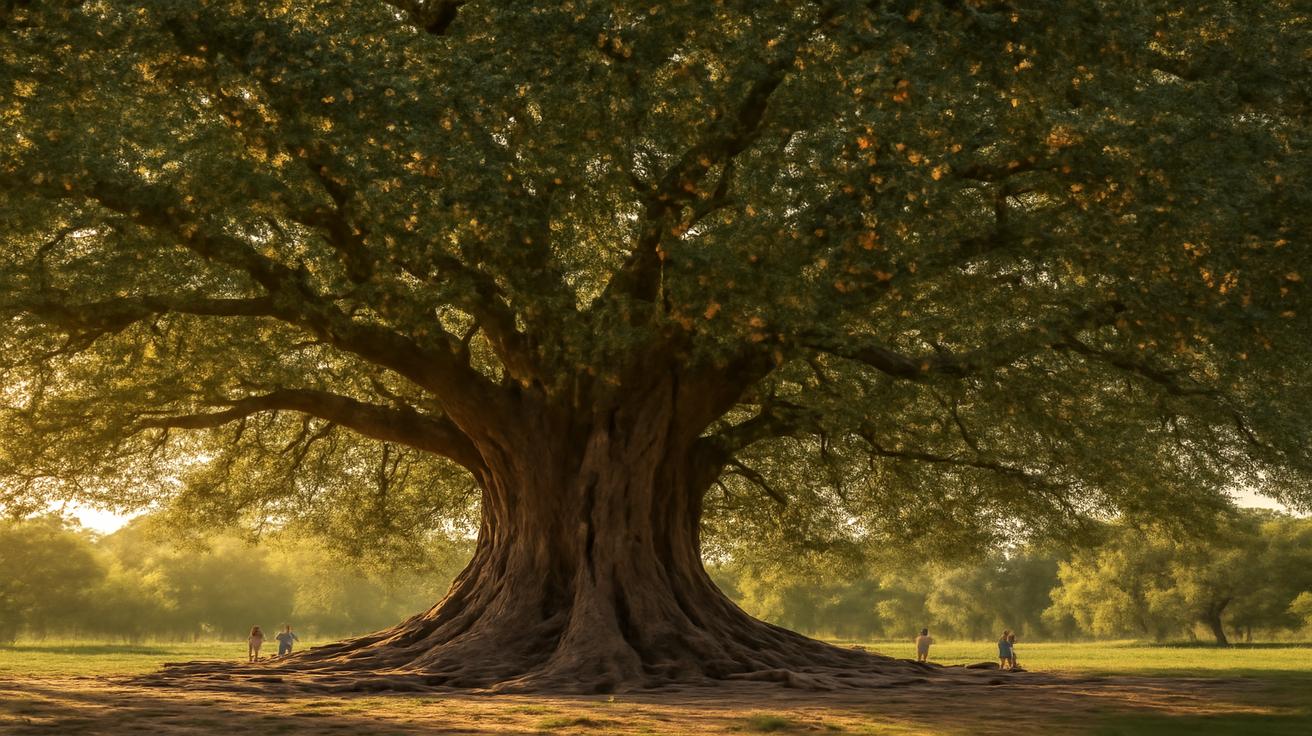
Some of the youngest trees planted in the 1990s are now tall enough to throw long shadows. Their trunks hold a thin stack of growth rings—narrow in dry years, wider when rains were kinder—each ring a quiet record of the climate and care that shaped it. Inside those rings is also something else: the imprint of human choice.
Standing under such a tree on a hot afternoon, a planter might remember the day it went into the ground: the softness of the seedling’s stem, the way the wind tugged at its first small leaves, the uncertainty of whether it would survive. Multiply that moment by millions, by decades, by shifting techniques and improved understanding, and you start to sense the magnitude of what has been attempted—and, increasingly, what has been achieved.
There are still debates, sharp and necessary, about how to plant better: how to balance water use, prioritize native species, protect biodiversity, and ensure that rural communities benefit fairly from restoration projects. There are worries about what climate change will do to these fragile gains—whether hotter, drier conditions might undo some of the hard-won progress.
Yet when you look out over a once-barren hillside now patched with young forests and recovering grassland, it is hard not to feel that something important has shifted. The story is no longer only one of loss and advance—desert moving, people retreating. It has become a more complex conversation between land and humans, one in which the land is being given, at least in places, a chance to heal.
Somewhere in northern China this evening, a farmer will close a gate along a fence meant to keep livestock off a newly restored slope. A child will walk home beneath the shelter of a row of young trees. A forester will note the survival rates of last year’s plantings. High above, a satellite will capture a tiny change in color—just a fraction of a shade greener than last year. Each of these moments is small. Together, they mark the slow, deliberate act of turning back the desert’s edge.
It begins with a seedling pressed into dry soil, a splash of water, and a hopeful pat. It continues with the quiet hard work of maintenance, adjustment, and learning. And over years, then decades, it becomes something you can see from space, breathe in your lungs, feel under your feet: a landscape that did not give up, because people chose not to let it.
Frequently Asked Questions
Has China really planted over 1 billion trees since the 1990s?
Yes. Across multiple national programs, China has planted well over a billion trees since the 1990s, making it one of the largest tree-planting and land restoration efforts in the world. These trees are part of broader strategies to combat desertification, control dust storms, and restore degraded land.
Did tree planting alone stop the deserts from expanding?
No. Tree planting is a major component, but it works alongside other measures: reducing overgrazing, changing farming practices, protecting fragile land, and adjusting local policies. Together, these actions have slowed or reversed desert expansion in several regions.
Are all the planted trees surviving?
Not all. Early projects sometimes used unsuitable species or planted in very dry areas, leading to high mortality. Over time, strategies improved, with more emphasis on native, drought-tolerant species, mixed vegetation, and better site selection, which has increased survival and long-term success.
How has this affected dust storms and air quality?
In many parts of northern China, the frequency and severity of dust storms have decreased compared to previous decades. While climate and other factors also play a role, restored vegetation and stabilized soils have contributed significantly to this improvement.
What can other countries learn from China’s experience?
Key lessons include the power of large-scale, long-term commitment; the importance of using species adapted to local conditions; the need to integrate tree planting with broader land management changes; and the value of involving local communities in design and stewardship. Perhaps most importantly, China’s experience shows that even large-scale degradation is not destiny—landscapes can recover when people invest in their healing.






Leave a Comment