
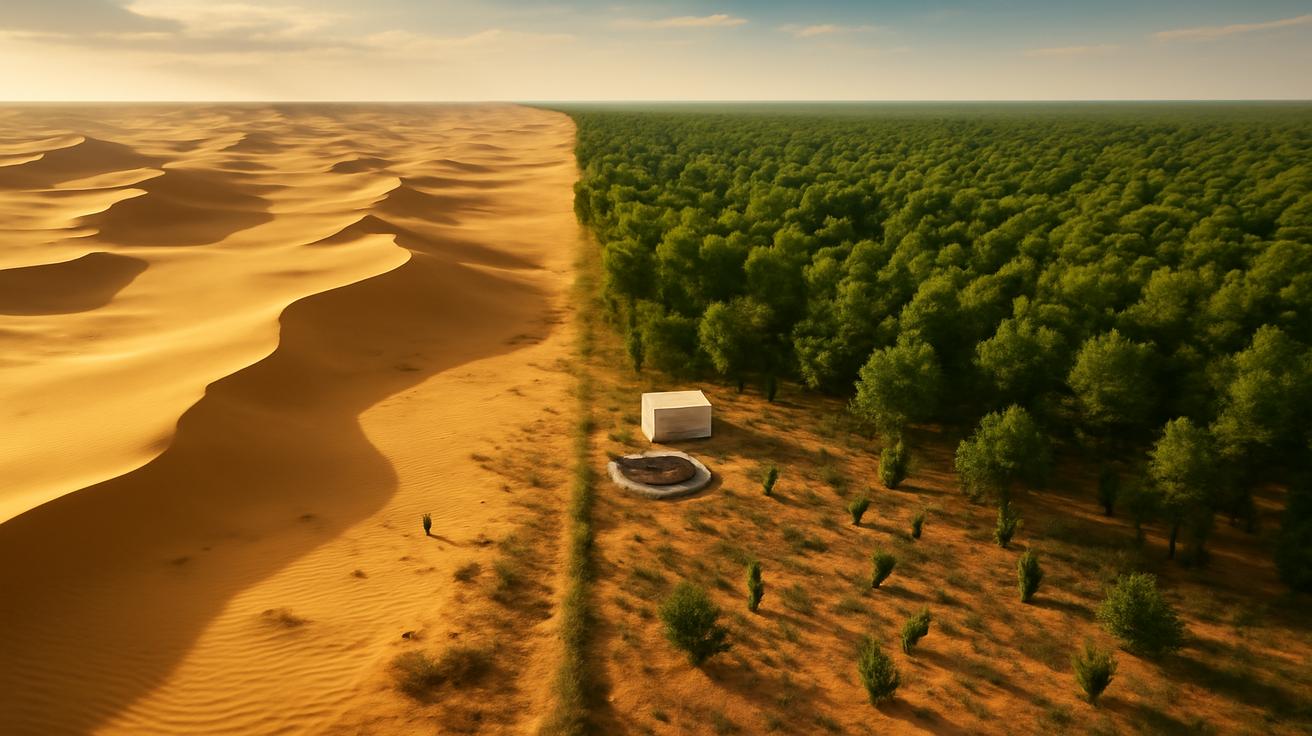
On a dim spring morning in northern China, the wind moves differently than it used to. Thirty years ago, it arrived knife-sharp and unapologetic, hurling sand and dust across villages, turning the sky the color of old parchment. Today, the same wind still comes—but it is slowed, filtered, gentled by a strange and beautiful thing that did not exist here in such abundance a generation ago: trees. Rows and rows of them, stretching out like a green tide against the brittle edge of the desert.
A Green Line Against a Moving Desert
If you had stood here in the early 1990s, near the edge of the Gobi Desert, you might have thought the land was giving up. The soil was tired and loose, fields were turning to sand, and each year the desert crept a little further into farmland, villages, and roads. Dust storms, sometimes so thick they turned noon into twilight, swept not only across China but into Korea, Japan, and even as far as North America.
China’s leaders called it “desertification”—a technical word that hides the emotional weight of watching a landscape unravel. It wasn’t only about land. It was about people leaving their homes because the soil could no longer feed them. It was about herders who found less and less grass for their animals. It was about children who grew up learning how to tie cloth over their mouths and eyes when the dust storms rolled in like armies.
In response, China undertook one of the most ambitious tree-planting campaigns the world has ever seen. Since the 1990s, the country has planted more than one billion trees in an effort to slow the spread of the desert and restore degraded land. The numbers are almost too large to picture. But if you were to walk through these forests—hand on rough bark, shoes crunching on dried needles and leaves—you would feel their weight not in numbers, but in shade, in birdsong, in the muffled sound of the wind.
This vast effort is often called the “Great Green Wall” of China, an echo of the stone wall that once sought to keep invaders out. But this time, the enemies are wind and sand, erosion and emptiness. Tree by tree, pit by pit, sapling by sapling, a living wall has risen along the frontlines of a moving desert.
The Land That Was Slipping Away
To understand why planting over a billion trees matters, you have to understand what was happening to the land before those saplings took root. Across northern and western China, millions of hectares of grassland and farmland had been pushed beyond their limits. Overgrazing had stripped hillsides bare. Unsustainable farming practices had exhausted the soil. Forests had been cut too quickly, leaving the ground exposed to the relentless wind.
Under such pressure, soil loses its structure. The darker, fertile layers blow away first, leaving behind a pale, sandy skin that can no longer hold water or nutrients. A field becomes patchy, then sparse, and eventually so barren that even hardy shrubs give up. In some places, sand dunes formed where crops once grew, leaning against abandoned fences like sleeping animals that had migrated from another world.
People living in these regions describe the sound of the wind when there are no trees: a hollow roar, like someone tearing fabric that will never be sewn back together. They remember waking up to find their courtyards filled with sand, their roofs coated, their throats scraped raw from breathing dust. In the worst years, dust storms traveled all the way to Beijing and beyond, turning famous skylines into smudged silhouettes behind veils of grit.
By the end of the twentieth century, the urgency was impossible to ignore. China faced not only an environmental crisis, but a human one. Something had to change—and fast.
From Bare Earth to Seedling Rows
At first glance, the idea seems almost too simple: plant trees, stop the sand. But the reality on the ground is far more complex, and it begins with an act of quiet, repetitive labor. Somewhere on the edge of the desert, a farmer kneels beside a shallow pit, presses a sapling into the earth, and hopes it will live.
This scene has played out millions of times. By the 1990s, China had already begun environmental restoration projects, but it was in those years and beyond that the scale exploded. Government programs offered incentives for farmers to plant trees on steep slopes instead of crops. Degraded land was reclassified for ecological restoration instead of production. Teams of workers dug planting pits in frozen ground, in baking heat, on slopes that crumbled under their boots.
You can trace their effort not in satellite images—though those are striking—but in the stories locals tell. A woman in Inner Mongolia recalls the first time she volunteered for a tree-planting drive: “We went out in buses at dawn. It was still cold, and the wind kept filling the holes with sand. We planted so many saplings that day that when I closed my eyes, all I could see were thin sticks, row after row.”
Today, many of those “thin sticks” have thickened into trunks. Where there were once open plains vulnerable to every gust, there are now belts of poplars, pines, and other hardy species that act like brakes on the wind. They cast shade, slow evaporation, and create pockets of cooler, moister air. Under their protection, grasses begin to recolonize the ground, binding the soil with a living net of roots.
How a Billion Trees Change the Wind
Walking through one of these restored areas, you can feel the difference long before you can measure it. Step from open land into a line of trees and the air temperature seems to drop by a breath. The harsh whistle of the wind dims to a low murmur. Dust that might have whipped across the open plain hits a wall of leaves and needles, swirls, and falls to the ground. The forest is not silent—the branches creak, insects click, birds call—but it is calmer. More deliberate.
On a larger scale, this is what over a billion trees have done for northern China: they have slowed the wind enough to weaken the sandstorms. They have anchored the soil so that dunes march more slowly, or not at all. They have interrupted the great, invisible river of dust that once poured from the deserts into farmlands and cities downwind.
Scientists tracking these changes have seen measurable results. In regions where tree belts and restored vegetation have taken hold, the advance of desert land has slowed and, in some places, reversed. Satellite images show once-barren stretches now tinged with green. Local meteorological data reveal fewer and less severe dust storms compared with the late twentieth century. These are not miracles—they are cause and effect, rooted in the humble physics of wind, sand, and roots.
Yet the change is not only mathematical. It is sensory. There are now places where children who once stayed indoors on “yellow sky days” can go to school without choking on dust. Farmers speak of slightly longer growing seasons and improved yields where shelterbelts (rows of trees planted to protect fields) now stand. Herders describe seeing grass return where only anemic shrubs once struggled. Even city dwellers far from the planting sites notice clearer skies in spring, fewer days when the world turns the color of ash.
The Human Dimension of a Green Wall
Behind every statistic about trees planted, hectares restored, or dust storms reduced, there are human lives reshaped by this ecological experiment. For some communities, the tree-planting programs brought new jobs: nursery workers, planters, forest rangers, technicians monitoring sapling survival. For others, it brought a more complicated transition, especially where traditional farming or grazing was restricted to allow land to recover.
Imagine being a farmer whose family has cultivated the same slope for generations. Then one day, you are told that this land is too fragile, too steep, too prone to erosion, and it must be retired into forest. In return, you’re offered compensation, sometimes training or opportunities elsewhere. This is not a simple trade. There is grief in letting the plow rust while seedlings take your place, even if those seedlings promise a more stable future.
Yet in many places, communities have adapted. Some have shifted to less land-intensive livelihoods. Others have become stewards of the new forests, earning income by protecting and maintaining them. There are villages that now hold annual tree-planting festivals, where the day is as much about music, food, and pride as it is about digging holes. The work of restoration has, in some corners, become a new cultural narrative: we were losing the land, and we fought to bring it back.
In regions once famous only for dust storms, local guides now lead visitors along forest paths, showing off the improbable greenery as if introducing old friends. What was once a symbol of loss has, in some cases, become a symbol of resilience.
What the Numbers Tell Us
It’s one thing to describe the feel of a forest where there was once desert; it’s another to see the scale of what’s happened. The table below offers a simplified snapshot of how tree-planting and restoration in China have aligned with changes in land and dust storms over recent decades. These numbers are broad estimates, but they help illuminate the arc of this massive effort.
| Period | Approx. Trees Planted (Cumulative) | Restored / Afforested Land (Million ha, Approx.) | Trend in Desert Expansion & Dust Storms |
|---|---|---|---|
| Early 1990s | Tens of millions | Limited, mostly pilot projects | Deserts expanding; frequent severe dust storms |
| Late 1990s–2000s | Hundreds of millions | Rapid increase in restored and protected areas | Desert expansion slows; some stabilization |
| 2010s onward | Over 1 billion cumulative trees | Substantial areas of afforestation and re-greening | In some regions, desert retreats; fewer major dust events |
Behind these figures lies a gradual transformation: from reaction to planning, from scattered projects to coordinated landscapes. No single year flipped a switch. Instead, a slow, stubborn accumulation of effort changed the direction of an entire region’s ecological story.
The Complications of Planting a Forest
Of course, planting over a billion trees is not an unbroken success story. Forests are not simply “on” or “off,” and not every sapling survives. Some areas were planted with species that struggled in local conditions or drew down scarce groundwater. In some early projects, large monoculture plantations—rows of the same tree species—proved vulnerable to pests, disease, or drought.
Ecologists have raised important questions: Are the right trees being planted in the right places? Are native species being prioritized? How much water do these forests consume compared with the landscapes they replaced? Are grasslands, which are valuable ecosystems in their own right, ever being improperly converted to forest just to meet tree-planting targets?
Over time, many restoration programs in China have evolved in response to these critiques. Later phases have placed greater emphasis on using native species, mixing trees with shrubs and grasses, and sometimes allowing natural regeneration rather than planting everything by hand. In water-scarce regions, planners increasingly weigh the trade-offs between dense forests and more open, drought-tolerant vegetation that can stabilize soil without straining aquifers.
These course corrections matter, not just for China, but for any country looking to its example. The lesson is not simply “plant trees.” It is “restore ecosystems wisely.” Done well, afforestation can cool landscapes, protect soil, and support biodiversity. Done poorly, it can strain water supplies or create fragile forests that cannot survive the very climate pressures they are meant to ease.
Lessons for a Warming World
Still, there is something undeniably powerful about standing in a place that once seemed doomed to sand and realizing that human action reversed the trend. In an era often defined by stories of loss—of glaciers melting, forests burning, coasts eroding—China’s billion trees offer a counter-narrative: degradation is not always a one-way street.
This does not mean the job is finished. Climate change continues to stress these new forests with higher temperatures and shifting rainfall patterns. Population growth and development still press on the land. Some restored areas may falter. Others will need ongoing care, thinning, replanting, or even redesign as conditions change.
And yet, the broad arc remains: desert expansion has slowed, and in some places reversed. Degraded land has been coaxed back into life. Dust storms that once defined springtime in northern China have grown less intense and, in some years, less frequent. A billion trees cannot solve every problem—but they have undeniably moved the needle.
From Barren to Believable
Perhaps the most enduring impact of China’s Great Green Wall is psychological. For decades, many people assumed that desertification was a kind of fate: once land crossed an invisible line into barrenness, it could never recover. The story of over a billion trees proves otherwise. It shows that with enough effort, planning, and patience, even a vast, fraying landscape can be persuaded to knit itself back together.
Picture again that dawn on the desert’s edge. A line of schoolchildren clamber off a bus, each carrying a sapling barely taller than their knees. The ground underfoot is sandy but not as loose as it once was; plant roots have begun to hold it in place. Their teacher shows them how deep to dig, how to straighten the fragile stem, how to press the soil firmly—gently—around the roots. They laugh, complain about the cold, race each other to finish their rows.
Years from now, those children might bring their own families back to the same slope. They may not remember exactly which tree they planted, but they will remember that there was a time when this hill was almost bare—and that they were part of the long, messy, imperfect, miraculous work of turning it green.
China’s billion trees are not just trunks and leaves. They are a declaration, written in living wood, that the future of a landscape is not fixed. Sand can be slowed. Soil can be mended. And even along the shifting edge of a great desert, it is possible to plant a line in the earth and say: this is as far as the sands will go.
Frequently Asked Questions
How many trees has China planted to combat desertification?
Since the 1990s, China has planted more than one billion trees as part of large-scale afforestation and restoration programs aimed at slowing desert expansion and restoring degraded land, especially in the country’s north and northwest.
Has tree planting in China actually slowed desert expansion?
Yes. Scientific studies and satellite observations show that in many regions, the advance of deserts has slowed and, in some areas, partially reversed. Vegetation cover has increased, and dust storms have generally become less frequent and less severe than in the late twentieth century, although challenges remain.
What is the “Great Green Wall” of China?
The “Great Green Wall” is an informal name for a series of large-scale environmental projects—most notably the Three-North Shelter Forest Program—designed to create belts of trees and restored vegetation along the northern edge of China to block sandstorms, stabilize soil, and reduce desertification.
Are all the planted trees in China surviving?
No. Not every sapling survives, and survival rates vary by region, species, and planting method. Some early projects faced high mortality due to drought, pests, or poor species selection. Over time, programs have increasingly focused on choosing better-adapted, often native species and improving planting techniques to boost long-term survival.
What are the main environmental benefits of China’s large-scale tree planting?
The benefits include reduced wind erosion and sandstorms, stabilization of soils, partial restoration of degraded land, improved local microclimates, increased vegetation cover, and, in some areas, modest gains in biodiversity and agricultural productivity. These forests also store carbon, contributing to climate mitigation.
Are there any drawbacks or concerns about China’s tree-planting efforts?
Yes. Concerns include overreliance on monoculture plantations, potential pressure on limited water resources, and, in some cases, the conversion of natural grasslands into forests where forests are not the most appropriate ecosystem. These issues have driven program adjustments toward more diverse, ecologically informed restoration.
What can other countries learn from China’s experience?
Key lessons include the power of long-term commitment, the importance of combining tree planting with broader land-management changes, and the need to focus on ecosystem restoration—not just hitting numeric tree-planting targets. China’s successes and mistakes both offer valuable guidance for nations planning large-scale restoration in a warming, crowded world.







Leave a Comment