
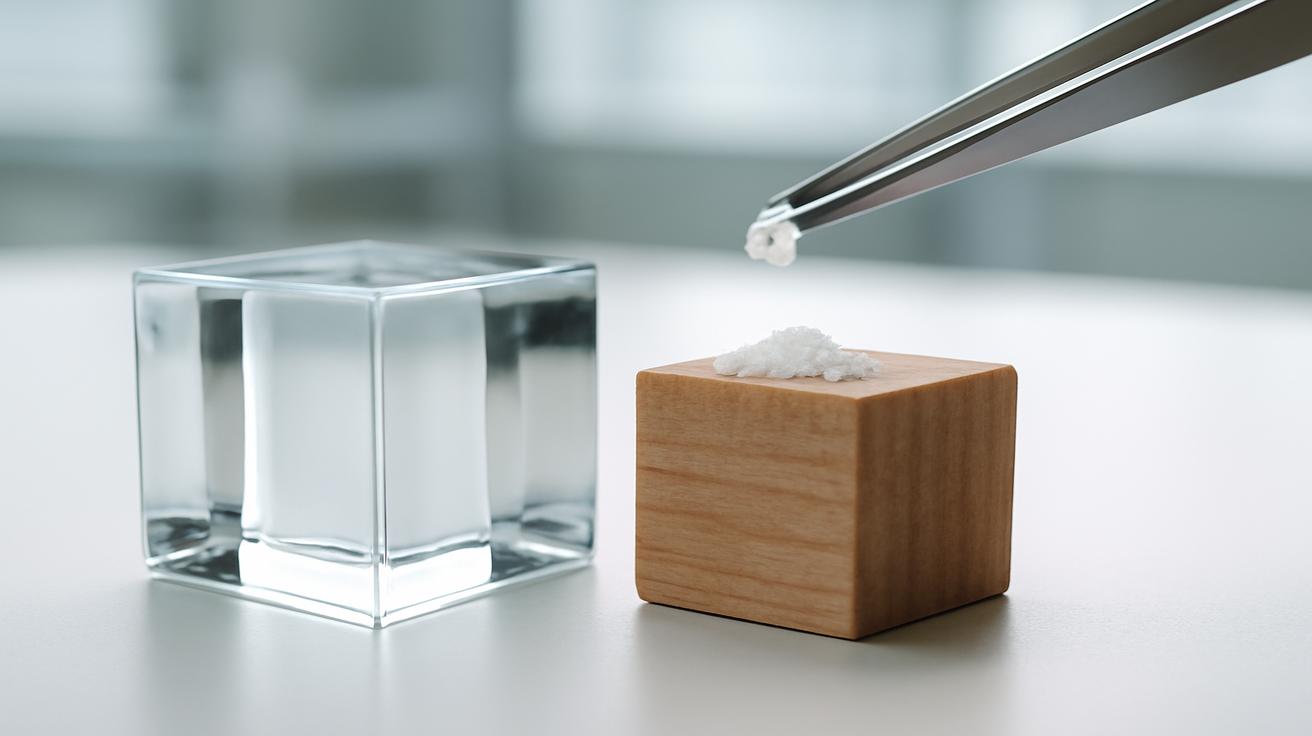
The first thing you notice is the sound—the soft, papery sigh of wood fibers as they yield under a strange new ritual. In a small lab in Japan, thin slats of pale wood are being bathed, pressed, and infused with salt, as if prepared for some culinary experiment rather than a materials revolution. On the table nearby, a transparent, feather‑light square rests under the fluorescent lights, catching them and bending them like water. It looks like plastic. It behaves like plastic. But it began its life as a tree.
From Forest to Flask: A Quiet Revolution
For more than a century, plastic has been the miracle and the menace of modern life. It is molded into the keyboard under your fingers, the packaging that delivered your last purchase, the medical syringes that save lives, and the uncountable fragments drifting now in the bellies of seabirds and deep ocean trenches. We made a material that lasts longer than we do—and we let it spill into everything.
Now imagine a different story. Picture a forest of Japanese cedar and birch, soaking up carbon from the air in the slow patience of photosynthesis. Scientists walk under that living canopy, seeing not only trunks and leaves, but a future inventory of car dashboards, smartphone casings, and building panels that might one day return, safely, to the soil.
This is the vision behind a quietly astonishing Japanese innovation: a new wood‑derived, salt‑enhanced “perfect” plastic. In the simplest terms, researchers have figured out how to take the strength of trees, the chemistry of salt, and the precision of modern engineering, and braid them into a material that could displace a significant portion of fossil‑fuel plastics. Not with a fantasy, but with something you can hold, bend, drill, and recycle.
It begins with cellulose—the long, stringy molecules that form the scaffolding of every plant. Cellulose is already one of Earth’s most abundant organic substances. But in wood, those fibers are packed together with lignin and hemicellulose, the natural glues and matrix that make trunks tough and rigid. The Japanese teams asked a deceptively simple question: What if we could re‑engineer that structure rather than replace it entirely? Could wood itself become a high‑performance plastic?
The Alchemy of Salt and Fiber
To understand how this new material comes to life, imagine a piece of wood deconstructed and rebuilt from the inside out. The process typically starts with thin wood planks or veneers. They are treated in a solution that gently removes some of the lignin—the dark glue that stiffens and colors the wood—while leaving much of the cellulose scaffolding intact. This step opens up microscopic spaces within the wood, tiny channels and pores ready to host a new guest.
That guest is salt—not the table salt you sprinkle over dinner, but carefully chosen inorganic salts that can slip between the cellulose nanofibers. The wood is soaked in a salt solution, allowing these ions to infiltrate the newly freed spaces. At a scale far smaller than a human hair, the ions rearrange how fibers talk to each other. They change surface charges, tweak hydrogen bonds, and help the fibers slide, lock, and pack together more efficiently.
Then comes pressure. The treated wood is pressed under intense force, compacting the structure until those cellulose fibers and salt ions knit into a dense, glassy, almost transparent solid. What emerges is no longer simply wood, but a wood‑based bioplastic: hard, stiff, and shiny, yet born from a living organism and grown using sunlight and carbon dioxide.
If you were to touch it, you’d feel something that sits between plastic and bone—light but firm, with a faint grain still hinting at its arboreal origin. Hold it to the light, and it can be surprisingly transparent, depending on how it’s processed. That transparency is crucial; it means this material can step into roles normally reserved for petroleum plastics or even glass: screens, windows, optical components, and clear packaging.
Why This “Perfect” Plastic Matters
Calling any material “perfect” might sound like marketing hyperbole, but from an environmental and engineering perspective, this salt‑injected wood plastic checks an uncanny number of boxes. It addresses three long‑standing problems with conventional plastics: where they come from, how they behave, and what they leave behind.
From Fossil Carbon to Forest Carbon
Conventional plastics pull their carbon from the deep past—from oil and gas that have been locked underground for millions of years. When we produce them, we are effectively digging up ancient carbon and releasing it into today’s atmosphere. Wood, by contrast, is contemporary carbon. Trees inhale it, in the form of CO₂, and store it in their trunks, branches, and roots. By turning wood into durable materials, we extend the life of that captured carbon, delaying its return to the air.
In Japan, where forests cover a large portion of the country and many plantation stands are under‑harvested, this matters. The new plastic offers a use for sustainably managed, fast‑growing timber—a way to keep forests economically valuable while encouraging careful stewardship instead of clear‑cutting. Done wisely, every panel of this plastic could be a piece of stored atmospheric carbon, locked into buildings, cars, and devices for decades.
Strength Without the Guilt
At the microscopic level, cellulose nanofibers are tremendously strong—stronger even than many metals when compared by weight. The salt‑infused plastic taps into that strength. Laboratory tests have shown mechanical properties that rival or exceed common petroleum‑based plastics: impressive tensile strength, high stiffness, good dimensional stability.
What makes this unique is not only its performance, but its origin. It’s a material that whispers rather than shouts its presence. You can imagine it as the skeleton of a chair, the housing of a laptop, the trim inside an electric vehicle. It can be drilled, cut, sanded; it can be colored with natural pigments or left in a warm, pale translucence. And all the while, it is not shedding microplastics made from petrochemicals, but fragments of a plant‑based composite that the biosphere at least has a chance of recognizing.
Designing for a Softer Afterlife
Perfection, environmentally, is not about never breaking. It’s about how you break—and what happens next. Conventional plastics fragment into smaller and smaller pieces that persist, often chemically inert and biologically confusing. Sea turtles mistake bags for jellyfish. Zooplankton ingest microscopic beads. Human blood now carries traces of plastic whose consequences we are still puzzling out.
The Japanese wood plastic is designed with a different fate in mind. Because its backbone is cellulose and its stabilizing additives are largely mineral salts, it can, under the right conditions, return more gracefully to the natural cycle. It does not vanish overnight; it is meant to be durable in use. But when it is finally shredded, composted industrially, or otherwise discarded into environments rich in microbes, those microbes recognize cellulose as food. They have been digesting it since long before humans appeared.
Even in the slow breakup that will inevitably occur if a piece escapes into nature, the resulting particles are closer to natural plant debris than to rogue petrochemical shards. It’s not a license to litter; it is a safety net for the moments our systems fail.
A World Built from Trees and Salt
The potential applications of this material are as wide as the fields of plastic it aims to replace. The most immediate targets are areas where strength, lightness, and sustainability sit side by side: packaging, consumer electronics housings, automotive interiors, and even structural elements in buildings.
Imagine a smartphone cover that feels like cool, polished stone but is actually wood and salt. Or a car dashboard that has the warm glow of natural timber yet meets the strict impact and temperature standards of modern safety regulations. Think of office partitions, lighting fixtures, and furniture made from panels that started their lives as saplings, grew in managed forests, and will one day decompose like fallen leaves once their service is done.
Researchers talk about replacing not just the “hard shell” plastics we see and touch, but also some of the hidden plastics in composites, laminates, and coatings. In Japan, there is particular excitement around combining this wood plastic with traditional design aesthetics: integrating shoji‑like translucence into modern architecture, or crafting utensils and tableware that echo centuries of lacquerware but are derived from entirely different chemistry.
To get a clearer sense of how this new material compares with what we’re used to, consider the following simplified overview:
| Property | Salt‑Injected Wood Plastic | Conventional Petroleum Plastic |
|---|---|---|
| Main Carbon Source | Wood (renewable, atmospheric carbon) | Oil & gas (fossil carbon) |
| Typical Strength‑to‑Weight | High—leverages cellulose nanofibers | Varies—often lower unless reinforced |
| Transparency Potential | Can be semi‑ to fully transparent | Wide range from opaque to transparent |
| End‑of‑Life Options | Industrial composting, material recycling, energy recovery | Recycling (limited), landfill, incineration |
| Microplastic Impact | Fragments closer to natural plant matter | Persistent synthetic microplastics |
The Promise—and the Hard Questions
It is tempting to frame this material as a silver bullet: solve plastic, save the oceans, rescue wildlife, erase microplastics from our bloodstreams. Reality is more entangled and more interesting. Even a “perfect” plastic, if scaled carelessly, can introduce new problems.
Wood, after all, grows on land that is already under many pressures—agriculture, urbanization, biodiversity loss. If global demand for wood‑based plastics skyrocketed without guardrails, forests could be over‑harvested, biodiversity could suffer, and communities that rely on those ecosystems could be pushed aside. The very thing meant to save life could harm it.
Japanese research groups are acutely aware of this. Many of the projects behind this material are embedded in broader visions of circular bioeconomies: systems where wood comes from certified, well‑managed forests; where waste wood from construction, thinning, or furniture production feeds the plastic pipeline; where every step is audited not just for carbon, but for ecological and social impact.
Then there is the matter of energy. Transforming wood into this high‑performance plastic requires chemical treatments, controlled heating, pressure, and precision manufacturing. To be truly climate‑kind, that energy must itself be low‑carbon, drawn from renewables rather than coal or gas. The miracle is not only in the material, but in the invisible grids and policies that power the factories beneath the forested hills.
And yet, the possibilities remain breathtaking. Consider coastal communities where mangrove restoration projects could one day feed sustainable materials industries. Or cities where construction waste—wood beams, offcuts, and panels—could be upcycled into new plastics instead of being burned or left to rot. Picture product labels that read: “Made from local forest carbon, designed to return safely to nature.”
A Different Relationship with Matter
Perhaps the greatest change this salt‑injected wood plastic invites is not merely technical but emotional. For more than a century, we have lived in a world where many of the objects around us were born in refineries, their origins abstract and distant. A plastic bottle does not hint at fossil seas or the delicate geologies that formed its molecules. It simply appears in our lives, then refuses to leave.
A plastic that begins as a tree tells a different story. It ties our possessions to rainfall patterns, to forest soils, to the quiet labor of chloroplasts in leaves. When we hold a phone or chair or lamp made from such a material, we are touching something that was, not long ago, alive—a material that passed through the mouths of fungi and beetles every autumn for millions of years before we learned to mold it with salt and pressure.
In Japan, where cultural traditions have long revered impermanence and the quiet patina of use—the crackle of old ceramics, the wear of wooden floors—this kind of material feels almost inevitable. It aligns with a subtle ethic: beauty not in things that last forever, but in things that last long enough, and then let go.
Plastic, reimagined this way, ceases to be an immortal intruder. It becomes a temporary form taken by the forest. When its work is done, it can, with care, rejoin the cycles that shaped it. The life it might help save is not only the turtles and seabirds spared from suffocation, but also our own sense of place in the great metabolism of the planet.
Somewhere in that Japanese lab, a researcher picks up a thin translucent sheet and flexes it between their fingers. No crack. No clouding. Outside, a stand of cedar leans into the wind, turning sunlight and air into the next generation of raw material. Between them lies a narrow, hopeful bridge—a way to keep the conveniences of modern life without treating the Earth as a dumpster of forever waste.
If a perfect plastic exists, perhaps it is not the one that never breaks, never ages, never yields. Perhaps it is the one that remembers it was once a tree, and knows how to be part of the world again.
FAQ
Is this wood‑based plastic really biodegradable?
It is more biodegradable than most petroleum‑based plastics because its main component is cellulose, which many microbes can digest. However, it usually requires the right conditions—such as industrial composting or long exposure in microbe‑rich environments—to break down efficiently. It is durable in daily use but designed for a softer environmental afterlife.
Will this material replace all conventional plastics?
Unlikely. Different applications need different properties, and some specialized plastics will still be needed, especially in extreme conditions like high heat or aggressive chemicals. The goal is to replace a large share of everyday plastics—packaging, housings, structural parts—with something far less harmful, not to eliminate all other materials.
Does it compete with food production for land?
If managed poorly, it could. That is why responsible sourcing is crucial. The most sustainable pathways use existing managed forests, thinning wood, and wood waste from other industries, rather than clearing new land. Policy, certification, and good forest management are key to preventing competition with food or damage to natural ecosystems.
Is the salt in the plastic harmful to the environment?
The salts used are generally mineral and chosen for stability within the material. They are present in low concentrations and are far less problematic than many additives in traditional plastics, such as certain plasticizers or flame retardants. When the material eventually breaks down, the salts can re‑enter natural mineral cycles.
When might I start seeing products made from this material?
Early prototypes and pilot products are already appearing in Japan in forms like packaging, small consumer goods, and experimental building materials. Widespread global adoption will take years, as manufacturers scale up production, test long‑term performance, and build supply chains based on sustainable forestry. But the path from lab to shop shelf has already begun.








Leave a Comment