
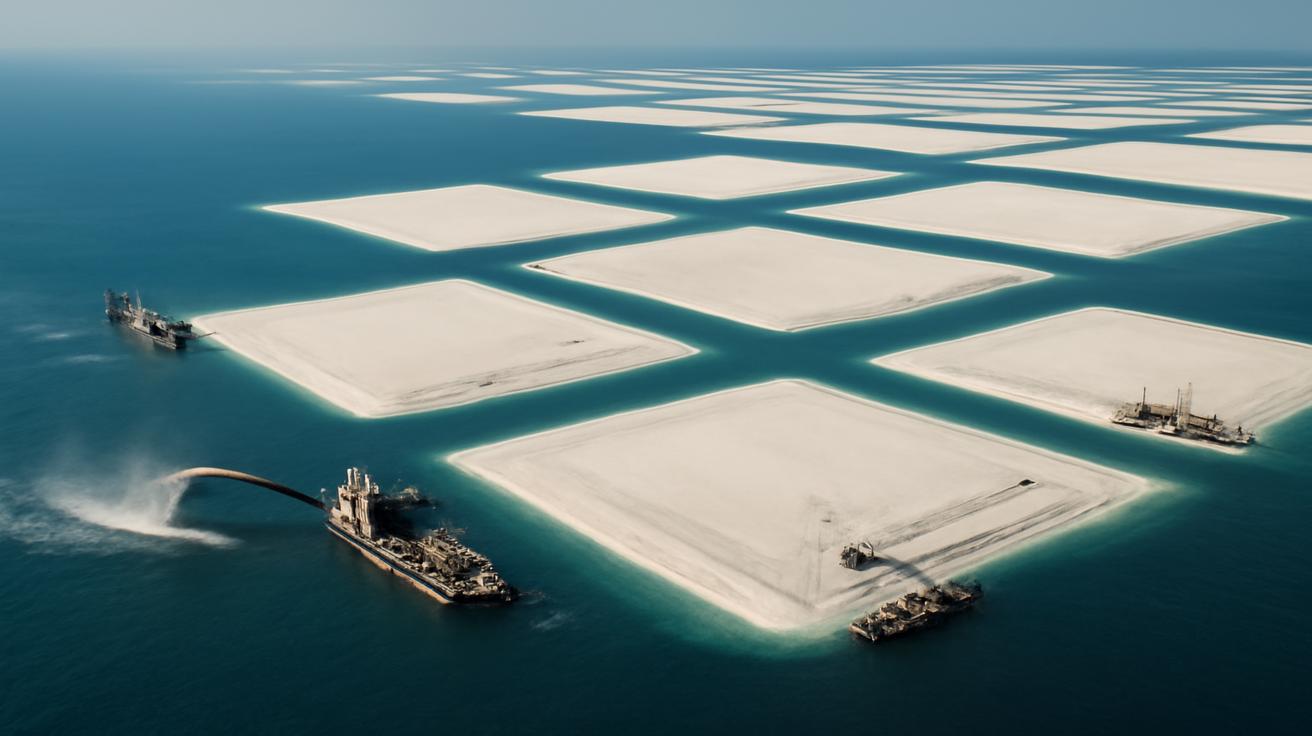
The first thing you notice is the color of the water. It changes. What used to be a deep, wind-ruffled blue in satellite images becomes an odd milky turquoise, then a smear of beige. As the years pass, that beige hardens, acquires straight edges, right angles, a geometry that has nothing to do with reefs or tides or storms. Runways appear. Harbors sharpen into focus. A place that never existed before begins to take shape in the middle of the sea, as if someone had drawn a new country with a pencil and then decided to fill it in with sand, concrete, and steel.
Where the Sea Becomes a Construction Site
Out in the South China Sea, far beyond the sightlines of ordinary coastal life, the ocean has been behaving strangely. Or rather, humans have been behaving strangely around it. Over roughly a dozen years, China has pushed the idea of “land reclamation” into something that looks, from space, like outright world-building. Tonnes of sand and rock have been dredged, poured, flattened, and paved over shallow reefs, conjuring islands where there were once only shoals and coral heads just under the surface.
These new islands rise out of turquoise lagoons like artificial crowns. Many started as barely-there features: submerged reefs, atolls that vanished at high tide, or lonely spits of sand that a storm could erase in an afternoon. Today, they host airstrips long enough for military jets, radar domes swollen like white blisters in the sun, piers for warships, storage bunkers, and neat rows of buildings with red-tiled roofs. In a place once defined by the absence of solid ground, there is now a raw, angular presence.
If you stood on one of these islands at dawn, the scene would feel surreal. The air would smell of salt and diesel. Generators would hum. Cranes might still be lurking at the edge of the runway like giant steel herons, and fresh concrete would hold the night’s heat. On all sides the sea presses in, a reminder that this land is not ancient or slow-grown. It is recent, forced, almost impatiently assembled—more construction site than coastline, more intention than accident.
The Mechanics of Making Land from Water
To make an island from scratch, you start by finding something that is barely there: a reef, a shoal, a submerged ridge. These underwater features are like the ghosts of continents, the outlines of land that never quite broke the surface. For engineers, they are an opportunity—a foundation already waiting in the shallows.
The process begins with dredgers: huge ships with long arms that reach down to the seabed and inhale sand and sediment. Imagine a mechanical vacuum cleaner the size of a small town, sucking up the seafloor and pumping it through miles of pipe. The slurry—sand, silt, crushed shell, sometimes pulverized coral—is then blasted onto the chosen reef in thick, muddy plumes. Slowly, truckload by invisible truckload, the water shallows, turns opaque, then gives way to something you can stand on.
It does not look like a tropical paradise. It looks like a wound. The first layer is ugly: gray-brown, wet, and unstable, shifting underfoot like a living thing. Bulldozers crawl across this new skin of earth, pushing it into shape, while excavators scoop, level, and carve. Retaining walls of rock and concrete are added to hold the new land in place against waves and storms. Then comes another layer, and another, raising the ground level higher, hardening the surface, pushing the ocean back a few meters at a time.
Where coral once broke the waves in ornate, living patterns, the horizon is now cut by the clean line of a runway or the square jaw of a pier. Lights are installed. Drainage channels are cut. Fuel tanks are buried. What started as slurry and silt acquires addresses and coordinates and names. In the span of a few years, the sea is made to behave like land.
The Scale of China’s Sand Ambition
China’s campaign in the South China Sea is not a few experimental sandbars; it is industrial-scale geoengineering. Beginning around the early 2010s, work accelerated dramatically on a scatter of reefs and atolls across the region. Dredgers operated day and night, carving channels, deepening harbors, and piling up earth where charts once showed only blue.
By some estimates, China has created more artificial land in the South China Sea than all other claimant countries combined. What’s striking is not just the area—measured in square kilometers—but the speed. In the time it takes a tree to reach adolescence, these islands went from concept to near-permanent fixtures, complete with multi-story buildings and the hum of ongoing life. Never before has a great power so rapidly altered such a remote and contested maritime landscape.
To grasp the intensity of this transformation, imagine watching a time-lapse video stitched from satellite photographs across twelve years. A bare reef appears as a chalky oval beneath the sea. Then, over a handful of frames, it rises, swells, blossoms into a platform, and suddenly sprouts infrastructure. Clouds drift in and out of the images like theater curtains between scenes. Below them, history accelerates.
Life—and Silence—on the New Shores
For all the metal and machinery, there is a strange quiet to these places. There are no ancient fishing villages here, no grandparents telling stories about monsoons from decades past, no weathered docks that have seen generations of boats come and go. The islands are too new for that. They do not have folklore yet, only strategy.
Still, there is human presence. Somewhere, a cook in a canteen is chopping vegetables. A maintenance worker is checking the air conditioning units on a low, white building. A radar operator is watching a glowing screen in a windowless room. A soldier stands at the edge of a concrete pier, looking out over the water, which—apart from a few distant specks—looks empty, infinite, unchanged.
At night, the islands are marked by their own glow. Lights trace the runways like necklaces dropped into the dark. From a passing ship, they might look like a small city adrift, but step ashore and you’d quickly realize how compact and controlled everything feels. Every structure has a purpose. Every square meter seems planned, counted, claimed.
What is missing is the slow, messy life that usually wraps itself around coastal places: the small cafés, the laundry flapping in side streets, the stray cats, the kids running dirty-footed along the sand. These islands were not built to grow that sort of life. They were built to extend reach, to plant a flag in the water, to turn a disputed sea into something more fixed, more graspable.
Islands as Tools, Not Just Territory
To understand why you would spend twelve years pouring sand into the ocean, you have to look beyond the glitter of fresh tarmac and the novelty of replacing waves with warehouses. This is not just a construction project; it is a statement, a strategy, and, depending on whom you ask, a provocation.
In the South China Sea, geography and politics have always been entangled. The region is a tangled web of overlapping claims from multiple countries, all eyeing the same tiny features and the watery space around them. Under international law, control over an island—even a tiny one—can generate rights over the surrounding sea and seabed: shipping lanes, fishing grounds, and potentially enormous reserves of oil and gas.
By transforming low-lying reefs into full-fledged islands capped with runways and radar, China has tried to solidify its footprint across a wide arc of ocean. These specks of new land form a chain of eyes and ears, and, some argue, fists. They can host aircraft, surveillance equipment, and naval vessels in a region that otherwise offers few safe harbors. In any tension or confrontation, that matters.
Critics point out that you can’t simply manufacture historical entitlement with a dredger. You can’t retroactively turn a reef into an island in order to rewrite maritime boundaries. Others worry that these outposts, whether or not they carry legal weight, shift the facts on the water: they change patrol routes, shape where fishing fleets dare to sail, and alter how neighboring countries calculate risk.
A Sea That Feels Smaller
For centuries, this part of the world was defined by unpredictability. Fisherfolk read the sky, the smell of rain, the pulse of currents. Storms could rise out of a clear day, and reefs lay in wait just below the surface. It was a sea that could not be tamed, only respected.
Now, with radar domes staring over long distances and aircraft able to leapfrog from one new airstrip to another, the South China Sea feels less like a wild frontier and more like a closely watched corridor. The islands reduce distance—not literally, of course, but practically. Airplanes can refuel. Ships can dock for repairs. Sensors can track movement that once vanished into horizon and haze.
In the process, the emotional geography of the sea changes as well. Places that were once names on a weather chart or whispered locations shared by fishermen—Scarborough, Mischief, Fiery Cross—become fixed coordinates in a swelling debate about power, sovereignty, and the future of maritime law. The water is still the same salt and the same color, but it is more crowded with meaning.
The Hidden Cost Beneath the Waves
Earthmovers and dredgers leave scars that are invisible from the deck of a ship. To really understand the cost of these islands, you have to dive under the surface, where the sand plumes billow and the seabed heaves.
Coral reefs are slow builders. They construct cities of calcium carbonate one tiny polyp at a time, over centuries. A healthy reef is a riot of color and motion: parrotfish chewing on coral, clouds of small fish shimmering in unison, sea cucumbers raking the sand, turtles passing through like thoughtful ghosts. This is the sort of landscape that dredgers erase in a season.
When sand is pumped over a reef, living coral is buried and crushed. The sediment clouds the surrounding water, blocking the sunlight that sustains the tiny algae inside the corals. Without light, they sicken and die. Fish that rely on the reef for food and shelter scatter or vanish. Even reefs nearby—those not directly smothered—can suffer as currents carry the silt outward, dulling once-clear water into a chalky haze.
The transformation looks something like this:
| Aspect | Before Island Building | After Island Building |
|---|---|---|
| Reef Structure | Complex coral formations, natural channels | Flattened, buried under sand and concrete |
| Water Clarity | Generally clear, high sunlight penetration | Turbid, high sediment, reduced light |
| Marine Life | High biodiversity and dense fish populations | Reduced diversity, displacement, habitat loss |
| Coastal Protection | Natural reef barrier absorbs wave energy | Replaced by artificial sea walls, altered wave patterns |
What’s destroyed is not just beauty; it is function. Reefs support fisheries that coastal communities rely on. They act as natural seawalls, breaking waves before they crash onto distant shores. They are nurseries for countless species that roam far beyond their limestone borders. When these foundations are paved over, the loss ripples outward in ways that are hard to count but easy to feel.
Can These Islands Ever Be “Natural”?
Given enough time, nature will creep back into almost anything. Algae will darken the edges of concrete. Barnacles will stud the pilings of new piers. Fish will wander into artificial harbors, picking through whatever food they can find among the rubble and hulls. On the margins of these man-made islands, little pockets of accidental habitat may emerge.
But there is a difference between recolonization and recovery. An island that began as a military outpost or a hardened air base is unlikely to become a lush, wild sanctuary anytime soon. Its shape, materials, and use are all aligned with human intent, not ecological balance. Its edges are armored against erosion; its interior is paved and patrolled.
From the air, the contrast is stark. Natural islands in the region tend to be soft-edged, ringed with bright shoals and gentle gradients of color. The artificial ones are crisp, rectilinear, abruptly bordered. They look, even under full tropical sun, slightly out of place—pieces of somewhere else, glued onto the surface of the sea.
Living with the Consequences of Manufactured Land
Once created, land is hard to unmake. Even if the dredgers stopped tomorrow and the cranes folded away, the islands would remain, slowly settling but stubbornly there. Storms will test them, of course. Typhoons will lash their runways, chip away at their sea walls. Rising seas will push at their edges. Engineers will respond with higher walls, stronger foundations, thicker layers of rock. A quiet arms race with the climate will unfold, concrete versus ocean.
For nearby countries, for sailors and fishers and coastal communities, the islands are a new fact of life. Ships change course to account for newly restricted waters or newly enforced boundaries. Fishing grounds that once felt open and shared now bristle with patrol boats and surveillance. The psychological map of the sea—where one feels welcome, wary, or watched—has been redrawn.
Yet for all their solidity, these islands are deeply dependent on the very systems they disrupt. Without constant resupply, they could not easily support their populations. Fuel, food, spare parts, fresh water—most of it must come by ship. Each artificial island, in its own way, is an outpost moored not just to the seafloor, but to the logistics of a distant mainland.
There is also a quieter, more philosophical consequence. The idea that we can simply decide to create land where there was none shifts how we think about coasts and seas elsewhere. If a reef can be turned into an air base, why not raise a new city from the shallows off some crowded shoreline? Why not push back the tide another few hundred meters, another kilometer, more? With each successful project, the boundary between “impossible” and “under consideration” moves a little farther out.
And yet, feel that boundary closely, and you’ll notice it is still wet. The ocean never fully forgets. Waves hammer against the sharp corners of these young islands. Saltworks its way into steel and concrete. Corrosion begins almost as soon as the paint dries. For all our engineering, we are still building castles in a place that never agreed to hold still.
Questions That Linger Over the Water
Stand at the outer rail of one of these islands during a calm evening and you’d see nothing obviously dramatic: just the steady breathing of the sea. The horizon would be a thin, unwavering line. The wind might smell of rain from hundreds of kilometers away. If you didn’t know the story, you could almost mistake this for any other scrap of land at the edge of an ocean.
But that story is embedded in every layer under your feet. Twelve years of dredging and dumping, of carving and reinforcing, lie between the original coral and the present concrete. The cost is scored into the blankness where a reef used to be, into the patterns of fish that no longer gather in the same place, into the tense radio calls exchanged between ships that now pass a little farther apart.
The questions this raises are not just about one country or one sea. They are about what we are willing to trade for a sense of security, for resources, for reach. They are about how fast we are prepared to move in environments that took millennia to form. They are about what it means to redraw the map not on paper, but on the planet itself.
From orbit, the new islands look small—specks of pale geometry on an enormous canvas of blue. Up close, they feel big and solid, bristling with hardware and hope and ambition. Between those two perspectives lies the truth: they are both. Insignificant on a global scale, transformative within their immediate orbit. Fragile in the face of deep time, yet powerful in the span of a few human decades.
We have learned, unmistakably, that with enough machinery and political will, we can make land out of sea. What we haven’t yet learned is how to do it without losing more than we gain, or how to live with the islands we have already conjured from the deep.
FAQ
Why did China build artificial islands in the South China Sea?
China’s artificial islands serve strategic, political, and logistical purposes. They extend the country’s practical reach over disputed waters, provide bases for aircraft and ships, and reinforce its territorial claims in a region rich in resources and busy with global shipping.
How are these islands actually constructed?
Engineers use large dredging vessels to suck sand and sediment from the seafloor and pump it onto shallow reefs or shoals. The material is piled up above sea level, then compacted and stabilized with rock, concrete, and retaining walls. After that, infrastructure such as runways, ports, and buildings is added.
Are these new islands legally recognized as territory?
International opinion is divided and often critical. Some legal rulings have rejected attempts to use artificially expanded features to justify extended maritime claims. While the islands physically exist, their status under international law remains contested and politically sensitive.
What impact do they have on marine ecosystems?
The environmental impact is severe. Dredging and sand dumping can destroy coral reefs, cloud the water with sediment, and displace or kill marine life. The loss of reef habitat affects fisheries, biodiversity, and natural coastal protection well beyond the immediate construction zone.
Could these islands be used for peaceful or civilian purposes in the future?
In theory, they could host scientific research stations, weather monitoring, or search-and-rescue facilities alongside or instead of military uses. In practice, their design and current infrastructure are heavily geared toward strategic and security roles, so any shift toward peaceful, shared use would require major political change.





Leave a Comment