
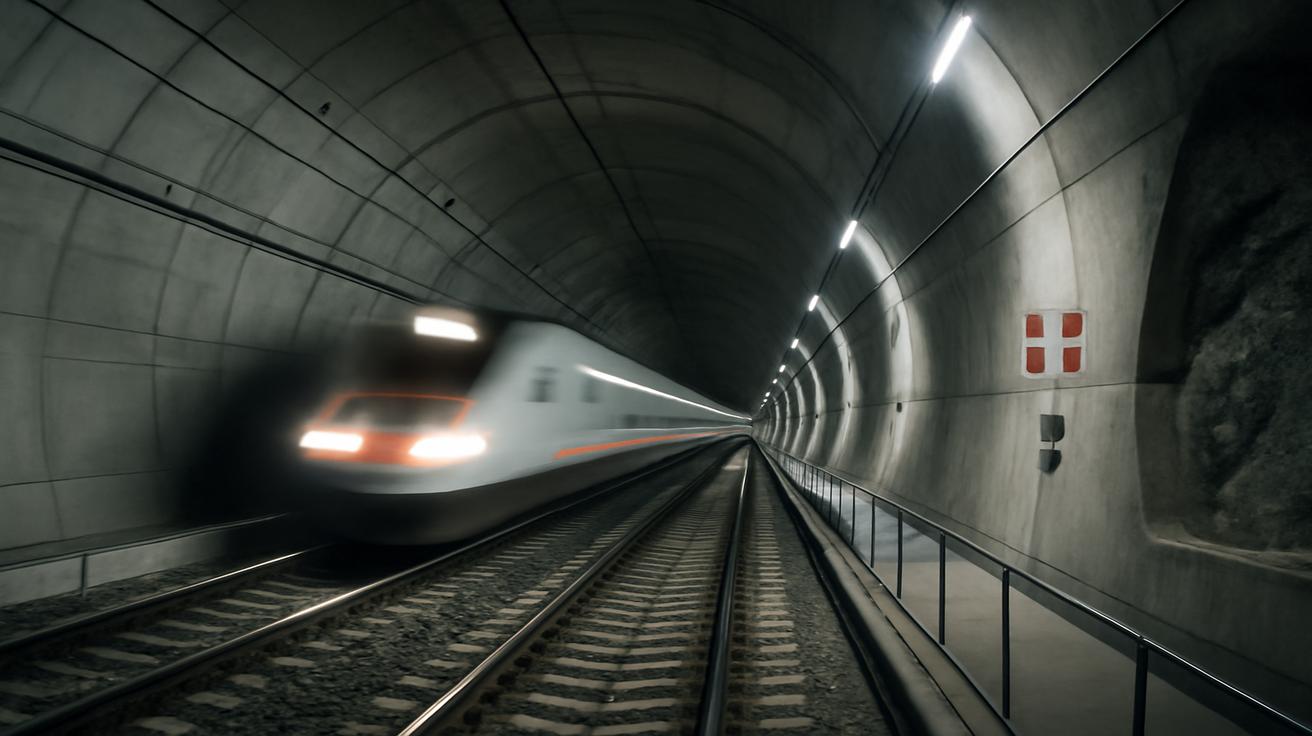
The first time you feel a Swiss mountain tremble, it’s not an avalanche you hear. It’s a whisper, far below your feet, the hum of hidden engines and the faint rush of air pushed through a tunnel no sunlight has ever entered. Somewhere deep inside those mountains, machines are chewing through stone, laying tracks and cables and ducts, carving out a second Switzerland beneath the one framed in postcards. For nearly thirty years, this quiet excavation has been underway—an underground project so vast that, if you could pull back the mountainside like a curtain, you’d see a shadow-country of galleries, tunnels, and caverns larger than many cities above ground.
The Country That Learned to Think in Tunnels
Switzerland did not wake up one morning and decide to become a nation of moles. The story begins, as so many Alpine stories do, with snow and time. For centuries, the mountains were both fortress and prison, cutting off communities each winter, strangling trade, isolating valleys for months. The Swiss learned early that the shortest line between two points is not over the mountain; it’s through it.
In the 19th century, dynamite and sheer stubbornness gave birth to the first transalpine rail tunnels. These passages—some of the longest in the world at the time—were hailed as miracles of engineering. But compared to what lies below the surface today, those early tunnels were simple, almost naive: single-purpose tubes bored through rock to get trains from point A to B.
Fast-forward to the late 20th century, and Switzerland had a different problem. More people, more trade, more trucks grinding up switchback passes, more exhaust trapped in narrow valleys. The country had promised its citizens—by national referendum—to protect the Alps from the roar of highway traffic. If goods had to cross, they would cross on rails, and preferably without wrecking the quiet of those postcard landscapes.
So the Swiss did something characteristically radical and understated. They looked at their mountains and decided: we’ll hollow you out. Not with one tunnel, or two, but with a continuous, interlocking system—a hidden network of rails, roads, utility shafts, drainage galleries, evacuation passages, and service caverns. For nearly 30 years, the work has gone on almost like a second, subterranean city-building project. On the surface, cows graze and tourists snap photos. Underneath, the country is quietly redrawing its map in three dimensions.
The Great Hollowing: How Rock Becomes a Second City
Imagine standing at the north portal of the Gotthard Base Tunnel, near Erstfeld. The entrance looks modest: a clean concrete arch, a tangle of overhead wires, a few service buildings. Nothing that screams “world’s longest railway tunnel.” Yet step inside—if you’re lucky enough to join a rare guided visit—and the scale swallows you whole.
The air cools almost immediately, smelling of iron, damp stone, and a metallic tang from the rails. Ahead, the tunnel stretches into a gentle, unending curve. The walls are ribbed with cables and pipes, the ceiling dotted with lights that disappear into a vanishing point. Behind the main bores, out of sight, run service galleries and cross passages, every 325 meters, like the rungs of a ladder stitched between twin arteries of steel. Somewhere off to one side is an emergency station—a hidden chamber large enough to hold a small town’s worth of people in a crisis.
The Gotthard Base Tunnel, opened in 2016 after 17 years of construction, is more than just a hole through a mountain. It’s a subterranean corridor 57 kilometers long, with an internal world of ventilation systems, drainage channels, control rooms, and maintenance niches. And it’s not alone. The Lötschberg Base Tunnel, the Ceneri Base Tunnel, the earlier highway tunnels, the myriad smaller service and utility tunnels—they all add up.
Engineers like to talk not just about length but about volume, about the cubic meters of rock removed and the hollow spaces left behind. If you could line up these tunnels and caverns, then add in the underground bunkers, water conduits, metro lines, parking garages, data centers, military facilities, and storage depots, the statistics become surreal. Beneath Swiss feet lies an urban fabric without sky, shaped by drills instead of cranes.
And the work has been steady. For nearly three decades, tunnel-boring machines—massive metal worms with spinning teeth—have advanced meter by meter, sometimes as slowly as a few centimeters an hour. When they finally break through, two separate excavation teams, digging from opposite sides of the mountain, often meet with less than a meter of deviation. In that moment, when rock gives way and crews see each other for the first time, the usually reserved Swiss allow themselves something like joy. The applause echoes off fresh-cut stone.
The Quiet Geometry of Underground Life
To understand how an underground infrastructure can be “larger than many cities,” it helps to picture a city stripped to its skeleton: roads, pipes, subways, cables, storm drains, underpasses, parking levels, storage basements. Now imagine building much of that skeleton in solid rock instead of loose soil, running not just under one city, but across an entire country.
Switzerland’s underground is not a single, continuous cave. It’s a layered geometry of purpose: some spaces are for rushing, some for waiting, some for simply existing, cold and dark, until needed. Many are hidden behind harmless doors in hillsides or disguised as ordinary buildings. Over decades, the cumulative effect has been astonishing. A large share of the country’s true nervous system—the arteries of movement, water, electricity, and data—no longer lives under streets. It lives in mountains.
| Type of Underground Space | Primary Role | Typical Location |
|---|---|---|
| Base tunnels (rail) | High-speed freight & passenger transit | Deep under Alpine massifs |
| Road tunnels | All-weather road connections | Across passes & key valleys |
| Service & evacuation galleries | Safety, access & maintenance | Parallel to major tunnels |
| Utility & water tunnels | Power, water supply, data | Within mountains & under cities |
| Storage & special-use caverns | Reserves, research, strategic uses | Converted rock caverns |
Step into a smaller, service-only tunnel and you see the less glamorous side of this underground city: the cable trays, valve rooms, maintenance platforms. These aren’t spaces built for beauty, but they have a kind of brutal grace: clean concrete, utilitarian lighting, an unwavering sense of purpose. Water seeps from rock joints and is caught by drains, channeled away in trickles that will never see the sun. The temperature is stable, seasonless. Down here, winter and summer are concepts that belong to other people.
In some caverns, however, human imagination has taken the lead. Underground parking garages spiral like inverted towers. Data centers hum behind armored doors, their servers taking comfort in the cool, constant climate of bedrock. Below a modest facade, a staircase might descend to a multi-level shelter space or a storage vault, relics of Cold War anxieties repurposed for more mundane uses. The result is a sort of palimpsest: layers of history, fear, innovation, and logistics all sharing the same carved-out voids.
Rock, Risk, and the Long Patience of Engineers
What does it feel like to spend a career turning solid mountain into hollow space? Ask a tunnel engineer, and you’ll get a blend of geology lesson and love story. They speak of gneiss and granite the way winemakers talk about soil: each rock has its temperament, its quirks, its capacity for surprise.
On paper, every tunnel starts with surveys and models: laser scans of surface topography, deep borehole data, seismic readings. Engineers trace the path of the future tunnel in three dimensions, trying to avoid fault zones, aquifers, and overly fractured rock. They simulate how the mountain will respond, how water will flow, how heat will dissipate. But once the boring machine starts to rotate, reality takes over.
Sometimes the rock is perfect—a smooth, competent mass that holds its shape confidently as the cutterhead advances. The machine can move faster, shield open, crews working almost rhythmically: install support rings, bolt them, inject grout, push forward. The tunnel grows like a steel worm’s burrow.
Other times, the mountain turns treacherous. The rock crumbles or swells, saturated layers drench the working face, unexpected heat builds up. Work slows to a crawl. New supports have to be designed on the fly. Ground freezing might be used to stabilize a weak section. Night after night, crews work in fluorescent twilight, adjusting, recalculating, coaxing the mountain into cooperation rather than submission.
There is risk, always. Risk of collapse, of sudden water inrush, of unseen faults unlocking tons of pressure. Every meter is an argument between human intent and geological memory. And yet, over nearly 30 years, Switzerland has turned this argument into a kind of craft discipline. Accidents still happen, but the country’s tunneling expertise is now exported around the world. The Swiss have becomes quiet global authorities in the art of moving safely through stone.
Why Bury So Much of a Country?
The obvious answers—winter, mountains, traffic—are only part of the story. The deeper logic of Switzerland’s underground turn is about space and survival.
This is a small country with big demands. Its valleys are narrow, its lakes hem in cities, and its best flat land is already busy with houses, crops, and factories. Building more highways or above-ground railways would mean erasing pieces of landscape that people fiercely love. The referendum that pushed freight onto rail was also a referendum about what the Alps should look and sound like, decades from now.
By going underground, Switzerland found a way to move enormous volumes of goods and people without filling the air with diesel and the valleys with asphalt. Trains glide under rather than over, trucks roll onto rail shuttles instead of clogging passes. For locals, the Alps remain what they have always been: walls of rock, not walls of noise.
There’s also a subtler cultural element. Switzerland’s history is marked by a careful, almost anxious attention to preparedness. For much of the 20th century, the country dug bunkers into hillsides, hid military infrastructure in mountains, embedded redundancy into its very geography. While the strategic fears have evolved, the habit of thinking underground never quite left. A tunnel is not just a piece of infrastructure; it is a promise that the country can keep functioning when the world above is unpredictable.
The Environmental Trade: Scar Tissue and Sanctuary
Digging into mountains is not gentle. Blasting and boring create shock waves that ripple through rock, spoil heaps that must be stored or reused, groundwater flows that can be disturbed. The base tunnel projects in particular displaced millions of tons of excavated material. Swiss planners responded with an almost obsessive interest in reuse—turning rock into aggregate, landscaping material, even artificial islands in lakes. But the scars, especially during construction, were very real.
And yet, against that damage, one has to weigh the long-term environmental gain. Every train that crosses under the Alps instead of a convoy of trucks crossing over means less air pollution in narrow valleys, less blackening of snow with soot, fewer accidents on icy passes. The base tunnels are flatter and straighter than older mountain lines, allowing trains to run more efficiently, with less energy. Freight can shift from road to rail—a central goal of Swiss transport policy.
The underground also offers a kind of sanctuary for other systems. Power cables buried in rock are less vulnerable to storms than those strung on pylons. Water channels protected in tunnels are less exposed to surface contamination. Data lines in bedrock are harder to disrupt. In a century of climate instability, some of the most climate-resilient infrastructure may turn out to be the infrastructure we cannot see.
Living Above a Hidden Network
If you walk through a Swiss village, it’s hard to visualize the machinery humming beneath it. On the surface, the country clings firmly to its image: wooden chalets, church spires, a cowbell echoing in a side valley. But under the roads, under the lakefront promenades, under the pastures, there are access shafts, technical galleries, and sometimes vast, echoing caverns.
Occasionally, the underground breaks into view. A hillside door stands ajar to reveal a tunnel mouth; a fenced-off shaft hums with ventilation fans; a neat concrete structure at the edge of a field hides the entrance to a hydroelectric gallery. These are the above-ground punctuation marks of a sentence mostly written inside the mountain.
City dwellers have an even more intimate relationship with the underground, though many barely think about it. In Zürich, Lausanne, Geneva, and Basel, commuters thread through subway passages and underpasses without realizing that the same logic that drove Switzerland to pierce the Alps also shaped their daily pathways. Layers of transport crisscross beneath their feet: trams at street level, trains in tunnels, utilities in deeper galleries. The country’s above- and below-ground infrastructures are less separate worlds than synchronized layers.
One day, perhaps, Switzerland’s hidden city will be mapped for everyone to see, in augmented reality or some elaborate interactive model. People will be able to stand on a grassy hill and toggle a view that peels back the earth, revealing the pulsing arteries just meters below their picnic blankets. Until then, the knowledge remains partly abstract, present mostly in the vibrations you feel on a quiet afternoon when a freight convoy roars far beneath you, unseen.
The Future: Deeper, Smarter, More Connected
Will the next 30 years of Swiss infrastructure look like the last? In some ways, yes: rock will still be drilled, rail will still be laid, water and power will still be tucked away in bedrock. But new technologies and new pressures are steering the next chapter of this subterranean story.
Digital monitoring has already turned many tunnels into semi-autonomous organisms. Sensors stitched into concrete linings track movement, water pressure, temperature, vibration. If something shifts—a crack begins, a drainage line clogs—the system knows, often before humans do. Maintenance teams move with more precision, fixing small issues before they become big ones. The underground becomes less a set of static voids and more a living, responsive network.
There is talk of new uses for underground spaces: large-scale energy storage systems in rock caverns, deeper data vaults, climate-controlled agricultural experiments. The same skills that let Switzerland hide a high-speed rail line inside a mountain might one day be used to build underground logistics hubs or even new forms of housing, freeing precious surface areas for green space.
At the same time, each new tunnel project faces sharper questions: How much more hollowing can the mountains take? What does safety mean in an era of cyber threats, not just physical ones? How do you balance the instinct for redundancy and shelter with the need for transparency and democratic oversight? The answers, like the tunnels themselves, will take years to carve out.
For now, though, the reality is striking enough: by carving tunnels through solid rock for nearly 30 years, Switzerland has already built an underground infrastructure that, in scale and complexity, rivals whole cities. It is a city without streets, a network without skyline, a country that exists twice—once in sunlight, and once in the steady, humming half-dark of the mountain’s heart.
FAQ
Why has Switzerland built so many tunnels?
Switzerland’s steep terrain, dense population, and commitment to protecting the Alps pushed it toward underground solutions. Tunnels allow efficient year-round transport, reduce surface traffic and pollution, and free up limited flat land for homes, farms, and nature.
How long did it take to build the major base tunnels?
The Gotthard Base Tunnel took about 17 years of construction and decades of planning; the Lötschberg and Ceneri base tunnels each required roughly a decade to build. Across projects, Switzerland has been tunneling continuously for nearly 30 years.
Are these tunnels only for trains?
No. While many of the largest tunnels are for rail, the underground network includes road tunnels, service galleries, evacuation passages, water conduits, power and data tunnels, storage caverns, and civil protection spaces.
Is tunneling under mountains safe?
Modern Swiss tunnels are designed with strict safety standards: parallel bores, regular cross passages, fire-resistant materials, advanced ventilation, and constant monitoring. Though there are risks during construction, once completed, these tunnels are among the safest transport routes in the country.
Can the public visit any of these underground spaces?
Some tunnels and underground facilities offer occasional guided tours, especially before they fully open to traffic. However, many technical galleries, data centers, and strategic caverns are off-limits for safety and security reasons.
How does all this tunneling affect the environment?
Construction does disturb rock and ecosystems, but Switzerland mitigates impacts through careful planning, reusing excavated material, and strict environmental standards. Over time, the shift of freight from road to rail via base tunnels significantly reduces emissions and noise in Alpine valleys.
Will Switzerland keep expanding its underground network?
Most likely, yes—but with a stronger focus on smart monitoring, multi-purpose underground spaces, and climate resilience. Future projects will aim to enhance capacity and safety while minimizing both environmental impact and surface land use.








Leave a Comment