
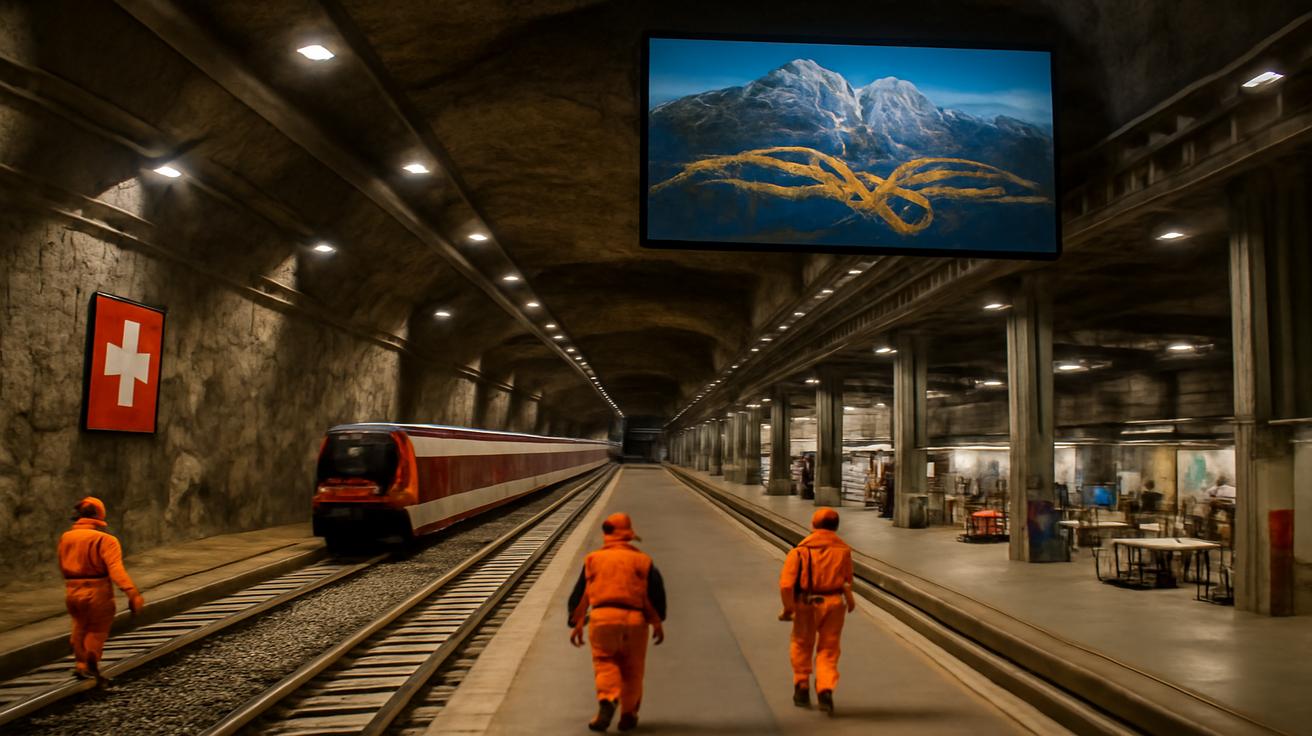
The first thing you notice is the silence. Not the kind that comes from being alone in a forest or on a mountain ridge, but a thick, engineered quiet that hums beneath the sound of steel on rails. You’re inside a train, deep under the Swiss Alps, with a thousand meters of rock pressing down above your head. There is no view from the window, only the faint reflection of your own face in the glass, and a corridor of light sliding past at 200 kilometers an hour. Somewhere above, glaciers glow in the sun and cows graze on meadows. Down here, Switzerland is a different country altogether—one carved, drilled, blasted, and bored into existence beneath the surface.
A Country That Lives Sideways
Switzerland is often introduced as a postcard: mountains, lakes, tidy villages, the neat geometry of farm fields. But that image is incomplete. For nearly thirty years, the Swiss have been quietly digging themselves a second nation underground, one that doesn’t appear on tourist brochures or Instagram feeds. This subterranean Switzerland is made of tunnels—rail tunnels, road tunnels, service shafts, ventilation caverns, emergency shelters, and maintenance galleries that braid the bedrock together like a hidden nervous system.
If you could peel away the soil and snow and peer into the stone, you’d see streaks and ribbons of empty space, some as wide as cathedrals, some as thin as veins. You’d see trains slipping below mountains that used to be insurmountable obstacles, trucks vanishing into portals in the hillside and reappearing in a different valley, high-voltage cables and fiber-optic lines humming in protected conduits. Measured in sheer connected volume, this underground infrastructure rivals and in some ways exceeds the above-ground footprint of many European cities.
It didn’t happen all at once. It happened day by day, blast by blast, as engineers, geologists, and miners worked in the half-dark, pushing slowly through granite and gneiss. The result is a national habit: in Switzerland, when the landscape says “no,” the answer is often, “We’ll go through.”
Thirty Years of Digging into the Alps
Stand at the northern portal of the Gotthard Base Tunnel, near the town of Erstfeld, and you could be forgiven for thinking you’re at the gate of some mythic underworld. The concrete mouth is clean and functional, unadorned, almost modest. But beyond it stretches 57 kilometers of almost perfectly straight tunnel—the longest railway tunnel on Earth—cut through hard rock over 17 years of unbroken work.
When the Gotthard Base Tunnel opened in 2016, it was hailed as a triumph of engineering. Yet it was only the headline act in a much longer story. Throughout the 1990s, 2000s, and 2010s, Switzerland invested tens of billions of francs in what it calls the New Rail Link through the Alps. The idea is disarmingly simple: if a country made mostly of mountains wants to move people and goods efficiently, it must stop spiraling up and over peaks and start shooting straight through their roots.
The Gotthard and Lötschberg base tunnels are the most famous of these passages, but they are merely the core of a lattice. Around them, a dense web of smaller tunnels has emerged—access shafts, cross passages, ventilation ducts, connecting galleries, service tubes that let engineers reach the depths. Each base tunnel is not one tube but several, running parallel, stitched together by emergency escape routes. Each needs its own hidden infrastructure: drainage channels for mountain water, niches for maintenance crews, alcoves for sensors that listen to the mountain’s slow shifts and strains.
From the air, Switzerland’s rail lines still look like threads stitched between valleys and over passes. Underground, those threads multiply and merge. You begin to understand that the Swiss solution to geography is not to fight it, but to slip beneath it and reshape the rules of distance.
The Underground City You Never See
On a map, cities are flat. Streets, blocks, rivers, parks—everything drawn as if life were lived in two dimensions. Underground Switzerland shreds that illusion. Here, you could walk through a modern Swiss city and never realize that beneath your steps there is another architecture entirely, one that ignores property lines and zoning categories and daylight.
Imagine standing in central Zurich. Somewhere far below, trains glide in and out of the Löwenstrasse underground platforms, part of a cross-city tunnel that lets long-distance services slip silently under the old station. Beneath other neighborhoods, road tunnels burrow under hills to avoid dense districts, utilities run in service corridors, and in some places, older civil-defense bunkers still wait in the dark. Add the alpine base tunnels stretching off into the distance, and you can think of the entire country as a multi-level organism: city on top, spinal cord below.
Engineers talk about “underground space” the way architects talk about floor area. It can be measured, budgeted, planned. Taken together, Switzerland’s road and rail tunnels alone add up to hundreds of kilometers of enclosed volume. When you include the branching side tunnels, caverns for substations and ventilation plants, water conduits, cable tunnels, and the legacy of Cold War shelters dug into hillsides and beneath public buildings, the scale becomes comparable to a network of mid-sized cities—except it is all hidden inside solid stone.
It’s easy to miss this reality because almost all of it is invisible by design. The portals are few and discreet. The control centers operate behind ordinary office façades. For passengers, the underground world is reduced to a momentary sensation: the pressure in your ears, the blink of daylight replaced by fluorescent tunnel walls, the sense of acceleration and then arrival somewhere new. The complex web that makes that journey possible remains tucked into the bedrock like secret infrastructure.
The View from Inside the Mountain
For the people who carved this universe, the mountain is not just scenery; it’s a workplace, a companion, sometimes an adversary. Picture a tunneling machine the length of a city block, its steel teeth slowly grinding through rock as if it were biting its way home. The air smells like wet dust and diesel. Over months and years, that machine advances meter by meter, leaving behind it a smooth, cylindrical void that crews line with concrete segments, cable trays, drainage pipes.
The psychological landscape inside a tunnel is different from the world above. Time stretches. The seasons change on the surface, snow comes and goes, tourists arrive and depart, but in the tunnel, the view ahead is always the same: a circle of rock illuminated by lamps. Miners work in shifts so that progress never stops, the mountain always being negotiated with, the ground always being persuaded to let go.
When breakthrough comes—when teams drilling from opposite sides of a mountain finally meet—it is a moment of almost ceremonial significance. The last wall of rock collapses. The two beams of light from the opposing sides join. People who have been working in separate underground worlds now stand face to face in a corridor that did not exist an hour before. Suddenly, the idea of Switzerland as an interconnected subterranean country is no longer abstract. You can walk through it, feel the dampness on the tunnel walls, hear the echo of your footsteps racing ahead into darkness.
Why Dig? The Logic of Going Underground
In a country this mountainous, building straight, fast routes above ground is almost impossible without either scarring the landscape or winding so slowly that modern mobility becomes a joke. The underground alternative solves several problems at once: flatter tracks mean faster trains and more efficient freight, tunnels reduce noise in inhabited valleys, and the surface landscape remains largely intact for forests, farms, and villages.
There is also a strategic logic. Switzerland sits at the crossroads of Europe, between northern industry and southern ports. Trucks once queued for hours on alpine passes, spewing exhaust as they crawled up and down hairpin bends. By pushing freight onto trains that shoot through base tunnels, the country can keep heavy traffic off the surface roads and protect its sensitive mountain ecosystems. To the casual tourist, that policy might just look like clean air and quiet valleys. Underground, it looks like cavernous loading terminals, double-track tubes, and a choreography of steel.
For residents, the benefits appear as time saved and annoyances avoided. Driving from one side of a ridge to the other no longer requires weaving along cliff edges. Commuters move in straight lines, not squiggling over passes. And because the underground system is built with a kind of Swiss obsession for redundancy and safety, it doubles as a giant protective shell when things go wrong: fires can be contained, trains rerouted, traffic redirected.
A Network Hidden Beneath the Landscape
When you line up just a handful of Switzerland’s major tunnels, the scale starts to become tangible. Consider a simplified snapshot of some of the most prominent ones:
| Tunnel | Type | Approx. Length | Opened |
|---|---|---|---|
| Gotthard Base Tunnel | Rail | 57 km | 2016 |
| Lötschberg Base Tunnel | Rail | 35 km (partially double) | 2007 |
| Ceneri Base Tunnel | Rail | 15 km | 2020 |
| Gotthard Road Tunnel | Road | 16.9 km | 1980 |
| M5 Zurich Cross-City Tunnels (combined) | Rail & Urban | ~10+ km (multiple tubes) | 2014 onward |
And this table doesn’t even touch the countless shorter connections—road bypass tunnels that curve gently around neighborhoods, metro-like suburban tunnels that let local trains slip under congested rail yards, service tunnels that exist only for maintenance crews. The sheer density of this hidden infrastructure has grown, piece by piece, over the last three decades, to the point where in some regions the space hollowed out inside the rock approaches the footprint of the town above.
Life Between Rock and Light
For most people, underground Switzerland is not a destination; it’s a passage. You enter with a certain expectation of where you’ll emerge, and between those points, you surrender yourself to the system. The train driver watches signals on a screen. The car driver follows a white line in dim orange light, trusting that fresh air will keep circulating and that any danger will be detected before they smell it.
Yet in the physical experience of moving through these tunnels, there is a strange kind of intimacy with the country. You might not see the peaks, but you feel their weight. Your ears pop as barometric pressure changes. The temperature stabilizes; in deep tunnels, it no longer matters whether it is snowing or blazing hot outside. Sensors in the walls track tiny shifts in rock, microphones listen for the whisper of cracks. Humans, machines, and mountain are constantly in conversation.
On maintenance nights when a tunnel is closed to traffic, workers move through the space almost like gardeners tending a hidden landscape. They inspect joints in the concrete lining, replace cables, clean drainage channels where mountain water insists on finding its way in. For them, the tunnel is not an abstract marvel of engineering; it is a living environment, one that must be nurtured if it is to keep carrying the country’s daily life on its back.
From Fear to Familiarity
There was a time when tunnels inspired unease, a sense of being trapped under tons of rock. Long distances underground were something to be endured, not embraced. In Switzerland, with the passage of years and the consistency of everyday experience, that fear has softened into familiarity. Children grow up taking school trips through base tunnels. Commuters barely look up when the daylight vanishes; they scroll their phones or sip coffee from plastic lids while racing through hollow mountains.
Yet even now, there are moments when the scale of what lies below hits home. Perhaps it’s when you glance at a map in a station and notice that the straight line drawn for your route goes through what, on any normal map, would be solid stone. Or when you drive into a tunnel on a stormy day and emerge on the other side into unexpected sunshine, as if the mountain itself were a door between different weathers, different moods.
Switzerland has, over the last thirty years, domesticated its geology without ever quite stripping it of mystery. The tunnels are proof that humans can reshape even the hardest parts of the planet. The mountains above remain proof that there are still limits, that nature is more than a set of obstacles to be optimized away.
Looking Forward: Deeper into the Quiet
The digging is not over. Planned expansions, second tubes for existing road tunnels, and further optimizations to freight corridors continue to push Switzerland’s underground frontier forward. There is talk of even faster connections that might one day run like subterranean high-speed spines across the country and under neighboring borders, extending this invisible city of rock and light.
At the same time, the conversation is changing. Modern tunnel projects are less about beating records and more about rethinking what kind of mobility a mountain country—and a warming planet—should embrace. If you can move more people and goods by electric train through base tunnels, do you still need as many cars grinding up alpine passes? If you can concentrate heavy infrastructure inside the mountain, can you leave the surface quieter, greener, wilder?
Underground Switzerland isn’t about escaping the landscape; it is about allowing the surface to remain itself. Meadows can stay meadows, forests can remain forests, and historic towns can keep their narrow streets, because the bulk of the country’s modern nervous system hums out of sight, deep inside the stone.
Next time you cross the Alps and notice that the familiar bends and passes have been replaced by a few minutes of darkness and the distant thrum of a well-tuned machine, you’ll be traveling through more than just a tunnel. You’ll be passing through decades of human stubbornness, ingenuity, and patience, and through a second Switzerland—a vertical one, built not on hillsides and lakeshores but threaded sideways through the mountain heart.
Frequently Asked Questions
Why has Switzerland built so many tunnels?
Switzerland’s mountainous terrain makes traditional surface routes slow, steep, and environmentally intrusive. Tunnels offer flatter, straighter lines for trains and vehicles, reduce noise and pollution in valleys, and help protect delicate alpine ecosystems while maintaining fast, reliable transport across the country.
Is it really true that the underground infrastructure rivals cities above ground?
In terms of total length and enclosed volume, the cumulative network of Swiss tunnels—especially when you include base tunnels, road tunnels, technical galleries, and service caverns—is comparable to the built-up area of many mid-sized cities. It’s not a single continuous “underground city,” but a sprawling, interconnected system embedded in the rock.
How safe are these long tunnels?
Swiss tunnels are designed with multiple layers of safety: separate tubes for each direction in many cases, frequent cross passages for evacuation, sophisticated ventilation and fire-detection systems, and regular maintenance. Strict regulations and constant monitoring make them among the safest in the world.
Do these tunnels only serve trains and cars?
No. While rail and road tunnels are the most visible, there are also many smaller tunnels and underground structures for utilities, water, electricity, and data, as well as maintenance and emergency access tunnels that the public rarely sees.
Will Switzerland keep building more tunnels in the future?
Yes, though the focus is shifting toward upgrading and optimizing existing routes, adding second tubes for older road tunnels, and refining freight corridors. Future projects are increasingly shaped by environmental and climate goals, aiming to move more transport underground and onto rails while preserving the landscape above.







Leave a Comment