
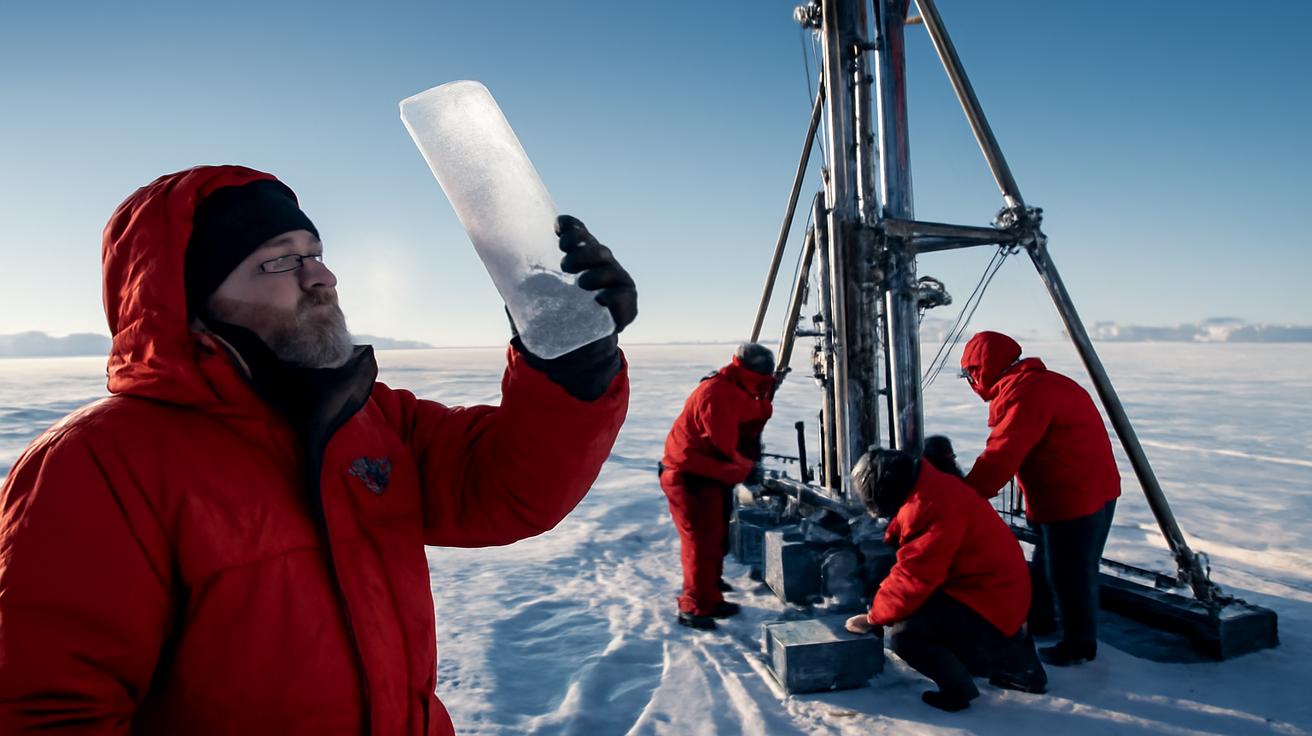
The drill bit shuddered, the ice groaned, and then—after four days of careful, bone-rattling descent—everything went still. Two kilometers below the frozen surface of East Antarctica, where no sunlight has touched the ground for tens of millions of years, a core of ancient mud was lifted into the fluorescent light of a research tent. The room went quiet. The scientists leaned in. Suspended in that dull-brown cylinder was something no one had ever seen with human eyes: a long-buried world, locked away since before the first ice sheet spread across Antarctica. A world frozen in time for 34 million years.
The Day the Ice Gave Up Its Secrets
Outside, the wind screamed over the flat white desert, dragging curtains of snow across the horizon. Inside the drill tent, the air smelled faintly of diesel fuel and wet metal. Everyone’s breath clouded in the cold, mingling with the hiss and hum of generators. When the core barrel finally broke the surface, gloved hands moved with a kind of rehearsed urgency—unbolting, lifting, and laying the core into a waiting cradle.
The ice itself was familiar: blue-white rods of compacted snowfall, banded with stories of ancient atmospheres and volcanic eruptions. But at the very bottom, past layer upon layer of ice older than human civilization, the drill had bitten into something new: sediment. Real ground. The floor of a vanished landscape.
As the scientists carefully split the core open, they weren’t just handling mud—they were turning a page in Earth’s own memory. That mud had been sealed away since the Eocene–Oligocene transition, a time when global climates lurched from greenhouse warmth to the cold regimes we know today. Above it now sat a two-kilometer-thick monument to that shift: the Antarctic Ice Sheet.
From the outside, the whole scene might have looked mundane: people in bulky parkas, hunched over a workbench, scraping at something the color of wet cardboard. But around that bench, hearts were pounding. They were about to see the fingerprints of a forest that had flourished where only ice now rules.
A Forest Beneath the Ice
Under a microscope, the drab-looking sediment erupted into color and pattern. Tiny fragments of pollen—once carried by wind and insects; once part of an entire living, breathing ecosystem—appeared like constellations under the glass. There were grains from flowering plants, perhaps shrubs and low-growing trees. There were spores from mosses and ferns. Even the faint outlines of ancient roots were etched into the silt, ghostly traces of a time when the ground under Antarctica wasn’t a deep-freeze, but a living soil.
Imagine standing there, 34 million years ago. The air would have been cool, but nowhere near as brutal as today’s minus-50-degree winds. Instead of a blinding white plain, you’d see patches of forest spreading over rolling hills, gnarled trees clinging to rocky slopes, mossy wetlands pooled in low-lying valleys. Streams would thread through the landscape, carrying leaves and silt, chattering under a sky that knew more clouds and rain than swirling snow.
The fossils in that core whisper of willow-like shrubs, perhaps southern beech, mosses soft underfoot, and hardy plants clinging to seasons of dim sun and long darkness. Antarctica sat roughly where it sits now at the bottom of the world, but the climate was different. Carbon dioxide levels in the atmosphere were higher, global temperatures warmer, and the continent was still in the last stages of shedding its lush, green past.
For years, we’ve known from scattered rock outcrops and fossil leaves along the coast that Antarctica once hosted forests. What this buried record adds is intimacy and detail: direct evidence from the very bed beneath the ice, preserved in a place untouched by weather, erosion, or human interference. It isn’t just that there used to be trees. It’s that this specific spot, beneath your boots and these drilling rigs, was once part of a living landscape.
What the Numbers Whisper
Within weeks, samples from the core were packed into insulated boxes, loaded onto aircraft, and ferried north to climate labs. There, in quiet rooms humming with instruments, the ancient mud began to speak in numbers. Geochemists measured isotopes—tiny variations in atoms of oxygen and carbon locked in microscopic shells. Palynologists, specialists in pollen and spores, counted and cataloged thousands of grains to decipher past vegetation.
Those numbers painted a startling picture. The region now entombed beneath two kilometers of ice likely experienced mild summers, with temperatures hovering just above freezing, and winters of long, lingering cold. Not a paradise, but not the lifeless wasteland we might imagine either. Think of a modern-day subpolar forest or tundra-forest transition—hardy, windswept, but very much alive.
Crucially, the timeline encoded in the core pointed to a moment of profound change. Around 34 million years ago, as atmospheric CO2 dropped and ocean currents shifted, this patch of forested ground cooled and eventually froze. Snow that fell in winter no longer fully melted in summer. Year after year, thin layers of snow compacted into ice. The forest withered, soils locked up, and over millions of seasons, the ice above grew thicker and thicker, crushing that old world beneath a rising, frozen ceiling.
| Time Period | Antarctic Landscape | Climate Clues from the Core |
|---|---|---|
| Before 34 million years ago | Patchy forests, tundra-like vegetation, flowing rivers | Pollen from shrubs and trees, root traces, organic-rich soils |
| Around 34 million years ago | Landscape cooling; first large, permanent snowfields | Shift in pollen types, changes in isotopes showing temperature drop |
| After ice sheet formation | Land buried under growing ice sheet, ecosystems vanish | Dominance of glacial sediments, loss of forest indicators |
The core held the story of the continent’s tipping point: the birth of the modern Antarctic Ice Sheet, and with it, a new chapter in Earth’s climate history. And as scientists translated that story, another realization took hold—one that reached uncomfortably into our present.
The Ghost of Climates Past
There’s a particular quiet that falls in a lab when data begins to line up in a way that no one quite expected. Numbers appeared on computer screens: estimates of ancient carbon dioxide levels, reconstructed temperatures, models of how much ice must have existed to fit the evidence in the sediment. These values were not abstract. They sounded eerily familiar.
Some of the conditions recorded in that buried landscape resembled the levels of CO2 and warmth our planet is hurtling back toward today. Not exactly the same, not a simple copy-paste—but close enough to send a chill that had nothing to do with polar breezes down the spines of the people reading them.
We tend to imagine Antarctica as timeless, an eternal fortress of ice. Yet this core makes it clear: the ice sheet is not permanent. It grew when the planet cooled past a threshold. It can shrink when the planet warms beyond another. The forests, soils, and flowing streams that once graced this very spot are proof that there is nothing inevitable about a frozen Antarctica.
Looking into this ancient world is a bit like walking into a dim museum and realizing that one of the stone statues looks a lot like you. The past is not merely old; it’s relevant. The question is not just “What was Antarctica like?” but “What does Antarctica’s past tell us about our future?”
Anatomy of a Hidden World
To answer that, scientists pull apart the core’s secrets grain by grain. Each layer of sediment is a thin snapshot of what was happening at the surface when it settled—what plants grew there, what the rivers carried, what the climate felt like. Organic molecules hint at temperatures. Minerals speak of erosion and ice. Tiny fossils of shelled organisms that once lived in shallow waters hint at sea levels and nearby coastlines.
From all these clues, a vivid reconstruction emerges. Imagine a low, undulating landscape, studded with hardy shrubs and dwarf trees, stitched together by mosses and lichen. The soil squelches underfoot after autumn rains, dark and spongy. In summer, streams fed by modest snowmelt gasp their way through peat and gravel, releasing a cold, earthy smell as they cut through the ground.
Then, slowly, inexorably, the seasons stretch. Winter shades into an age. Snow layers mound and linger. Glaciers creep from the highlands, grinding their way downhill, pulverizing rock, scraping away forests. What the core preserves of that time is less a cataclysm and more a long, drawn-out sigh—an ecosystem losing its foothold year after year until ice finally wins.
Beneath today’s ice sheet, echoes of that terrain remain. Radar surveys from planes and satellites have revealed buried mountains, ancient river valleys, and basins once filled with lakes. The mud in the core is their diary, pressed into a column only a few centimeters wide.
Drilling into the Unknown
None of this insight came easily. Getting a single pristine core from beneath two kilometers of ice is an engineering and logistical feat on the scale of a small space mission. Everything about Antarctica conspires against you: the extreme cold, the remoteness, the wind that can smash equipment and morale in a single night.
The camp where the core was drilled was a stitched-together village of tents and containers, perched on a surface that is itself slowly flowing toward the sea. Every fuel drum, every spanner and microscope slide, had to be flown or dragged in over great distances. Power was precious, time even more so. The drill rig, a towering skeleton of steel and cable, had to operate with near-surgical cleanliness. Any oil or antifreeze in the borehole could contaminate exactly what scientists had come to see.
When the drill finally broke through the ice into the soft underworld below, a different set of risks emerged. Would the sediment core hold together, or crumble into useless slurry? Had the drill disturbed the layers beyond recognition? The first intact section of muddy core was not just a scientific prize; it was a moment of profound relief.
The people who coaxed that core up from the darkness often describe the work in almost emotional terms. Many had dedicated decades to understanding Antarctica’s hidden past, poring over indirect clues from rocks on the margins and chemical traces in shallower ice. To finally touch the real thing—the ground beneath the ice, frozen in mid-transition between forest and glacier—was like meeting a pen pal you’d written to your entire life.
Why This Lost World Matters Now
Sitting in that mud, locked into the crystal lattice of ancient minerals and organic remnants, is something the modern world desperately needs: a benchmark. The Earth, 34 million years ago, was in flux. Carbon dioxide levels fell below a critical point, and ice exploded across Antarctica. Today, we are pushing the system in the opposite direction, cranking CO2 upward at a speed unprecedented in the geological record.
By comparing the climate conditions recorded in the core with models of how ice sheets behave, scientists can better estimate how much warming it would take to thin or destabilize parts of Antarctica’s vast ice reserves. That, in turn, feeds into predictions of future sea level rise. The lost world beneath the ice becomes a yardstick, helping us understand how close we might be to thresholds beyond which coastal cities, fertile deltas, and island nations face profound change.
This is not a simple story of “it used to be warm, so it will be warm again.” The planet in the Eocene–Oligocene was arranged differently; tectonic plates had not yet carved the ocean basins into their present shape, and ecosystems were built from older lineages. But climate is governed by physics that doesn’t care about who is alive to experience it. The way heat moves, the response of ice to temperature, the role of greenhouse gases—all of that is timeless.
To hold that core is to cradle a warning written in mud and pollen. It says: ice sheets grow and shrink. Forests can colonize a frozen land, and ice can evict them again. The only constant is change—and the pace of that change matters.
A Different Kind of Time Travel
Perhaps the most unsettling part of this story is not that Antarctica was once green. It’s how quickly our own world is moving toward conditions that echo those ancient states. We live on a planet whose deep past is only just becoming legible, thanks to technologies that can read the chemistry of a single grain of sediment, or chart the contours of a mountain range no human eye has ever seen.
The lost world buried beneath the Antarctic ice sheet reminds us that time is layered, not linear. Every year, snow falls on the continent, and a new sheet of ice grows infinitesimally thicker, pressing down on that ancient soil. Isolated in their labs, scientists reconstruct a forest that no longer exists, while outside their windows, glaciers in parts of West Antarctica thin and retreat in response to modern warmth.
In a sense, we’re standing between two Antarcticas: the green one of 34 million years ago, and a future version we are, piece by piece, creating. Will that future hold a reduced ice sheet and rising seas? Will coastal landmarks we know vanish under water, just as the forests beneath East Antarctica vanished under ice?
The answers aren’t fixed. Unlike the lost world preserved in that core, our own world’s story is still being written. We have a say in how much carbon we release, in how we adapt to changes already in motion, in how we treat the fragile systems that keep our climates stable.
For now, those ancient soils remain buried, inaccessible except through narrow metal tubes and months of analysis. The people who study them return each season to a continent that feels, to most of us, impossibly distant. Yet their work folds Antarctica into our everyday lives: into the insurance tables for coastal properties, the design specifications for new ports and sea defenses, even the long-term planning of where future generations will live.
Beneath two kilometers of Antarctic ice, a lost world has been found—quiet, patient, enduring. It waited 34 million years to be seen again. The question that hangs in the cold air above it is simple, and impossibly large: now that we can finally read its story, what will we do with what it tells us?
Frequently Asked Questions
How do scientists drill through two kilometers of Antarctic ice?
Researchers use specialized ice-core drilling systems that can operate in extreme cold and at great depth. These rigs lower a rotating drill barrel into a narrow borehole, cutting and retrieving cylindrical sections of ice and, eventually, sediment. The process can take days or weeks, and everything must be kept meticulously clean to avoid contaminating the samples.
How do we know the buried landscape is about 34 million years old?
The age is estimated using a combination of methods: dating microfossils, analyzing isotopes in the sediment, and matching changes in the core’s chemistry to known global climate events recorded elsewhere, such as the Eocene–Oligocene transition around 34 million years ago.
Was all of Antarctica forested in the past?
No. Even during warmer periods, the continent likely contained a mix of habitats: coastal forests, tundra-like regions, and colder interior zones. The evidence from this particular core indicates that at least parts of East Antarctica once hosted forest or shrubland ecosystems before being overtaken by ice.
Does this discovery mean Antarctica will definitely lose its ice sheet?
Not necessarily. The discovery shows that Antarctica’s ice sheet formed at a particular climate threshold and that it has not always existed. It highlights that the ice can grow and shrink in response to long-term climate change. Modern models use this information to assess how much warming might destabilize parts of the ice sheet, but human choices over emissions and adaptation will strongly influence what happens.
Why does this ancient buried world matter for people today?
The sediments beneath Antarctica provide a rare, detailed record of how Earth’s climate system behaved when it shifted from a warmer world to an ice-dominated one. Understanding that transition helps scientists predict how today’s warming might affect the Antarctic ice sheet and global sea levels, which in turn affects millions of people living in coastal regions worldwide.






Leave a Comment