
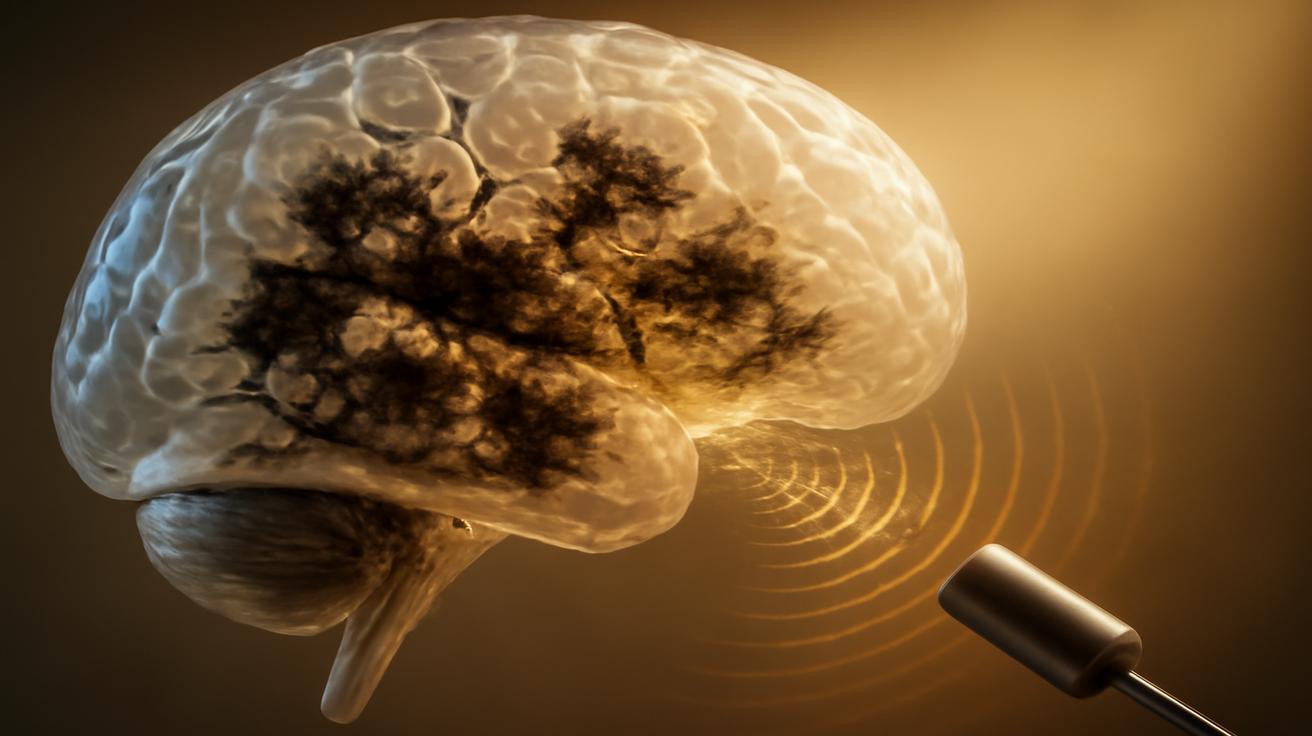
The first time you hear it, it sounds like nothing—just a faint, pulsing tone, like a distant machine left running in another room. Yet in a dim lab, this soft sound is doing something both eerie and astonishing. Under the microscope, in the tiny, intricate city of a mouse’s brain, immune cells begin to stir. They stretch and crawl and gather, like a quiet neighborhood suddenly waking to a call to action. As the sound continues—steady, precise, almost hypnotic—something even stranger happens: the sticky protein clumps that define Alzheimer’s disease start to shrink.
A New Kind of Medicine You Can’t Hold in Your Hand
We’re used to medicine being something we swallow, inject, or patch onto our skin. Pills and potions. Droppers and drips. The idea that a simple sound—no more substantial than a vibration in the air—might help clear some of the most feared plaques in the human brain feels almost like a folk tale.
Yet this is exactly what a growing body of research suggests. In a series of remarkable experiments, scientists have found that carefully tuned sound stimulation, delivered at a very specific rhythm, may help clear away the amyloid plaques and tau tangles that are hallmarks of Alzheimer’s disease. Not in humans just yet—not fully—but in animals whose brains develop damage surprisingly similar to our own.
Imagine a future neurologist saying, “I’m prescribing you one hour of sound today.” No needles. No blister packs. Just a chair, a quiet room, and a carefully designed soundscape. As strange as it may seem, the foundations for that future are being laid right now.
The Language of the Brain: Why Rhythm Matters
Inside your skull, your brain hums with electricity. It’s not a steady hum like a refrigerator; it’s a storm of sparks, billions of neurons firing in an endless dance of patterns. These patterns form rhythms called brain waves, and they come in different speeds—slow rolling waves of deep sleep, faster ripples of attention, and everything in between.
One of those rhythms, the gamma wave, is especially important for attention, memory, and perception. Gamma waves usually buzz along at about 30 to 80 cycles per second (30–80 Hz). In Alzheimer’s disease, these gamma rhythms weaken and wobble. It’s as if the orchestra of the brain has lost its conductor; instruments are still playing, but they’re no longer in sync.
Researchers began to wonder: what if you could restore these rhythms from the outside? If you play a sound at just the right frequency, could the brain start to echo it—like one violin gradually pulling the whole orchestra back into tune?
That question led to one of the most intriguing discoveries in modern neuroscience: specific sound stimulation, especially at 40 Hz (within the gamma range), can nudge the brain’s own rhythms back toward that gamma beat. And when that happens, immune cells in the brain—called microglia—seem to wake up and start clearing away Alzheimer’s debris.
The Mouse in the Sound Bath
Picture a small, quiet room. In the center is a box where a mouse, genetically engineered to develop Alzheimer’s-like plaques, moves slowly and uncertainly. Speakers around the box begin to pulse with a soft 40 Hz tone. It’s not music, not exactly; more like an audible flicker, a steady tap on the air.
Inside the mouse’s skull, something extraordinary begins to take shape. Brain scans show that neurons start to fire more rhythmically, syncing themselves to the external sound. Microglia—the brain’s long-overlooked custodians—stir to life. These cells, which are responsible for cleaning up waste and damaged material, move toward the plaques.
Over days of repeated sound exposure, studies have shown up to dramatic reductions in amyloid plaques in parts of the mouse brain responsible for memory and navigation. The tissue that once glowed with sticky deposits begins to look cleaner, more open, less choked. Even behavior changes; the mouse that once fumbled its way through mazes begins to remember the route.
There’s something almost magical in this: not a drug molecule binding to a receptor, but a pattern—a rhythm—changing the behavior of cells. The medicine is a vibration.
When Sound Becomes a Tool, Not Just a Sensation
Of course, this isn’t just “any sound will do.” The studies zeroed in on a specific frequency—40 hertz—and a repeated pattern. It’s less like listening to a song and more like standing under a strobe light tuned to just the right flicker, except here the flicker is in the realm of hearing.
Researchers call this “entrainment”: using external stimulation—light, sound, or both—to align the brain’s internal rhythms. The analogy is simple: if you hear a steady drumbeat, sooner or later your foot starts tapping along. Your brain does something similar. The neurons begin to fire in time with the beat. When that beat is in the gamma range, certain networks related to attention and memory may come back into better coordination.
In Alzheimer’s disease, those networks are often disrupted. Gamma waves weaken, like a lighthouse beam fading in a storm. Sound stimulation at 40 Hz may function like a backup lighthouse—external, artificial, but strong enough to guide the rhythm back into place. As the rhythm strengthens, microglia act differently: they seem more likely to surround and nibble away at plaques, and less likely to remain lethargic or over-reactive.
We’re still uncovering the fine print of how this works. Does the sound directly affect microglia, or does it act first on neurons, which then send signals that change immune behavior? Does it work the same in all parts of the brain? Which patterns of sound, duration, and timing matter most?
Yet beneath all the complexity, a simple and startling truth is emerging: the brain is listening, not just in the obvious way of hearing words and music, but in a deeper sense. Its very rhythms can be coaxed and guided with carefully tuned sound.
What the Early Human Studies Whisper
The leap from mouse to human is not a step; it’s a canyon. Many “miracle cures” for mice have failed spectacularly in people. The human brain is larger, more intricate, and influenced by a lifetime of experiences, injuries, and subtle changes. Any early results need to be met with equal parts excitement and caution.
Still, early pilot trials in humans are quietly hopeful. Small groups of volunteers with early Alzheimer’s symptoms have sat in carefully controlled environments, exposed to 40 Hz sound or combined light-and-sound stimulation. Their brains are monitored with scans and EEG caps, their memory tested before and after weeks of sessions.
The first hints are subtle: slight improvements in certain cognitive tests, small shifts in brain connectivity, changes in how different regions “talk” to one another. There are early signs that some brain areas shrink more slowly in people who receive the stimulation compared with those who do not. None of this is yet definitive, and no one is claiming a cure. But the pattern is enough to keep research teams pushing forward.
It’s not just about effectiveness, either; it’s also about safety. So far, 40 Hz sound stimulation at controlled levels appears to be well-tolerated in trial settings. Participants describe it as a sort of gentle, repetitive soundscape—strange at first, then oddly calming, like the hum of an airplane cabin or the thrum of rain on the roof.
How Could Sound Clear Plaques? A Closer Look Inside
To understand what’s happening, you have to meet the brain’s quiet janitors: microglia. For years, these cells were background characters in neuroscience—thought of as basic cleanup crews that swept away dead cells and debris. But it turns out they’re far more complex, switching between protective and harmful roles depending on signals from neurons and their environment.
In Alzheimer’s disease, microglia are often found clustered around plaques, but they can be oddly ineffective, sometimes contributing to inflammation rather than clean-up. It’s as if a cleaning crew showed up to a disaster site but ended up arguing and throwing dust in the air instead of sweeping it away.
Sound-induced gamma entrainment seems to change their behavior. Under the microscope, after 40 Hz stimulation, microglia appear more organized and purposeful around plaques. They extend their tiny arms, wrap around the clumped proteins, and begin to ingest them. Gene activity inside these cells also shifts—turning up programs involved in digestion and waste processing, dialing down some of the chronic inflammatory signals that can worsen brain damage.
The sound does something else, too: it influences blood flow and the delicate barrier between brain and bloodstream. Some studies suggest that gamma entrainment may slightly loosen this barrier in a controlled way, allowing waste products, including fragments of amyloid, to be carried out more effectively. In addition, changes in the brain’s “washing system”—the glymphatic pathway, which flushes out toxins especially during sleep—may also play a role.
It paints a picture of sound as a subtle choreographer, waving a baton that guides not just neurons but the entire maintenance workforce of the brain. The immune cells, the blood vessels, perhaps even the flow of cerebrospinal fluid—all responding, in some way, to a rhythm heard through the ears and echoed inside the skull.
A Glimpse of the Future Living Room Clinic
Close your eyes and imagine how this might someday look at home. A soft, padded headset rests around a person’s ears and perhaps across their forehead, light and comfortable enough to wear while sitting in a favorite chair. It might be late afternoon; the room is warm, the air still carries the scent of tea. The device begins its session—a gentle pulsing sound, maybe paired with barely flickering light, tuned so it’s not irritating, just present.
On a nearby table, a small display quietly shows that the session is in progress. Brain activity is monitored just enough to confirm that gamma rhythms are responding. The person might read, rest, or daydream. The treatment doesn’t demand their full attention; it simply hums along in the background, like a ritual of maintenance.
This vision isn’t science fiction, but it’s not tomorrow either. A long path winds between promising lab findings and something reliable, regulated, and ready for everyday use. The safety, timing, dosage, and long-term effects must all be mapped with great care. Most likely, such sound stimulation—if proven effective—would be just one tool among many: used alongside medications, lifestyle changes, and cognitive support.
Yet there is something deeply human and strangely beautiful in the possibility. Our brains are, at their core, organs of rhythm and pattern. To heal them not just with chemicals, but with rhythm itself, feels almost poetic.
Balancing Hope with Honest Uncertainty
There’s a particular kind of hope that emerges around Alzheimer’s: fierce, hungry, and often bruised by disappointment. For decades, families have watched new “breakthroughs” flicker across headlines, only to watch them quietly dim under the weight of larger, slower clinical trials.
Sound stimulation research sits squarely inside that tension. The findings in animals are among the most visually striking in recent memory—dramatic cleanup of plaques, improved behavior, even changes you can see glowing on brain scans. The human studies, though, are still early whispers, not full-voiced answers.
This is where it gets risky in another way: not medically, but emotionally. People reading about 40 Hz sound might be tempted to experiment on their own, using apps, YouTube videos, home-built devices, hoping to capture some of that lab magic. But the precision behind the research—the duration, volume, pattern, individual brain differences—matters deeply. Improvised versions could end up being useless at best, irritating or harmful at worst.
The real power of this approach lies in its careful design and testing, not in the simple fact that “sound at 40 Hz is good.” The brain is delicate. The conditions are complex. Sound is a tool, not a miracle.
And yet, even with all the necessary caution, something has undeniably shifted. For the first time, serious scientists are showing that a non-invasive, sensory-based therapy could change the physical landscape of an Alzheimer’s brain. Not metaphorically, but literally: fewer plaques, altered immune activity, changed connections.
Listening Differently to the World Around Us
There’s a quieter, more personal layer to this story too. It invites us to think differently about the soundscapes of our own lives. Long before labs began pulsing gamma tones into mouse brains, humans have used sound as medicine of a sort: lullabies to soothe, chanting to focus, drumming to gather, waves and wind to calm frayed nerves.
Modern neuroscience is, in some ways, rediscovering that the brain is exquisitely sensitive to rhythm. The difference now is that we can measure those rhythms, see them, and sometimes deliberately shift them. We’re learning that the sounds we immerse ourselves in—noise, music, silence—leave traces in our nervous system.
Will prescribed, therapeutic sound one day sit next to prescriptions for blood pressure or cholesterol? It’s possible. But even now, before the clinical verdict is in, this research nudges us toward a more attentive relationship with the vibrations that surround us. The hum of the city. The tick of a clock. The murmur of leaves. The rhythms we live inside may be shaping us in ways we’re only beginning to hear.
At a Glance: Sound Stimulation and Alzheimer’s Plaques
| Aspect | Key Details |
|---|---|
| Type of stimulation | Sound (often 40 Hz), sometimes combined with light |
| Main brain rhythm targeted | Gamma waves (linked to attention and memory) |
| Findings in animal studies | Reduced amyloid plaques, activated microglia, improved memory tasks |
| Status in humans | Early-stage clinical trials; promising but not yet proven or approved |
| Potential advantages | Non-invasive, drug-free, may be used alongside other treatments |
| Main cautions | Not a cure, needs precise dosing and medical oversight; DIY attempts not recommended |
Questions People Are Already Asking
Is sound stimulation a cure for Alzheimer’s?
No. Sound stimulation is not a cure. In animal models, it has reduced plaques and improved behavior, and in early human studies it has shown encouraging but modest effects. It should currently be viewed as an experimental, complementary approach under active investigation, not a standalone cure.
Can I try 40 Hz sound therapy at home using apps or online videos?
It’s understandable to feel tempted, but home experiments are not recommended. The research uses tightly controlled volumes, durations, and patterns, often monitored with brain activity measurements. Consumer tools are unlikely to replicate this precisely and could cause discomfort, headaches, or simply waste valuable time without benefit.
Who might benefit most if this therapy is proven to work?
Based on what we know so far, people in very early stages of Alzheimer’s—those with mild cognitive impairment or early symptoms—are the most likely candidates. At later stages, when brain damage is more widespread, therapies that gently fine-tune brain rhythms may have less impact.
Is sound stimulation safe?
In controlled studies so far, 40 Hz sound stimulation has generally been well-tolerated, with side effects like mild fatigue or irritation in some participants. However, long-term safety, impacts on different age groups, and effects on other neurological conditions are still being studied. That’s why clinical supervision is critical.
When might this become available as a regular treatment?
Timelines are uncertain. It typically takes years—from early promising results to large, carefully controlled trials, and then to regulatory review. If ongoing studies continue to show benefit and safety, sound-based therapies might begin to appear in specialized clinical settings first, and only later, if proven, in broader use.
Will sound stimulation replace Alzheimer’s medications?
Most experts expect it to be part of a combination approach rather than a replacement. Alzheimer’s is complex, and treating it may require multiple strategies working together: drugs, lifestyle changes, cognitive therapies, and potentially sensory-based interventions like sound and light.
What should families and patients do right now?
Stay informed, but grounded. If you or a loved one is affected by cognitive decline, speak with a neurologist about current, evidence-based options—approved medications, lifestyle strategies, and clinical trials you may be eligible for. Ask about non-invasive stimulation research if you’re interested, but be cautious of untested commercial devices making big promises without data.
For now, the story of sound and Alzheimer’s is still being written. In quiet labs across the world, soft pulses of 40 hertz continue to echo through small rooms, stirring tiny cells to action. The rest of us wait and listen, hopeful that these gentle vibrations might someday help clear the fog that has stolen so many memories—and that, in the rhythm of sound, we may find a new language for healing the brain.







Leave a Comment