
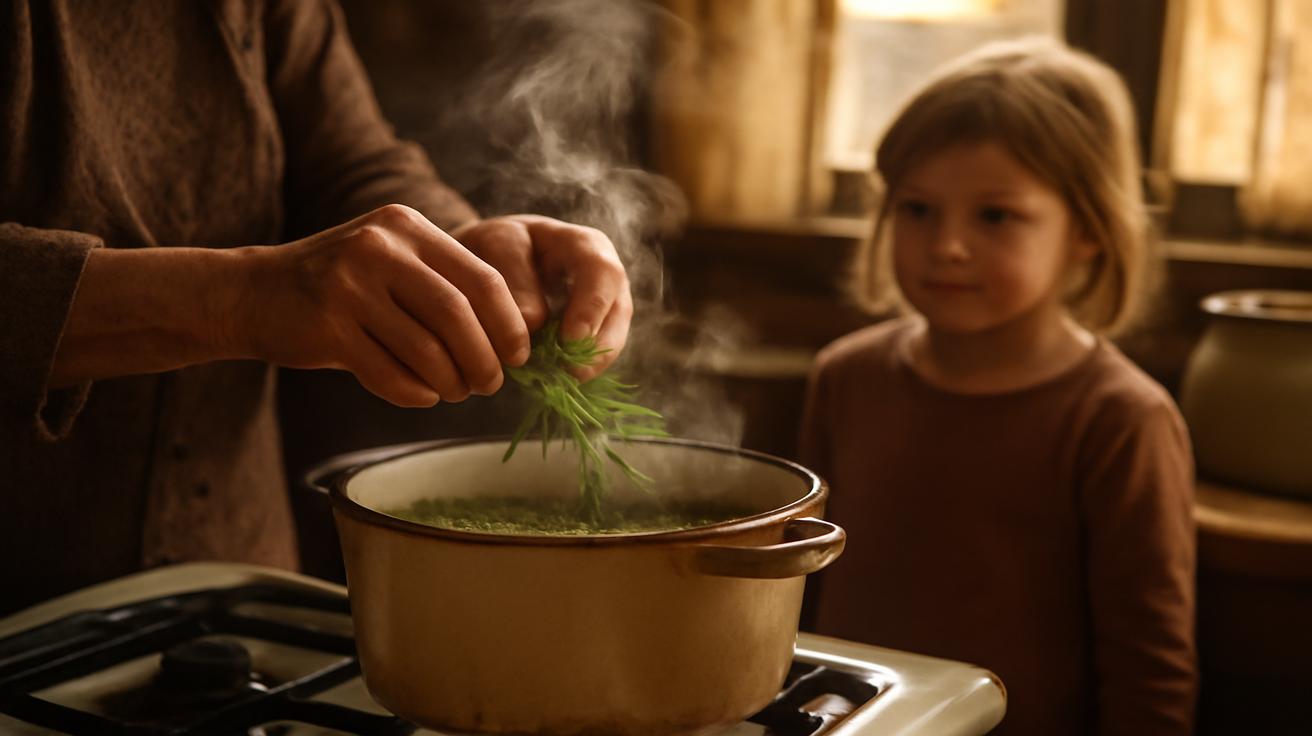
The first time I watched my grandmother boil rosemary, I thought she was making soup for the house itself. The kitchen was dim and humming with the quiet sounds of late afternoon—clock ticking, kettle whispering, a radio murmuring in the next room. She took a handful of green sprigs, still damp from the garden, dropped them into a pot of water, and set it to simmer. Within minutes, the air began to change. The sharp, piney sweetness of rosemary unfurled like a memory, drifting down the hallway, softening everything it touched. “Smell that,” she said, closing her eyes for a moment. “That’s what a home should feel like.”
The Scent That Feels Like Coming Home
There are some smells that don’t just float through a room, they anchor it. Boiling rosemary is one of those. It slips under doors, curls around picture frames, and settles into the folds of the curtains as if it has always belonged there. When I was a child, that scent meant my grandmother was in a certain kind of mood—quiet but content, house freshly cleaned, windows cracked open just enough to let the breeze mix with the herbal warmth.
It didn’t occur to me then that she was doing anything intentionally clever. To me, it was just one of her many odd little rituals: the way she folded towels into perfect thirds, the way she saved rubber bands in an old tin, the way she talked to her plants when she watered them. But later, long after I’d moved into my own place, I found myself chasing that smell. I bought candles labeled “Mediterranean Herb” and “Forest Retreat.” I tried diffusers, wax melts, sprays that promised “freshness” in a bottle. They were pleasant enough, but they all felt like imitations—like looking at a painting of a forest instead of walking through one.
One rainy evening, I remembered the pot on my grandmother’s stove. No fancy equipment. No label. Just water and rosemary. I rummaged through my spice cabinet, found a small jar of dried rosemary, and thought, “Why not?” I filled a saucepan with water, added a generous spoonful of the brittle green needles, and set it to simmer. Ten minutes later, my small apartment didn’t feel so small anymore. It felt expansive, alive, and—most surprisingly—quiet inside my own head.
That simple pot of simmering rosemary did far more than “make the room smell nice.” It shifted the entire mood of the space. The clutter on my desk was still there. The laundry basket was still half-full. But the atmosphere had softened, the way light softens in the last hour before sunset. The room felt tended to, even if nothing else had changed.
The Simple Ritual of Boiling Rosemary
Boiling rosemary is almost laughably simple, which is part of its magic. In a world that loves complicated solutions and elaborate gadgets, this tiny ritual feels both old-fashioned and quietly radical. It asks very little of you, yet gives so much in return.
Here is the way I do it most days, almost exactly the way my grandmother did:
- Fill a small pot with water—about halfway is enough.
- Add a handful of fresh rosemary sprigs or 1–2 tablespoons of dried rosemary.
- Bring the water to a gentle boil, then immediately lower the heat to a soft simmer.
- Let it simmer for 15–30 minutes, adding more water if needed so it doesn’t dry out.
- Turn off the heat and simply let the steam finish its quiet work.
You don’t stir it, you don’t fuss over it. You just let it be. The rosemary releases its oils into the steam, which drifts into corners and over furniture, wrapping the room in a clean, resinous, almost ancient fragrance. It smells like hillside gardens and cool forests and wooden cupboards that have held herbs for decades.
There’s something profoundly human about transforming plain water and a humble herb into atmosphere. No electricity required beyond the stove. No packaging, no branding, no algorithm predicted that you’d like “rosemary-forward notes with a subtle pine base.” It’s just you, a plant, some heat, and time. And that, somehow, is enough.
Why Rosemary Changes More Than Just the Air
We often underestimate how much scent shapes our experience of a place. Walk into a room that smells like stale air and dust, and your shoulders tense without you even noticing. Walk into a room that smells like warmed herbs and open windows, and your breath drops a little deeper into your lungs.
Rosemary in particular has a way of sharpening and softening at the same time. The scent is crisp, but not cold. It’s soothing, but not sleepy. It seems to find a middle path between comfort and clarity. When I have rosemary simmering, I find it easier to sit down and write, to have a conversation, or even to clean up without feeling rushed. It’s as if the house and I agree, silently: we’re going to take our time with this.
My grandmother used to say, “Rosemary clears more than just the air.” She meant it in that half-practical, half-mystical way older women have when they’ve lived long enough not to over-explain something. She believed rosemary made the home feel lighter, but also more grounded—as if the walls themselves were exhaling.
Building a Sensory Sanctuary at Home
There is a specific sound you hear when the water under rosemary finds its simmer: a faint tremble, tiny bubbles shouldering each other at the surface, the soft clink of a metal lid if you’ve covered the pot. The first time you stand in a quiet kitchen and listen to it, you may realize how much of your life happens at full volume—notifications, traffic, voices, a constant stream of information. This small sound is the opposite of all that: it is the sound of something simple working slowly.
As the steam rises, the windows may cloud at the edges. The air feels slightly warmer near the pot, more alive. If you walk into another room and then come back, you’ll notice how the scent has grown, like a story that keeps adding details each time it’s told. You may find yourself slowing down—moving more gently, speaking more softly, almost as if the house has shifted into a different tempo.
The beauty of this ritual is that it doesn’t demand you stop what you’re doing. You can still respond to emails, fold laundry, chop vegetables for dinner. The rosemary simply runs in the background, a quiet presence like a friend sitting at the table while you work. Yet over time, this background presence starts to shape the way you experience your own space. A home stops feeling like a container for your stuff and starts feeling like a living place you are in relationship with.
My grandmother never called it “self-care.” She would have laughed at that phrase. But she knew that a house that smells of something alive—something from the garden, something from the earth—behaves differently. People linger longer in the kitchen doorway. They lean against counters instead of hovering anxiously. They stay for “just one more cup of tea.”
Small Moments, Big Shifts
Most of the changes we want in life feel enormous: better habits, more peace, a calmer mind, a warmer home. When we think of these changes, we imagine major renovations—new furniture, cleared schedules, a different city, a different job. But our nervous systems are often far more responsive to small, repeatable cues than to grand announcements.
Boiling rosemary is one of those cues. It’s a way of whispering to your own body, “You are safe here. You can soften here.” The act is tiny, but its message is clear. With repetition, that message becomes part of the way you inhabit your space. You might begin to associate the scent with evenings, or with slow Sunday mornings, or with the end of a long workday. It can act as a gentle boundary between “out there” and “in here.”
There are evenings when I come home restless and scattered, my mind still buzzing with unfinished conversations and worries about the next day. On those nights, I don’t have the energy for elaborate rituals. But I can fill a pot with water. I can reach for the jar of rosemary. Within minutes of the first steam curling into the air, I feel something in me start to rearrange, the way coats get hung up by the door after being shrugged off.
Making the Ritual Your Own
My grandmother’s version was always the same: just rosemary, just water. But homes are as individual as their inhabitants, and this simple practice can unfold in countless ways. The important part isn’t strict adherence to a rule; it’s the intention you fold into the act.
On cold winter afternoons, I add a strip of lemon peel to the pot—nothing dramatic, just a ribbon of yellow zest. The rosemary deepens, the citrus lifts, and suddenly the kitchen smells like a sunlit hillside, even if it’s gray and raining outside. Sometimes I’ll add a small cinnamon stick, which doesn’t fight the rosemary but rounds it out, like a soft note at the bottom of a chord.
On days when I’m cleaning, I move the pot from burner to burner, letting the steam drift into different parts of the house while I wipe counters and sweep floors. On slow Sundays, I put the pot on the back burner and then forget about it until the scent reminds me it’s there, nudging me gently back into the present moment.
The practice is also wonderfully forgiving. You don’t need fresh rosemary from a garden. Dried rosemary works beautifully. You don’t need a special pot. Any old saucepan will do. You don’t need hours. Fifteen to twenty minutes can shift the entire mood of a space.
Practical Ways Rosemary Steadies a Home
Even though the magic of boiling rosemary feels almost poetic, it’s also deeply practical. It’s one of those rare habits that satisfies both the part of you that loves atmosphere and the part that likes practical benefits. Here’s how I’ve seen it shape the day-to-day feel of a home:
- Odor softening: It gently nudges away lingering cooking smells or stale air without the artificial sharpness of chemical sprays.
- Transition moments: Perfect for Sundays, post-cleaning afternoons, or the hour between work and dinner when you need to “change chapters” in your day.
- Hosting: Guests often walk in and say, “What is that? It smells amazing in here,” without being able to name it immediately. It creates a sense of thoughtful hospitality without any grand display.
- Morning grounding: On quiet mornings, a brief simmer pairs beautifully with coffee or tea, inviting you to begin the day a little more slowly.
For those who like to compare this ritual with other scent options, here’s a simple overview:
| Method | Pros | Cons |
|---|---|---|
| Boiling Rosemary | Natural, inexpensive, customizable, creates a calm ritual | Requires stove, needs supervision so it doesn’t boil dry |
| Scented Candles | Convenient, decorative, many fragrance options | Often synthetic, open flame, can be overpowering |
| Aerosol Sprays | Instant effect, easy to use | Short-lived, artificial, can feel harsh |
| Diffusers & Oils | Long-lasting, adjustable intensity | More expensive, requires equipment, oil quality varies |
Threads That Connect Generations
The older I get, the more I realize that the most enduring lessons from the people we love rarely arrive as formal teachings. They arrive as habits, small repeated acts stitched quietly into the fabric of everyday life. Boiling rosemary was one of those threads from my grandmother to me. She never sat me down and taught me a “tip for a fresher home.” She just lived it, over and over, until the scent of rosemary came to mean comfort, presence, and care.
Sometimes, when I simmer rosemary now, I can almost hear the sound of her slippers on the kitchen tiles, the soft thud of a cupboard closing, the faint clink of her favorite mug. The ritual collapses time: her kitchen and mine, her life and mine, woven together for a little while in the rising steam.
In a culture that often treats homes as backdrops for carefully staged moments, it feels quietly rebellious to choose something so unpolished, so unmarketed, as your favorite “home tip.” But maybe that’s why it feels so grounding. There is nothing to perform here. No one needs to see it but you. The rosemary doesn’t care whether you’re wearing old pajamas or your nicest sweater. It doesn’t care what your living room looks like on Instagram. It just does what it has always done—releases itself into the air, transforming plain water and a bit of heat into a kind of everyday alchemy.
And when the pot cools, when the steam fades and the house settles into its usual quiet, something lingers. Not just the scent, which will stay, faintly, in the curtains and cushions. Something subtler: the memory of having tended to your space, of having given your home—and by extension, yourself—a moment of gentle, fragrant attention.
Maybe that’s what my grandmother understood all along. A house becomes a home through repeated acts of care. Some of them are grand and visible. Most are not. A small pot, a handful of rosemary, and a few minutes of simmering might not look like much from the outside. But step through the door, breathe in once, and you’ll know: something here has been loved.
Frequently Asked Questions
How long should I boil rosemary to scent my home?
Start with 15–20 minutes of gentle simmering. If you want a stronger scent, you can let it go up to 45 minutes, adding more water as needed so it doesn’t boil dry.
Can I use dried rosemary instead of fresh?
Yes. Dried rosemary works very well. Use about 1–2 tablespoons for a small pot of water. Fresh sprigs will smell slightly greener and brighter, while dried rosemary gives a deeper, warmer scent.
Is it safe to leave the pot simmering unattended?
It’s best not to leave it completely unattended. Keep the heat low, check the water level occasionally, and turn off the stove if you leave the house or get very distracted. Treat it like any other pot on the stove.
Can I reuse the rosemary water?
You can usually re-simmer the same pot once more later the same day, though the scent will be lighter. After that, discard it and start fresh next time for the best aroma.
Can I combine rosemary with other ingredients?
Absolutely. Rosemary pairs beautifully with lemon peel, orange peel, cinnamon sticks, cloves, or a few sage leaves. Just keep the mix simple so the fragrance doesn’t become muddled or overpowering.








Leave a Comment