
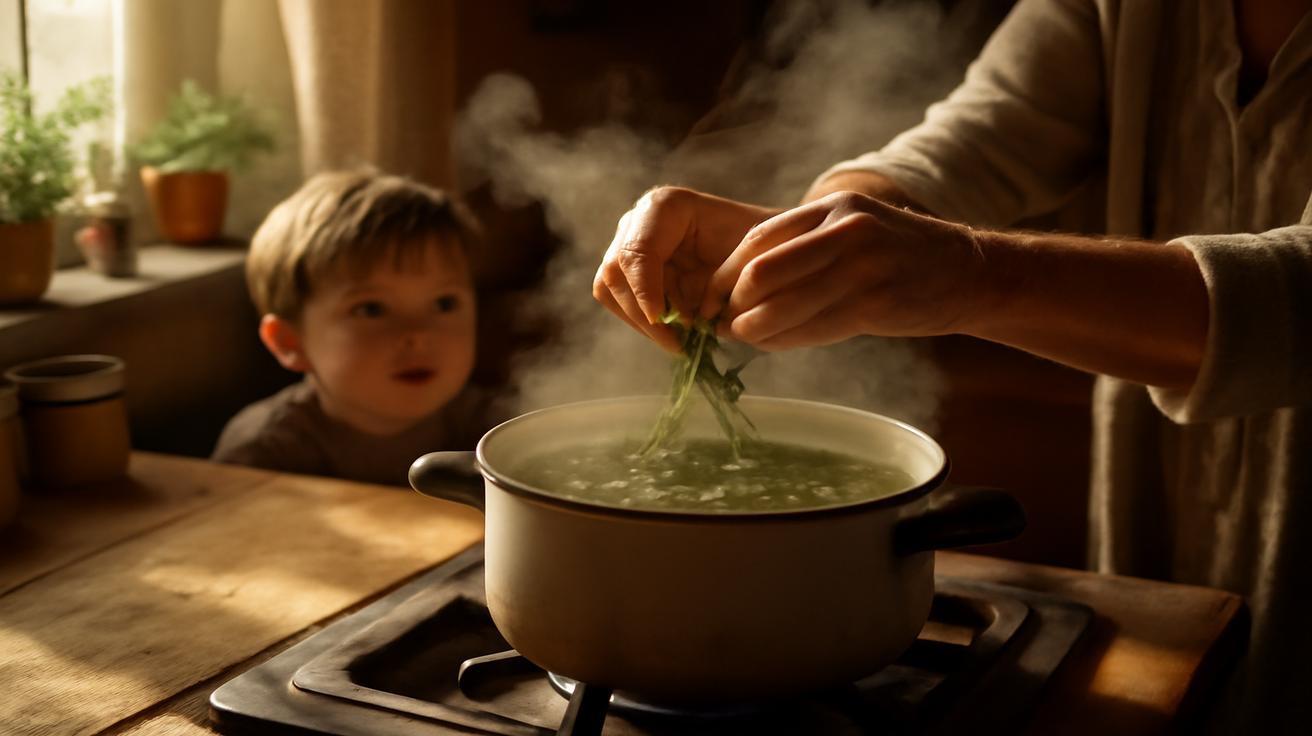
The first time I watched my grandmother boil rosemary, I thought she’d lost something in the pot. She stood over her old enamel saucepan, tossing in twig after twig of green needles as if she were feeding a tiny, bubbling forest. Within minutes, the kitchen shifted. The air thickened with scent—sharp, piney, a little like the woods after rain and a little like something you couldn’t quite name but suddenly needed. The television hummed in the other room, the washing machine rattled in the hallway, but in the kitchen everything felt slower, softer, somehow cleaner. “This,” she said, waving her wooden spoon like a wand, “is how you change a house without buying a thing.”
The Steam That Stopped Time
My grandmother lived in a small brick house that always smelled like something: simmering tomatoes, rising bread, lemon peels drying on the windowsill. But rosemary days were different. They were quiet days, days when she moved more gently, like she was trying not to disturb an invisible thread running through the rooms. I’d sit at the narrow kitchen table, legs swinging off the chair, pencil hovering over homework I was supposed to care about more than the steam drifting across the curtains.
“Why rosemary?” I finally asked, as a tiny cloud puffed up when she lifted the lid of the pot. She didn’t answer right away. Instead, she leaned down and breathed in, closing her eyes as if the rosemary had something to say. Then she nodded, satisfied, and turned off the flame.
“Because it remembers,” she said. “And it makes you remember too.”
At the time, I thought it was just another one of her poetic, half-baffling sayings. Grandmothers specialize in those. But over the years, that little ritual—water, heat, a handful of herb—worked its way into my life like a quiet melody you don’t notice until you start humming it on your own. I’d move apartments, change cities, outgrow furniture and friends, but a small pot would always find its place on my stove, and rosemary would always find its way inside.
It wasn’t just a scent; it was a switch. The moment the house smelled like rosemary, it felt like I lived there, even if my belongings were still in boxes.
Boiling Rosemary: A Tiny Ritual with a Big Atmosphere
We live in a world where “changing the atmosphere of your home” is usually translated into spending money: new paint, new furniture, new diffuser, new candle, new thing shipped in a box. But my grandmother, who grew up when nothing arrived in boxes and everything had to stretch further than it reasonably should, understood something simpler and older: your senses are the quickest way to transform a space.
Boiling rosemary is one of those small rituals that seems too humble to be powerful—until you try it. There’s no fancy diffuser, no carefully branded oil, no perfect glass jar with linen labels. Just water, heat, and the sort of herb you can find tied with string at the grocery store or growing stubbornly in a cracked pot by your window.
When the rosemary hits the water, it doesn’t explode with scent. It unfurls. First, there’s the faint green note, like crushed leaves between your fingers. Then the sharper, resinous edge arrives, the part that smells a bit like pine forests and a bit like old apothecaries—clean, slightly medicinal, but comforting. The steam carries that scent through your home, softening the corners, slipping under doorways, layering over the day’s leftovers: the bus ride, the emails, the city dust, the burnt toast you’d like to forget.
What I love most is how physical it feels. You watch the small bubbles gather at the bottom before they rise, the rosemary sprigs bobbing like tiny boats in a green-tinted sea. Your hands get warm from the pot, your face dewy from the steam if you lean in. You can literally see the transformation rising in the air, then smell it, then feel it in the way your shoulders shift down from your ears.
My grandmother didn’t talk about “self-care” or “mindfulness.” Those weren’t her words. But she believed in doing small, deliberate things that quietly changed the way you existed in a space. Boiling rosemary was one of her favorite spells.
The Simple How-To (Grandmother-Approved)
Her instructions were as unfussy as she was:
- Fill a small pot halfway with water.
- Add a generous handful of fresh rosemary (or a couple of tablespoons of dried if that’s what you have).
- Bring it to a gentle boil, then lower the heat to a simmer.
- Let it bubble softly for 10–20 minutes, topping up the water if it gets too low.
- Turn off the heat and leave the pot uncovered to let the steam wander through the house.
That’s it. No timers, no measuring cups, no extra gadgets cluttering the counter. Just a pot on the stove, doing what pots have always done: turning the ordinary into something else.
Aroma, Memory, and the Strange Science of Feeling at Home
My grandmother wasn’t a scientist, but she knew that scent could change a room faster than any mop or vacuum. What I learned later is that she was absolutely right, and there’s quiet science tucked into her kitchen wisdom.
Smell is wired straight into the parts of our brain that deal with memory and emotion. That’s why one whiff of something—your grandfather’s aftershave, a bus exhaust, a particular brand of laundry detergent—can throw you back in time more forcefully than a photograph ever could. Rosemary, in particular, has this almost uncanny ability to feel both old and fresh at the same time, like it’s pulling from deep memory but also whooshing open a window somewhere inside your head.
Boiling it intensifies that experience. The heat teases out the oils, suspending them in the air just enough for you to breathe them in as you move through the house. You don’t have to stand over the pot, eyes closed like some movie scene; you just go about your afternoon, and the rosemary follows, subtle but insistent.
There’s a lightness that comes with it, as if the room has been aired out without you having to crack a window. The stale edges of yesterday’s dinner, the faint mustiness of a closed-up room, even the emotional residue of a stressful day—they don’t exactly vanish, but they feel… negotiated with. Softened. Wrapped in something that says, “You’re home now. You can let go a little.”
And then there’s the memory-making piece. The more you repeat the ritual, the more your brain starts to weave it into your personal story. The smell of boiling rosemary becomes associated with your own quiet evenings, your own slow Sunday afternoons, your own decision to pause. Years later, you might not remember the emails you answered or the shows you watched, but you’ll remember the way your kitchen smelled like rain in a Mediterranean hillside village, even if you’ve never set foot in one.
Little Moments, Big Shifts
It can be tempting to look for big changes when we feel off balance: a new job, a new city, a total redesign of the living room. But sometimes the thing that shifts us is a small, repeatable act that grounds us in our senses—something that takes five minutes and doesn’t require a username or a tracking number.
Boiling rosemary became that for me. When the apartment felt like a box, when the walls felt closer than usual, when the to-do list was longer than my patience, I’d fill the pot, drop in the herbs, and wait for the first breath of green in the air. It didn’t fix everything, of course. But it did tilt the room a few degrees toward calm, and sometimes that was enough.
Beyond Scent: The Quiet Art of a Home Ritual
There’s another part of this practice that matters just as much as the smell: the slowness. We’re used to tapping a button to make things happen. Light: tap. Music: tap. Fragrance: tap. But standing at a stove, waiting for water to boil and herbs to release their scent, inserts a small, gentle delay into your day.
It asks you to be there, even for just a few minutes.
My grandmother would use those minutes to wipe the counter, rinse a mug, or just rest her hands on the edge of the sink and look out the window. She didn’t narrate it or analyze it. She just did it, the way some people straighten a picture frame without thinking.
In my own kitchen now, I find myself doing the same. While the rosemary simmers, I’ll put away a few dishes, take slower breaths, maybe open a window if the weather allows. Sometimes I sit on the floor with my back against the cabinet, letting the warmth of the stove touch the room while I stretch out the stiffness of the day. The ritual pulls me out of my head and into my body, into the very real space I occupy.
And then there’s the way it marks time. Boiling rosemary can become a signal: the workday is over now. The guests will be here soon. The storm outside is loud, but in here we’re safe. It’s like lighting a candle without the wax and the wick—less visual, more primal, a small ceremony of heat and scent that says, “This is a different moment from the one before.”
Customizing the Ritual Without Losing the Heart
My grandmother was a purist—just rosemary, just water, just a pot. Over time, though, I’ve learned to gently bend the ritual to meet different moods.
- A slice of lemon tossed into the pot for a bright, clean edge.
- A stick of cinnamon when the air outside is cold and you want warmth that smells like long afternoons and soft sweaters.
- A few sage leaves mingling with the rosemary on days that feel heavy, like they’re dragging their feet.
But I always keep the rosemary. It’s the anchor, the thread that ties these variations back to that small brick house and the woman who believed your home was something you cultivated, not something you just happened to live in.
How Rosemary Quietly Upgrades the Feel of Your Home
If you strip it down to basics, home atmosphere is built on three sensory pillars: what you see, what you hear, and what you smell. The first two get most of the attention—lighting design, furniture, playlists, the soft clink of dishes. Scent is often an afterthought, addressed with a quick spray or a plug-in warmer that hums away in the background.
But rosemary shifts that balance in a subtle, tactile way. It’s not just “adding a nice smell” so much as actively participating in the life of your home:
- It clears the canvas. The herbal sharpness seems to cut through lingering odors, making the air feel lighter and more breathable.
- It suggests cleanliness even before you’ve finished cleaning. A rosemary-scented home feels tidier, even if there’s still a stack of mail on the counter.
- It softens the atmosphere. Arguments don’t echo as long, worries feel less jagged against the edges of the day.
- It adds a seasonal flexibility. In winter, it feels comforting and warm; in summer, it feels fresh and green.
Over time, this single, simple ritual can become the quiet signature of your space, the thing people can’t quite put a finger on when they say, “It just feels so good in here.”
A Tiny Rosemary Reference Table
Here’s a small, mobile-friendly guide you can keep in mind when you start boiling your own rosemary at home:
| Purpose | How to Use Rosemary | Atmosphere Created |
|---|---|---|
| Daily reset after work | Simmer a handful of fresh rosemary for 15 minutes | Calm, “I’m home now” feeling |
| Before guests arrive | Add rosemary and a slice of lemon to gently boiling water | Welcoming, fresh, subtly clean |
| On cold, rainy days | Simmer rosemary with a cinnamon stick | Cozy, warm, comforting |
| During cleaning sessions | Keep a pot of rosemary simmering on low in the background | Energized, fresh-start vibe |
| Quiet reflection or reading time | Simmer rosemary alone on low heat, lights slightly dimmed | Grounded, clear, gently focused |
Carrying the Tradition Forward
Every family has its small, almost invisible threads—the habits and rituals that travel quietly from one generation to the next. Some arrive as recipes, some as sayings, some as songs hummed while folding laundry. For me, one of those threads is a humble sprig of rosemary in a pot of water.
There are days when my life feels comically far from my grandmother’s: I answer messages she could never have imagined, stare at glowing screens for most of my waking hours, move through a world faster and louder than the one she knew. And yet, there’s this one place where our days line up perfectly: standing in front of a stove, waiting for water to boil, watching green needles darken and gloss over with heat.
Sometimes, if I close my eyes, I can feel her there beside me. Not in the dramatic sense—no thunderclap of revelation, no cinematic music—just a quiet, companionable presence in the simple act we share. I imagine the way she would glance at the pot, nod when the scent hit a certain note, and then move on to whatever came next, satisfied that the house was on its way to feeling right.
You don’t have to have grown up with this ritual to make it your own. That’s the beauty of it. Maybe you’ll try it once on a whim and find yourself doing it again a week later. Maybe it will become your Sunday evening reset, your rainy-day comfort, your pre-guest habit. Or maybe it will simply be the thing you do the first time you step into a new place with cardboard boxes and unfamiliar shadows, just to say: I live here now.
In a world crowded with products promising transformation, there’s something quietly radical about changing the feel of your home with something so simple, so old, and so alive. A sprig of rosemary, a pot of water, a little heat—and suddenly, the house breathes differently. So do you.
Frequently Asked Questions
How long should I boil rosemary to scent my home?
Generally, 10–20 minutes of gentle simmering is enough to fill an average-sized home with a noticeable, pleasant rosemary aroma. You can let it go a bit longer on very low heat, just be sure to keep an eye on the water level so the pot doesn’t dry out.
Is it better to use fresh or dried rosemary?
Fresh rosemary usually gives a brighter, greener scent, while dried rosemary can smell a bit deeper and more herbal. Both work well. If using dried, start with 1–2 tablespoons; with fresh, a small handful of sprigs is ideal.
Can I leave the pot on the stove unattended?
It’s best not to. Even on low heat, water can evaporate faster than you expect. Stay nearby, or set a timer to remind you to check the pot and add more water if needed. Safety always comes before scent.
Will boiling rosemary remove bad odors from my home?
It won’t erase strong odors completely, but it can significantly soften and mask them, especially lingering cooking smells or mild mustiness. For best results, combine it with basic ventilation—crack a window or briefly run a fan while the rosemary simmers.
Can I reuse the rosemary after boiling?
You can reuse the same sprigs once or twice within the same day for another simmer, though the scent will be a bit weaker each time. After that, compost or discard them. Fresh sprigs will always give the strongest aroma.
Is boiling rosemary safe if I have pets?
In normal cooking or simmering amounts, the scent in the air is generally considered safe for most pets, as long as the area is well-ventilated and your pets don’t have specific respiratory sensitivities. Just make sure they can’t access or drink the hot rosemary water, and consult your vet if you have any concerns.
Can I combine rosemary with other ingredients?
Yes. Lemon slices, orange peels, cinnamon sticks, cloves, bay leaves, or sage all pair beautifully with rosemary. Start with simple combinations—like rosemary and lemon or rosemary and cinnamon—and adjust based on what smells best to you.
How often can I do this ritual?
As often as you like. Some people simmer rosemary once a week as a reset, others use it during seasonal cleanings, and some enjoy it daily in small doses. Listen to your own senses; if it still feels comforting and fresh, you’re not overdoing it.







Leave a Comment