
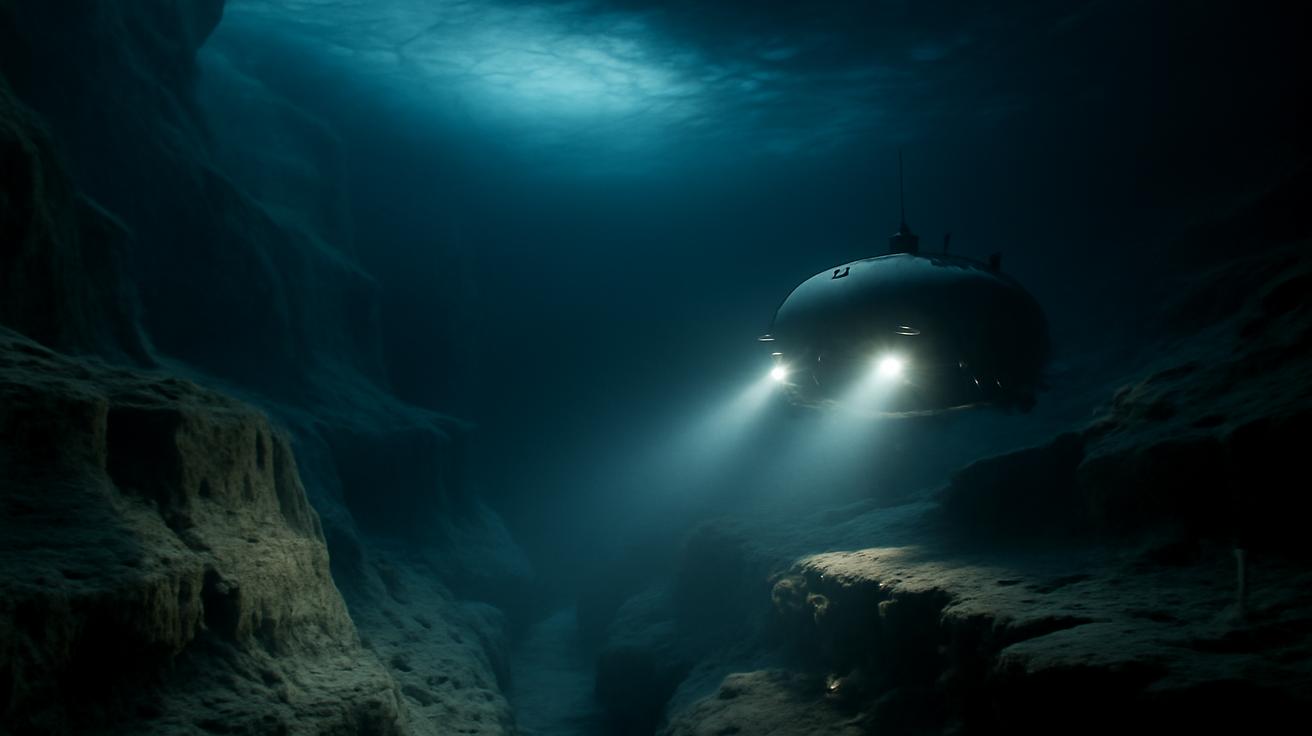
The ship’s lights carved a trembling path across the Southern Ocean as the sonar pinged into the dark water below. Outside, the air was knife-cold, the kind of cold that steals breath before you can see it. Inside the dimly lit control room, a cluster of scientists leaned over glowing monitors, watching as thin green lines on the screen twisted, dipped, and then did something none of them expected—they plunged. A canyon appeared where the seafloor, by every existing map, should have been smooth and uneventful. Then another. And another. The silence that followed wasn’t boredom or fatigue. It was awe. Under the ice-shrouded edges of Antarctica, the ocean floor was not a blank margin at the bottom of the world. It was scarred and sculpted, alive with hidden architecture—hundreds of submarine canyons, some as deep as the Grand Canyon, that no human being had ever seen.
When the Map of the World Turns Out to Be Wrong
For most of us, maps feel final. We learn in school that Antarctica sits like a frozen crown at the bottom of the globe, white and monolithic, encircled by blue. The ocean around it looks deceptively simple on a wall poster, a clean gradient of increasing depth. But that picture—still hanging in classrooms and hallways—is an illusion built on enormous gaps in knowledge.
Until recently, large parts of the seafloor around Antarctica were more guesswork than fact. Ice cover, brutal weather, and remoteness meant that detailed measurements were sparse. In many places, scientists relied on satellite gravity data, clever mathematical interpolation, and sheer hope to “fill in the blanks.” The Southern Ocean, despite circling an entire continent, remained one of Earth’s least known landscapes.
That began to change when research vessels equipped with high-resolution multibeam sonar started threading their way along the Antarctic continental margin. Each voyage traced a narrow ribbon of revealed seafloor, a tiny corridor of truth cut through a vast area of assumption. It was slow, painstaking work. Yet when those ribbons were stitched together, a startling pattern emerged: the continental slope was not a smooth descent into abyssal depths; it was riddled with steep, twisting gashes.
The more they mapped, the more they found. A few dozen canyons became a hundred, then several hundred—long, branching trenches cutting from the edge of the ice shelf far down the continental slope. Some were old and buried under soft sediments. Some were alarmingly fresh, sharp and incised, like fingernail scratches in clay. Together, they suggested something profound: we hadn’t just underestimated the ruggedness of the seafloor. We had misunderstood the way Antarctica breathes into the ocean.
The Secret Rivers of Ice and Water
On land, canyons are intuitive. Rivers carve through rock, glacial meltwater gouges valleys, erosion is written in cliffs and switchbacks. Underwater, the same physics whisper through darkness, but in forms we’re only beginning to learn to read. Submarine canyons are, in essence, rivers you can’t see—pathways where dense water, sediment, and sometimes even ice cascades from the continental shelf into the deep ocean.
Around Antarctica, these hidden riverbeds begin near the grounding lines and fronts of vast ice shelves—those floating tongues of ice that reach out from the continent over the sea. As glaciers flow outward from the continent’s interior, they meet the ocean and start to melt from below. That meltwater is colder and fresher than the salty sea but, crucially, can mix with other water masses to form dense plumes that sink and slide downslope, hugging the seafloor. Like water trickling over sand, these flows gradually deepen and widen their pathways, carving the first faint outlines of a canyon.
But it doesn’t stop there. Turbidity currents—sediment-laden flows triggered by storms, glacier collapse, or underwater landslides—can roar down these nascent gullies like avalanches, scouring them deeper. Year after year, century after century, the ocean revises its own plumbing. The result is a branching network of canyons that guide everything from meltwater and nutrients to carbon-rich particles.
These Antarctic canyons are not all the same. Some are ancient, relics of past ice ages when sea levels were lower and glaciers reached farther. Others appear to be active, dynamic corridors still fed by modern ice and ocean processes. Their shapes—broad U-shaped valleys, knife-edged V-shaped incisions, looping meanders—offer clues to the forces that built them. In their composite, they form a cryptic history book of how ice and ocean have argued and negotiated at the bottom of the world.
Listening to the Landscape with Sound
Because no one can simply walk down the walls of a submarine canyon, scientists turn to sound. High-frequency pings from multibeam sonar instruments fan out beneath ships, bouncing off the seafloor and returning with subtle changes in timing and intensity. Computers translate those echoes into colorful 3D maps, where the gentle slope of the continental shelf suddenly collapses into shadowy ravines.
In dim ships’ labs, those bathymetric maps command the room like topographic art. Ridges and spurs show as bright ridgelines. Chasms are rendered in indigo and violet. Over days and weeks at sea, teams watch previously blank regions fill in with extravagant detail. Sometimes the canyon walls rise nearly vertical. Sometimes silt has choked the lower reaches, flattening them into quiet, sediment-filled basins. Each new survey area feels like opening a curtain on a world that has been performing in darkness for millions of years.
These maps also let scientists estimate the scale of what they’re dealing with. Some Antarctic submarine canyons stretch for hundreds of kilometers from the shelf toward the deep ocean. Others fan out like tree roots, with side branches feeding a larger trunk. Depths can rival famous features like the Grand Canyon, but here, everything is submerged, invisible to satellites and human eyes alike.
Where Ice Meets Ocean: Canyons as Climate Gateways
At first glance, submarine canyons might seem like geological trivia, the kind of detail that delights map nerds but doesn’t matter much to the rest of us. Yet in the case of Antarctica, these canyons are anything but minor. They act as express lanes for heat, salt, and nutrients, shaping not just local ecosystems but global climate.
One of the most consequential roles these canyons play is as conduits for relatively warm, salty deep water—especially a water mass known as Circumpolar Deep Water. This water circles Antarctica like an underground weather system, carrying heat from lower latitudes. Left to its own devices, it might skim harmlessly under the Southern Ocean’s surface layers. But the newly mapped canyons reveal a more intimate choreography.
Guided by canyon walls, warm deep water can be funneled up toward the bases of ice shelves. Once there, it melts ice from below, sometimes dramatically. Scientists now think many of Antarctica’s most vulnerable ice shelves—those buttressing enormous inland glaciers—are intimately connected to these canyon-borne currents. The canyons are, effectively, pipelines for heat delivery.
In a warming world, this matters enormously. Small changes in wind patterns or surface waters can alter how much deep water is steered into these canyons, which in turn affects melt rates, ice shelf stability, and ultimately sea level rise. Without accurate canyon maps, climate models might miss critical pathways, underestimating how quickly ice can respond to changing oceans.
Feeding Life in the Coldest Waters
There’s another side to these hidden chasms, one that concerns not just physics but the very fabric of life in the Southern Ocean. Canyons, for all their cold and darkness, are often biological hotspots. As dense, sediment-rich flows tumble downslope, they carry organic material—dead plankton, fecal pellets, fine particles of carbon—that settles in canyon bends and basins. Over time, this creates food-rich patches in an otherwise sparse deep sea.
In some canyons, currents accelerate along the walls and floors, stirring up nutrients from the seafloor and lofting them back toward the surface. This upward leak of chemical wealth can fuel blooms of phytoplankton—the microscopic plants of the ocean—near canyon mouths. Tiny plant cells then support entire food webs: krill, fish, squid, penguins, seals, whales.
The cold, iron-poor surface waters around Antarctica are notoriously stingy, limiting how much life they can support. If submarine canyons help deliver nutrients and carbon upward, they effectively punch biological “windows” into an otherwise tight system. Many of the ocean’s larger creatures may unknowingly rely on invisible ravines beneath them, steering migration routes or feeding grounds along zones enriched by canyon-driven upwelling.
In this way, the discovery of hundreds of hidden canyons doesn’t just redraw a physical map—it suggests a parallel, unseen ecology: corridors where whales might find more krill, where deep-sea corals cling to ledges in current-swept darkness, where carbon from the surface quietly falls and is stored for centuries. Canyons are both delivery routes and resting places for the planet’s biological currency.
The Numbers Beneath the Ice: Scale of a Hidden World
From a distance, the idea of “hundreds of canyons” sounds abstract—impressive, but hard to visualize. Step closer, and the scale begins to feel dizzying. Imagine flying along the edge of Antarctica in a small plane, then looking down not at a simple continental slope, but at a margin pocked and incised like the edge of an eroded book, each tear and groove a canyon system.
While different surveys report varying totals, combined mapping efforts now suggest that the Antarctic margin hosts several hundred submarine canyons and canyon-like valleys, many of them newly identified in the past decade. They vary wildly in size and shape, like a family of giants and dwarfs sharing the same address.
| Feature | Typical Range | Why It Matters |
|---|---|---|
| Number of mapped canyons | Hundreds across the Antarctic margin | Reveals a far more complex seafloor than previously assumed |
| Canyon length | Tens to >200 km | Long corridors linking coastal zones to deep ocean basins |
| Canyon depth (relief) | Hundreds to >1500 m | Determines capacity to channel dense water and sediments |
| Connection to ice shelves | Many rooted near shelf fronts and grounding lines | Controls pathways of warm water toward vulnerable ice |
| Biological influence | Localized hotspots, enhanced productivity | Shapes distribution of Antarctic marine life and carbon storage |
Each canyon is a small universe of gradients—of pressure, light, temperature, chemistry. At the top, near the edge of the continental shelf, conditions are more familiar: seasonal light, swirling ice, surface storms. As you descend, light vanishes, temperatures stabilize just above freezing, and pressure builds with almost theatrical insistence. By the time you reach the canyon floor, human lungs, bones, and technology designed for the surface would fail in seconds.
Yet for the organisms that live there—strange worms, cold-water corals, brittle stars, bioluminescent jellyfish—this is home. Some canyons may even act as refuges, pockets of relative stability as surface conditions shift. Others, especially where active flows continually reshape sediments, are more like construction zones, always unsettled, always in flux.
From Data Gaps to New Eyes on the Deep
One of the sobering truths emerging from this research is how little of the seafloor we have actually seen at comparable resolution. Globally, only a modest fraction of the ocean floor has been mapped in detail by ships. The rest is blurred, extrapolated from sparse soundings and satellite measurements. Antarctica’s canyons are a particularly stark reminder that major planetary features can still lurk in those blurred zones.
New tools are helping to fill the gaps. Autonomous underwater vehicles, gliding robots, and ice-capable research vessels push into previously unreachable regions. Some can operate under seasonal sea ice, sliding silently above canyon heads. Others release instrument packages that drift with currents, listening for subtle temperature and salinity changes that hint at water flowing through these hidden corridors.
Back on land, supercomputers and machine learning sift through terabytes of sonar data, teasing out canyon shapes, slopes, and branching patterns that a human eye might miss during a single expedition. Layered on top of ocean circulation models and climate projections, this digital relief of the Antarctic margin is transforming from a static backdrop into a living, dynamic interface between ice and sea.
Rewriting Our Story of the Oceans
The most powerful impact of discovering hundreds of Antarctic submarine canyons is less about the spectacle of deep ravines and more about what they force us to reconsider. For decades, oceanographers and climate scientists treated the continental margins of Antarctica as relatively smooth transition zones—important, but not intricately structured. Now, those margins look more like complex machinery than simple geometry.
Canyons complicate almost everything. They change how we estimate where and how quickly dense Antarctic Bottom Water—the cold, heavy water that sinks around Antarctica and ventilates much of the global deep ocean—is formed. They modify predictions of how meltwater and freshwater from retreating ice may spread, potentially altering ocean stratification and currents thousands of kilometers away. They recast our assumptions about where marine life can flourish in waters we once imagined as uniformly hostile.
They also challenge the comforting idea that we have a reasonably complete picture of our planet. It turns out that in the 21st century, with satellites mapping minute details of Earth’s surface and rovers driving across Mars, we can still stumble upon vast, unmapped canyon systems on our own world. And not in some obscure corner, but under the ice fringe of the continent that holds most of Earth’s freshwater, a major lever on sea level and climate.
In a way, these submarine canyons are both discovery and mirror. They reveal how much activity is happening beneath thresholds we rarely cross—in darkness, under ice, below crushing pressure. At the same time, they reflect our own limitations: our habit of assuming smoothness where we have no data, of drawing straight lines across places we’ve never truly seen.
Standing at the Edge of an Invisible Cliff
Imagine, one last time, the scientists on that Antarctic research ship, staring at the new sonar maps. Somewhere outside, icebergs grind softly against the hull; the sky glows with a pale, indifferent light. Below them, the ocean falls away into a canyon deeper than the tallest skyscrapers stacked end to end. Currents slip through that space, unseen but relentless, shouldering heat toward ice and carrying the past—dust, ash, microscopic shells—into the deep archive of sediments.
Above, far to the north, cities buzz, fields ripen, storms gather, and coastlines slowly tire under the stress of a rising sea. Few people will ever feel the shudder of ice-flecked waves against a research hull in the Southern Ocean. Fewer still will run a gloved hand over a 3D print of a canyon carved in the dark beneath Antarctica. Yet the story written there is one we all live inside.
The canyons don’t care what we call them. They will keep deepening and silting, guiding water and life along their shadowed paths. But for us, naming and mapping them is a way of acknowledging their power, of accepting that the planet is more textured, more intricate, more surprising than our neat diagrams once suggested. And in a century defined by climate, that recognition is more than academic. It is a reminder that the hidden places—in the ocean, in ice, in the data we haven’t yet gathered—may hold the keys to understanding what comes next.
Frequently Asked Questions
What exactly are submarine canyons?
Submarine canyons are deep, steep-sided valleys cut into the seafloor, often starting near continental shelves and extending down slopes into the deep ocean. They are carved by dense water flows, sediments, and sometimes glacial or tectonic processes, much like rivers and glaciers shape canyons on land.
How did scientists discover so many canyons around Antarctica?
Most of the discoveries came from high-resolution multibeam sonar mapping conducted by research vessels. As ships systematically surveyed the Antarctic margin, detailed bathymetric maps revealed numerous previously unknown canyons in areas that had been poorly mapped or interpolated from sparse data.
Why are these Antarctic canyons important for climate science?
The canyons act as channels that guide warm deep water toward the bases of ice shelves and help transport dense, cold water into the deep ocean. These processes strongly influence ice shelf melt rates, deep ocean ventilation, and global sea level, making the canyons critical components of the climate system.
Do submarine canyons support marine life?
Yes. Submarine canyons often function as biological hotspots. They can concentrate organic matter on the seafloor and enhance nutrient upwelling, which supports phytoplankton growth and, in turn, rich food webs that include krill, fish, seabirds, and marine mammals.
Are all of Antarctica’s submarine canyons fully mapped now?
No. Despite major progress, large sections of the Antarctic margin remain unmapped or only coarsely mapped. Ongoing and future expeditions, along with autonomous underwater vehicles and improved technology, are expected to reveal even more detail and possibly additional canyons.
How do these discoveries change our understanding of the oceans?
They show that the seafloor, especially around Antarctica, is far more complex than previously believed. This complexity affects how we model ocean circulation, climate, carbon storage, and marine ecosystems, prompting scientists to revise assumptions about how the global ocean really works.
Can submarine canyons influence sea level rise?
Indirectly, yes. By funneling relatively warm water toward ice shelves, canyons can enhance basal melting and destabilize ice that buttresses large inland glaciers. Faster ice loss from Antarctica contributes to global sea level rise, linking these hidden features to coastlines worldwide.






Leave a Comment