
The photo was still there—tucked between a recipe for slow-cooker chili and a meme about being “such a tired mom.” A little girl in a bathtub, foam beard on her chin, eyes squinting mid-laugh. It had been posted twelve years ago, back when the internet still felt like a living room instead of a stadium. Her mother had added a caption: “She’s going to kill me when she’s older 😂.”
She was older now.
And she wasn’t laughing.
The Day the Internet Stopped Being Cute
When the letter arrived, it didn’t look like the kind of thing that could split a family in half. Just a plain white envelope, return address from a law office two states away. Inside: a formal notice, dense paragraphs, neutral font. Yet beneath the polite phrasing ran a vein of accusation sharp enough to draw blood.
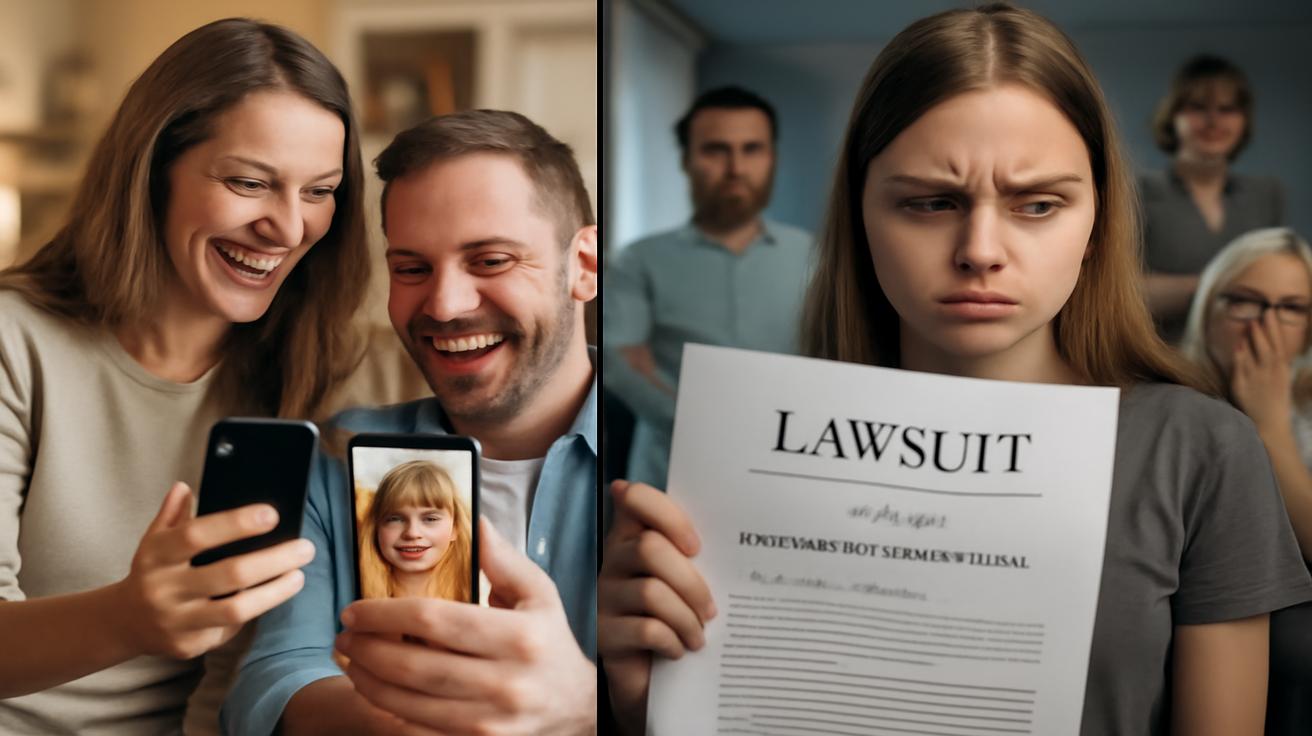
A 19-year-old college student was suing her parents for invasion of privacy.
Not for reading her diary. Not for bugging her room. For posting her entire childhood online—thousands of photos, intimate stories, medical updates, embarrassing anecdotes, all carefully curated over the years on Facebook, Instagram, parent forums, and a long-forgotten parenting blog.
Her parents had called it “sharing.” The law, increasingly, has another word for it.
“Sharenting.”
It sounds harmless, almost adorable—like a Pinterest board full of lunchbox ideas. But in living rooms, dorm rooms, and therapists’ offices across the world, grown children are starting to ask an unsettling question: What did you do to my privacy before I was old enough to even know I had any?
Life Lived in the Glow of a Screen
The first time Lena’s mother posted about her, Lena was not yet breathing on her own.
She arrived six weeks early, a scrunched pink face against a web of hospital tubes. Her father took a shaky photo, hands trembling from equal parts adrenaline and terror, and uploaded it with a caption about miracles and modern medicine. Friends commented with heart emojis and prayers. A cousin confessed she cried reading the update.
From that moment on, Lena’s life unfolded not only in her home, but in the digital theater of her parents’ social feeds.
There was Lena, three months old, in a pumpkin costume she definitely did not choose. Lena’s first steps, captured on grainy video and slowed down with inspirational music. Lena’s tantrum in the grocery store aisle, framed as a “tell me I’m not alone” post. Lena with chicken pox. Lena with a cast. Lena on the potty, proudly holding up a sticker chart. “So proud of my big girl!” the caption read, under a shot that would follow her much further than anyone imagined.
Her mother saw it as connection. During nap times, in the small quiet hours that cracked between feedings and dishes and deadlines, she shared the growing archive of her child’s life. It made the isolation of early parenthood bearable. Friends cheered her on, relatives across continents watched Lena grow, brands slid into her DMs asking to gift toys or baby clothes in exchange for tags.
The line between family album and public feed blurred so slowly that no one noticed it disappearing.
When the Likes Start to Feel Like Love
For parents, especially in the raw, bewildering years of early childhood, the internet can feel like a lifeline. You post a story about your kid refusing to sleep anywhere except on top of the dog, and instantly dozens of parents appear in your notifications, saying: Me too. You’re not alone. You’re doing fine. You’re one of us.
Every like is a tiny nod of reassurance. Every comment is a brief, glittering second of solidarity. It’s easy to understand why so many parents keep sharing, one moment at a time, until their child’s life becomes not just a story but a brand.
Sometimes quite literally.
Sponsored posts, gifted trips, monetized YouTube channels—sharenting has grown up into an industry. There are children whose first steps were filmed with a DSLR and color-graded before upload. Toddlers who can’t read but have follower counts larger than most adults will ever see.
And somewhere in that growing shadow, a child—quiet, watching, absorbing—starts to wonder what part of them is really theirs.
The Moment Kids Realize the Whole World Has Seen Them
Lena was 14 when she learned what it feels like to have your own face stare back at you from a stranger’s phone.
She was sitting in a cafeteria, a place dense with the scent of French fries and adolescent insecurity. A boy at the next table was scrolling through old posts on an anonymous “cringe” account, snickering. Suddenly he froze, snorted, and turned his screen to the group.
On the screen: a screenshot from her mother’s Facebook, years ago. Lena, age six, wearing nothing but muddy underwear and a superhero cape, her hair tangled, holding a garden hose like a sword. The caption: “My wild child. This kid is feral 😂.”
The laughter at the table hit her like a slapped door.
She felt two things at once: a deep, amorphous shame, and a white-hot flare of betrayal. Her mother had been the one behind the camera. Her mother had written those words. Her mother had left the post public.
It didn’t matter that the photo was “old.” It didn’t matter that at the time, it had seemed like harmless fun. Someone had taken a screenshot years before, passed it around, stitched it into the digital rumor mill that never stops grinding. Now it was back, resurfaced in a space where Lena had to live out her days, where every snicker carved her a little thinner.
That night, she did what hundreds of teenagers now quietly do: she went home, opened every social account she could find associated with her mother’s name, and scrolled. And scrolled. And scrolled.
There she was: sick, asleep, half-dressed, mid-scream, covered in rashes, described as “difficult,” “too much,” “my little drama queen.” Her daydreams. Her night terrors. Her embarrassing mishaps. Even the time she’d wet the bed at a sleepover, immortalized as a “keeping it real” post about how hard parenting could be.
She read through hundreds of comments from strangers who knew intimate details about her body, her fears, her failures—all without ever having met her.
Something fundamental shifted in the way she understood her childhood. The safe, private world she thought she’d grown up in was an illusion. She had been living on a stage she never agreed to step onto.
When Your Baby Photos Become Evidence
For generations, children rolled their eyes at embarrassing baby photos dragged out at family dinners. But those photos lived in shoeboxes and heavy albums, not on global platforms with search bars and algorithms.
Now, those same images are being examined not just by teasing relatives or potential crushes—but by lawyers, judges, and lawmakers.
In some countries, courts have already begun to set precedents that would have sounded like science fiction twenty years ago. Judges ordering parents to take down decades’ worth of childhood posts. Young adults invoking data protection laws to force platforms to erase their digital histories. There are heated debates in parliaments about whether parents’ “right to share” outweighs a child’s future right to control their identity.
The legal ground under sharenting is still soft, still shifting, but one thing is becoming increasingly clear: the idea that parents can post anything about their children with zero consequences is starting to crumble.
The cases that break into headlines often sound extreme—lawsuits, restraining orders, estrangement. But beneath those dramatic stories lies a quieter, wider truth: millions of children are quietly growing into adults who feel like they were never given a chance to be unknown.
The Family Group Chat That Exploded
The first thing Lena did was ask.
“Can you please delete the posts about me?” she texted her mother after that cafeteria incident. Her thumbs hovered as she chose each word carefully. “The old ones, especially. The ones where I’m not clothed or I’m having a meltdown. It’s really embarrassing. People at school have found them.”
Her mother’s reply came quick.
“Oh honey, no one cares about that stuff! It’s just cute. You’re overthinking. Besides, I’d have to go through YEARS of posts. I don’t have time for that.”
Lena stared at the screen, that old, familiar feeling of being dismissed settling over her like dust. She tried again—this time longer, shakier, explaining the cafeteria, the anonymous account, how exposed she felt. How it wasn’t just “cute” anymore; it was humiliating.
This time, the reply was slower—and harder.
“Honestly, this really hurts. I was just sharing my life as a mom. You wouldn’t even be here if it weren’t for me. Everything I posted came from love. Why are you attacking me?”
It escalated fast. A thread in the family group chat turned into a shouting match in person. “You embarrassed me in front of the whole internet” crashed into “You’re trying to erase my memories.” A therapist’s office got involved. Someone suggested mediation. An aunt took sides. A cousin unfriended someone. The fracture lines spread outward like cracks in ice.
In the end, Lena did something that, to older generations, can sound unthinkable: she talked to a lawyer friend.
There was no dramatic courtroom showdown. No televised trial. But there were papers. There were legal terms, negotiated boundaries, agreements about what could stay and what had to go. There were months where she didn’t speak to her mother at all.
What broke her heart wasn’t just the posts themselves. It was realizing how tightly her mother’s sense of self—as a “good mom,” a “relatable mom,” an “honest mom”—had tied itself to her child’s most vulnerable moments.
What Kids Wish Their Parents Knew
If you ask teenagers and young adults who grew up as background characters in their parents’ online lives what they wish had been different, their answers are startlingly consistent—and disarmingly simple.
They don’t speak in legal jargon. They don’t quote privacy statutes or refer to landmark cases. They say things like:
- “I wish she’d asked before posting.”
- “I wish there weren’t photos of my body online before I even knew what consent was.”
- “I wish my worst moments weren’t content.”
- “I wish my anxiety, my meltdowns, my diagnoses weren’t used to get likes.”
- “I wish my childhood wasn’t a public record.”
They know their parents were tired, lonely, sometimes desperate for support. They know the posts often came from love, pride, or a genuinely felt desire to help other parents not feel so alone. They know you can be both well-intentioned and deeply wrong.
What they struggle to forgive is this: being turned into a story first and a person second.
A Quiet Revolution at the Kitchen Table
There is no rewind button for the internet. You cannot unring a bell. But you can decide what sounds ring out from now on.
In kitchens and living rooms around the world, newer parents are starting to look at their phones differently. The glow of the screen is still there—still tempting, still comforting—but something else is flickering alongside it now: doubt.
Before snapping a photo of their toddler mid-tantrum, some are pausing and asking, “Will they be okay with this in ten years?” Before posting a funny story about bedwetting or secret fears or social struggles, they’re asking, “Is this my story to tell?”
Some decide to keep sharing—but with rules.
Some stop entirely.
Others find strange new middle paths. They share the messy edges of parenthood, but they blur faces, skip names, keep details vague, shift the frame so the child becomes almost an idea rather than a pinpointed person. They talk more about their feelings and less about their child’s specific vulnerabilities.
And slowly, a new kind of digital parenting culture is beginning to take shape—one that treats a child’s future self as a visible presence in the room, not an abstract concept to be worried about “someday.”
A Simple Table for a Very Complicated Problem
There is no universal formula or perfect rulebook, but some practical questions can help parents navigate the blurry border between sharing and oversharing.
| Before You Post… | Ask Yourself |
|---|---|
| Photo of your child in underwear, swimsuit, bathtub, or partly unclothed | Would I be okay if this image were shown to their classmates at age 13? Could this be misused? |
| Story about meltdown, bedwetting, bullying, or medical/mental health issues | If this story followed them into adulthood, would it harm their dignity, safety, or opportunities? |
| Any post that includes full name, school, location, routine | Am I unintentionally making it easier for someone to find or target my child? |
| Sponsored or monetized content featuring your child | Who is benefitting financially? What will my child think about this arrangement when they’re 18? |
| Any post once your child is old enough to understand | Have I asked for their permission in a way they can truly say no to? |
These questions are not laws. But they are the beginnings of something law can’t always provide: empathy stretched forward in time.
What Happens When the Laws Catch Up
Laws are slow. Technology is fast. Culture spins somewhere in between, stumbling, recalibrating, sometimes crashing into itself. When it comes to children’s privacy online, all three are currently colliding in strange, uneven ways.
In one place, a judge might order a parent to delete hundreds of posts after a child complains. In another, a lawsuit might be thrown out as “family business” the courts don’t want to touch. Policymakers experiment with new regulations around child influencers, data rights, parental consent. Meanwhile, tech companies write and rewrite their policies, trying to anticipate reputational fires before they spark.
The legal trend line, though, seems to be bending in a specific direction: toward recognizing that children are not extensions of their parents, but people with their own rights—including the right to a private life and to control their digital footprint.
That doesn’t mean every kid will grow up wanting to sue. Most won’t. Many will roll their eyes, laugh at the old posts, tease their parents, maybe ask them to delete a few of the worst ones, and move on.
But for the children whose most intimate struggles were broadcast to thousands, whose lives were essentially serialized for public consumption, the hurt can cut deep enough to reach courtrooms, therapists, and estrangement.
Behind every headline about a child suing their parents sits something far more fragile and irreplaceable than a social media account: the trust that, in your most helpless years, the people who loved you the most also protected your dignity.
Choosing the Kind of Story You Want to Leave Behind
Someday, your child might hold your phone in their hands and scroll all the way back.
Past the ultrasound photo. Past the birth announcement. Past the sleepless nights and the first steps and the glitter-splattered school projects. Past the messy kitchen counters and the “send help” memes and the proud graduation shots.
They might pause on a photo of themselves: tear-streaked, half-dressed, or deeply vulnerable in a way their younger self had no language for. They might read the comments from strangers laughing or commiserating. They might see exactly how many “likes” that moment of their pain earned.
What story will they believe about themselves from what you’ve left behind?
That they were a person whose privacy mattered before they could ask for it?
Or content in someone else’s feed?
Years from now, in courtrooms or coffee shops, in family therapy or long walks alone, that question will echo through the lives of the children who grew up always half-aware of the invisible audience just beyond the screen.
The law is waking up to that question now. Families are, too.
It’s not about never posting. It’s about posting from a place that remembers the child at the center of the frame is more than a cute story, a brand asset, or a relatable anecdote. They are a future adult who will inherit the digital trail you leave behind on their behalf.
Someday, they may hold those posts like evidence—for a lawsuit, for a late-night argument, or for a quiet, private reckoning you’ll never see. Today, while they are still small and soft and trusting, the choice is still mostly yours.
What kind of choice do you want them to discover you made?
Frequently Asked Questions
Can children really sue their parents for posting about them online?
Yes, in some jurisdictions children and young adults can bring legal actions related to invasion of privacy, misuse of personal data, or defamation. Whether they win depends on the local laws and the severity of what was shared, but courts are increasingly willing to recognize that children have privacy rights—even within their own families.
Is all sharenting bad or illegal?
No. Sharing ordinary, respectful moments with close friends and family is not inherently harmful or unlawful. The problems usually arise when posts include sensitive details (like health, location, or school), humiliating content (tantrums, bedwetting, punishments), or when a child’s image is heavily monetized without clear safeguards.
What kind of posts are most likely to cause problems later?
Posts that reveal too much—about a child’s body, mental health, medical history, school, or social struggles—tend to be the ones that come back to hurt. Anything that a future classmate, employer, or partner could use to shame or target your child is especially risky. Public or easily shareable content poses a higher danger than private, tightly controlled sharing.
How can I keep sharing without violating my child’s privacy?
Consider limiting your audience, avoiding full names and locations, skipping photos of your child in vulnerable states (undressed, upset, ill), and focusing on your own experience rather than your child’s specific struggles. Once your child is old enough, ask for their consent and be ready to respect a “no” without pressure or guilt.
What should I do if my child asks me to delete old posts?
Take the request seriously. Listen to why they feel uncomfortable and work together to review and remove posts that bother them. Even if you meant well at the time, honoring their feelings now can help repair trust and show that their autonomy matters more than preserving your online memories.
Is deleting posts enough to protect my child?
Deleting posts helps, but it isn’t a perfect solution. Others may have taken screenshots or reshared content. Still, reducing the amount of publicly available information about your child is worthwhile and can significantly lower future risks—from embarrassment to identity theft and targeted harassment.
How early should I start thinking about my child’s digital footprint?
From the very first post. Every image, caption, and tag builds a record your child did not choose. Imagining them as a teenager or young adult reading back through your posts can be a powerful guide to deciding what you share today.








Leave a Comment