
The air over the polar night has its own kind of silence. It’s not the hush of a quiet room or a sleeping city, but a vast, almost cosmic stillness—cold, star‑hard, and old. Somewhere above that frozen calm, nearly 30 kilometers up where jetliners never fly and sunlight slants in at impossible angles, the atmosphere is doing something it rarely does. Wind patterns are twisting out of their usual choreography. Temperatures are flipping from their familiar script. The invisible gears of the polar sky are catching, jolting, rearranging themselves. And far below, in cities that think of winter as an inconvenience and summer as a given, the consequences of that high‑altitude drama may soon arrive like a slap instead of a whisper.
A Sky That Suddenly Changes Its Mind
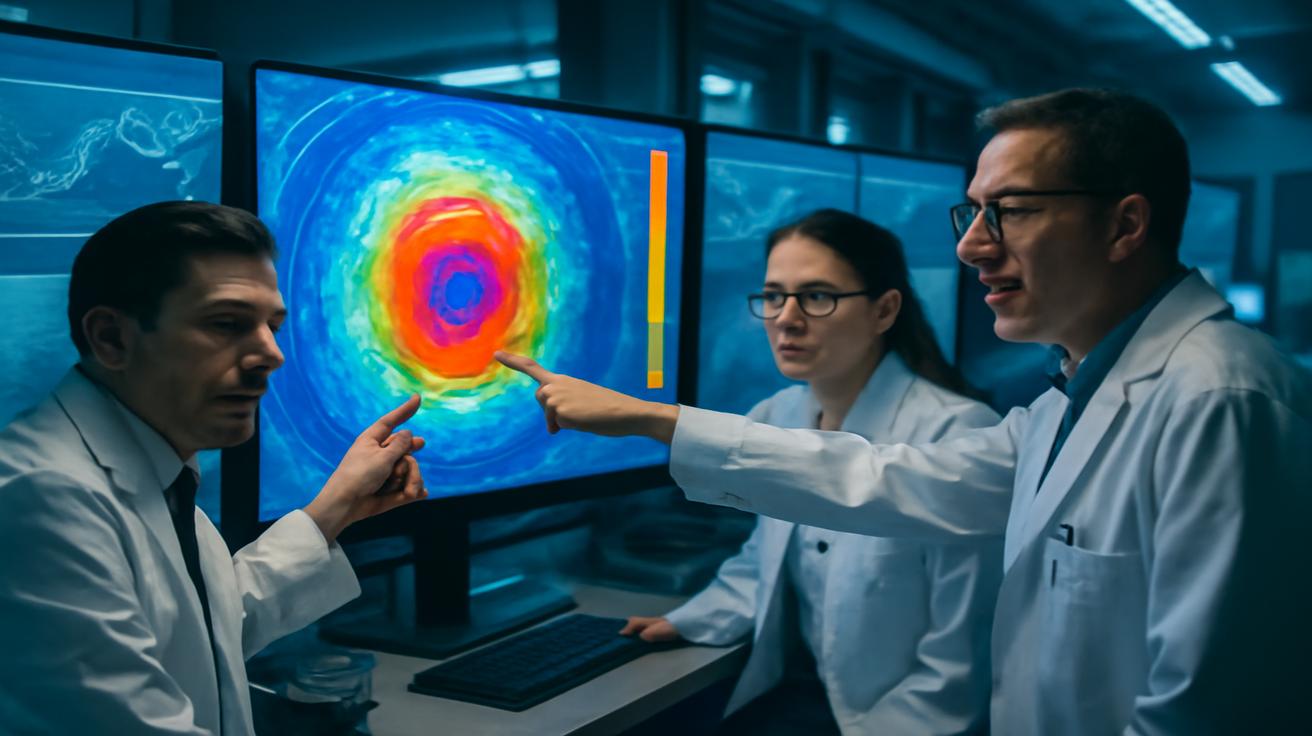
On a satellite screen, it looks deceptively simple: a swirling mass of colors, blues and purples wrapped tight around the North Pole like a luminous ghost. Atmospheric researchers call it the polar vortex, a crown of cold, fast‑moving air pinning winter to the top of the planet. Most years, it minds its business. It spins, it strengthens, it weakens, but it largely keeps the Arctic cold bottled up where we expect it.
This winter, though, the vortex has started to misbehave in ways that have set off alarm bells in quiet labs from Boulder to Berlin. Measurements from weather balloons and satellites show the telltale fingerprints of a rare polar circulation anomaly—a reshuffling of winds and temperatures so unusual that some scientists are digging through data sets from the 1980s to find anything comparable.
“The circulation is not just wobbling,” one researcher explained in a briefing. “It’s reconfiguring.” In their calm, careful language, that word carries a weight that’s easy to miss. Reconfigure the top of the atmosphere, and you begin to tug on the rest of it. Tug hard enough, and the weather we know—its storm tracks, its cold snaps, its heat waves—can slip sideways into something we haven’t seen in decades.
When the vortex behaves, cold air mostly stays corralled above the Arctic Ocean, and the mid‑latitudes experience what most of us would call a “normal” winter. But when the polar winds weaken, warp, or split, they can let lobes of frigid air spill south like slow‑motion avalanches. The opposite can happen too: regions that should be locked in ice can suddenly find themselves thawing under inexplicable warmth. That is the strange possibility now keeping forecasters and climate scientists awake at night.
Listening to the Atmosphere’s Subtle Alarms
The anomaly first appeared, as these things so often do, as a faint deviation in the data—temperatures in the stratosphere above the pole ticking upward faster than models had projected, winds starting to slacken. Researchers saw a familiar phrase begin to surface in internal notes and early reports: sudden stratospheric warming. It’s a mouthful, but to the people who study the upper air, it means one thing: pay attention.
Sudden stratospheric warming events are dramatic, if invisible, upheavals. In a matter of days, the polar stratosphere can heat by 30 to 50 degrees Celsius. That doesn’t melt ice caps or make surface air feel like the tropics—up there, even “warm” is still well below freezing—but it radically disrupts the stability of the vortex. Like jamming a stick into the spokes of a spinning wheel, it can slow or even split the vortex into pieces. Once fractured, those pieces don’t just hover politely over the Arctic. They wander.
From a distance, all of this can feel like abstract science, the kind of thing that shows up in weather blogs and research journals but not in your driveway. Yet, historically, some of the most notorious cold blasts—those bone‑gnawing episodes when pipes burst, power grids strain, and breath hangs in the air like smoke for weeks—have followed weeks after such high‑altitude disruptions.
And there is another side to this coin. In other years, similar anomalies have steered the jet stream into looping patterns that trap warm air over regions that should be freezing. Snowpack melts too early, river ice breaks, and insects and plants wake before they should, only to be shocked by a lingering winter that never really left. Extremes of both cold and warmth become more likely, not less. That is what makes this current event so unsettling: the air above us is sending signals that the coming weeks could be anything but ordinary.
When Extremes Come Knocking
Imagine waking one morning to find that the season you thought you understood has been swapped out overnight. In one city, roads glaze in hours, the air filling with the metallic scent of snow and exhaust, sirens echoing as cars slide where they usually cruise. In another, farther north, the snowpack slumps into slush, drips from eaves ticking like clocks. The cold isn’t where it “belongs.” It has packed its bags, moved south, and left behind a strange, untimely thaw.
Atmospheric researchers talk about probabilities more than predictions, but their language has sharpened as this anomaly has grown. They speak of “temperature anomalies not seen in decades,” of “tail‑risk events” that have sat quietly in the edges of their models but are now nudging toward the center. For energy planners, farmers, city officials, and anyone whose life is pinned to the rhythm of seasons, that shift in tone is a warning.
If the current circulation pattern continues to evolve, parts of North America, Europe, and Asia could face wintertime temperature swings of 15 to 25 degrees Celsius away from what’s typical—either brutally colder or startlingly warmer. Heat demand could spike in one region just as power lines sag under snow and ice. Farther east or west, a fragile winter warmth could push trees to bud weeks ahead of schedule, leaving them exposed to a snapback freeze.
These outcomes are not guaranteed. The atmosphere is a restless, nonlinear system; even with the best models, it can surprise. But the point of the warning is simple: the deck is stacked for unusual, possibly historic, temperature extremes, and the time to prepare is before your breath turns to crystals in the living room or the local river floods from out‑of‑season snowmelt.
Old Stories in a New Climate
For elders in northern communities, none of this feels entirely new. They have stories of winters that arrived like a hammer, of rivers freezing so fast that the sound of the water stopped in a night, of weeks when the sun rose into a sky like brushed aluminum and the air never climbed above a breath‑killing cold. They know that the atmosphere has always had its rare fits and anomalies.
What is different now is the background hum of a warming world. In a climate pulled steadily warmer by human‑driven greenhouse gases, the baseline on which these anomalies play out has shifted. The Arctic has heated at more than twice the global average. Sea ice has retreated, snow cover has dwindled, and permafrost has softened. All of that changes the way heat, moisture, and momentum move through the atmosphere.
Researchers are careful here. Not every extreme event can be stamped with the label of climate change like a passport. But many now see a pattern: as the Arctic warms, the contrast between pole and equator—the temperature gradient that helps power the jet stream—is altered. Some studies suggest this can make the jet stream wavier, its loops more dramatic, its deviations more stubborn. In such a world, a rare polar circulation anomaly has more room to express itself, stretching extreme cold or warmth over regions and durations that strain our sense of normal.
This is where history and present day meet. Those cold blasts “not seen in decades” are now arriving in a climate that is utterly different from the one that hosted their predecessors. The same absolute temperature may land harder on a city that has spent years building for milder winters. On the flip side, unusually warm winter spells can now compound long‑term trends, eating away at ice and snow that once would have been replenished without question.
The Human Footprints Beneath the Sky
Walk through a city on the cusp of such extremes and you can sense how much depends on the sky remaining mostly predictable. Power lines stitch from pole to pole, carrying electrons toward heaters that were sized for a certain kind of cold. Pipes snake under streets, buried at depths calculated against the average frost line. Supply chains bring salt for roads, fuel for furnaces, and food for shelves at a pace set to “normal winter.”
When the upper atmosphere decides to rewrite that normal, the ripple effects can be swift. Energy systems may find themselves pulled taut: natural gas demand surging during a deep freeze, or, in the case of an unexpected warm spell, hydro reservoirs struggling with early runoff. Agriculture, too, is vulnerable. Winter wheat relying on a slow, steady cold can be damaged by a sudden thaw followed by a harsh relapse. Fruit trees awakened by warmth can have their blossoms killed by a returning frost. Even wildlife moves to the wrong cues, following temperature signals that no longer align with food availability.
Yet the story is not just about vulnerability. In workshops and planning meetings, some of the same researchers sounding the alarm about the anomaly are sitting with engineers, city planners, and emergency managers, asking: what can we do differently, knowing that rare is no longer the same as impossible?
They talk about modernizing grids to handle surges and stresses, building redundancy into heating and cooling systems, and designing homes that can hold warmth or shed heat through passive means when the power falters. They explore nature‑based solutions, like restoring wetlands that can buffer floods triggered by volatile freeze‑thaw cycles. Each choice is a small recalibration of human infrastructure to an atmosphere that no longer sticks to twentieth‑century rules.
Reading the Fine Print of Uncertainty
Despite the growing urgency in their voices, atmospheric researchers are wary of speaking in certainties the planet cannot yet offer. The models they run—vast numerical experiments that simulate the physics of air, water, and energy—do not produce single outcomes. They generate ensembles, clouds of possible futures. When those ensembles start to cluster around unusual extremes, the warnings begin.
To understand what they’re seeing, it helps to glimpse, however briefly, the complexity beneath a forecast. Above the turbulence that buffets airplanes, the stratosphere sits like a second, more ordered sky. Its temperatures are driven by patterns of sunlight and ozone, its winds by the tug‑of‑war between tropical waves propagating upward and the sharp gradients near the pole. When those waves grow strong, they can crash into the vortex, spilling energy and momentum, triggering the sudden stratospheric warming that unravels its tight circulation.
The anomaly now in motion is unusual in its strength, timing, or configuration—that’s what the scientists are still debating. What they do agree on is that it is rare enough to push the odds toward temperature extremes “not seen in decades” across wide swaths of the Northern Hemisphere in the coming weeks or months. Where exactly, and for how long, remains the kind of question that keeps supercomputers humming and forecasters cautious.
For the rest of us, the fine print of uncertainty doesn’t erase the headline. An atmosphere capable of swinging so far, so fast, is an atmosphere worth respecting—and preparing for.
Living with a Restless Sky
There is a moment, walking outside on a winter night, when you can sense something has shifted even before the forecast catches up. The air smells different: sharper, or strangely soft. The wind comes from a direction it usually doesn’t. The stars feel closer, or more remote. You might not know that somewhere above, the polar night has warmed by dozens of degrees, that high‑altitude winds have faltered, that the vortex has split or slumped. But your skin, your breath, your habits all register that something is off.
We live at the bottom of a fluid, ever‑moving sky whose deeper workings most of us rarely think about. The warning from atmospheric researchers about this rare polar circulation anomaly is an invitation to pay attention—to connect the invisible drama above the clouds with the very visible lives we lead below them.
That doesn’t mean living in fear of every forecast or reading doom into every cold snap or thaw. It means recognizing that in a warming climate, the old bounds of “normal” are being nudged from both sides. Heat records fall in summer; now, in winter, circulation anomalies threaten to pull the thermostat violently in either direction.
It means asking, at every level from household to nation: are we building for a past that no longer exists, or for a future where the rare and the extreme are closer at hand? Insulating a home, updating a grid, rehearsing emergency plans—these are ways of acknowledging that the atmosphere is not a steady backdrop but an active, changing partner in our story.
Above the polar night, the anomaly continues to unfold. In months or years, scientists will look back on the data from this season, teasing apart cause and effect, refining models, writing papers with restrained titles. They will compare what their simulations said with what actually occurred on the ground: which cities froze, which thawed, which records fell. Their work will quietly sharpen our understanding of a sky that still surprises.
For now, the message has left the research centers and entered the public realm: something rare is happening aloft, and its echoes may soon be felt in the streets you walk, the pipes that carry your water, the fields that feed your table. If the air feels different this winter, it may not be your imagination. Somewhere, far above the quiet snow and bright city lights, the atmosphere is turning a new page—and asking us, once again, to read it carefully.
Key Signals of the Polar Circulation Anomaly
| Signal | What It Means Aloft | What It Can Mean at the Surface |
|---|---|---|
| Sudden Stratospheric Warming | Rapid heating of the polar stratosphere and disruption of vortex winds | Higher risk of extreme cold outbreaks or blocking patterns within weeks |
| Weakened Polar Vortex | Less stable circulation around the pole; cold air less confined | Cold Arctic air more likely to spill south into mid‑latitudes |
| Wavier Jet Stream | Deeper north–south meanders in upper‑level winds | Stalled patterns: prolonged cold spells, warm spells, or storms |
| Persistent High‑Pressure Blocks | Large, slow‑moving ridges that divert storm tracks | Clear, frigid conditions or unseasonable warmth lasting many days |
Frequently Asked Questions
What exactly is a polar circulation anomaly?
A polar circulation anomaly is an unusual pattern in the winds and temperatures around the poles, especially in the stratosphere. Instead of the typical strong, stable polar vortex that keeps Arctic air confined, the circulation may weaken, shift, or split, increasing the odds of extreme cold or unusual warmth in mid‑latitude regions.
Does a polar vortex disruption always mean extreme cold where I live?
No. A disrupted polar vortex reshapes large‑scale weather patterns, but its effects vary by region. Some areas may see severe cold, others may experience milder‑than‑normal conditions, and some may notice little change. The anomaly raises the risk of extremes; it doesn’t guarantee them for every location.
How is climate change involved in these anomalies?
Climate change warms the Arctic faster than lower latitudes, altering the temperature contrast that helps drive the jet stream and polar vortex. This can influence how often and how strongly the circulation deviates from its usual state. Scientists are still refining how much warming affects specific anomalies, but many see a link between a changing climate and more frequent or persistent extremes.
Can we predict these events far in advance?
Researchers can often detect the onset of a polar circulation anomaly days to weeks ahead, especially when a sudden stratospheric warming begins. However, translating that signal into precise local forecasts—how cold, how warm, where, and for how long—remains challenging. Forecast skill improves as the event draws closer.
What can individuals and communities do to prepare?
Preparation focuses on resilience to both intense cold and unusual winter warmth. That includes weatherizing homes, checking heating systems and backup power, updating emergency kits, protecting plumbing, and planning for vulnerable populations. Communities can strengthen grids, improve communication systems, and ensure shelters and critical services are ready for prolonged stress.








Leave a Comment