
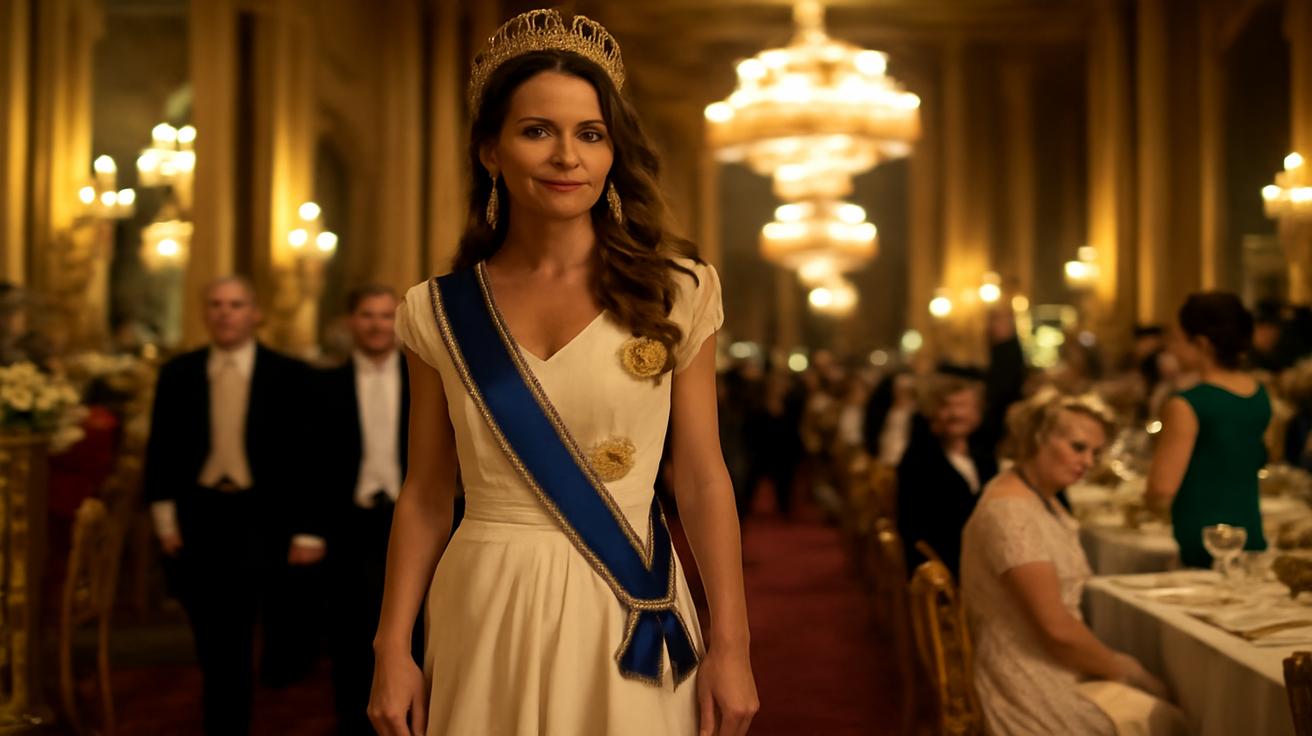
The first thing people noticed was the light. Or rather, the way the light bent around her as she stepped into the ballroom. The chandeliers of Buckingham Palace—those heavy constellations of crystal and gold—caught on the diamonds in Kate Middleton’s tiara and fractured into a thousand pinpoints, glittering like frost on a winter hedgerow. For a moment, there was a hush: the kind that never quite makes it to television, the sort that trembles in the air between camera shutters, clinking glass, and under-the-breath whispers of “Oh, look at her…”
A Night Built from Gold, Glass, and Unspoken Questions
State banquets at Buckingham Palace are carefully choreographed performances—part diplomacy, part theatre, part ritual older than most of the world’s modern nations. Outside, London glows softly under a damp sky, buses rolling past the palace railings, tourists pressing their faces to the gates. Inside, everything is turned up a notch: silver-gilt cutlery lined like soldiers, the crimson of the carpets rich and deep, place cards written in measured, looping script. Even the air smells intentional—beeswax, polished wood, a faint echo of floral arrangements that seem to float down the length of the table like a slow, fragrant river.
Tonight, though, there’s an extra layer of charge in the air, a subtle electric crackle that even the finest champagne can’t smooth away. The Princess of Wales is back on the world stage, reclaiming her place at the top table after weeks of intense speculation, worry, and tabloid frenzy. And she has chosen to do it wearing a piece of royal history that hadn’t seen this kind of spotlight in generations.
Balanced on her dark hair—smoothed and swept into a neat, glossy updo—sits a tiara once worn by queens and consorts from another era. It almost seems too delicate for this kind of scrutiny, the diamonds catching every flashbulb while the intricate, looping design seems to whisper of drawing rooms perfumed with pipe smoke and lavender, of handwritten letters and horse-drawn carriages crunching on gravel.
In an age of TikTok reels and rolling news alerts, this small, glittering relic has done something extraordinary: it has made people lean in. Not just to examine the fashion moment, but to ask the larger, more complicated question that hovers just behind the photographs: What does this say about Kate’s future—and about the monarchy she is destined to help shape?
The Tiara with a Memory
Royal jewels are never just decoration. They are arguments you can wear; footnotes in diamonds and platinum. The tiara Kate chose for this state banquet is one of those pieces that seems to come pre-loaded with meaning, whether she meant it to or not.
This is not the first time she’s dazzled in royal headpieces. We’ve seen her in the Cartier Halo tiara on her wedding day—small, restrained, almost tentative—and the Lotus Flower tiara, playful and softly romantic. Then, of course, there’s the Lover’s Knot tiara, once a favorite of Princess Diana, its swinging pearls like tear drops held in mid-air. Each of those choices told a story about where she was in her public life, about how closely she wished to tie herself to memory, myth, or a careful modern restraint.
Tonight’s tiara reaches further back, to a time before Diana, before the 1980s gloss and 1990s anguish, even before the kind of relentless media glare we now take for granted. Whether revived from the vaults or reimagined from an older piece, its design—floral, almost botanical in its curves—feels like it belongs in a sepia-toned photograph or in the reflection of a gas-lit ballroom mirror. It’s the kind of jewel that once would have traveled in velvet-lined boxes on royal trains, attended by lady’s maids and lists of protocols.
Placed on Kate’s head in this electric, ultra-documented moment, it bridges those eras. It suggests continuity at a time when nothing in public life feels particularly stable. It whispers: We have been here a long time. We know how to do this.
The symbolism isn’t lost on anyone watching. Fashion writers begin dissecting the silhouette and provenance almost before she’s taken her seat. Royal historians dust off references and old photographs, matching scrolls and clusters to a tiara last seen on the head of a previous queen or consort. Social media hums as timelines fill with split-screen comparisons: Kate tonight, an earlier queen in the same piece half a century ago, the monarchy aging and renewing like an ancient tree putting out new leaves every spring.
Staging the Future at the State Banquet
Look past the dazzle, and the scene is almost startlingly human. The grand table is a river of white—tablecloths perfectly ironed, napkins folded like miniature crests. In the glow of the candelabras, tiny details reveal themselves: the bead of condensation on a wine glass, the flicker of flame reflected in polished silver, the way a single dessert spoon gleams like a sliver of moonlight. Footmen move in choreographed silence, their steps precise but surprisingly soft, like dancers trained never to steal focus.
At the center of it all, the principal players hold court. The King, in his white tie and evening order, speaks warmly with the visiting head of state. At his side, the Queen consort, draped in her own historic jewels, radiates practiced calm. And then there is Kate—Princess of Wales, future Queen, mother, patient, modern icon—smiling in a way that manages to be both serene and ever so slightly fragile.
You can almost feel the effort that has gone into this moment: the medical clearances, the rehearsals, the styling sessions, the difficult decisions about how visible to be, how strong to appear, how much of her own vulnerability to allow into the room. Every move is watched, every tilt of the head, every conversation across the table, every time her eyes catch the cameras. Behind the polished glamour sits the reality of a woman who has spent months being discussed as a headline more than a human.
Her tiara glitters under the chandeliers, but it’s her steadiness that seems brighter. She’s not the shy, newly-minted duchess of a decade ago, testing the weight of royalty. Nor is she the rebellious outsider some once hoped she might be. Instead, she has become something subtler: a hinge between eras, a person straddling the old costume trunk of monarchy and the sharp, unforgiving lens of the 21st century.
Her presence here doesn’t just reassure the guests in the room; it sends a signal to millions watching from sofas, phones, café tables. She is back. She is working. She is, for tonight at least, exactly where so many expect her to be—at the gilded heart of the institution whose future she will one day help define.
| Element | What Viewers Saw | What It Signaled |
|---|---|---|
| Historic tiara | Vintage design, intricate diamonds, echo of earlier queens | Continuity, respect for tradition, long-term commitment |
| White-tie gown | Floor-sweeping elegance, structured yet soft | Full return to duties, readiness for senior state occasions |
| Public composure | Calm smiles, attentive listening, easy conversation | Stability, reliability, a future queen who can carry pressure |
| Soft glam styling | Natural makeup, simple hair framing the tiara | Modern sensibility, approachability within tradition |
The Debate Hidden in the Diamonds
As the speeches begin, the camera angles soften, pulling back to capture the sweep of the room. Viewers at home will catch the edited moments—the polite applause, the shared jokes, the standing toasts. But beyond the official feed, another conversation is already roaring to life in living rooms and online comment threads around the world.
In one corner of that debate is the argument of destiny. For many, Kate’s presence in that tiara confirms what they’ve long believed: she isn’t just another royal wife. She’s the beating heart of the monarchy’s next chapter. Her popularity, her calm under pressure, her careful navigation of public life—these are not taken for granted. They are studied, praised, sometimes idolized. To these onlookers, tonight’s historic jewel and polished poise look like a rehearsal for the crown that will one day sit above it.
In another corner lies a quieter, but no less intense concern: the cost of that destiny. The weight of expectation that comes with being turned into a symbol. The physical and emotional toll of surgeries, of relentless media storms, of an existence scripted by tradition and duty. Some viewers look at the tiara and see not continuity, but constraint. A glittering cage, even if willingly worn.
There are those who wonder whether the monarchy itself can—or should—carry on unchanged into the coming decades. Climate crisis, economic upheaval, generational shifts in values: this isn’t a gentle age. Can a thousand diamonds and a historic hall speak to the anxieties of a generation drowning in student debt and climate dread? Or is this precisely when ritual matters most—when, as everything else shapeshifts, there is comfort in the known choreography of state, crown, and tiara?
Kate has not given interviews to answer these questions. She doesn’t need to. In the logic of monarchy, her language is symbolic: clothes, gestures, patronages, the choice to appear or stay away. By choosing this moment, this tiara, this level of visibility, she is answering in the only way she truly can: Yes, I am still in this. Yes, I know what you expect from me. Yes, I am thinking not just of tonight, but of decades from now.
Tradition, Rewritten in Real Time
It would be easy to look at a state banquet and see only repetition—a royal Groundhog Day of glitter, ceremony, and protocol. But zoom in closer and you’ll notice how tradition is constantly being rewritten, if only in tiny strokes.
Once upon a time, these rooms would have been filled almost entirely with men in uniform and women in near-identical gowns, jewels chosen not for meaning but for size. Tonight, the guest list is a mosaic of cultures, professions, and identities. Technology executives sit beside poets, international leaders beside scientists. Attire may be formal, but conversations travel from policy to mental health, from climate action to children’s education.
Kate’s own public work has threaded new priorities into an old tapestry. Her focus on early childhood, mental wellbeing, and practical community support has shifted the tone of royal patronage from ribbon-cutting to problem-solving. Gentle, yes. But strategic. She has used her soft power to nudge the institution toward subjects that resonate with younger generations and global audiences.
Tonight’s tiara, then, becomes more than a costume. It is a visual shorthand for the argument she seems to be making with her whole public life: that you can take something old—a palace, a protocol, a title—and pour new meaning into it without smashing it to pieces. That evolution doesn’t always look like revolution; sometimes, it looks like a woman quietly wearing an old jewel and talking about childhood trauma, evidence-based policy, and the importance of play.
The Human Behind the Glass
Somewhere between the third course and the dessert, something almost imperceptible happens. The official cameras look away for a moment, directed toward a speech or a toast. In the background, just out of focus, Kate leans toward a guest and laughs—not the polite, public chuckle, but a real one. Her shoulders loosen just a fraction, her eyes crinkle at the corners, her hand brushes the base of the tiara as if checking it’s still there.
That small gesture is strangely grounding. For all the symbolism piled on her—future queen, national figurehead, modern icon—she is still, fundamentally, a person navigating a difficult, very public life. Someone who has been ill. Someone who is a mother. Someone who knows every step she takes will be replayed in slow motion and analyzed for clues to the country’s emotional temperature.
There have been moments when the palace windows have felt less like glass and more like mirrors, reflecting back the public’s own fears and obsessions. Kate’s absence from view sparked wild speculation; her reappearance, for many, is a reassurance that something in their world still looks the way it “should.” It’s an extraordinary burden to place on any one person, no matter how photogenic, polished, or born to—or married into—privilege.
And yet, watching her move through the candlelight, tiara shimmering with every turn of her head, there is a sense that she understands the assignment on some deep, instinctive level. That she has made her peace, at least for tonight, with being more symbol than citizen.
What Comes After the Glitter Fades
When the guests leave and the last car glides out through the palace gates, the night unspools itself quietly. In the kitchens, staff scrub pans and stack gleaming plates. Flowers begin their slow journey toward wilting. The echo of music lingers briefly in the stairwells, then fades into the thick, upholstered silence of the palace after midnight.
The tiara will be lifted gently from Kate’s head, its weight suddenly noticeable in its absence. Pins will be removed, jewelry catalogued, gowns unzipped. Somewhere behind those famous façades, she will step out of the costume of the evening and back into something softer, less formal. Perhaps, for the first time all day, she will look in a mirror and see not the Princess of Wales, but simply herself—tired, relieved, maybe quietly proud that she made it through.
The photographs, however, will live on. They will be printed on front pages, shared on timelines, dissected in opinion pieces. Some will argue that this glittering display is exactly what the monarchy should be: a carefully staged spectacle of continuity and soft power. Others will see it as a beautiful, anachronistic performance at odds with the urgencies of the age.
Somewhere between those extremes lies a more complicated truth: that nights like this are both. They are at once irrelevant and deeply symbolic, outdated and oddly enduring. They are a reminder that, for all our talk of disruption and progress, humans still crave stories, rituals, and figures onto whom we can project hope, anxiety, and expectation.
Kate Middleton, in her revived historic tiara, has become one of those figures. Not because she asked for it in any explicit way, but because the role grew around her, like ivy around stone. Tonight, she stepped fully into that role again, under the chandeliers of Buckingham Palace, and in doing so, reignited an old debate in a new light: not just about whether the monarchy should have a future, but about what kind of future it might be—and who, exactly, we are asking to carry it.
Frequently Asked Questions
Why was Kate’s tiara choice at the state banquet considered so significant?
The tiara she wore is a historic royal piece associated with earlier queens and consorts. By bringing it back into public view at such a high-profile event, Kate signaled continuity with past generations and underscored her long-term role within the monarchy. The choice felt deliberate, almost like a visual statement about stability and the future.
How do royal tiaras influence public perception of the monarchy?
Royal tiaras are more than decorative jewels; they are symbols. Each piece carries associations—who wore it before, on what occasions, and in which historical era. When a senior royal chooses a particular tiara, it subtly shapes narratives about tradition, memory, and identity. Viewers read those choices as clues about alignment with the past and intent for the future.
Did this appearance change how people see Kate’s future role?
For many, yes. Her return to a major state occasion, especially in such a resonant piece of jewelry, reinforced the idea that she is central to the monarchy’s next chapter. It suggested resilience after a difficult period and a willingness to step back into intense public scrutiny, which many interpret as a sign of commitment to her eventual role as queen consort.
Why do state banquets still matter in the modern world?
State banquets function as highly choreographed acts of soft power. They reinforce diplomatic ties, showcase national heritage, and project an image of continuity and stability. In a fast-changing world, these rituals offer a sense of narrative and tradition that some find reassuring, even as others question their relevance.
Is there criticism of this kind of royal display?
Yes. Critics argue that lavish events in palaces feel disconnected from everyday realities like economic strain and social inequality. Others question the environmental and symbolic costs of maintaining such a traditional institution. At the same time, supporters see these ceremonies as a relatively low-cost way to maintain cultural identity and international influence.
How does Kate balance tradition with a more modern public role?
She tends to blend classic royal symbolism—like historic tiaras and formal dress—with modern causes such as mental health, early childhood development, and practical community initiatives. Her style is often traditional in silhouette but quietly updated in detail, mirroring her broader approach: respecting the institution while nudging it toward contemporary concerns.
Will we see this historic tiara again?
Very likely. Once a royal returns a major piece like this to regular use, it often becomes part of their rotation for state occasions. Each reappearance would add new layers of meaning, linking future chapters of Kate’s public life back to this glittering night in Buckingham Palace when debate about her role, and the monarchy’s future, flared to life once again.







Leave a Comment