
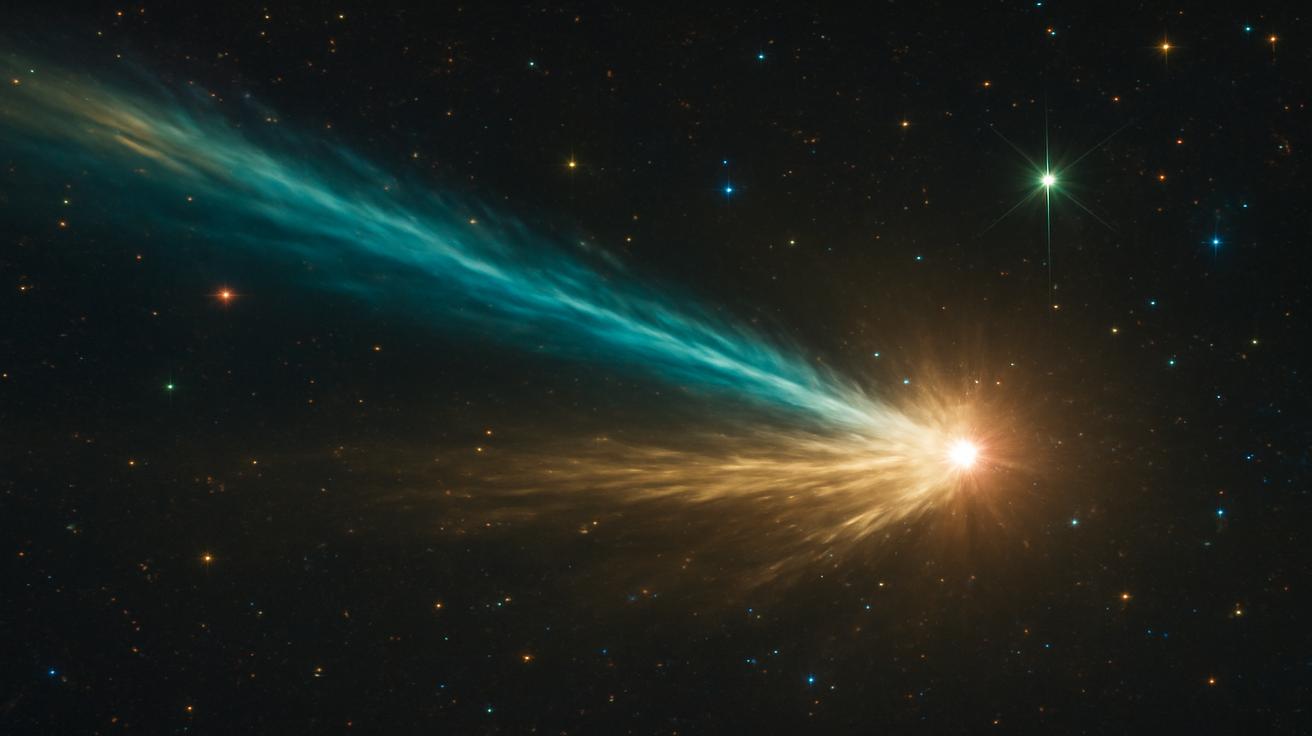
The first images don’t look like much at all—just a faint smudge of light against velvet black, a ghostly streak crossing a field of stars. But if you sit with them for a moment, let your eyes adjust to the subtle glow, you begin to feel it: that quiet shiver of awe that comes from realizing you’re looking at something not from here. Not from our Sun. Not from our planetary nursery. This pale, wandering ember—known as 3I ATLAS—is an interstellar comet, a visitor from another star system, and astronomers around the world have just released the most detailed images of it ever captured.
A Stranger Drifting Through Our Sky
On a chilly predawn morning, an astronomer in Hawaii leans closer to the observatory monitor. The data stream isn’t dramatic—no blazing fireworks or obvious cosmic spectacle. Just another set of exposures, another pale object swept up by the Asteroid Terrestrial-impact Last Alert System, better known as ATLAS. But the numbers are off. The speed, the path, the angle at which this object is slicing through the Solar System—none of it matches what you’d expect from a homegrown comet.
That’s how the story of 3I ATLAS begins: not with a sudden burst of light in the sky, but with a discrepancy in an orbit. As scientists track its motion across successive nights, a pattern emerges that feels eerily familiar. It looks a little like the track of 2I/Borisov, the interstellar comet discovered in 2019. And going back even further in the collective memory of astronomy, it echoes the strange hyperbolic path of 1I/‘Oumuamua, the first known interstellar object to pass through our cosmic neighborhood in 2017.
Only this time, astronomers are ready.
By the time the orbit is pinned down and the word “interstellar” begins to ripple across the global network of observatories, telescopes all over Earth and in orbit are already pivoting. Requests for observing time are filed in a rush. Schedules are reshuffled. Somewhere in Chile, a telescope operator sips coffee under a pale Milky Way while the dome above rotates to lock onto a tiny, distant target that has crossed unimaginable gulfs of space just to briefly skim past our Sun.
In the days and weeks that follow, observatories big and small take their turn. The result is not a single photo-op, but a symphony of observations: different wavelengths, different instruments, different vantage points. And woven through the pixels is a simple but staggering fact—3I ATLAS was formed around some other star, light-years away, long before Earth had oceans, forests, or eyes to witness its passing.
The Global Telescope Ballet
A Worldwide Chase for a Fading Visitor
Once astronomers are confident that 3I ATLAS is truly interstellar, a new kind of choreography begins. You can imagine it like a global relay race. A radio telescope array in the southern hemisphere passes the baton to an optical telescope in the north. Infrared observatories pick up the trail where visible-light instruments struggle. Space-based telescopes contribute pristine, atmosphere-free views.
This coordinated effort isn’t just about pretty pictures—it’s about squeezing every possible bit of science out of a brief, unrepeatable encounter. Interstellar comets don’t stick around. They plunge into our neighborhood on steep, hyperbolic paths and then slip away forever, never looping back like the periodic comets that visit us over and over again. No second chances.
Each observatory adds a different kind of detail to the growing portrait:
- Large ground-based telescopes resolve the structure of the coma—the hazy cloud of gas and dust that forms as the comet warms.
- Infrared instruments sniff out the heat signature of dust grains and frozen gases, revealing 3I ATLAS’s hidden chemistry.
- High-speed imaging tracks subtle changes in brightness, hinting at jets, fractures, and eruptions on the nucleus.
- Space telescopes deliver ultra-clean data unblurred by Earth’s atmosphere, perfect for teasing out the faintest features.
Together, these observations begin to peel back the layers of an alien iceberg. What they find is at once deeply familiar and profoundly strange.
A Comet That Feels Almost Like One of Our Own
In the new images, 3I ATLAS wears the classic cometary attire: a bright central condensation where the nucleus hides, wrapped in a glowing coma and trailing a slender, luminous tail. To a casual skywatcher, it would look a lot like any other long-period comet slipping through the inner Solar System—a fragile relic of some distant, icy reservoir.
But beneath that visual familiarity lies something more disconcerting. The orbit of 3I ATLAS is not closed; it does not bend into an ellipse. It’s open, a hyperbola: the mathematical signature of a traveler who is simply passing through, never to return. This is the gravitational fingerprint of a wanderer not bound to our Sun.
In a way, that juxtaposition is what makes these images so haunting. They show us a body that behaves like the comets we know, driven by the same physics of sunlight, ice, and vacuum, yet carrying a past that points to another sky altogether. These icy grains, evaporating into sparkling tail and hazy shroud, were once solid in the deep far-cold night surrounding a completely different star. That star rose and set over a system of planets we will never see, warmed disks of gas and dust that evolved in silence billions of kilometers away from us. And now those frozen crumbs are streaming out across our telescopes, offering themselves up to spectroscopy and pixel analysis as they fade.
Reading the Colors of an Alien Iceball
Spectra as a Chemical Map
If the raw images give us the silhouette of 3I ATLAS, then spectra provide its fingerprints. By splitting the comet’s light into a rainbow and examining the subtle dips and spikes within, astronomers can identify which molecules are present—each leaving behind a characteristic pattern like a barcode.
The multi-observatory campaign on 3I ATLAS has produced an intricate collection of spectra across visible, infrared, and even radio wavelengths. What’s emerging from the data is a picture that is simultaneously comforting and disquieting for planetary scientists: the chemistry of this interstellar stranger looks, in many ways, a lot like that of our own comets.
There are familiar culprits in the glow: water vapor, carbon monoxide, carbon dioxide, trace organic molecules. Ratios between some of these match the range seen in comets born in our own outer Solar System. The implication is profound. It suggests that at least some of the building blocks of icy bodies—the way volatiles freeze, cluster, and grow into comets—might be fairly universal across star systems.
Yet not every detail lines up neatly. Certain molecular ratios appear skewed; some rare compounds seem unusually abundant, others curiously scarce. The dust grains, probed by infrared reflection and emission, show subtle differences in composition and size distribution. Tiny deviations, but they whisper of a different recipe, a different oven, a different timeline for formation.
In essence, 3I ATLAS is telling us: “Your cosmic neighborhood isn’t entirely unique. But it isn’t the blueprint, either. It’s one version of how things can go.”
What the Images Reveal About Its Journey
Beyond chemistry, the detailed images hint at the life history of 3I ATLAS. Comets evolve. Their surfaces crack, their crusts thicken, their interiors fracture as they are heated and cooled over eons. Many of the close-up frames show a slightly lopsided coma, with denser clumps of light on one side, suggesting jets—localized vents where subsurface ice is explosively turning to gas.
Variations in brightness over hours and days suggest that 3I ATLAS is spinning, exposing different regions to sunlight as it tumbles along its track. This rotational pattern can be modeled, giving a rough idea of the nucleus’s shape and spin rate, even if it’s too small and distant for our telescopes to resolve as a discrete, solid point.
When scientists compare the behavior of 3I ATLAS with that of long-period comets from our Oort Cloud, the similarities are striking. This suggests it may have been born in a roughly analogous environment—a cold, distant swarm of icy bodies orbiting a star, possibly jostled and scattered by giant planets. At some point, a gravitational nudge—maybe from a passing star or a reshuffled planet—would have flung it so hard that it broke free entirely, embarking on a slow, solitary drift through interstellar space until, by pure accident, it blundered into ours.
Why Interstellar Comets Matter So Much
Postcards from Other Star Systems
It’s easy to think of these images simply as beautiful space photography—and they are—but for astronomers, 3I ATLAS represents something deeper. Every interstellar object is a physical fragment of another solar system. We can’t yet send probes to exoplanets orbiting distant stars, but now and then, the universe does us a strange favor: it sends us debris from those systems instead.
With 3I ATLAS, we’re getting a direct sample—albeit at a distance—of the material that built planets around some other star. By comparing its composition to that of our comets, we can start to answer questions that have hovered over planetary science for decades:
- Are water and organic molecules common building blocks in planetary systems, or a happy accident here?
- Do most stars host distant, icy reservoirs like our Kuiper Belt and Oort Cloud?
- How often are comets ejected into interstellar space?
The emerging answer, in part thanks to 3I ATLAS, is that our Solar System is neither completely ordinary nor wildly exceptional—it’s somewhere in the broad middle. The materials of life, the volatile chemistry that feeds atmospheres and oceans, likely arise again and again across the galaxy. Interstellar comets become messengers of that probability, carrying evidence across light-years.
A New Era After ‘Oumuamua and Borisov
In a sense, 3I ATLAS is the third act in a story that started with 1I/‘Oumuamua, that strangely elongated, tumbling object that baffled scientists with its odd shape and non-comet-like behavior. Then came 2I/Borisov, the first clear interstellar comet, with a classic coma and tail but a distinctly alien composition. Each new visitor has sharpened our tools and raised our expectations.
By the time 3I ATLAS appeared, astronomers had learned how to mobilize quickly, how to design observation campaigns that stretch across continents and wavelengths. They’d refined the algorithms that comb through sky surveys for hyperbolic interlopers. They’d debated and updated theories about how often other stars eject debris into the void.
The latest images of 3I ATLAS are, in a way, proof of that growing maturity. They are crisper, deeper, more varied than what we captured just a few years ago. They hint at what’s possible as new telescopes come online—particularly wide-field survey instruments that will scan the sky nightly, hunting for more of these rare visitors. In the not-so-distant future, we may be accustomed to having multiple interstellar objects on our observing schedules, each adding a brushstroke to our portrait of how planetary systems form and evolve across the galaxy.
What the Images Actually Look Like
From Raw Data to Cosmic Portrait
It’s worth pausing for a moment to think about how these “stunning new images” are actually made. When a telescope collects light from 3I ATLAS, it doesn’t spit out a finished photograph. It gathers faint photons as digital counts sprinkled across a detector. These are then cleaned, calibrated, aligned, and combined by teams of scientists and image processors.
The final color images you might see in a press release or a magazine spread are the result of layering exposures taken through different filters. One might capture blue light, another red, another near-infrared. Assigning colors and balancing contrast isn’t about “faking” anything; it’s about revealing structures and features our eyes would otherwise miss. A delicate gas tail might be emphasized by boosting contrast in the specific wavelength where that gas glows most strongly. Dust features might be brought out by tuning the brightness around certain infrared bands.
In the most detailed composites of 3I ATLAS, the comet’s nucleus itself is still just a point—too small and far away to resolve as more than a star-like dot. But around that point spreads a complex halo, glowing brighter toward the center and fading smoothly outward. Finer processing reveals asymmetries: a faint fan of light angled slightly off the main tail, a subtle kink where solar radiation and the solar wind are shaping the flow of particles.
It’s in these nuances that the comet’s personality emerges. Scientists pore over them like forensic investigators, while the rest of us simply gaze, aware at some instinctive level that we’re seeing something impossibly distant, impossibly old.
A Brief Visitor, a Long Memory
The Clock Is Always Ticking
Even as new images are processed and shared, astronomers are keenly aware of the clock winding down. Every passing week, 3I ATLAS moves farther from the Sun, its store of energy dwindling. The jets ease. The coma contracts. The tail thins and fades into the background stars. Eventually, the comet will grow too faint for even our most powerful telescopes to track.
Once it slips beyond our reach, 3I ATLAS will continue into the dark, coasting silently along its hyperbolic path, outbound from our system on a journey that will last millions of years. Perhaps it will drift through the outskirts of another star’s domain someday, a microscopic chance in a vast galaxy. More likely, it will spend its existence in empty space, slowly darkening, an ancient shard of another world’s history lost to everything but memory and math.
What remains for us is the archive—terrabytes of data, rows of spectra, thousands of frames captured in lucky windows of clear air and stable tracking. The newly released images are the most public, visible tip of that iceberg, the part we can collectively marvel at. But for years to come, scientists will return to the deeper layers of the dataset, comparing 3I ATLAS to new interstellar arrivals, refining models, re-running analyses with improved techniques.
Long after the comet has faded beyond our instruments, it will still be teaching us.
How 3I ATLAS Fits in the Bigger Picture
Many Worlds, Many Icy Messengers
The images of 3I ATLAS do something subtle but powerful: they make the galaxy feel a little more connected. It’s one thing to know, abstractly, that other stars host planets and debris. It’s another to look at a photograph and realize that the glowing smear in front of you is literally a piece of one of those systems, now drifting through our sunlight.
These interstellar comets suggest a universe in which worlds are not sealed away from each other in perfect isolation. Debris is traded, flung out, captured, and sometimes, perhaps, even delivered gently to the surfaces of young planets. Icy bodies like 3I ATLAS could in principle carry complex organic molecules across vast distances, scattering seeds of chemistry that might one day play a role in life’s emergence.
We don’t know if that has ever truly happened. But the existence of travelers like this tells us the traffic lanes are there, open and operating, in slow motion over cosmic time. The galaxy, it seems, likes to share.
Observations at a Glance
Here’s a simplified snapshot of how different observatories contributed to the new views of 3I ATLAS:
| Observatory Type | Wavelength Focus | Key Contribution |
|---|---|---|
| Large Ground-Based Optical Telescopes | Visible Light | High-resolution images of coma and tail; precise tracking of orbit and brightness changes. |
| Infrared Observatories | Near- & Mid-Infrared | Dust temperature, grain sizes, and detection of key ices and organic molecules. |
| Radio & Millimeter Arrays | Radio / Submillimeter | Precise chemical fingerprints of gas emissions; insight into volatility and outgassing. |
| Space Telescopes | UV to Infrared | Atmosphere-free, ultra-deep imaging; detection of faint outer coma and extended tails. |
Questions We’re Still Asking
For all the answers 3I ATLAS has offered, it leaves us with an equally rich set of questions. How many more such visitors pass through the Solar System unnoticed because they’re too small or too faint? Are there interstellar objects that actually get captured, settling quietly into long, disguised orbits among our native asteroids and comets? Could we, one day, launch a fast enough spacecraft to intercept one in real time, sampling its material directly before it leaves?
The stunning new images of 3I ATLAS aren’t a final chapter. They’re more like a vivid, full-color postcard from the edge of a story that is only just beginning—a story in which our understanding of planets, comets, and even life’s ingredients will be shaped not just by what formed here, but by what drifts in from the vast, dark in-between.
FAQ
What is 3I ATLAS?
3I ATLAS is an interstellar comet—an icy body that originated around another star and is passing through our Solar System on a one-time, hyperbolic trajectory. The “3I” designation marks it as the third recognized interstellar object, and “ATLAS” refers to the survey system that discovered it.
How do astronomers know 3I ATLAS is from another star system?
Its orbit is hyperbolic, meaning it’s not gravitationally bound to the Sun and is moving too fast to stay in our Solar System. When scientists calculate its trajectory backward, it doesn’t match any known origin within our planetary system, strongly indicating it came from interstellar space.
What makes the new images of 3I ATLAS special?
They combine data from multiple observatories across different wavelengths, offering the most detailed, multi-layered view of an interstellar comet so far. This allows astronomers to study its structure, composition, and behavior in unprecedented depth.
How is 3I ATLAS different from ordinary comets in our Solar System?
Visually, it looks quite similar—coma, tail, and all. The main difference lies in its orbit and subtle details of its chemistry. Its hyperbolic path and some unusual molecular ratios mark it as a visitor from another stellar nursery rather than a native of our own.
Can we see 3I ATLAS with the naked eye?
By the time most people heard about it, 3I ATLAS was too faint for naked-eye viewing. Observations require telescopes, often quite large ones, coupled with sensitive cameras and long exposures to capture its delicate glow.
Will 3I ATLAS ever come back?
No. Its hyperbolic orbit means it will escape the Sun’s gravity and leave the Solar System forever. Once it recedes beyond the reach of our telescopes, it will continue drifting through interstellar space indefinitely.
Why are interstellar comets important to science?
They’re physical samples of other planetary systems, allowing astronomers to compare their chemistry and structure with our own comets. That comparison helps answer big questions about how common water, organics, and planet-forming materials are throughout the galaxy.








Leave a Comment