
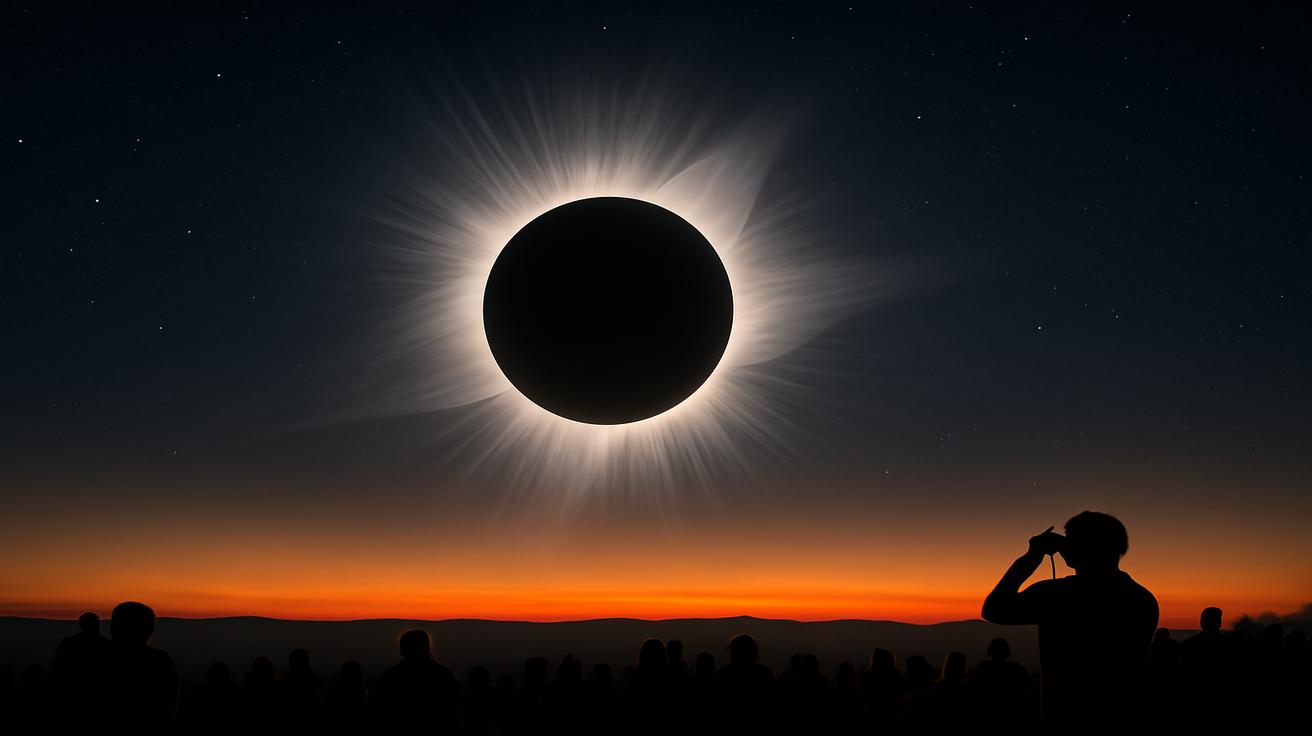
The news broke, fittingly, just as the sun was slipping behind the horizon. Astronomers, after months of quiet calculations and cross‑checking, stepped up to their microphones and confirmed it: the longest eclipse of the century is coming, and for a few trembling minutes, the middle of the day will resemble the hush of midnight. Not the gentle dimming of a clouded afternoon, but a true unmasking of the sky—stars pricking through the blue, temperature dropping, birds bewildered into silence. Somewhere on Earth, in broad daylight, the sun will vanish.
A Date with the Dark
It’s the sort of announcement that makes people slide their phones aside and look out the nearest window, even though nothing has changed. The sky still looks ordinary. Traffic still hums. But now there’s a secret woven into that pale blue: a shadow is on its way.
For years, astronomers have been tracing the dance of the sun, moon, and Earth with exquisite precision. They knew this eclipse was coming, of course; eclipses are not surprises in the way storms are. What is surprising is just how long this one will last. Under the very center of its path, day will dissolve into night for more than seven swollen minutes—an eternity, by eclipse standards, when most totalities are over in a nervous blink.
They say that during totality, time behaves strangely. People forget to breathe. Children cry and then laugh. Strangers clutch each other’s arms just to anchor themselves to something. The world goes not just darker, but other—as if the universe has flipped a hidden switch marked “reverse.”
That switch will be thrown in the middle of a perfectly regular day. And the people who make a conscious choice to stand in the narrow path of the moon’s shadow will experience a transformation that even seasoned scientists struggle to describe without reaching for words like “primal,” “cosmic,” “holy.”
The Long Shadow
To understand what makes this eclipse so unusual, you have to imagine the geometry as more than just a diagram in a textbook. Picture the Earth turning through space, a spinning ball wrapped in thin air and weather and human stories. The moon loops around it, locked in a precise but slightly wobbly orbit. The sun, blazing and distant, throws light across this entire stage.
Most days, the moon passes above or below the sun from our line of sight—near misses you never notice. But occasionally, the alignment is perfect. The moon slides directly between us and the sun, and its disk—just the right size from our vantage point—covers the whole solar face like a coin placed neatly over an eye.
This time, that alignment will be almost supernaturally exact. The moon will be close to Earth in its elliptical orbit, appearing a little larger than usual in the sky. That slightly swollen size means it will carve out a fully dark central patch, the umbra, that lingers longer than usual as it races along Earth’s surface.
Imagine you’re standing in that path. The eclipse will not arrive like a light switch but like a slow, deliberate dimming. Over the course of more than an hour, the moon will take a tiny bite out of the sun. At first you won’t feel it; the daylight will seem unchanged. Then shadows will sharpen and lengthen with a peculiar crispness. Colors flatten, as if the world is being quietly drained of saturation. Temperatures begin to fall—just a degree or two at first, then more.
It’s only in the final minutes before totality that the atmosphere carries a strange tension. The sunlight has turned thin and metallic, as though someone swapped the bulb in the sky for a fluorescent tube. The wind, if there is any, shifts. Even people who know exactly what is coming report feeling their skin prickle with some old, instinctive unease. Our bodies remember what our minds have forgotten: day is supposed to be safe.
When Day Steps Aside
Then, at last, the moon’s disk clicks into place. The sun collapses to a silver ring of fire—the corona—the star’s ethereal outer atmosphere usually drowned by daylight. A shadow rushes over you at hundreds of meters per second, and you stand suddenly in a cold, violet‑tinted world that should not exist at noon.
Those few minutes are what make this eclipse the event of a century. In that slab of time, the ordinary rules of daytime are suspended. Streetlights may flicker on. The horizon glows in a 360‑degree sunset, a luminous ring encircling you as day still burns just beyond the edge of the moon’s shadow. Planets appear as bright, steady lanterns; Venus often pops into existence first, audacious in the sudden dark.
Birds spiral toward trees and rooftops, thinking night has ambushed them. Insects alter their hum. If you’re close to fields or woods, you might hear an eerie, mistaken dusk chorus as crickets and frogs join in. Humans, for their part, fall into a reverent stillness punctuated by nervous laughter, gasps, and the soft clicking of camera shutters that could never truly capture it.
Seven minutes, give or take a few seconds depending on where you stand. Long enough to stare, to look away, to look back, to whisper to the person next to you, to forget for a moment what you meant to say. Long enough for the idea to sink in that the sun can go away, that the very structure of your days—work, meals, commutes, errands—rests on the steady burn of a star that can, under the right circumstances, simply disappear.
Where the Shadow Will Fall
On diagrams, the path of the eclipse arcs like a dark ribbon across a map. In reality, it is not a line but a moving patch of night carved out of daylight. Towns and cities along its narrow corridor are already circling the date on calendars, planning festivals, renting out spare bedrooms, and imagining what their familiar streets will look like under an impossible sky.
If you stand just outside that path, you’ll see a partial eclipse: the sun will become a crescent, daylight will thin, but the world will never fully slip into night. The magic of totality is reserved for those who travel into the umbra’s track. It’s a narrow road, often just a couple hundred kilometers wide, but it stretches thousands of kilometers around the planet—across oceans, mountains, and cities that may experience their first total eclipse in living memory.
For astronomers, the specifics are already meticulously charted: entry times, maximum eclipse, exit moments. For everyone else, the path is less a string of numbers than an invitation. You can choose to remain at home, glancing up at a nibbled sun through a pair of safe glasses, or you can join the quiet migration of eclipse chasers, people willing to cross continents for a few minutes under a shadow.
| Experience | Partial Eclipse | Total Eclipse (Path of Totality) |
|---|---|---|
| Appearance of the Sun | Sun looks like a crescent; never fully covered | Sun completely hidden; only corona visible |
| Daylight Level | Dim, like late afternoon or storm clouds | Like deep twilight or night in the middle of the day |
| Stars and Planets | Usually not visible | Bright planets and some stars become visible |
| Duration of Peak Moment | Lasts many minutes but never becomes full night | Up to ~7 minutes of totality in this century’s longest eclipse |
| Eye Protection | Required for entire event | Required before and after totality; can be removed only during full totality |
The Science Written in Shadow
Behind the awe, there is work. Every eclipse is a temporary observatory, a rare laboratory in which the sun and our own atmosphere reveal secrets they never show under ordinary daylight. Astronomers plan for these moments the way mountaineers plan for a summit window. The clock is always ticking.
During totality, telescopes will be trained relentlessly on the corona—the sun’s ghostly outer halo. That shimmering ring, visible only when the sun’s fierce disk is blocked, is hotter than the solar surface itself, a longstanding puzzle in solar physics. By dissecting its light, scientists hope to refine their understanding of solar storms and flares that can disrupt satellites, power grids, and the quiet hum of our digital habits.
Other teams will watch Earth instead of the sun. They’ll measure how fast temperature drops, how moisture and wind shift, how the sudden dark stirs the atmosphere. These fleeting changes ripple upward from ground level to the high, thin layers where radio waves bounce and satellites glide. That knowledge feeds into everything from weather models to communications technology.
And then there is the human data—more difficult to quantify, but no less real. Psychologists and anthropologists are increasingly interested in how shared celestial events affect communities. Does standing under a midday night change how people feel about their place in the universe, their belief systems, their neighbors? Does awe linger, and if so, does it alter behavior in measurable ways?
Stories from past eclipses suggest that something subtle does shift. People talk about feeling small in a way that is more liberating than frightening, about sensing how thin the boundary is between routine and wonder. Villages and cities across the path of totality report, again and again, that for a few hours the arguments of everyday life seem to fall out of focus.
Preparing for a Noon Midnight
If you are tempted to witness this rare length of totality, the preparation is as much ritual as logistics. It begins with marking the date and finding a place that lies under the moon’s narrow track. Some people will book hotel rooms or campsites years in advance, wagering on clear skies and easy travel. Others will throw folding chairs into car trunks at the last minute and chase the weather report, driving wherever the forecast promises a break in the clouds.
Safety, however, is not negotiable. The sun’s light, even when partially obscured, is more powerful than your eyes can handle. Viewing the eclipse without proper protection can permanently damage vision. Certified eclipse glasses or solar viewers—those awkward, cardboard-framed things that make you look like a time traveler—are essential for every phase except the brief window of totality when the sun is completely covered.
Many people choose to soak in the moment with the naked eye during totality, but if you bring cameras or telescopes, specially designed solar filters are required. Professionals always advise: prioritize the experience over the photograph. Sensors will capture images; memory will capture context. No picture has yet fully conveyed the feeling of standing in the world when it decides, briefly, to pretend it is night.
Communities along the path are already sketching out plans: street fairs that pause for the shadow, school field trips that turn a celestial event into a spontaneous outdoor classroom, small observatories throwing their gates open to the public. In some towns, it will be the biggest gathering in decades, a festival not of harvest or history but of alignment itself.
Myths, Memories, and the First Time the Sun Disappears
We are not the first people to look up in stunned silence as day becomes night. Long before the word “astronomer” existed, eclipses streaked across oral histories and sacred stories. In some traditions, a mighty creature devours the sun and must be frightened away with drums and shouting. In others, an eclipse is a wedding between sun and moon, an omen of change, or a reminder from the sky that human affairs are not the only drama unfolding.
What sets our century apart is not that the eclipse still stuns us—it does—but that we can place it in a calendar years in advance and model its path down to the kilometer. Yet even with all this knowledge, the emotional texture of the event remains wild. Knowing why it happens does not make your heartbeat steadier when the light drains from the world.
Ask someone who has seen a total eclipse what it was like, and their voice usually tilts into a different register. They’ll talk about the moment before totality, when the last sliver of sun fractures into “Baily’s beads,” bright pearls of light shining through lunar valleys. They might mention the rush of the lunar shadow across distant hills, a visible wall of dusk racing toward them. Some will admit they cried without understanding exactly why.
For many, the first totality feels like a hinge in their personal timeline: a “before” and “after” stamped into memory. The coming eclipse, with its unusually long duration, promises not just a glimpse of that otherworldly sky but a chance to dwell in it, to look around, to breathe in the strangeness rather than just gasp at it in passing.
A Shadow That Connects
There is something unexpectedly tender about the idea that, on a given day, people scattered across continents will look up at once. Some will stand on city sidewalks between glass towers; others will be in farm fields, on boats, on mountain ridges, on school playgrounds. They may speak different languages, hold different beliefs, vote for opposing parties, carry different kinds of worries home at night.
Yet in those minutes of darkness, they will share a single, real-time experience written in light and shadow. Children in one country may be peering nervously through cardboard glasses at the same crescent sun that an elderly couple in another country is watching with arthritic hands clasped. Astronauts on the International Space Station may glide over the event, watching the moon’s shadow as a dark bruise creeping across Earth’s surface.
Events like this eclipse tug at a quiet, often-neglected thread: we all live under the same star. The boundaries we draw across our maps do not exist from the sun’s perspective, or from the moon’s. The shadow that turns day into night will cross deserts and suburbs, forests and freeways, pausing for no border.
And when it passes, when the first blazing diamond of sunlight explodes from behind the moon’s edge and day surges back like a tide, there will be, in countless places, a split-second of collective exhale. People will blink against the brightness, laugh, cheer, maybe feel a pang that it’s already over. The world will look unremarkable again. But for a while, it wasn’t.
After the Shadow
Eventually, the eclipse will be just another line in an almanac, another data set, another story told at dinner tables and campfires. Astronomers will file their papers. Meteorologists will fold the sudden coolness of those minutes into new models. Teachers will pin students’ crayon drawings of a black sun on classroom walls.
Yet the imprint will linger in smaller, subtler ways. In the way someone glances upward on an ordinary afternoon and remembers how quickly the light can change. In the way a teenager who watched the corona blaze at noon decides, years later, to study physics or art or poetry, still chasing that feeling of vastness. In the way a city that gathered to watch the sky together finds, however briefly, a reservoir of shared memory deeper than any news headline.
The longest eclipse of the century will be, in strict scientific terms, a predictable alignment of celestial bodies. But for those who choose to step into its path, it will also be something messier and more human: a reminder that our days are not as fixed as they seem, that the world can flip, without warning, from the familiar to the uncanny—and that sometimes, if we are paying attention, we can stand in that strangeness together and call it wonder.
FAQ: The Century’s Longest Eclipse
How long will the total eclipse last?
At its maximum, totality will last just over seven minutes in the very center of the path, making it the longest total solar eclipse of the century. Locations slightly off-center will see shorter but still unusually long periods of totality.
Will it really look like night in the middle of the day?
Yes. In the path of totality, the sky will darken to deep twilight or near‑night. Bright planets and some stars will become visible, the temperature will drop noticeably, and the horizon will glow in a ring of sunset colors.
Is it safe to look at the eclipse with the naked eye?
It is only safe to look without eye protection during the brief period of totality when the sun is completely covered by the moon. At all other times—before and after totality, and during any partial eclipse—you must use certified solar viewing glasses or filters.
What makes this eclipse the “longest of the century”?
The moon will be relatively close to Earth in its orbit, appearing slightly larger in the sky and covering the sun more fully. Combined with the specific alignment of Earth, moon, and sun, this geometry allows the moon’s inner shadow (the umbra) to linger longer over certain locations than in typical eclipses.
Do I need to travel to see the total eclipse?
You’ll need to be in the narrow path of totality to experience the day turning into night. Outside that path, you’ll see only a partial eclipse. Many people travel, sometimes long distances, to stand under the full shadow for those few extraordinary minutes.
What should I bring if I plan to watch it?
At minimum, bring certified eclipse glasses for everyone in your group. Consider a comfortable chair or blanket, extra layers for the temperature drop, water, and a way to check the time so you don’t miss the onset of totality. Cameras and binoculars can be rewarding, but safe solar filters are essential if you point them toward the sun.
How often do eclipses like this happen?
Total solar eclipses occur somewhere on Earth every year or two, but any given location may see one only once in many generations. An eclipse with this unusually long duration of totality is rarer still, making it a once‑in‑a‑lifetime opportunity for most people.





Leave a Comment