
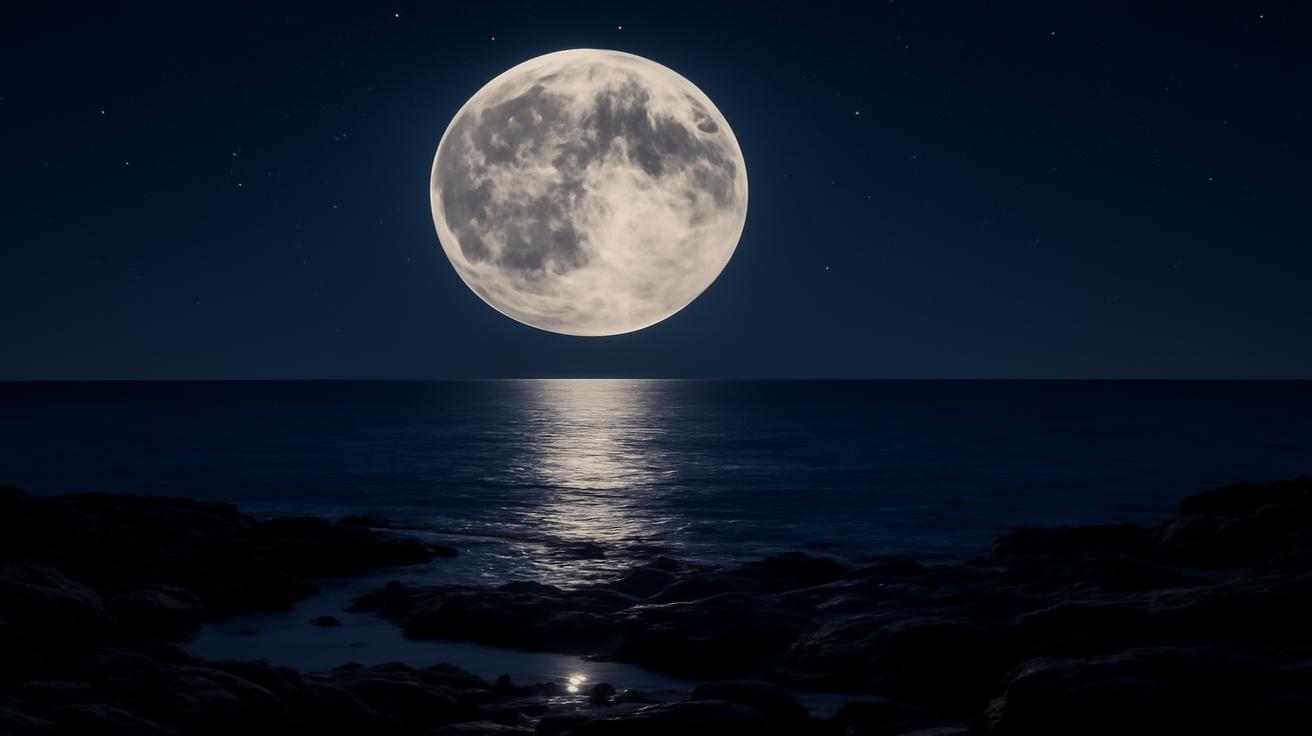
The Moon is leaving us. Not in a dramatic, sudden way, but in the quietest, slowest shrug of motion you can imagine. Each year, it slips a tiny bit farther from Earth—about the same distance your fingernails grow in a week. No one notices. The tides still rise and fall. The nights still glow under that familiar silver coin. But in the secret arithmetic of gravity and time, everything is changing. Our days are getting longer. Our tides are softening. And the planet is slowly rewriting the rhythm of its own heartbeat.
The Moon’s Slow Goodbye
If you could speed up time—years into seconds, centuries into minutes—you’d see something astonishing. The Moon wouldn’t hang still in the sky, as it seems to in our human span of days and decades. Instead, it would spiral outward, like a dancer slowly letting go of a partner’s hand.
Right now, the Moon is drifting away from us at about 3.8 centimeters per year. That’s less than the width of a typical adult finger. To a person, that’s nothing. To a planet, it’s enormous.
This drift isn’t a mystery; it’s physics, etched into stone and ripples of seawater and the faint tug of gravity that never turns off. Billions of years ago, after the colossal collision that likely birthed the Moon, it orbited much closer to Earth. Imagine a Moon looming huge and bright in the sky, tugging violently at the oceans, whipping up tides far taller than we know today. The early Earth spun faster too—days lasting only about 5 or 6 hours, the Sun rising and setting four times in what we now call a “day.”
Over time, friction between ocean tides and the seafloor has acted like a giant planetary brake, slowing Earth’s spin. The energy lost from this slowing doesn’t just vanish; it’s passed to the Moon, nudging it outward. Our days stretch longer. The Moon glides away. Gravity keeps the two worlds locked in a kind of slow-motion dance, exchanging energy across the darkness.
The Secret Link Between Tides and Time
To understand why the Moon is drifting away, it helps to picture the tides as something more than water coming and going. Think of them as invisible ropes made of gravity, forever dragging across the face of the Earth.
The Moon’s gravity pulls on our oceans, raising bulges of water on the side of Earth facing the Moon and, thanks to inertia, on the opposite side as well. But Earth is spinning faster than the Moon orbits us, so those bulges don’t sit neatly lined up under the Moon. They’re tugged a little ahead—pulled forward by the turning planet.
Here’s where it gets interesting: those shifted bulges tug back on the Moon. Imagine a hand pulling slightly ahead of a partner in a slow dance, giving a gentle forward yank. The Moon feels that tug. It gains a bit of energy, inching into a higher orbit. Meanwhile, Earth loses a bit of rotational energy and spins more slowly. The result is a subtle trade: slower days for a more distant Moon.
You can sense this relationship even in small, human moments. Standing on a beach at dusk, as the tide draws back or rushes forward, you are watching gravity move energy around the solar system. Each curl of foam at your ankles is a tiny part of the mechanism lengthening your day.
The Math You Can Feel
We can measure this process with exquisite precision. Laser beams bounced off mirrors left by Apollo astronauts on the Moon reveal that outward drift of 3.8 centimeters every year. Atomic clocks record the growing length of a day—so slowly that we correct our clocks with “leap seconds” every so often, patching the gap between human timekeeping and an Earth that’s subtly easing her spin.
Here is a simple way to picture the scale of it:
| Timescale | Moon’s Extra Distance from Earth | Change in Length of Day (Approx.) |
|---|---|---|
| 1 year | 3.8 cm | Microseconds |
| 100 years | 3.8 meters | Milliseconds |
| 1 million years | About 38 km | ~20 seconds |
| 1 billion years | About 38,000 km | Several hours |
The numbers are tiny on human scales and immense on geological ones. The world you wake up in tomorrow won’t feel any different, but the planet itself is already partway through a long, slow reconfiguration of time and tide.
The Softening of the Seas
Walk along a rocky shoreline when the tide is at its peak. Water heaves and slaps the stones. Kelp frays and flutters in the surge. The whole coastal world seems to swell and shrink with this unseen pulse. Now imagine that pulse, just slightly weaker, a bit more mellowed. That is the direction in which we’re moving.
As the Moon moves farther away, its gravitational pull on Earth weakens. This doesn’t mean the tides will disappear; the Sun also plays a role in shaping them. But the overall strength of lunar tides will gradually diminish. Over deep time, the extremes of high and low tides will soften.
This gentling has already begun. In Earth’s youth, when the Moon hugged much closer, tides were turbulent and towering. They churned shorelines, flooded vast coastal areas, and may have been powerful enough to influence early life. Some scientists suspect that intense tidal zones could have concentrated organic molecules in shallow pools, mixing them again and again, like a planetary laboratory beaker, until something alive finally emerged.
Today’s tides, while still strong, are shadows of those ancient surges. They shape estuaries, sculpt salt marshes, and guide the migrations of crabs, fish, and seabirds. The Moon’s pull dictates where oysters root, when coral reefs feed, when sea turtles crawl from sand to surf. With a softer tug, that choreography will subtly shift.
What Softer Tides Might Mean
Imagine a coastline ten million years from now. The exact configuration of continents may be different, but wherever land meets ocean, the tides will still breathe in and out. Yet the breath might be shallower.
Shallower tides could mean gentler erosion in some regions, allowing more stable shorelines to persist. Marshes and mangroves, those intricate laceworks of roots and mud, might spread where now they’re stripped away by more aggressive waves. In other places, ecosystems that rely on strong tidal flushing might change or decline, replaced by new communities better suited to calmer waters.
This isn’t a simple story of “weaker is better” or “stronger is better.” It’s a story of difference. The Moon’s slow retreat is scripting a new marine world, one tiny gravitational nudge at a time.
Earth’s Changing Rhythm of Day and Night
Now look away from the coasts and up at the sky. The length of a day is something we rarely question. We inherit it like gravity or the color of the ocean—a given. But it isn’t fixed. It’s a work in progress.
Right now, one Earth day is 24 hours long, give or take those leap-second corrections. But rewind the clock with a geologist’s imagination and you find a very different planet.
In the age of the dinosaurs, a day was closer to 23 hours. Go back to the time when life first crawled from the oceans, and you’d have seen sunsets roughly every 21 hours. Push further still, to a young molten Earth under a looming Moon, and the days compress toward just a handful of hours. The planet spun like a top.
Rock layers and fossil corals carry a record of this shift. Some corals build growth bands—like tree rings—that record daily and seasonal cycles. Ancient specimens show more daily bands per year than we see now, revealing more, shorter days in a year long past. Earth has been quietly slowing down for billions of years, and the Moon has been drifting away to match.
A Future of Longer Days
Project this forward, and the days inch longer. Millions of years from now, sunset will arrive slightly later than it would have if nothing changed. Not by enough for any single generation to notice, but enough that, across deep time, Earth’s daily rhythm will feel alien compared to ours.
There is an endgame of sorts. If nothing else interferes—no dramatic shifts in Earth’s structure, no major gravitational encounters—our planet and the Moon will eventually reach what’s called tidal locking. The Moon is already tidally locked to us; we always see the same face. One day, eons from now, Earth could rotate so slowly that one of its sides continually faces the Moon as well. A full spin of our planet would match one orbit of the Moon. In that far day, a single Earth “day” might stretch to something like our current month.
By then, other forces may have reshaped the solar system. The Sun will grow brighter, Earth’s climate will be transformed, life may be unrecognizable—or gone. The specifics are uncertain, but the trend is not: every night you look up, the Moon is just a little farther away, and your next day will be just a tiny bit longer than the last.
The Emotional Gravity of a Retreating Moon
All of this can feel oddly personal, even though it unfolds on scales beyond any human life. There’s something intimate about the Moon. We hang our stories on it—myths, poems, love songs, promises. It has watched over nights of fear and nights of celebration, guided sailors across black oceans, and given farmers a clock by which to plant and harvest.
To know that this companion is leaving stirs a quiet ache, like realizing that a childhood home is slowly sinking into the sea. Rationally, you know that the change is glacial, that no one alive today will look up and see a noticeably smaller Moon. But emotionally, there’s a pull, a sense of witnessing a farewell in progress.
And yet, that departure is part of what shaped the world you love. Without the Moon’s tidal braking, Earth’s rotation would be faster, the climate different, maybe too volatile for complex life as we know it. Those same tides that now seem ordinary have been sculptors of continents and midwives to ecosystems. The slow escape of the Moon is entwined with the slow rise of forests, coral reefs, and, eventually, us.
In that sense, what’s happening above us is less a loss and more a continuum. A reminder that nothing in nature holds perfectly still—not oceans, not mountains, not even the sky itself.
Standing in the Middle of Geological Time
You stand on a beach some night, maybe with bare feet sinking into cold sand, the air tasting faintly of salt and seaweed. The Moon hangs above the water, laying down a shifting silver path on the waves. You feel small, but not in a crushing way. More like being a single note in a long song.
Somewhere in the depths, the tides are responding to that pale disk: water masses surging, currents bending. The friction of all that movement is, this instant, stealing a whisper of speed from Earth’s spin and gifting it to the Moon’s orbit. You’re part of that transfer. Every breath you take happens on a planet very slightly different from the one that existed a day ago.
We often think of change as loud: storms, quakes, extinctions. But there is a quieter kind of change too, the kind that works patiently. The Moon’s drift is like that. It alters the length of our days and the character of our tides so gradually that we need instruments and imagination to even notice. Yet it’s as real and relentless as the tide brushing the hem of the shore.
So next time you catch that pale shape in the sky—waning, waxing, veiled by thin cloud or sharp in winter clarity—remember: it’s not just a light. It’s a moving partner in Earth’s story. It is slowly, quietly, re-writing the length of your days and the strength of your seas. And you, tiny as you are, are living in the middle of that grand, almost imperceptible transition.
FAQ
Is the Moon really moving away from Earth?
Yes. Precise laser measurements show that the Moon is receding from Earth at about 3.8 centimeters per year. This has been happening for a very long time due to tidal interactions between Earth and the Moon.
Why does the Moon’s drift make our days longer?
The Moon’s gravity raises tides on Earth. Because Earth spins faster than the Moon orbits, tidal bulges are pulled slightly ahead, creating friction that slows Earth’s rotation. As Earth loses rotational energy, that energy is transferred to the Moon, pushing it into a higher orbit. A slower rotation means longer days.
Will the tides eventually disappear?
No. Tides will not vanish, but over very long timescales they will become weaker. The Moon’s gravitational pull will lessen as it moves farther away, softening the extremes between high and low tides. The Sun’s gravity will still contribute to tidal forces as well.
Can humans notice that days are getting longer?
Not without instruments. The change in the length of a day is tiny—milliseconds over a century. Atomic clocks can detect it, but our bodies and daily routines can’t. The effect is only obvious when considered over millions or billions of years.
Will Earth and the Moon ever stop changing their relationship?
If left undisturbed for billions of years, Earth and the Moon could eventually reach a state where Earth’s rotation period matches the Moon’s orbital period—both become tidally locked to each other. In that scenario, one side of Earth would always face the Moon. However, long before that, changes in the Sun and the solar system might alter their evolution.
Does the Moon’s movement affect life on Earth today?
It does, but very subtly. The current strength and timing of tides, influenced by the Moon’s position, are crucial to many ecosystems and coastal processes. The slow drift changes these only over immense timescales, so the impact on modern human life is negligible, though it remains fundamental in shaping Earth’s long-term environmental history.
Could we ever stop or reverse the Moon’s drift?
In theory, altering the Moon’s motion would require enormous amounts of energy—far beyond our current technological capability and likely beyond any realistic future plans. The Moon’s gradual departure is a natural, unstoppable outcome of gravity and tidal physics, and it has been essential in creating the Earth we know today.





Leave a Comment