
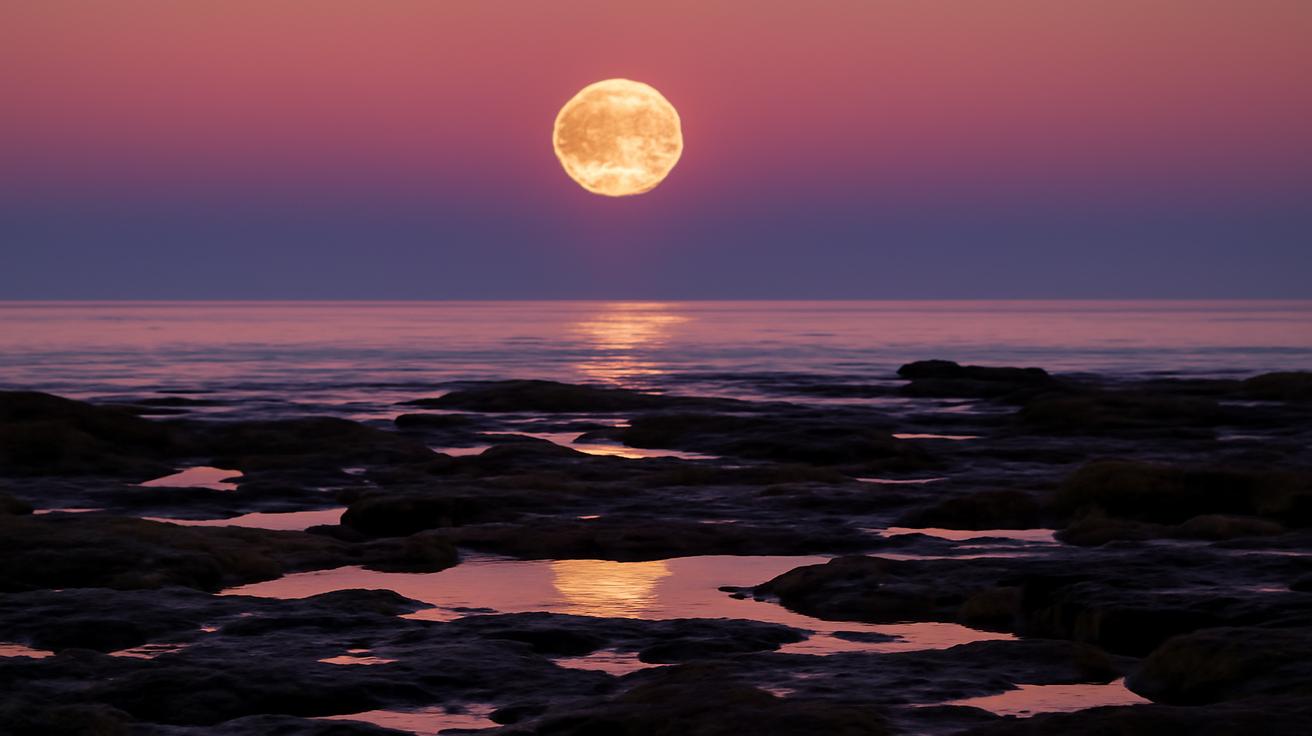
The last light of evening lays a silver path across the sea, a trembling ribbon that reaches from the horizon right up to your toes. You stand there, waves licking at your ankles, watching the Moon rise—soft, round, and impossibly ancient. The water tugs and loosens around your feet, then slides back with a sigh. It feels timeless, this rhythm, as if it has always been and will always be the same. But it isn’t. Quietly, invisibly, the rules are changing. The Moon is leaving us—slowly, gently, but steadily—and as it drifts away, our days lengthen, our tides soften, and the Earth itself rewrites its own story in increments too small for a single human life to feel.
The Slow Goodbye Written in Dust and Rock
Walk through an ancient dry lake bed—say, one marbled with cracked mud and scattered with flat white stones—and you’re walking across a fossil archive of the sky. Buried in rocks, in coral skeletons, even in the microscopic rings of certain marine fossils, there is a subtle, repeated pattern: the record of the tides, like a heartbeat pressed into stone.
When geologists and paleontologists read these patterns, they find something unsettling and oddly beautiful: hundreds of millions of years ago, Earth spun faster. A “day” wasn’t 24 hours; it was closer to 22, then 21, then even shorter as you rewind the clock back toward the planet’s youth. The year was still the same length in terms of total sunlight received—Earth’s orbit around the Sun hasn’t changed much—but the number of days in that year was different. More sunrises, more sunsets, packed into the same orbital loop.
The evidence lives in things like stromatolites and corals. Some ancient corals, long dead and turned to stone, grew daily and seasonal bands in their skeletons, a bit like the rings of a tree. When scientists count those bands, they find that a year once contained about 400 days. That only works if the days were shorter. And the culprit, or perhaps the sculptor, behind that difference is the pale light that still rises over today’s oceans: the Moon.
Long before anyone walked these dry lake beds or counted the bands in a fossil coral, something fundamental had already begun. The Moon started drifting away from Earth soon after it formed, born in a violent collision early in the Solar System’s story. Ever since, the speed of that departure has changed—faster at some ages, slower at others—but the direction has never reversed. Like a slow-motion farewell, our only natural satellite has been backing away, centimeter by centimeter, for billions of years.
The Physics of a Tidal Tug-of-War
To understand why the Moon is leaving, picture the ocean as something halfway between a liquid mirror and thick honey—sluggish but responsive. The Moon’s gravity tugs at this moving skin of water, lifting the seas on the side of Earth facing it and, thanks to the way gravity works, also on the opposite side. These bulges are our tides.
Now remember that Earth is spinning. The world turns once every 24 hours, but the Moon takes about 27 days to circle us. That means the ground beneath your feet races ahead of the lunar tug. The tidal bulges don’t sit neatly beneath the Moon; Earth’s rotation drags them a little forward, offset from that straight line of pull.
In that offset lies the quiet engine behind everything. The Moon’s gravity yanks back on those forward-leaning bulges, trying to realign them. That constant tug acts like a brake on Earth’s spin. It’s friction writ large—the oceans grinding against the seafloor and coastlines, tides sloshing back and forth, converting some of the planet’s rotational energy into heat and movement. Earth’s rotation slows, imperceptibly, all the time.
But energy doesn’t disappear. As Earth loses some of its spin, the Moon gains orbital energy. It climbs to a slightly higher orbit, moving farther away. Our tides, our lengthening days, and the Moon’s growing distance are all chapters in the same tidal story, stamped into the very geometry of Earth and sky.
Days That Stretch While No One Is Looking
On a quiet morning, before the traffic starts and the coffee cools, a leap second would hardly be noticeable. Yet, to keep our official clocks in sync with Earth’s slowing rotation, scientists sometimes add exactly that—an extra tick to Coordinated Universal Time. These adjustments are tiny acts of respect paid to an ancient tide-driven process.
Right now, the Moon is sneaking away from Earth at roughly 3.8 centimeters per year—about the speed your fingernails grow. Because of that retreat, our days are lengthening by roughly 1.7 milliseconds per century. It’s a number too small to feel. Your lifetime won’t be noticeably longer because of it; your great-grandchildren’s won’t either. But stretch it across millions, then billions, of years, and the scale becomes startling.
A billion years in the past, a day might have lasted about 20 hours. Keep going back and we land in an era when Earth spun so quickly that a single day may have been only 6 hours long, the Sun rising and falling four times over what we now call one day. The planet then was wilder—more volcanic, more frequently struck by cosmic debris, its atmosphere a different chemical stew. The rapid spin helped carve the shape of the young world’s weather, its winds, its waves, even how heat moved from equator to poles.
Today’s 24-hour rhythm is a compromise, a snapshot in a slow evolution. We often talk about day length as if it were carved in stone, a cosmic constant, like a metronome built into the fabric of reality. Yet it’s more like a pendulum whose chain is steadily, gently being lengthened. Every century, the swing slows a fraction. Every million years, that difference becomes profound.
Stand in an old-growth forest under the shifting dapple of sunlight. The beams that warm your skin move with the turning of the Earth, but the rate of that turning is not fixed. You’re feeling the result of eons of invisible negotiations between gravity, water, rock, and the Moon—negotiations that continue, second by second, as shadows creep across the forest floor.
What Changes for Life When Time Stretches?
Life on Earth has always danced with the length of the day. Circadian rhythms—the internal clocks ticking away in plants, animals, fungi, even some bacteria—have been tuning themselves to the changing spin of this planet for billions of years. When days were shorter, those rhythms adapted; when days lengthened, they adapted again. Nature is a patient choreographer.
Imagine a future Earth, so far ahead that human languages have been remade many times over—if humans are even still here. The day is 25 or 26 hours long, maybe more. The Sun lingers differently in the sky. Morning stretches, evening shifts. Creatures adjust hunting, feeding, resting. Plants open and close their leaves on a subtly altered schedule. Birds migrate by starlight under a slightly changed pattern of night, the constellations the same but the timing of darkness altered.
These changes unfold so gradually that, from generation to generation, they will seem unchanged. No one will notice a new hour being added to the day. Yet the inheritance of time will be different. Evolution loves gradients, and the slow lengthening of the day is one of the most pervasive gradients life has ever known.
Tides That Once Towered
Walk along a rugged coastline where cliffs plunge into the sea and the rocks are slick with seaweed. Twice a day, the ocean climbs these walls and then abandons them, leaving behind stranded pools full of motion and color—urchins, tiny anemones, darting fish the size of your thumb. You can follow the high-tide line like a memory etched into stone: driftwood, shells, a fringe of drying algae.
If you could step back hundreds of millions or billions of years, you might find those lines drawn much higher and carved far more violently. When the Moon was closer, its pull on the oceans was stronger. Tides would have been more extreme, especially in certain ancient basins and seas. The difference between low and high tides could have been immense in some regions, with huge walls of water racing in and out.
Those ancient tides likely did more than just rearrange shorelines. Many scientists suspect they helped shape the very chemistry of life. When tides surge inland and then retreat, they leave behind shallow pools that pulse between wet and dry. In these changing conditions, simple molecules can become more complex, concentrating as water evaporates, then mixing again when the tide returns. Some origin-of-life scenarios place the first complex organic chemistry in exactly these fickle, tidally influenced zones.
Even after life took hold, tides became a clock. Certain creatures timed their spawning or feeding to the Moon’s cycle. Intertidal species—the limpets clinging to rocks, the barnacles, the crabs—live and die by the ocean’s rise and fall. Imagine how different that world would be with tides larger and faster than any we see today, the shoreline a more dangerous, more dynamic frontier.
As the Moon moves away, that energy is slipping out of the system. Tides are, very gradually, shrinking. They are still powerful enough to move entire coastlines, to sculpt estuaries and salt marshes, to stir nutrients and shape the lives of whales and plankton alike. But the long, downward trend is set. Our descendants, many millions of years from now, might stand on a coast that feels less dramatic, less thunderous, its tides gentler even as sea level and climate write their own far quicker changes.
A Quiet Table of Invisible Change
If you could condense Earth’s long story into a simple snapshot, it might look something like this—rough, approximate, but enough to hint at the scale of the change:
| Era (Approx.) | Length of a Day | Moon’s Distance* | Tidal Character |
|---|---|---|---|
| ~4 billion years ago | 6–10 hours | Much closer than today | Very strong, extreme tides |
| ~1 billion years ago | ~20 hours | Closer than today | Stronger than modern tides |
| ~400 million years ago | ~22 hours | Somewhat closer | Noticeably stronger than now |
| Today | 24 hours | ~384,400 km | Modern tidal ranges |
| Far future (billions of years) | >30 hours | Significantly farther | Weaker, gentler tides |
*Distances are approximate, based on scientific models of lunar recession.
Moonlight by Laser and Fossil
On clear nights, on a dry plateau in New Mexico, a faint beam of green laser light sometimes reaches silently toward the Moon. It is invisible to human eyes by the time it leaves the telescope, swallowed by distance. But if you followed its path, you’d find it striking a small mirror left on the lunar surface by Apollo astronauts more than half a century ago.
Those mirrors—lunar retroreflectors—turn the Moon into a perfect target. Scientists fire pulses of light, wait, and record how long it takes for the signal to bounce back. From that travel time, they can calculate the distance between Earth and Moon with millimeter precision. By keeping at it, year after year, they can see the drift: the Moon is receding, step by tiny step.
It’s a strange partnership, this: ancient rocks and high-tech lasers, fossils and spaceflight. Coral skeletons whisper about a faster-spinning Earth hundreds of millions of years ago; retroreflectors whisper about a slowly fleeing Moon right now. Together, they outline a cosmic relationship that spans nearly the entire age of our planet.
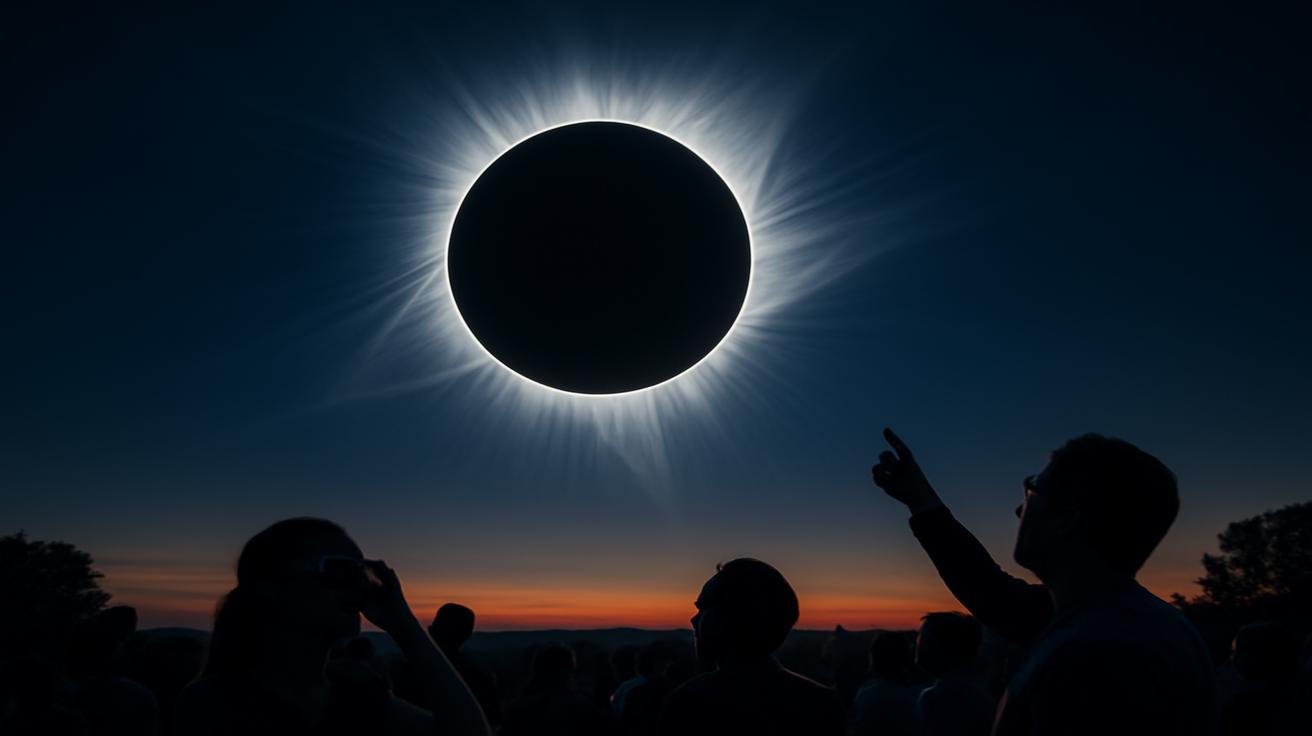
We like to think of the sky as static. The Big Dipper always there, Orion shouldering his way through winter, the Moon eternal in its phases. But in reality, everything is moving. The Moon’s drift is just one of the more intimate motions—a rearranging of the geometry between our world and its single, close companion. We are lucky, in a sense, to live in an era when the Moon still looms large enough to turn day into eerie twilight during a total solar eclipse, still close enough to pull mighty tides across the planet’s face.
The Far Future: A Different Earth–Moon Embrace
If you project this tidal story far enough into the future, you arrive at a curious equilibrium. One day, Earth’s rotation and the Moon’s orbit could become tidally locked to each other, the way the Moon is already locked to us. Right now, the Moon always shows us the same face because it rotates once for every trip around Earth. In a distant future—if other events don’t intervene—Earth could slow until its day is as long as the Moon’s orbital period.
In that scenario, one side of our planet would always face the Moon, seeing it fixed in the same spot in the sky like a pale coin nailed to the firmament. The other side would never see the Moon at all. Tides would become far simpler and weaker, more like slow breathing than the energetic in-and-out we know now.
But the Universe is not contractually obliged to let that scenario play out. Long before perfect tidal lock is reached, the Sun itself will have changed, swelling toward its red-giant phase. The dance of Earth and Moon may end in a different way entirely—consumed by stellar expansion, or left orbiting a transformed, dimmer Sun. These deep futures are speculative, the kind of timescales where human imagination starts to wobble.
What is certain is that the Moon’s quiet departure is part of a much larger unfolding. Our lives occupy only a few brief heartbeats of this story. We won’t watch the Moon shrink visibly, or see days become 25 hours long. But we can know it’s happening. We can stand by the ocean, feel the tug of the tide around our legs, and understand that this moment is one frame in a film that has been running for eons.
Listening to the Planet’s Almost-Silent Clock
So what does it mean, really, to live on a world whose days are getting longer and whose tides are fading—so slowly that no one feels them change? On one level, it means nothing at all. You still need to catch your bus. The tide chart for next summer’s trip to the coast will look much like this year’s. Your phone will buzz at the same time tomorrow morning.
On another level, though, it reframes everything. It reminds us that the scales of change we usually talk about—years, decades, even centuries—are thin slices of a much deeper time. The atmosphere is warming fast by geological standards; species are vanishing. Those are urgent, human-driven changes we can measure, feel, and, crucially, influence.
Set against that, the Moon’s slow retreat and the stretching of Earth’s days are like the background music of a film. They set a tempo we almost never hear, because it is too low, too slow, for our moment-to-moment lives. And yet it’s there: a planet gradually changing its spin, an ocean gradually changing its reach, a moon gradually dimming into the distance.
Stand again at the water’s edge in the blue hush before dawn. The Moon hangs low, its reflection broken into shards by the restless surface. Each wave that folds over your feet has been pushed and pulled not just by winds and storms, but by that quiet presence in the sky. Long after you leave the beach, long after your footprints are erased, the process continues. Grains of sand shift, coastlines evolve, days lengthen by fractions of a breath. The Earth turns, ever so slightly more slowly, under a Moon that is ever so slightly farther away.
We live inside this story. Whether we notice it or not, time itself—measured in sunrises and tides—is a moving target. And on clear nights, when the Moon climbs over the horizon and lays its silver path across the sea, you can look up and know: that gentle light is not just a lamp for lovers and night travelers. It is the visible face of a long, patient drift that is quietly remaking the length of our days and the rhythm of our planet’s beating heart.
Frequently Asked Questions
Is the Moon really moving away from Earth?
Yes. Precise laser measurements show that the Moon is receding from Earth at about 3.8 centimeters per year, mainly due to tidal interactions between Earth’s oceans and the Moon’s gravity.
Will the Moon ever leave Earth’s orbit completely?
Under current models, it’s unlikely that the Moon will escape Earth’s gravity before the Sun dramatically changes in its red-giant phase. Other cosmic events will probably reshape the system long before a clean “breakup” occurs.
Are Earth’s days actually getting longer?
They are. Earth’s rotation is gradually slowing, adding roughly 1.7 milliseconds to the length of a day every century. Over hundreds of millions of years, this becomes a substantial change.
Do the changing tides affect us today?
The long-term weakening of tides is so slow that it has no direct impact on human life right now. Short-term tidal variations we notice are caused by local geography, weather, and the current positions of the Moon and Sun, not by the slow drift of the Moon.
How do scientists know what day length was like in the distant past?
They study natural “records” such as growth rings in ancient corals and layered sedimentary rocks. These can preserve daily and seasonal cycles, allowing scientists to estimate how many days once fit into a year, and thus how long each day was.
Will we ever notice a change in the length of the day?
Not within a human lifetime. The change is far too gradual. We rely on atomic clocks and occasionally add leap seconds to keep civil time aligned with Earth’s rotation, but no one will feel a day “stretch” in any direct way.
Does the Moon’s recession affect eclipses?
Over very long timescales, yes. As the Moon moves farther away, it will appear slightly smaller in our sky. Far in the future, it may no longer fully cover the Sun during eclipses, turning today’s total solar eclipses into annular, ring-like ones.





Leave a Comment