
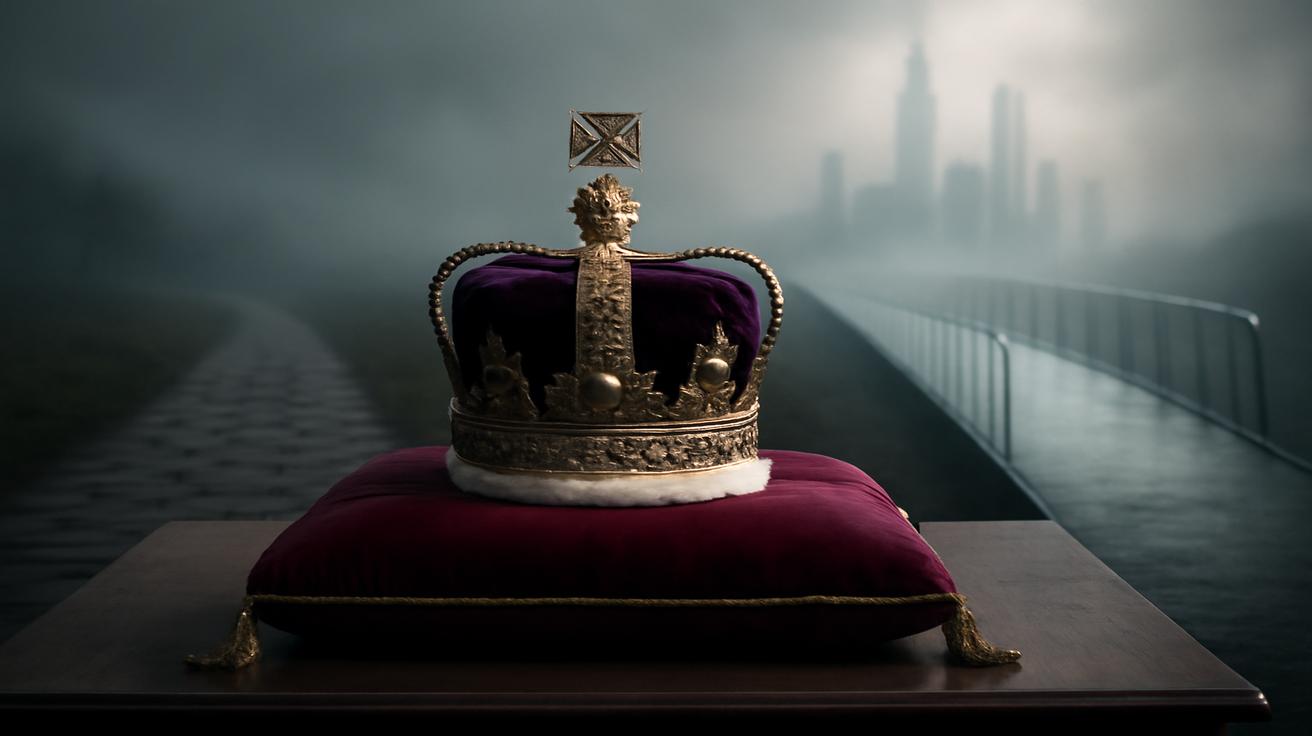
The rain over Windsor doesn’t fall so much as drift—fine as breath, soft as silk, barely there until it beads along the railings and creeps into your sleeves. On a gray English afternoon, the castle rises out of that mist like something half remembered, half imagined: too old to feel real, too familiar to feel distant. Yet lately, for all its stone and ceremony, the monarchy it houses has never seemed more fragile, more human, more exposed.
The senior royals—the faces on stamps, the names on hospital bulletins—are aging in front of the world. Health updates arrive as formal statements, trimmed of emotion but not of impact: diagnoses, treatments, “a period of rest,” “stepping back from duties.” Behind the antique language, there is something startlingly simple: a family confronting illness, mortality, and the uncomfortable fact that even crowns can’t outlast time.
And so an ancient institution, designed for continuity at any cost, has stumbled into a very modern question: when the bodies that embody the monarchy are weakened, does the system double down on its old scripts—or dare to evolve into something that looks, sounds, and feels different from anything that came before?
The Sound of Footsteps in an Aging Palace
Walk, in your mind, through Buckingham Palace early in the morning. The carpets are thick, the marble floors cold, the air still. A maid draws back heavy curtains, the room brightens, and portraits of long-dead monarchs watch with familiar indifference. For centuries, the business of monarchy has moved along these corridors: red boxes, audiences, investitures, handshakes, smiles.
But in recent years, another rhythm has joined the footsteps and fanfare: the slow, uneven beat of medical updates. A king undergoing treatment. A princess recovering from surgery. An aging duke fading from public view before disappearing entirely from the balcony. The camera lenses, once trained on balcony kisses and glittering tiaras, now linger a little longer on tired eyes, thinner frames, carefully managed schedules.
The monarchy has always insisted on the illusion of tirelessness. The Queen never stops. The Prince never falters. The Princess always smiles. Yet no institution—no matter how carefully choreographed—can outrun biology. The image of unbroken duty begins to fray around the edges when wheelchairs are hidden behind curtains and hospital visits are described as “routine.”
In that delicate space between the official statement and the public’s imagination, a new narrative has taken root: not of invincible figureheads, but of aging human beings carrying the weight of a nation’s expectations. The question is no longer just, “Will the monarchy continue?” but “At what cost, and to whom?”
When Continuity Means Carrying On, Whatever the Price
Continuity has been the monarchy’s defining promise. Through wars, recessions, scandals, and changing governments, the institution presents itself as the still point in a turning world. The crown passes, the rituals remain, and the story goes on. That sense of unbrokenness is not accidental—it has been meticulously protected, even when reality strains against it.
Think of the late Queen, well into her nineties, still standing on balcony railings, still opening parliaments, still receiving red boxes of government papers daily. Her presence was treated almost as a natural resource: steady, renewable, unquestioned. To many people, she seemed timeless, as if age itself had made a separate treaty with her.
But as her health declined, the institution reached instinctively for its oldest reflex: carry on as if nothing is wrong, until that fiction can no longer be maintained. Appearances were scaled back, not cancelled; mobility aids were minimized, not normalized. The machine of continuity whirred on, even as its central figure grew frail.
Now, with the next generation, the pattern threatens to repeat. Even as senior royals announce medical treatments or “reduced schedules,” the language of continuity hums in the background: the work goes on, the crown endures, the system holds. It is a remarkably successful narrative—until it crashes into a simple truth: human beings get sick, get tired, and eventually cannot carry on at the same pace.
In that tension—between the relentless push for continuity and the finite limits of the human body—the monarchy’s future is quietly being negotiated.
The Quiet Emergence of a “Working” Royal Family 2.0
If you listen carefully to the way palace briefings are worded now, there is a subtle shift underway. Talk of a “slimmed-down monarchy” started as a practical calculation—fewer working royals, more focused roles, clearer value for money. But illness and aging have turned this idea from a branding exercise into a structural necessity.
Royal duties, once spread across a wide family network, now rest on a shrinking core of people. Some have stepped back by choice, others by controversy, others by simple exhaustion. What remains is a smaller, more visible group, each carrying a heavier public load at a time when their private burdens are also growing.
In effect, the monarchy is being forced to test an unspoken hypothesis: could it survive as a more concentrated, more transparent, more explicitly human institution? One where vulnerability isn’t fully hidden behind lace curtains and medical euphemisms, but acknowledged—carefully—in the open?
At the same time, the old idea that royals are “born for this” feels increasingly strained. The younger generation has grown up in a world that understands mental health, burn-out, and work-life balance in a way their grandparents did not. Their language—about anxiety, strain, and the need for time away—is worlds apart from the stoic codes of the past.
For an institution built on the idea of duty without complaint, that is radical. Yet it might also be its best chance at evolution: a monarchy that admits it cannot, and should not, pretend to be superhuman.
Generational Tectonics: When Old Rituals Meet New Expectations
Outside the palace walls, something else is shifting. Younger generations are growing up with a more skeptical relationship to inherited power. The monarchy is no longer a distant, unquestioned background presence; it is a choice, a subject of debate, a line item on a national budget, a frequent topic of social media critiques.
Meanwhile, global conversations about privilege, inequality, and colonial histories have thickened the air around royal processions and gilded carriages. The same pomp that once inspired awe can now feel, to some eyes, like an echo from a more unequal age. When combined with visible frailty at the top, this tension becomes inescapable: can a hereditary institution defended in the name of “stability” still justify itself when that stability appears physically fragile and morally contested?
To understand how quickly attitudes can diverge, it helps to visualize them. Consider this simplified snapshot of generational sentiment within the UK and other Commonwealth countries:
| Age Group | General Attitude Toward Monarchy* | Key Feelings |
|---|---|---|
| 60+ | Mostly supportive; strong attachment to tradition and continuity | Nostalgia, gratitude, stability |
| 40–59 | Mixed but generally positive; focus on national identity and soft power | Pragmatism, respect, mild skepticism |
| 25–39 | Divided; more open questioning of relevance and cost | Ambivalence, critical curiosity, ethical concern |
| 18–24 | More likely to be indifferent or favor alternatives to monarchy | Detachment, reform-mindedness, focus on social justice |
*Generalized trends based on recent opinion patterns; not a precise survey.
As senior royals face health battles, younger viewers are less inclined to see stoic suffering as noble and more inclined to ask: why must any one family carry this? Why should leadership be hereditary at all? Why is the well-being of a nation’s constitutional figurehead left to luck, genes, and the random cruelty of illness?
These are not just abstract political questions; they are deeply personal ones when the subjects involved are visibly unwell. For some, the vulnerability of the royals invites empathy—a sense that, beneath the diamonds, this is simply a family under pressure. For others, it sharpens the feeling that no role, however historic, should demand such unrelenting exposure from individuals who did not fully choose it.
Illness in Public: The Human Face Behind the Institution
There’s a particular stillness to hospital corridors that doesn’t care who you are. The fluorescent lights hum. Monitors beep. A paper cup of tea cools on a windowsill. Somewhere, a member of the royal family has sat in that silence, waiting for news like anyone else: mother, father, spouse, patient.
When their health crises are announced, the language is cautious, curated, sometimes frustratingly vague. Yet beyond the careful phrases—“following medical advice,” “positive prognosis,” “private matter”—real emotions churn: fear, uncertainty, exhaustion. The public sees only the narrow strip allowed through the palace gates.
That partial view can create an odd kind of dissonance. On one hand, there is an old instinct to protect privacy, to close ranks, to say as little as possible. On the other, the modern public has grown used to a different level of openness around health, especially mental health. Opacity that once felt respectful can now feel evasive.
And so the monarchy teeters on a thin wire between two generations of expectation: the stiff upper lip and the open wound. Each health bulletin becomes not just medical information, but a tiny referendum on how much this institution is willing to share—and how much it expects sympathy without complete transparency.
There is, ironically, an opportunity here. Moments of vulnerability can humanize an institution often caricatured as aloof or anachronistic. To see a royal admit exhaustion, or express gratitude to medical staff, or frankly acknowledge fear, is to glimpse a person beyond the performance. But that humanization only works if it feels authentic rather than stage-managed, if it invites a conversation rather than closing it down with the familiar words: “No further comment will be made at this time.”
Continuity or Care: The Question Inside the Question
At the core of all this—the aging faces, the careful statements, the balcony appearances calibrated to last exactly long enough but no longer—lies a sharper dilemma than most press releases admit: is the monarchy’s highest obligation to project continuity, or to care for the human beings who personify it?
For centuries, that question barely surfaced. The assumption was simple: personal comfort, even personal health, yielded to duty. Monarchs were expected to be tireless, and if they weren’t, the system quietly moved around them, shielding their weaknesses from view. Abdication was a scandal, stepping back a betrayal.
Today, the moral calculus is changing. A culture that believes in workplace rights and compassionate leave looks differently at an institution that expects devotion unto collapse. When a king or senior royal continues public duties while undergoing treatment, admiration mixes with unease: is this courage, or compulsion? Inspiration, or unhealthy precedent?
The institution itself, too, must wrestle with timing. Step back too early, and you risk appearing unreliable, feeding critics, unsettling tradition. Step back too late, and you appear in denial, clinging to continuity at the expense of basic humanity. Hover between the two, and you look indecisive.
One path forward lies in a concept the monarchy has been historically wary of: planned, dignified transition. Not emergency abdications or sudden withdrawals, but transparent phases of shared responsibility, gradual handovers, and honest conversation about limits. Such a model would acknowledge something the old scripts never quite said out loud: there is no shame in being human, even in a job framed as divine right.
Imagining a Different Kind of Royal Future
So what might a “necessary evolution” actually look like? The answer won’t come in one grand announcement, but in hundreds of small choices across years: which events are prioritized, which are quietly retired, who steps forward, and who is allowed to rest.
Picture, for a moment, a royal calendar designed with sustainability in mind, not just symbolism. Fewer ceremonial marathons; more focused engagements tied tangibly to contemporary challenges—climate, mental health, inequality. Public appearances scheduled to protect health, not to push it to the brink. Transparency not as a reluctant concession but as a guiding principle.
Imagine, too, a more honest public education about the constitutional role royals actually play: the legal limits of their power, the specific functions they perform in governance, the costs and benefits of retaining them. Stripped of myth, the institution could invite support based not on fairy tale imagery but on a clear-eyed assessment of its usefulness—and its willingness to change.
Such an evolution may well include more straightforward discussions of succession and semi-retirement. Just as many professions acknowledge that certain responsibilities are best shared or passed on after a certain age, the monarchy could normalize phased transitions: a monarch stepping aside from day-to-day duties while remaining a symbolic figure, for example, instead of clinging to an all-or-nothing model.
None of this would silence the republicans, nor should it. A healthy democracy can withstand, and even benefit from, arguments about its oldest institutions. But it would at least meet modern citizens on honest ground, rather than on the hazy plateau of deference.
In the end, the choice facing the British monarchy is not simply between survival and extinction. It is between a continuity that demands invisibly sacrificed bodies and a continuity that evolves openly, accepting that the health of the institution is inseparable from the health of the individuals inside it.
FAQs
Why are health issues among senior royals such a big deal for the monarchy?
Because the monarchy is built around individuals, not offices. When a senior royal is unwell, it affects public duties, state ceremonies, and the image of stability that the institution relies on. Illness forces the palace to navigate privacy, transparency, and continuity all at once—and each choice carries political and emotional weight.
Does the monarchy have to keep going even when royals are seriously ill?
Formally, the Crown never “stops”—there are constitutional mechanisms like Counsellors of State who can act when a monarch is incapacitated. But in practice, the system still leans heavily on visible, personal presence. That’s why serious illness raises tough questions about whether traditional expectations of constant duty are still fair or sustainable.
What does “evolution” actually mean for the British monarchy?
Evolution could mean a smaller, more focused group of working royals; clearer boundaries around privacy and health; more transparent communication; and perhaps more structured transitions of power or responsibility. It doesn’t necessarily mean abolishing the monarchy, but rethinking how it operates and what it asks of those born into it.
Are younger generations really less attached to the monarchy?
Many surveys and opinion patterns suggest that younger people, especially under 30, tend to be more indifferent or critical of the monarchy than older generations. They’re more likely to question inherited privilege and to judge institutions on transparency, inclusivity, and relevance to current social issues.
Can visible royal vulnerability actually help the monarchy survive?
It can, if handled authentically. Seeing royals acknowledge vulnerability—physical or emotional—can make them more relatable and counteract the perception of them as distant symbols. But if vulnerability feels tightly scripted or is used selectively, it can deepen mistrust instead of empathy. The line between humanizing and performative is thin, and the monarchy is learning in real time how to walk it.







Leave a Comment