
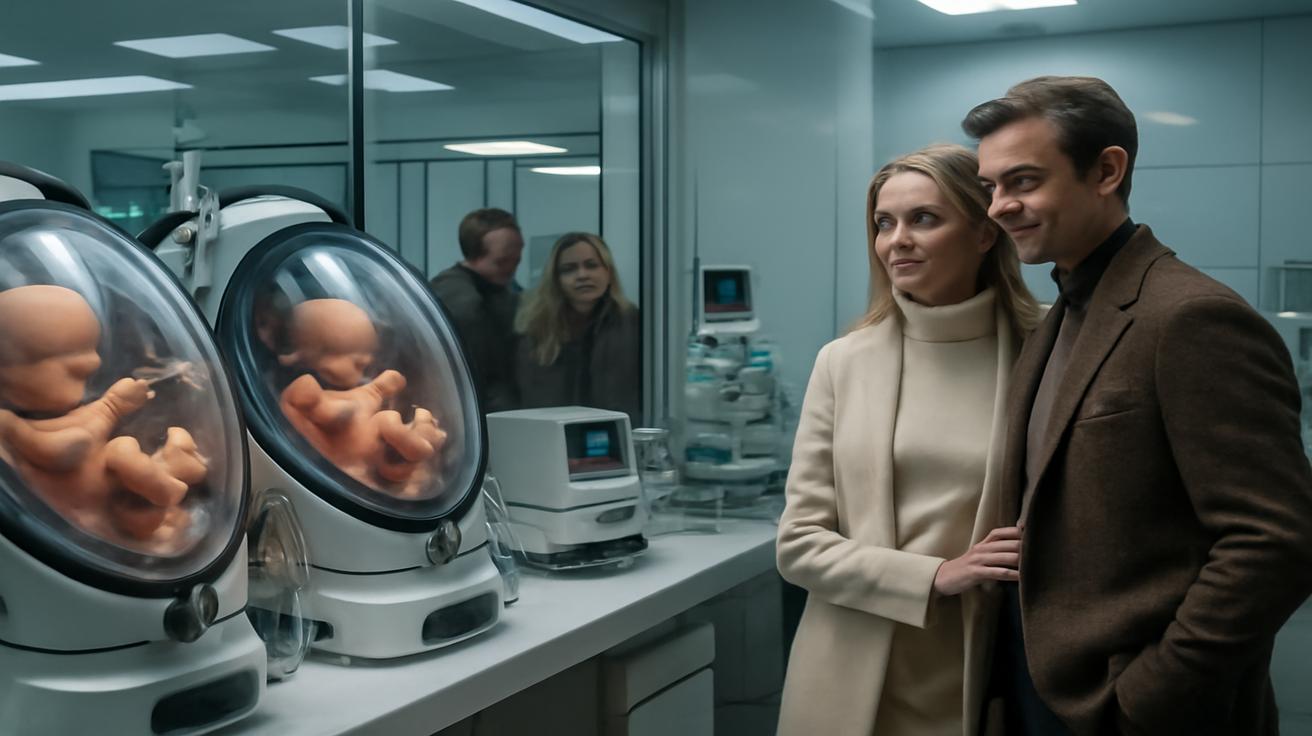
The first time you see the artificial womb, it looks less like science fiction and more like a strange, glowing aquarium. Clear pods line the walls of a pristine lab, each softly humming with the quiet insistence of machinery that never sleeps. Inside, something that should feel sacred instead feels engineered: tiny hands, curled like commas, move in slow motion inside perfectly controlled amniotic fluid. Nutrients drip with algorithmic precision. Heartbeats are graphed and optimized in real time. Here, birth has been moved off the body and onto a platform. And in the silence between those glass pods, a single, unspoken question hangs in the air: if this is the future of reproduction, who gets to have it—and who, quietly, is left behind?
The new womb of the wealthy
In the brochures, it looks flawless. Sleek, reassuring language promises “stress-free gestation” and “genetic peace of mind.” There are pastel renderings of smiling couples, their hands placed not on a pregnant belly, but on a translucent pod. There’s no morning sickness, no high-risk pregnancy, no labor. Just monthly progress reports, curated ultrasound videos, and a due date synced to a calendar app.
The pitch is simple: what if you could outsource pregnancy itself? For the ultra-wealthy, that question is no longer hypothetical. Early-stage artificial womb technology—combined with advanced IVF, embryo screening, and soon, gene editing—is slowly slouching toward the mainstream of elite medicine. What began as a desperate medical intervention for extremely premature babies is evolving into something else: a luxury good, wrapped in the language of choice and safety.
The sales points are seductive. A celebrity couple who doesn’t want to put a billion-dollar brand on maternity leave. A CEO who wants a child but cannot “step away” during a crucial funding round. A tech founder worried about age-related risks. A politician who wants family photos without the scrutiny of a pregnancy press cycle. They are told they can have it all: genetic screening for disease, optimization for height or eye color “down the line,” curated immune systems, designer diversity of embryos to select from. No swollen ankles. No gestational diabetes. No maternal mortality.
In these climate-controlled nurseries of the future, pregnancy becomes a subscription service, reproduction an engineering problem, and birth a data-driven product. The love is real. The money is, too.
The silent epidemic nobody puts on a billboard
Outside those glass pods, in overcrowded clinics and drafty waiting rooms, a different reproductive story is unfolding. It is quieter, messier—and largely ignored.
Sperm counts across the globe have been dropping for decades. Some studies suggest a decline of more than 50% in less than half a century. Endocrine-disrupting chemicals seep into everyday life through plastic packaging, pesticides, cosmetics, and industrial waste. Air pollution doesn’t just choke lungs—it seeps into ovaries and testes, altering hormones and damaging eggs and sperm. Heatwaves bake city streets and the people on them, and subtle damage accumulates in the most intimate cells of human continuity.
Infertility used to be framed as a sad anomaly, something that affected “unlucky” couples. Increasingly, it looks like a structural feature of our era, especially among those who can least afford treatment. The people living next to highways, under flight paths, near refineries and unregulated factories are not browsing brochures for artificial wombs. They’re scraping together money for a single IVF cycle, or more commonly, foregoing treatment altogether because the upfront costs could swallow their rent, their savings, their future.
In a world of rising infertility, one group receives wellness newsletters, genetic counseling, and private fertility concierge services. Another gets hormone disruption, over-the-counter painkillers, and a suggestion to “try again next month.” For the wealthy, the new fertility economy offers more options—freeze your eggs, hire a surrogate, someday rent a pod. For the poor, the same economy quietly prices reproduction out of reach, converting a fundamental human experience into a luxury purchase.
Designer babies as the new inheritance
There is something almost mythic about the idea of a “designer baby.” It sounds like a plot device from a movie: tailor-made children, selected like items from an online catalog. Reality, as usual, is more subtle—but no less unsettling.
Right now, the most powerful tools of genetic privilege operate not through dramatic editing, but through selection. During IVF, multiple embryos are created. Clinics then offer preimplantation genetic testing, screening those embryos for certain diseases and sometimes for traits associated with height, intelligence, or appearance. The science is probabilistic, not absolute—but probability is enough when money and fear enter the room.
Couples are told they can lower the risk of hereditary cancers, avoid severe developmental disorders, choose embryos with “better” predicted outcomes. They are not told, or rarely dwell on, the social echo of millions of small, private, biased choices. Every time an embryo is favored for markers linked to higher education, certain body types, specific behavioral profiles, the genetic future of a population tilts—ever so slightly—toward the preferences of those who can pay.
Soon, artificial wombs could integrate seamlessly into this pipeline. Create dozens of embryos. Screen them. Select the “best.” Implant into a pod that will never smoke, never drink, never encounter workplace stress or malnutrition. Monitor continuously. Optimize conditions. Deliver a baby who, on paper, has been given every possible genetic and gestational advantage.
That child’s life is not guaranteed to be happier or kinder or more meaningful, but statistically, they are already ahead. They have inherited not only wealth and connections, but tuned genes, curated environments, and perhaps even a gestation free from the unpredictability of human bodies.
For a family in a polluted village downstream from a factory, none of this is on the table. Their unborn children inherit toxins and stress, not embryo screens and climate-controlled pods. Their “choice” in reproduction is like their choice in most things: constrained, shaped by forces that will never appear in a glossy brochure.
What’s quietly at stake
To see how this plays out, imagine two futures growing in parallel.
In one, an elite global class uses advanced fertility tools as casually as they now use private tutors and personal trainers. These families maintain multiple lines of frozen embryos created when the parents were in their 20s, long before they decided they were “ready” for kids. They screen, select, and someday may even lightly edit for resilience, cognition, risk of depression, athletic potential. Pregnancy becomes a service they purchase from a high-end facility—an artificial womb or a well-compensated surrogate with comprehensive medical support.
In the other future, everyone else copes with declining fertility in patchwork ways. They wait longer to have children because careers demand it. When they finally try, they discover their sperm counts are low, their egg quality compromised, their hormonal cycles irregular. Their insurance doesn’t cover fertility treatment. Their governments debate whether to fund reproductive healthcare at all. They give up after a few cycles of trying because the costs—financial, emotional, physical—are too high.
These aren’t just parallel lives. Over generations, they become diverging human lineages. One lineage accumulates layers of advantage—genetic screening, protected gestation, curated environments. The other accumulates risk—environmental damage, untreated health conditions, chronic stress. The result isn’t a sci-fi caste of visibly different “modified” humans; it’s something subtler: a world where privilege is quite literally written deeper into some bodies than others.
A looming fertility collapse, hidden in plain sight
If there were a single breaking news alert that announced, “Human fertility is collapsing,” it might spark global alarm. But that’s not how it’s happening. Instead, it’s a long, slow slide masked by personal stories: “We’ve been trying for two years.” “We had to do IVF.” “We had a miscarriage, then another.” “We’ve decided not to keep trying.”
Fertility is both hyper-personal and quietly collective. Each person’s struggle is unique, intimate, often shame-filled. Yet taken together, those struggles map onto something larger—an ecological and social pattern. Sperm counts down. Average maternal age up. Exposure to endocrine disruptors near universal. Climate stress escalating. Healthcare access unequal. Economic pressure pushing parenthood later and later, until biology simply closes the door.
In the middle of all this, artificial wombs appear as a kind of technological life raft. Can’t carry a pregnancy safely? Use a pod. Too old for low-risk gestation? Use a pod. Worried about your job, your body, your mental health? Use a pod. The technology is framed as liberation from the burdens of pregnancy—particularly for women and people with wombs whose bodies have long been sites of control and sacrifice.
But a raft is only a solution if everyone can climb aboard. When a technology emerges in a world already stratified by class, race, and geography, it rarely arrives as a neutral tool. It becomes another layer in the architecture of advantage. Those who could birth safely without it may become its earliest adopters, while those whose bodies and environments make pregnancy dangerous remain excluded.
The cruelty is quiet. The people most harmed by polluted air, toxic water, dangerous jobs, and inadequate healthcare are made less fertile, more at risk in pregnancy, and less able to afford the very technologies that could help them. Fertility collapses most sharply at the bottom—and only those at the top get lifeboats made of glass and steel.
Who gets to decide the future human?
Beneath the numbers and the glossy promises lies an uncomfortable truth: artificial wombs and genetic selection are not just medical tools. They are, in slow motion, writing the blueprint of who is allowed to be born.
This isn’t only the dystopia of authoritarian regimes deciding which traits are “desirable.” It’s also the softer, more pervasive eugenics of a marketplace. Clinic by clinic, consultation by consultation, prospective parents are nudged toward certain choices: this embryo is “higher risk,” that one “more promising.” Over time, certain kinds of bodies and minds become rarer, not because anyone banned them, but because a thousand little acts of optimization pushed them quietly out of existence.
Are we prepared to live in a world where people with certain disabilities simply stop being born, not through coercion, but through heavily marketed “peace of mind”? Where neurodivergence is screened away in embryos while still celebrated on social media as “different wiring”? Where queer families who rely on reproductive tech are held to unspoken standards of “perfect” genetics to justify their use of those systems at all?
In a deep sense, the question is not whether artificial wombs exist, but whose values they carry. Will they be governed as public goods—regulated, subsidized, integrated into a broader vision of reproductive justice? Or will they be warehoused in private clinics, wrapped in non-disclosure agreements and luxury branding, another status symbol in the long inventory of things money can quietly buy?
A world split by the right to be born
Imagine a table, modest and glowing on a phone screen, that tries to capture this split reality:
| Aspect | Wealthy Families | Low-Income Families |
|---|---|---|
| Access to fertility care | Multiple IVF cycles, egg/sperm freezing, concierge clinics | Long waits, limited coverage, often no treatment at all |
| Genetic screening | Routine embryo testing, expanding trait selection | Minimal or no access; decisions made later in pregnancy, if at all |
| Gestation options | Surrogacy now; early artificial womb tech as it emerges | High-risk pregnancies in under-resourced systems |
| Environmental exposure | Filtered air, low-toxin products, safer neighborhoods | Pollution, chemicals, unsafe work and housing conditions |
| Long-term outcome | Accumulating “genetic privilege” over generations | Rising infertility and health risks, fewer options to respond |
The table is oversimplified, of course, but it captures a core tension: the same era that promises hyper-controlled, optimized birth for some is quietly making it harder for others to conceive at all. It’s not just a difference in comfort or convenience. It’s a difference in who gets to continue their family line under conditions of escalating planetary and social strain.
When birth moves into machines, it doesn’t leave politics behind. The pods reflect and amplify the inequalities of the world around them, like mirrors made of glass and circuitry. Behind every artificially gestated child will be a chain of decisions: who funded the research, who owned the patents, who set the price, who got the appointment, who passed the background checks, who satisfied the invisible algorithm of worthiness.
Reimagining what reproductive justice means now
None of this is inevitable. Technologies do not arrive with a single destiny baked in. They are steered, regulated, resisted, reimagined. Artificial wombs could, in theory, become a profound tool of fairness: lifesaving for premature babies, transformative for those whose bodies cannot safely carry pregnancies, liberating for people who would otherwise be forced into reproductive labor under exploitative surrogacy arrangements.
But that potential will not realize itself automatically. It would require decisions that run counter to the usual gravity of profit and power: heavy public investment, global regulation, strict bans on coercive use, price controls, and genuine inclusion of disabled communities, feminists, queer parents, and people from the most polluted, marginalized regions in the rule-making process.
It would require broadening the question from “What can this tech do?” to “Who is it for, and on whose terms?” It would mean investing just as heavily in cleaning the air, banning harmful chemicals, improving basic healthcare, and funding fertility treatment as a right, not a luxury. It would demand that we see reproduction not only as a private dream, but as a shared, political space where justice or injustice is literally born into the world.
Even the language would have to change. Instead of “designer babies,” we might talk about “collective futures.” Instead of celebrating genetic optimization in isolation, we might ask: what kinds of diversity—of bodies, minds, and stories—do we want our descendants to inherit? What forms of vulnerability do we value rather than erase?
Listening to the quiet questions in the hum of the machines
Somewhere, right now, a prototype artificial womb is buzzing softly in a lab. Sensors blink. Data scrolls. The pod’s contents might be nothing more than synthetic tissue or an animal embryo used for testing. But soon enough, it will be human.
When that happens, the story we tell about it will matter. If we frame it simply as progress, as inevitable, as the natural next step in human control over nature, we will slide easily into a future where the wealthy engineer not only their lives, but their lineage. If we frame it as a horror, a monstrosity, we risk ignoring the incredible relief it could bring to those for whom pregnancy is perilous or impossible.
Between those extremes lies a more difficult, more honest stance: curiosity sharpened by caution, wonder braided with responsibility. We can stand in that lab, gaze at that shining artificial womb, and ask hard questions while still acknowledging the awe of what human beings—fallible, hopeful, frightened—have built.
Whose child is safest in this world? Whose child is most at risk? Who has been told their genes are “good investments,” and who has been told, in a hundred subtle ways, that their line should quietly end? As artificial wombs move from experiment to option, those questions will no longer be abstract. They will be embedded in policies, clinic forms, price lists, and the quiet calculus of who can afford to reproduce.
In the end, the story of artificial wombs is not just about technology. It is a mirror held up to our deepest beliefs about which lives we protect, which we optimize, and which we allow to fade out at the edges of our concern. The machines will not answer those questions for us. They will only amplify whatever answers we have already, silently, chosen.
FAQ
Are artificial wombs already being used to grow human babies?
No. Current research focuses mainly on extremely premature animal fetuses and human tissues. Experiments with “biobags” for lambs have shown promising results, but we are not yet at the stage where full human pregnancies are carried in artificial wombs from conception to birth. However, partial support for very premature infants may become clinically available sooner.
How do artificial wombs connect to designer babies?
Artificial wombs are one piece of a larger system. The “designer” aspect begins earlier, with IVF, embryo creation, and genetic screening or editing. Artificial wombs could then provide a tightly controlled environment for those selected embryos, potentially increasing the appeal of genetic optimization because gestation itself becomes more standardized and monitored.
Why is infertility rising, and who is most affected?
Infertility is linked to many factors: exposure to endocrine-disrupting chemicals, air and water pollution, stress, poor access to healthcare, and delayed childbearing due to economic pressures. While it affects all income groups, low-income communities are often more exposed to harmful environments and have less access to fertility treatment, making their infertility both more likely and harder to address.
Could artificial wombs actually help reduce inequality?
They could, but only under specific conditions. If artificial wombs were regulated as public health tools, made affordable or free, and integrated into a broader push for environmental cleanup and universal reproductive healthcare, they might reduce risks for those currently facing dangerous pregnancies. Without those safeguards, they are more likely to deepen existing inequalities.
What is meant by “genetic privilege”?
“Genetic privilege” refers to the advantages that come from having had your genes—and your gestation—carefully selected or optimized through expensive medical technology. Over time, families who can routinely access genetic screening, embryo selection, and advanced gestation options may accumulate biological advantages that compound with their social and economic ones.
Is this just science fiction, or should we be acting now?
While fully functional artificial wombs for entire human pregnancies are still in development, the surrounding ecosystem—IVF, embryo screening, and increasingly powerful genetic tools—is already here and expanding. Decisions about regulation, access, and ethics are being made now, often out of public view. Waiting until the technology is “finished” means accepting rules set without broad democratic debate.
What can be done to make the future of reproduction more just?
Key steps include treating fertility care as part of universal healthcare, strictly regulating genetic selection and any future editing, investing heavily in environmental cleanup and toxin bans, ensuring global participation in setting rules for artificial wombs, and centering disabled, marginalized, and reproductive justice voices in all policy conversations. The goal is not to block technology, but to shape it so that it expands, rather than narrows, who is allowed to be born.








Leave a Comment