
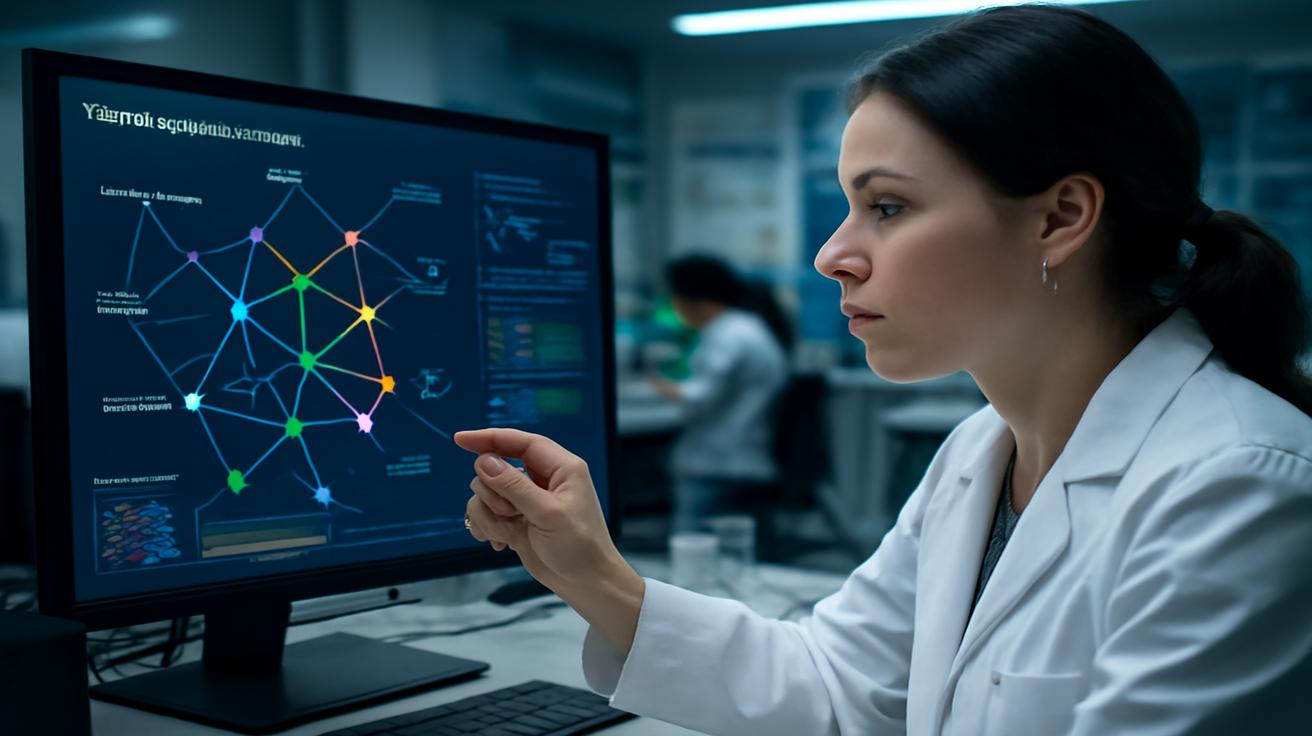
The computer glows in the half-dark of the lab, as if it’s thinking. Outside the window, a maple tree lifts its branches against a gray sky, each leaf veined like a tiny green lung. Inside, a screen fills with shifting constellations of data—dots, lines, colors blooming and fading. A scientist leans closer. Somewhere in this surging tide of information, a pattern is emerging, one that might tell us how to stop a cell from turning rogue, how to nudge a tumor into retreat, how to keep a life from slipping away.
People like to say that cancer is a war, but in rooms like this, it feels more like tracking a storm system over a forest. Invisible winds of mutation, currents of inflammation, sparks of immune response, molecules speaking in a language we’re only just beginning to decode. For decades, that language has been overwhelming—too many variables, too many exceptions, too many “it depends.” But now, artificial intelligence is pulling up a chair to the conversation, listening at a scale no human mind could ever manage, and quietly, methodically, pointing us toward the levers that matter most.
When the Forest Is Too Big for Human Eyes
Imagine walking into a forest where every leaf on every tree tells a story. One leaf whispers about a mutation, another about a hormone level, another about diet, another about environmental exposure. For a single cancer patient, there can be millions of such “leaves”: genes switched on or off, proteins pulsing in and out of action, immune cells drifting through tissues like scouts and soldiers.
For years, doctors have done what any of us would do in a forest that vast—we’ve followed the biggest trails. Tumor size. Stage. A handful of well-known mutations. We’ve treated patterns that stand out in bold print and hoped that was enough.
But beneath the visible trails, there is an intricate undergrowth: microscopic changes in cellular behavior, subtle combinations of genes, delicate balances between inflammation and immunity. The human brain can hold only a few variables in working memory at once; cancer biology laughs at such limits.
Artificial intelligence, though, doesn’t tire. Feed it millions of data points—genomic sequences, lab results, imaging scans, treatment histories, outcomes—and it can comb through the forest with a kind of mechanical patience. Not to replace the human eye, but to extend it, sharpening our sight where it was once blurred. AI thrives on complexity; cancer is made of nothing else.
The Moment the Pattern Clicks
In one hospital, late at night, an oncologist scrolls through a report generated by a machine-learning model trained on thousands of breast cancer cases. The report is not a single answer but a map of probabilities. It highlights that for this particular patient—her age, her metabolism, her exact pattern of mutations—the most important predictor of treatment success isn’t what the doctor usually expects. It’s a specific combination of immune markers and a rarely checked genetic variant.
In another center, an AI model quietly scans CT images of lungs—thousands every week. Human radiologists still look, still judge, still decide. But in the background, the system nudges their attention to subtle patterns of texture, shadow, and shape, the kind of thing a human eye might dismiss as “probably nothing.” It turns out that “nothing” sometimes grows, and early nudges translate into earlier biopsies, earlier treatments, fewer shocks when the word “cancer” finally lands in the room.
These may sound like small refinements, but cancer medicine is full of turning points that are measured in weeks, millimeters, or percentages. AI’s real power is not in some sci-fi miracle cure; it’s in stacking dozens of small, smart decisions in a way that bends the odds. Every nudge—toward a better drug, a faster diagnosis, a closer match between patient and therapy—is another slight pressure against the disease’s momentum.
Five Levers the Machines Keep Pointing Toward
When AI models are set loose on the tangle of cancer data, something intriguing happens. Across different hospitals, countries, and types of cancer, certain themes keep resurfacing—a handful of levers that seem to carry outsized influence over who gets sick, how fast the disease advances, and how well treatments work. Some of these levers we already knew; others we underestimated. But together, they create a kind of compass, a way to navigate the forest with a bit more confidence.
1. Early, Almost Whisper-Soft Detection
If cancer had a favorite trick, it would be silence. Many tumors grow quietly for years before they’re large enough to cause symptoms or show up clearly on a scan. By then, they’ve often sent microscopic seeds on journeys through blood and lymph, making cure far more difficult.
AI doesn’t change the biology of silence, but it does change what we can hear. Algorithms trained on enormous image libraries—mammograms, lung CTs, skin photos—are starting to pick up patterns that are invisible to the naked eye. They can notice how the grain of tissue shifts, how edges blur in a way that hints at early malignancy, how subtle differences in density may whisper “watch this spot.”
We’re entering an era where detection isn’t just about looking more often, but looking more deeply. In blood samples, AI sifts through fragments of DNA shed by tumor cells—circulating whispers of danger—spotting patterns that might predict a hidden tumor long before it alters a scan. This is not flawless yet, and false alarms remain a concern, but the direction is clear: the earlier we see, the more gently we can act.
2. The Immune System as a Silent Hero
For a long time, the story of cancer therapies was mostly about attacking the tumor directly—cutting, burning, poisoning. Surgery, radiation, chemotherapy. Then came immunotherapy, a new chapter built around a remarkable idea: teach the body’s own defense system to notice what it was previously ignoring.
AI is revealing that the immune system’s role is even more central than we thought. When models analyze data from patients on immunotherapies, they keep circling back to certain patterns: the diversity of T-cells, the presence or absence of specific immune checkpoints, the way immune cells cluster around or avoid the tumor.
Some patients have “hot” tumors buzzing with immune activity; others have “cold” tumors, eerily quiet. AI can predict, with growing accuracy, who is likely to respond to an expensive immunotherapy and who might need a different strategy—maybe a combination treatment to “heat up” the tumor first.
It’s a shift in focus: from just “How do we attack the cancer?” to “How do we empower the internal ecosystem that keeps renegade cells in check?” AI’s talent is in reading the immune landscape like weather patterns, finding the combinations of clouds and winds that signal a coming storm—or a clearing sky.
3. Metabolism: The Invisible Fuel Lines
Every cell in your body runs on chemistry. Sugars, fats, amino acids, oxygen—all flowing through an intricate web of reactions. Cancer cells, it turns out, are metabolic hackers. They reroute fuel lines, gorge on glucose, alter acidity, and thrive in conditions that would starve normal tissue.
When AI dives into metabolic data—blood tests, tissue oxygen levels, metabolite profiles—it keeps returning to the same conclusion: the way a body processes energy is a powerful lever. Certain metabolic signatures predict faster tumor growth, higher risk of spread, or resistance to therapy. Others hint that a tumor might be unusually vulnerable to drugs that target specific metabolic pathways.
In some research labs, AI is even helping design interventions that pair cancer drugs with changes in diet or metabolism-modifying agents. It’s not the simplistic “sugar feeds cancer” slogan that circulates online; it’s something far more nuanced—using data to understand which metabolic dials can be carefully turned, and when, to tip the balance away from tumor survival and toward normal healing.
4. Personalized Treatment: From Recipe to Remix
Not that long ago, a diagnosis like “stage II colon cancer” more or less prescribed the same treatment recipe for everyone in that category. Today, AI is turning those recipes into remixes—personalized variations tuned to the rhythm of an individual’s biology.
By feeding in genomic data (which mutations, in what combinations), clinical history, organ function, and even real-time responses to early doses, machine-learning models can suggest tailored options: this chemotherapy regimen instead of that one; add this targeted drug; reduce that dose; consider radiation here, skip it there.
In some clinical trials, AI systems are acting like navigators during a voyage. As patients move through treatment, the models continually update: Is the tumor shrinking as expected? Are biomarkers improving or stalling? If the ship is drifting off course, the algorithm proposes a steering correction—a different drug, a timing change, a switch to an emerging therapy.
The goal isn’t to strip doctors of their authority but to arm them with a constantly refreshed, data-driven second opinion: what, in thousands of similar journeys, tended to work best for a patient most like this one?
5. The Quiet Power of Environment and Lifestyle
One of the most humbling findings in cancer research is that genes aren’t destiny—not entirely. Environment and behavior leave fingerprints on our biology: in how DNA gets damaged or repaired, in chronic inflammation, in hormone levels and microbiome diversity.
Here, too, AI is spotting levers. When lifestyle data (sleep patterns, activity levels, diet measures, exposures) are integrated with genetics and clinical outcomes, models begin to hint at which changes might matter most for which people. For one patient, long-term exposure to air pollution might be a crucial factor; for another, disruptions in circadian rhythm and chronic stress stand out.
In some pilot programs, wearable devices stream information about heart rate variability, sleep depth, and physical activity into AI systems that flag patients at higher risk of treatment complications or relapse. The picture that emerges is clear: while no lifestyle tweak is a magic shield, the blend of environment and daily behavior is a powerful backdrop against which cancer either thrives or struggles.
The Levers on One Screen
All these threads—early detection, immune dynamics, metabolism, personalized therapy, environment—can feel abstract. But on a clinician’s screen, they appear as a series of quietly glowing numbers and probabilities, a dashboard of risk and opportunity.
| AI-Highlighted Lever | What AI Analyzes | Potential Impact on Care |
|---|---|---|
| Early Detection | Imaging, blood markers, subtle pattern shifts over time | Finds tumors earlier; reduces need for aggressive treatment |
| Immune Landscape | Immune cell types, checkpoint markers, tumor “hot/cold” status | Identifies who may benefit most from immunotherapy |
| Metabolic Profile | Glucose use, oxygen levels, metabolic byproducts | Uncovers vulnerabilities to metabolic or targeted treatments |
| Personalized Regimens | Genomics, prior responses, organ function, real-time outcomes | Optimizes drug choice, dosing, and sequence for the individual |
| Environment & Lifestyle | Exposure history, activity, sleep, stress indicators | Supports tailored prevention and survivorship plans |
Each cell in that table represents thousands of lives, billions of data points, and a slow, careful effort to translate mathematical insight into something deeply human: less suffering, more time, a gentler arc to a story that once felt brutally predetermined.
The Human Hand on the Lever
It’s tempting, in the glow of the AI screen, to imagine a future where decisions are simply handed down by an algorithm: do this, not that; this drug, not that one. But in every real cancer clinic, the story is messier, more human.
There’s the woman in her fifties who listens as her oncologist explains that an AI system predicts a high chance of success with a particular chemotherapy-immunotherapy combination—but also a risk of harsh side effects. She has grandkids she wants to chase around the yard, a garden she loves, an aging dog at her feet. “What would you choose,” she asks, “if you were me?”
AI can’t answer that. It can’t feel the weight of a grandmother’s decision, the value of one more summer with her roses, the terror of nausea that lingers for weeks. All it can do is present the shape of the forest: the likely paths, the hidden ravines, the potential clearings up ahead.
Doctors, nurses, patients, families—they’re the ones who step into that forest, who walk it together, who decide which levers to pull and which to leave untouched. Artificial intelligence offers a clearer map, a sharper compass. It doesn’t choose the destination.
The Future, Always Arriving, Never Finished
In a research lab, a young data scientist leans back from her screen. She’s just seen something surprising: a complex pattern linking air quality data, genetic variants, and a specific type of lung tumor response to therapy. The model flagged it as significant, but not yet understood. She scribbles a note, messages a collaborator, starts to plan the next layer of investigation.
In another city, a clinician opens a dashboard that summarizes the week’s newly enrolled patients. Risk scores, recommended regimens, predicted side-effect profiles. The doctor reviews each one, cross-checks with experience, memory, instinct. Sometimes the AI’s suggestions align perfectly; sometimes they don’t. Either way, the system learns from every outcome.
Meanwhile, out in the world, in the quiet spaces far from the whir of servers, people are simply living their days. Walking dogs at dawn under pink-tinged clouds. Sharing late dinners in dim kitchens. Sitting in waiting rooms, palms damp, listening for news. Some of them carry microscopic storms in their bodies—clusters of cells already drifting from normal to dangerous—but don’t know it yet.
Artificial intelligence will not stop every storm. It will not make cancer a simple problem or extinguish grief from the world. But it is already helping us understand which winds matter most, which trees are at greatest risk, which early signs herald a coming change.
Step by step, model by model, it is teaching us that the most effective levers against cancer are not single silver bullets but interconnected systems: vigilant detection, empowered immunity, tuned metabolism, individualized care, and a world that pays closer attention to the bodies and environments we move through every day.
And in that dimly lit lab, with the maple tree outside and the steady hum of computers inside, the data keeps flowing. The screens keep glowing. Somewhere in the noise, new patterns are forming—quiet, intricate suggestions from a machine that doesn’t feel hope, but nonetheless helps build it.
Frequently Asked Questions
How exactly is AI used in cancer diagnosis?
AI is trained on massive collections of medical images, lab results, and clinical records. In diagnosis, it analyzes things like CT scans, mammograms, pathology slides, and even blood markers to spot patterns that could indicate cancer earlier or more accurately than the human eye alone. It then provides risk scores or flags areas of concern for doctors to review, rather than making decisions on its own.
Can AI really personalize cancer treatment?
Yes, within limits. AI systems compare a patient’s unique profile—genetic mutations, tumor features, medical history, organ function—to large databases of past patients and outcomes. From this, they suggest which drugs, doses, or combinations are most likely to work and which may cause excessive harm. Doctors use these insights alongside clinical judgment and patient preferences to shape a personalized plan.
Does AI replace oncologists or radiologists?
No. AI acts as a support tool, not a replacement. It can read large volumes of data quickly, highlight patterns, and reduce oversights, but it lacks context, compassion, and the ability to weigh human values. Clinicians interpret AI outputs, explain options, consider the whole person, and ultimately make and share decisions with patients.
Is AI already improving survival rates?
In some areas, yes. AI-assisted screening programs are catching certain cancers earlier, which is strongly linked to better outcomes. In others, AI is helping match patients to effective therapies faster or avoid treatments unlikely to help. Long-term survival data is still emerging, but early signals from imaging, pathology, and treatment-optimization tools are promising.
What are the main challenges and risks of using AI against cancer?
Key challenges include data quality (biased or incomplete data can lead to biased models), lack of transparency in how some algorithms make decisions, and the need for rigorous clinical validation before tools are widely adopted. There are also ethical questions around privacy and who has access to advanced AI-guided care. Addressing these issues carefully is essential to ensure AI truly benefits all patients, not just a few.





Leave a Comment