
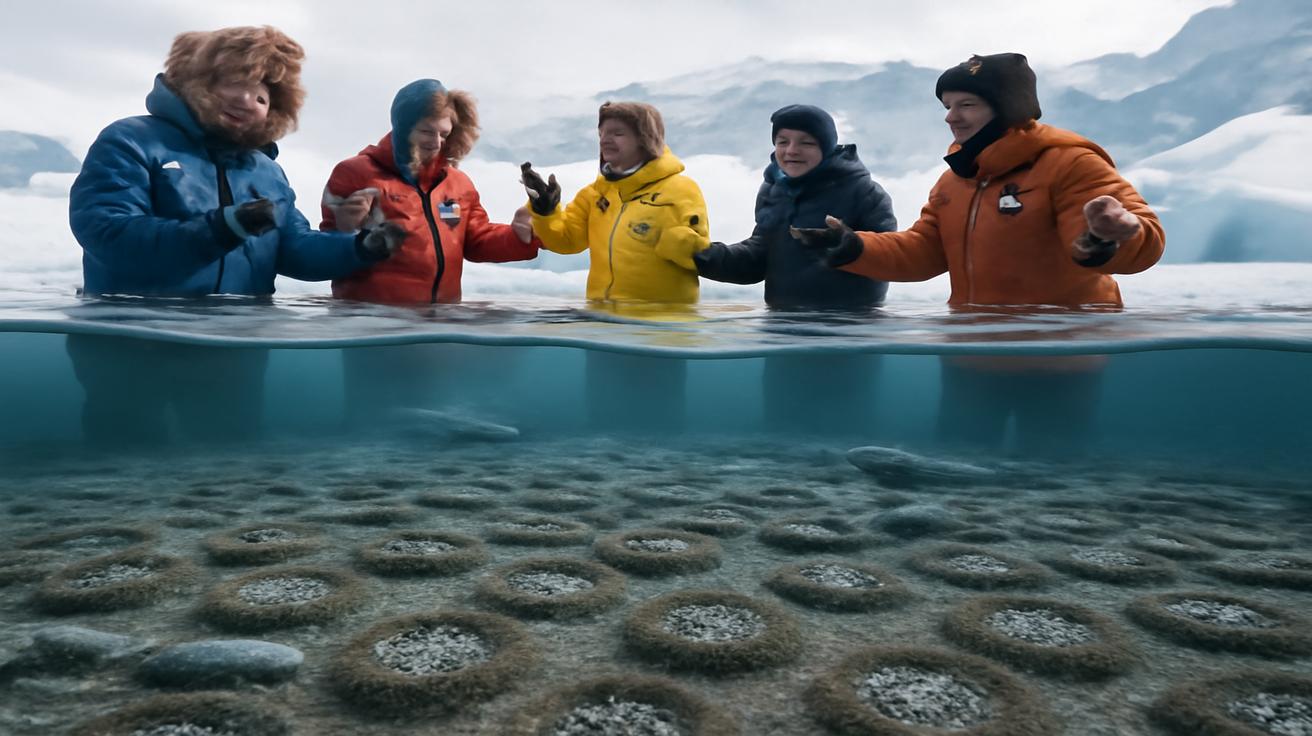
The first time a camera slipped beneath the ice of Antarctica’s Weddell Sea and drifted over the seafloor, the researchers in the control room went quiet. The live feed showed what looked, at first, like scattered pale circles on the dark bottom, a dusting of light against shadow. Then the camera moved a little farther, and more circles appeared. Then more. The ship kept steaming, the cable kept humming, and the circles did not stop. They turned into fields, and then into something like a city—thousands upon thousands of round, neatly sculpted nests, each one guarded by a pale fish with big eyes and a mouth full of eggs.
An underwater city no one knew existed
Until that expedition in early 2021, no human had any idea that beneath a slab of Antarctic ice the size of a small country, an enormous colony of icefish was quietly rewriting the rulebook of marine life. The research vessel was exploring a deep, frigid part of the Weddell Sea when its towed camera—a metal sled bristling with sensors—began sending home that ghostly footage. The scientists had expected mud, rocks, maybe a curious sea star scuttling past. What they found instead was the largest known fish-breeding colony on Earth.
Each nest was about the size of a dinner plate, carefully swept clear of debris, lined with small pebbles. In the center: a mound of translucent eggs, glistening like a clutch of glass beads. Over them hovered a single fish, a Jonah’s icefish, pearly white and faintly translucent, its fins beating slowly as if fanning the future. Many nests held between 1,500 and 2,500 eggs. And the nests went on and on, a mosaic of life stretching across the seafloor.
As the ship moved, the crew watched in disbelief. Ten minutes of footage. Thirty. An hour. The nests did not stop. When they finally crunched the numbers, the scale was almost absurd: roughly 60 million nests, spread across an area larger than some countries. Scientists were seeing, in real time, a hidden engine of the Southern Ocean—an enormous nursery silently humming away in the dark, beneath ice that had kept it secret for who knows how long.
Icefish themselves are already strange by any standard. Their blood is clear, almost colorless, because it carries no red blood cells and almost no hemoglobin. Cold Southern Ocean water holds so much dissolved oxygen that these fish can afford this peculiar physiology, passing oxygen directly through their plasma. Their bodies are adapted to an environment that hovers just above freezing, and they are so specialized for the cold that brief exposure to warmer temperatures can be lethal. To find that a species this finely tuned to ice and darkness depends on such a dense, vulnerable breeding ground adds a new layer of urgency—and vulnerability—to the story.
The secret ecosystem beneath the ice
On screen, the world under the Weddell Sea looks almost monochrome: charcoal mud, pale fish, pale eggs, the occasional lilac starfish creeping past. Yet it’s a remarkably rich scene. The nests draw in predators and scavengers—seals, other fish, opportunistic invertebrates. The ice overhead, two to three meters thick, filters out much of the light but stabilizes the water column. Currents slide beneath the ice sheet, delivering nutrients and oxygen and carrying away waste. In this pocket of the polar ocean, the conditions are just right for icefish to mass their reproductive effort in a single, enormous gamble.
The scientists realized that what they had found was not just a curiosity; it was a keystone. Those tens of millions of nests meant tens of millions of potential new icefish. Those icefish, in turn, feed larger predators: Weddell seals, penguins, other fish species, even whales indirectly. Take away the nursery and you do not just lose a fish—an entire food web shudders.
Viewed from above, Antarctica often appears as a blank: white ice, blue ocean, a desolate frontier. That blankness is deceptive. Under the pack ice, life has arranged itself in finely balanced mosaics, each one dependent on ice, temperature, currents, and timing. Many of these systems are still unknown to us. This one—the icefish megacolony—surfaced into our awareness only after a lucky decision to drag a camera over that particular patch of seafloor.
The timing could not be more fraught. Human interest in what lies beneath Antarctic seas is growing as fast as the ice is changing. Climate shifts are re-sculpting the region. Sea ice patterns are becoming less predictable. And in the background, a more familiar pattern has begun to emerge: where there is abundance, there will be arguments over who gets to use it.
The rush to claim what lies beneath
Antarctica is one of the few places on Earth that does not officially belong to any one nation. Instead, it is governed by a patchwork of agreements known collectively as the Antarctic Treaty System—a framework that suspends territorial claims and declares the continent a place for peace and science. On paper, it sounds immaculate, almost utopian. In practice, it’s full of tension, loopholes, and geopolitical shadows.
The Southern Ocean surrounding Antarctica falls under the purview of a specific body: the Commission for the Conservation of Antarctic Marine Living Resources, or CCAMLR. This group—made up of 27 member states, including big fishing powers like Russia, China, and the European Union—was created in 1982 to prevent the kind of runaway exploitation that had already ravaged whales and seals. In theory, CCAMLR manages fisheries with conservation at the core. In reality, every decision requires consensus. One or two countries can freeze any action, no matter how urgent.
Enter the Weddell Sea icefish colony. For some governments, it is a textbook argument for a marine protected area: an irreplaceable breeding ground, vital to the broader ecosystem, discovered just in time to protect it. For others, it is a potential treasure trove. Icefish themselves aren’t currently the main target of commercial fleets, but the discovery hints at the productivity of the region—its potential to support fishing for other species like Antarctic toothfish, often sold as Chilean sea bass, or to become more accessible as sea ice thins.
In closed-door meetings and polished conference halls, delegates now flip through satellite maps and density charts of nests, while legal advisors lean over thick binders of treaty language. Proposals to create a large marine protected area around the Weddell Sea have been on the table for years, supported by the European Union and several Southern Hemisphere nations. The discovery of the fish nests gave these proposals fresh, dramatic evidence.
Yet attempts to finalize protection have repeatedly stalled. Russia and China, among others, have raised concerns about restricting future fishing opportunities and questioned the scientific basis or “permanence” of the ecological value. Behind such arguments sits a familiar calculus: why give up access to a resource—real or potential—when your competitors might not?
In the language of diplomacy, the clash sounds abstract: “balancing conservation with rational use,” “maintaining flexibility for future resource needs.” But at its core, the debate is simple and human: Is this place more valuable to us alive than it would be carved into quotas and catch limits?
Who speaks for the fish?
Standing on the deck of a research vessel, peering out over a frozen horizon, you can feel the distance between those polished conference rooms and the reality beneath the ice. Down there, the icefish know nothing of treaties. They move in loops of instinct: find a patch of seafloor, clear a space, pile pebbles, lay eggs, guard them. The presence of 60 million nests means those instincts align with a very specific set of conditions—ones not easily duplicated should they be disturbed.
Biologists point out that disturbing such a breeding ground is not a subtle affair. Heavy fishing gear dragged along the bottom can break nests, scatter eggs, disrupt the pebbled architecture needed for proper aeration. Even if fleets don’t target icefish directly, bycatch and habitat damage can ripple through the colony. And because these fish are slow-growing and tightly adapted to the cold, recovery from disruption could be slow or incomplete.
There’s another layer of vulnerability: climate itself. The ice overhead functions as both a roof and a shield. It moderates temperature, shapes currents, and provides a kind of spatial memory—the colony exists in relation to the structure of the ice and the dynamics of the water beneath it. As polar temperatures climb and sea ice extent becomes less consistent, that fine-tuned environment is already changing. Adding industrial pressure on top of that instability risks pushing the system past thresholds we do not yet understand.
In meetings, diplomats ask: How certain are we that this colony will remain in this exact form for decades? What if the fish move? What if the ice changes? Should we lock away vast tracts of ocean based on one spectacular discovery? Scientists answer with data, models, and a repeated, quiet warning: uncertainty is not an argument for inaction when the stakes are this high.
Non-governmental organizations—environmental groups, polar advocacy networks—have stepped into the role of translators, turning charts and raw numbers into stories. They show images of the nests, publish animations of the camera drifting over the seafloor. They frame the Weddell Sea not as a blank hinterland, but as a living library of evolutionary oddities that could vanish before we even read them.
The quiet value of an untouched nursery
Trying to weigh fish against policy, or nests against national interests, often feels impossible. Yet there are ways to sketch their value. Leaving the Weddell Sea nursery intact means preserving a population that supports predators far beyond the colony itself. It means safeguarding a natural laboratory for studying how life endures in extreme cold. It means keeping options open—for future science, for undiscovered species, for ecosystem resilience in a time of rapid change.
Viewed narrowly, a fishery is worth what its harvest can sell for. Viewed ecologically, a fish population is worth much more: the stability it lends to food webs, the carbon it helps cycle, the way it buffers shocks when conditions wobble. In the Antarctic, where everything is amplified by cold and isolation, these broader values are harder to replace.
Many marine scientists argue that the icefish colony is precisely the kind of feature the world should choose, explicitly, to leave alone. Some ecosystems, once damaged, do not “bounce back” within any useful human timeframe. The deep sea, polar environments, coral reefs—these places operate on timescales that do not care how long our election cycles or business plans last. A nest that took months to build and guard might be destroyed in seconds by a trawl. The colony could, conceivably, collapse without anyone on the surface realizing until it was too late.
Still, there is a countercurrent of thought that sees the Antarctic not only as a sanctuary but as a bank of untapped opportunity: minerals under thinning ice shelves, krill for aquaculture feed, fish for market, shipping lanes along newly ice-free coasts. For governments facing domestic pressure to feed growing populations and maintain economic growth, the abstraction of “intact ecosystems” can feel distant next to the immediacy of jobs, food, and leverage.
When science meets politics in a frozen room
Inside CCAMLR meetings, the mood can shift from collegial to stubborn in a heartbeat. Representatives sit behind placards bearing their country names, headphones on, listening to simultaneous translation. A scientist might present a map of the colony, the density of nests glowing like a heat map across the seafloor. There are nods, a brief murmur of admiration. Then the negotiations begin.
One bloc pushes for a large, no-take marine protected area encompassing the breeding grounds and buffer zones around them. Another suggests a smaller core zone, surrounded by areas where limited fishing could be allowed under strict oversight. A third quietly resists any permanent closures, preferring “adaptive management” that can be revised if future data—or political priorities—shift.
Because CCAMLR operates by consensus, a single major player can keep protection proposals from passing year after year. So every season that the ice melts and reforms over the Weddell Sea, the fish continue their cycle in a limbo of uncertain protection. Their fate is entangled with disagreements about sovereignty, trust, and what it means to truly share a global commons.
Outside, in the corridors, the conversations are softer and more candid. “We agree on the science,” one delegate might say to another. “But you know how it plays back home.” The words “precedent,” “leverage,” and “future access” slip in. Agreeing to protect the Weddell Sea might be used as a bargaining chip in some other negotiation—fisheries in the North Pacific, shipping routes through the Arctic, trade deals that have nothing, on their surface, to do with icefish.
Listening to a place that cannot speak
Still, the discovery of the colony has pierced the usual haze of indifference that surrounds distant oceans. Suddenly, the story of Antarctic protection has a protagonist you can picture: a translucent fish, hovering over a nest of eggs in the lightless cold. Children see the images and ask simple questions: “Why would someone want to fish there?” “Can’t we just leave them alone?” Those questions aren’t naive. They cut through the thicket of technical language to the crux of the matter.
Scientifically, much remains unknown. How old are these breeding grounds? Do icefish return to the same places generation after generation, or do they establish new colonies if conditions change? What exactly makes this patch of seafloor so perfect—current patterns, sediment type, water chemistry? Could a single shift in temperature or salinity unravel the delicately timed hatching and growth of the young?
To answer those questions, scientists need time. Time to deploy more cameras and sensors, to track movements, to monitor conditions from year to year. And that is the quiet, often overlooked cost of inaction in governance: every year spent arguing is a year the system changes without a baseline. By the time all parties agree on what is happening, the “before” state they intend to protect might already be gone.
The Weddell Sea colony is, in a sense, a test. Not only of CCAMLR or of the Antarctic Treaty System, but of humanity’s ability to respond to new knowledge with caution instead of appetite. We have stumbled, quite literally, onto a hidden metropolis of life. No fleets have yet churned through it. We are, for once, in the rare position of knowing what’s there before we’ve broken it.
Choosing a future for the hidden nests
Imagine standing at the edge of the Weddell Sea on a windless day. The ice stretches out in a nearly perfect white plane, the sky a vast bowl of soft blue. Nothing moves, and the silence is so complete you can hear the faint crackle of your own breath in your hood. Beneath you, hundreds of meters down, 60 million fish cradles sway in a slow, unseen current.
Sooner or later, the diplomats will have to decide what that stillness is worth.
One future is easy to picture: a strong, well-enforced marine protected area encircling the colony, backed by countries that agree—grudgingly or enthusiastically—that some places are more valuable left unharvested. In that future, the icefish continue their ghostly vigil, and we keep learning from them, using their existence as a reminder that vast mysteries still lie beyond the edges of our maps.
Another future is less dramatic but more likely if gridlock continues: a slow, creeping increase in fishing in nearby waters; a few experimental ventures that nudge closer to the colony; scattered disturbance that might, at first, seem small. Impacts build quietly in the dark. A few broken nests here, a small shift in currents there, tweaked by a warming climate. The colony might endure but thinner, less certain. Or it might falter in ways we only understand in retrospect, when seals or penguins begin to decline and we work backward through the food web to find the missing piece.
The most reckless future is one we know too well from other oceans: intense, poorly managed exploitation that hits before science can track its consequences. In that world, the Weddell Sea’s great nursery becomes another cautionary tale—one more “if only” spoken at conferences decades from now.
Standing here, in our present, that last future is not inevitable. We are not yet locked into the arc of regret. The colony’s discovery gives us a rare second chance: to imagine a different relationship with abundance, especially when it lies in places most of us will never see with our own eyes.
For now, the fish continue their timeless choreography in the cold dark, building nests that glow like pale moons on the seafloor. They know nothing of flags, nor of laws, nor of negotiations carried out under fluorescent lights half a world away. Whether their secret city thrives or is slowly eroded will depend not on them, but on how seriously we take the responsibility that comes with knowing they are there.
Key facts about the Weddell Sea icefish colony
| Aspect | Details |
|---|---|
| Location | Weddell Sea, Antarctica, beneath thick sea ice |
| Estimated number of nests | Around 60 million individual fish nests |
| Species | Jonah’s icefish (a type of Antarctic icefish with clear blood) |
| Eggs per nest | Roughly 1,500–2,500 eggs guarded by a parent fish |
| Discovery method | Underwater camera system towed behind a research vessel |
| Main governance body | Commission for the Conservation of Antarctic Marine Living Resources (CCAMLR) |
| Current status | No dedicated, fully agreed marine protected area yet; ongoing international negotiations |
FAQ: Antarctic icefish nests and the battle over their future
Why is this fish colony such a big deal?
It is the largest known fish-breeding colony on the planet, with tens of millions of nests concentrated in one area. That makes it a critical nursery for the regional ecosystem and a globally unique natural phenomenon.
Are fishing fleets already operating in this area?
Industrial fishing in the broader Southern Ocean is well established, mainly targeting krill and toothfish. The specific colony area is remote and under ice, so direct fishing pressure there is still limited—but interest is growing as sea ice patterns change and as the colony’s productivity becomes better known.
Who decides whether the area will be protected?
Decisions are made by CCAMLR, a group of 27 member states. Any new marine protected area requires consensus, meaning that all members must agree. This makes strong protections difficult to pass if even one or two key nations resist.
Could the colony survive some level of fishing?
Possibly, depending on the type, scale, and location of fishing, but bottom-contact gear and activity near the nests would pose serious risks. Because icefish are slow-growing and highly specialized for cold, their breeding success is sensitive to disturbance, and recovery could be slow.
How does climate change factor into this?
Warming temperatures and shifting sea ice patterns may alter currents, water chemistry, and habitat stability beneath the ice. The colony evolved under a relatively stable regime of cold and ice; climate-driven changes could stress it even without added human pressure.
Is there any benefit to humans in leaving the colony untouched?
Yes. Intact ecosystems provide long-term ecological stability, support species that may have indirect economic value, and act as natural laboratories. Protecting the colony preserves options for future science and maintains resilience in a rapidly changing Southern Ocean.
Can ordinary people influence what happens there?
Indirectly, yes. Public pressure shapes national positions in international negotiations. Supporting organizations that advocate for Antarctic conservation, staying informed, and pressing elected officials to back strong marine protections all contribute to the political will needed to safeguard places like the Weddell Sea nursery.




Leave a Comment