
The first time you stand in the middle of a windswept grassland at dusk, it’s easy to imagine that almost nothing has changed here in tens of thousands of years. The wind still presses low over the grasses. The same orange light still spills over the hills. A hawk writes slow circles in the sky. It feels timeless—comfortingly separate from the noise and damage of the modern world. But that feeling, it turns out, is an illusion. The land may look wild, but hidden beneath the soil, written into pollen grains, animal bones, charcoal, and buried tools, is a very different story: humans have been shaping “wild” nature for much longer, and much more deeply, than we ever wanted to admit.
The Day the Mammoths Disappeared (And Why It Still Matters)
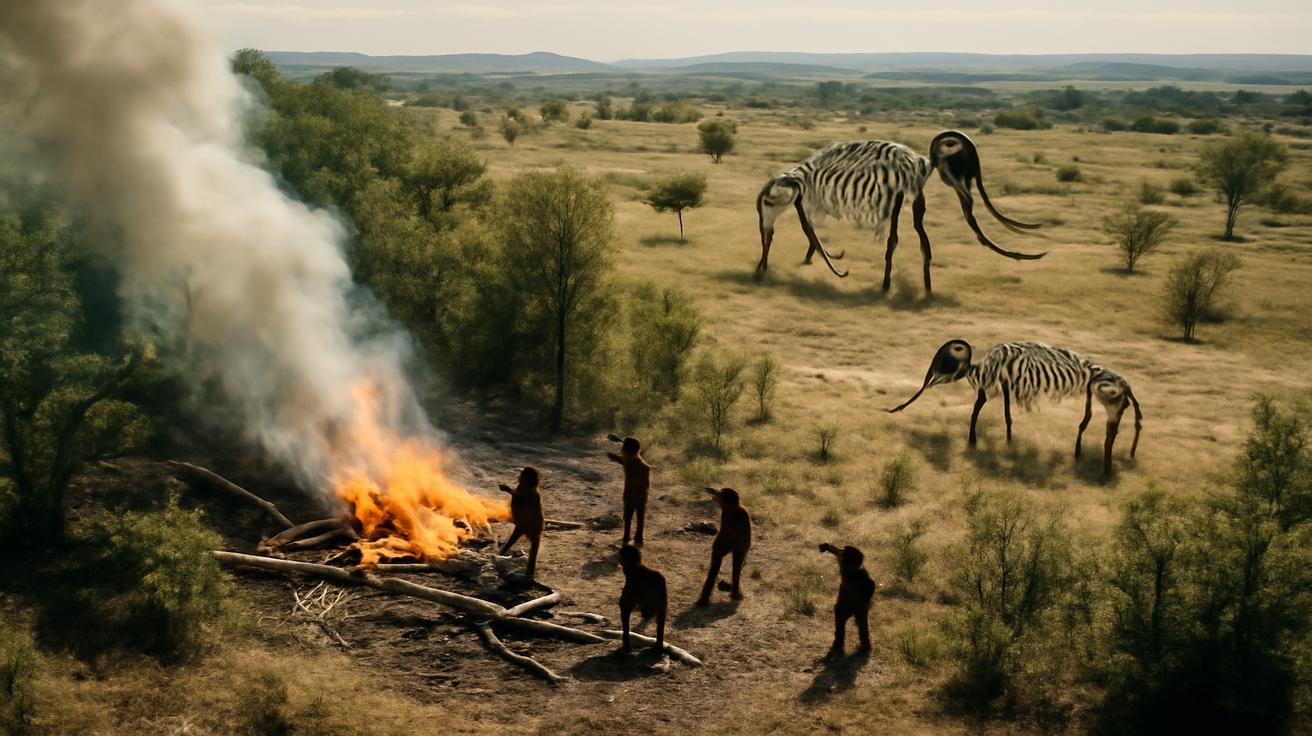
Picture the last Ice Age, around 20,000 years ago. This was not a world of subtlety. Giant ground sloths lumbered through forests. Saber-toothed cats slipped between shadows. Herds of mammoths and mastodons rocked the ground as they moved. Northern landscapes were not empty; they were crowded, noisy ecosystems dominated by colossal animals.
For decades, schoolbook explanations went something like this: then the climate warmed, the ice sheets shrank, and these megabeasts simply failed to adapt. Humans were part of the landscape—yes—but as small bands of hunters and foragers, supposedly too few to do more than leave a faint trace beneath the hooves and tusks of vast animal herds.
That story is beginning to crumble. All across the world, new research is telling a more complicated tale, and it starts to look less like quiet coexistence and more like a series of ecological jolts delivered by a surprisingly powerful primate. Radiocarbon dates, ancient DNA studies, layers of lake-bottom mud—their evidence is converging on an uncomfortable idea: long before tractors or chainsaws, ancient humans were already reshaping whole continents.
In some places, as soon as humans arrive in the fossil record, the megafauna disappear. In Australia, giant marsupials vanish just after humans show up. In the Americas, mammoths and giant ground sloths blink out in the same narrow window of time. Climate played a role, but patterns in the timing, the kill sites, and the spread of human tools make it hard to ignore the hunters in the story.
And when those big animals went, the ecosystems didn’t just mourn them and move on. They reorganized.
When Fire Became a Tool, the Forest Learned Our Names
Walk through a forest at dawn and you can smell stories in the air—damp soil, decomposing leaves, the faint acid tang of mushrooms, the incense of pine. For most of us, fire doesn’t appear in that sensory list unless we’re thinking about disaster or camp stoves. But for ancient people, fire was less an emergency and more an instrument, something woven into the daily fabric of life.
Across Africa, Australia, the Americas, and parts of Asia, early humans and Indigenous peoples didn’t just endure fire—they wielded it. Sparks from a carried ember, a line of flame in dry season grass, a patch of woodland deliberately burned to open a view, lure grazing animals, or coax edible plants from the soil. In charcoal records from lakes and bogs, in the patterns of fire-adapted plants, scientists are finding echoes of those choices.
It’s easy to imagine that lightning did most of the work. But the rhythm of ancient fires often doesn’t match the thunderstorm calendar. Instead, it matches the human one. Charcoal layers in sediment spike just as archaeological evidence of dense human activity appears. And they show up in places and times when lightning-ignited fire would have been rare.
These fires weren’t random acts of destruction. They were more like edits to an ecosystem’s script.
- Burning grasslands at specific intervals encouraged open habitats and fresh growth for grazers.
- Clearing underbrush around camps and paths created mosaics of habitat that suited berries, tubers, and game animals.
- Regular, low-intensity burns prevented the build-up of fuel that makes today’s catastrophic wildfires so devastating.
In other words, ancient humans were already acting as ecosystem engineers—selecting which plants thrived where, how dense the forests were, when the undergrowth would be cleared, and which animals followed the new patches of tender growth.
Modern satellite images of places still managed with traditional fire—like some Indigenous lands in northern Australia—show a patchwork of small, cool burns that resemble the patterns scientists are starting to suspect existed deep in the past. Our ancestors weren’t bystanders in “intact wilderness.” They were landlords with a box of matches and a deep, generational knowledge of how flame behaves.
The Ghost Gardens Beneath Our Feet
Stand in an Amazonian forest and it feels like the purest example of untouched nature: trees so tall your neck aches to see their crowns, air brewing with moisture and insect song, soil hidden under a quilt of fallen leaves. But move aside the romance for a moment and start asking the ground questions, and you discover something else entirely.
In pockets all across the Amazon, researchers are uncovering “dark earths”—rich, black soils full of charcoal, bone fragments, and pottery shards. These are not natural accumulations. They are the remains of centuries of human habitation and soil-building. Someone was here, long before Europeans arrived, carefully feeding their waste back into the land, turning poor tropical soil into something deep and fertile.
Nearby, the tree communities also tell a story. Food species—like Brazil nuts, certain palms, and fruit trees—grow in suspicious concentrations, as if planted by someone who loved them. Riverbanks show regular patterns of earthworks and raised fields. To call this “pristine forest” begins to sound like calling an abandoned orchard “wild.” The vines may have crept back, the houses may have rotted down to their foundations, but the arrangement of the living things still bears the fingerprints of human preference.
And this is not just true of the Amazon. In North America, archaeologists talk about “forest gardens” created by Indigenous peoples—landscapes where walnuts, chestnuts, hickories, and berry-producing shrubs were encouraged into productive blends. In Southeast Asia, ancient rice terraces wrap the mountains like contour lines of intention. In the Pacific, coral reefs show signs of centuries of careful harvest and stewardship.
The wild places we cherish are often ghost gardens—systems that remember us even when we have forgotten how to read them.
How Big Was Their Footprint, Really?
This is where the story shifts from romance to reckoning. For a long time, scientists separated “modern” impacts—industrial, machine-powered, global—from “ancient” impacts, which were seen as local, modest, ultimately swallowed by the immensity of nature. But as techniques improve, that confidence is fading.
Ancient DNA pulled from sediments is revealing waves of species replacement synchronized with human expansion. Pollen records show once-diverse vegetation shrinking into simpler communities after the disappearance of megafauna or the onset of regular burning. Shell middens—the heaps of discarded shells left by coastal peoples—show subtle but persistent shifts in the size and species of marine life, hinting at millennia of fishing pressure.
And perhaps most striking, the timeline of human influence keeps drifting backward. Where we once spoke of major human impact beginning with agriculture 10,000 years ago, we now see hints of influence tens of thousands of years earlier, carried not by plows but by fire, spears, and careful foraging.
To see how this plays out across types of activity, it helps to lay things side by side:
| Type of Ancient Activity | Scale of Ecological Change | Examples from the Record |
|---|---|---|
| Hunting large animals | Regional to continental shifts in food webs | Megafauna extinctions in the Americas, Australia, parts of Eurasia |
| Controlled burning | Transformation of forests to open woodlands, grasslands, and mosaics | Charcoal spikes in lake sediments, expansion of fire-loving plants |
| Early farming and gardening | Local to regional shifts in species composition and soil properties | Amazonian dark earths, forest gardens, early cereal cultivation |
| Fishing and coastal use | Changes in population structure of fish, shellfish, and marine mammals | Shell middens, size declines in harvested species over time |
| Translocation of species | Introduction of animals and plants to new islands and regions | Polynesian transport of crops and animals, spread of commensal species |
None of this means that Paleolithic hunter-gatherers were comparable to modern industrial societies in raw power. They weren’t clear-cutting mountain ranges with chainsaws or digging open-pit mines. But when you add up millennia of persistent pressure—especially on large, slow-breeding animals and fire-sensitive forests—their footprint becomes surprisingly broad.
What’s changing is our threshold for what counts as “big.” A footprint doesn’t have to be made by a boot to change the path of a valley; sometimes bare, persistent feet will do.
Rewriting the Myth of Pristine Wilderness
Many of us carry a quiet myth inside us: long ago, before cities and cars and plastic, there was a time of untouched wilderness. Nature then was pure; humans were either absent or lived in such fragile harmony that they left no mark. Only with the rise of agriculture and especially industrialization did the trouble truly begin.
The new science doesn’t let us keep that story, at least not honestly. It draws a more entangled picture of humans and nature—one in which we have been both destroyers and caretakers for a very long time.
That’s uncomfortable, but it might also be liberating. If we believe that real nature only exists where humans have never set foot, then almost everywhere on Earth becomes a kind of failure. National parks become consolation prizes, trying to resurrect a mythical state that perhaps never existed in the first place. Indigenous historical stewardship gets framed as “minimal impact,” rather than as active, knowledge-rich management.
But if we instead see humans as a long-standing ecological force, capable of both damage and healing, then a different picture emerges. The forest garden, the managed fire regime, the tended reef—they become as much a part of nature’s story as the beaver dam or the coral colony.
This doesn’t absolve the explosive, fossil-fueled damage of the last few centuries. A spear and a campfire are not a coal plant and an industrial trawler. Our present footprint is broader, deeper, and faster than anything our species has done before. But the older story reminds us of something we often forget in our guilt and panic: for most of our history, our power came hand-in-hand with intimacy. To use fire well, you had to read the wind. To harvest animals without wiping them out, you had to know their migrations, their calving sites, their food plants.
The tragedy today is not only that we are powerful; it’s that we are powerful while being, in many places, profoundly disconnected from the fine-grained knowledge that once guided our use of that power.
Lessons from the Ancients: Not Guilt, but Guidance
So where does this leave us as we stare down climate change, biodiversity loss, and a planet remade by eight billion human lives?
One tempting response is romantic regret: if even our ancient ancestors couldn’t tread lightly enough, maybe humans are simply a planetary mistake. But that ignores half the evidence. Because mixed in with the stories of extinction and deforestation are other stories—of resilience, abundance, and long-term stability under human care.
Some Indigenous fire practices reduced the risk of catastrophic burns and nurtured habitat for food species for thousands of years. Traditional agroforestry systems blended crops, trees, and wild species in ways that supported soil health and biodiversity. Sustainable hunting norms, rooted in taboo and ceremony, kept animal populations thriving. These were not people without impact; they were people whose impacts were guided by rules, relationships, and feedback from the land itself.
In a way, the deeper footprint of ancient humans is an invitation. It tells us that “no impact” is not the only moral horizon—and probably not a realistic one. The more meaningful question is: what kind of impact do we want to have?
Do we want to be the species that empties oceans, flattens forests, and heats the atmosphere beyond recognition? Or the species that learns, again, how to shape landscapes in ways that leave them richer, more alive, more capable of weathering change?
Listening to the past means listening not only to bones and charcoal, but also to living knowledge holders—communities whose relationships with land and sea have survived conquest, displacement, and erasure. It means noticing how quickly ecosystems can rebound when given space and support, and how often they still remember old arrangements, old partners, old burns.
It also means dropping the fantasy that we can step outside the story. There is no getting off the planet. There is only learning to be here differently.
A New Kind of Wild
Imagine standing again in that grassland at dusk, or that forest at dawn. Now, instead of trying to see it as it was “before us,” try to see it as it is with us. Notice the plants that spread along old pathways. The clearings that might once have been campsites. The age structure of trees that hints at a history of cutting and regrowth. The animals that have learned to live in this new arrangement of space and food.
This is not a lesser kind of wild. It is a wildness that includes us, whether we like it or not. The goal, then, is not to erase ourselves from the landscape, but to become a better kind of presence—less like a landslide, more like a river that deepens its banks even as it nourishes life along its course.
Ancient humans left a bigger ecological footprint than scientists once thought. That is a warning, because it shows how powerful we are, even in small numbers, with simple tools. But it is also a clue. It tells us that the line between human and natural history has always been blurred, that we are not visitors here but participants, and that the work of our time is not to withdraw from the stage, but to learn, urgently, how to play our part with more humility and more skill.
The land remembers us. The question now is: what kind of memory do we want to leave?
Frequently Asked Questions
Did ancient humans really cause extinctions of large animals?
Evidence from radiocarbon dating, fossils, and archaeological sites suggests that in many regions, the arrival or expansion of humans overlaps closely with the disappearance of large animals like mammoths, giant ground sloths, and giant marsupials. Climate change was also a factor, but the timing and patterns point strongly to human hunting and habitat alteration playing a major role.
How is ancient environmental impact different from modern impact?
Ancient impacts were usually slower, more localized, and tied to low-tech tools like fire and spears. Modern impacts are faster, global in scale, and driven by fossil fuels, industrial agriculture, and large-scale extraction. Both can be transformative, but today’s changes occur far more rapidly and affect the entire planet’s climate and biodiversity at once.
Does this mean there was never any “pristine” wilderness?
In many parts of the world, especially over the last tens of thousands of years, landscapes we once called pristine turn out to have been shaped by human activity. That doesn’t mean there were no areas with minimal human presence, but it does mean that human influence has been widespread and long-standing, even in places we thought were untouched.
Were ancient people bad for the environment?
The record shows a mixed picture. Ancient people sometimes contributed to extinctions and deforestation, but they also developed long-lasting, sustainable practices like controlled burning, agroforestry, and careful hunting. Rather than labeling them as simply “good” or “bad,” it’s more accurate to see them as powerful ecological actors whose choices, like ours, could either damage or enrich their surroundings.
What can we learn from ancient human impacts for today’s conservation?
Understanding ancient impacts reminds us that humans are inherently part of ecosystems, not separate from them. It highlights the value of Indigenous knowledge and long-term stewardship, and it suggests that conservation should focus not only on exclusion of people, but on supporting forms of human presence that maintain or increase biodiversity and resilience. The past offers examples of both mistakes to avoid and practices worth reviving or adapting.







Leave a Comment