
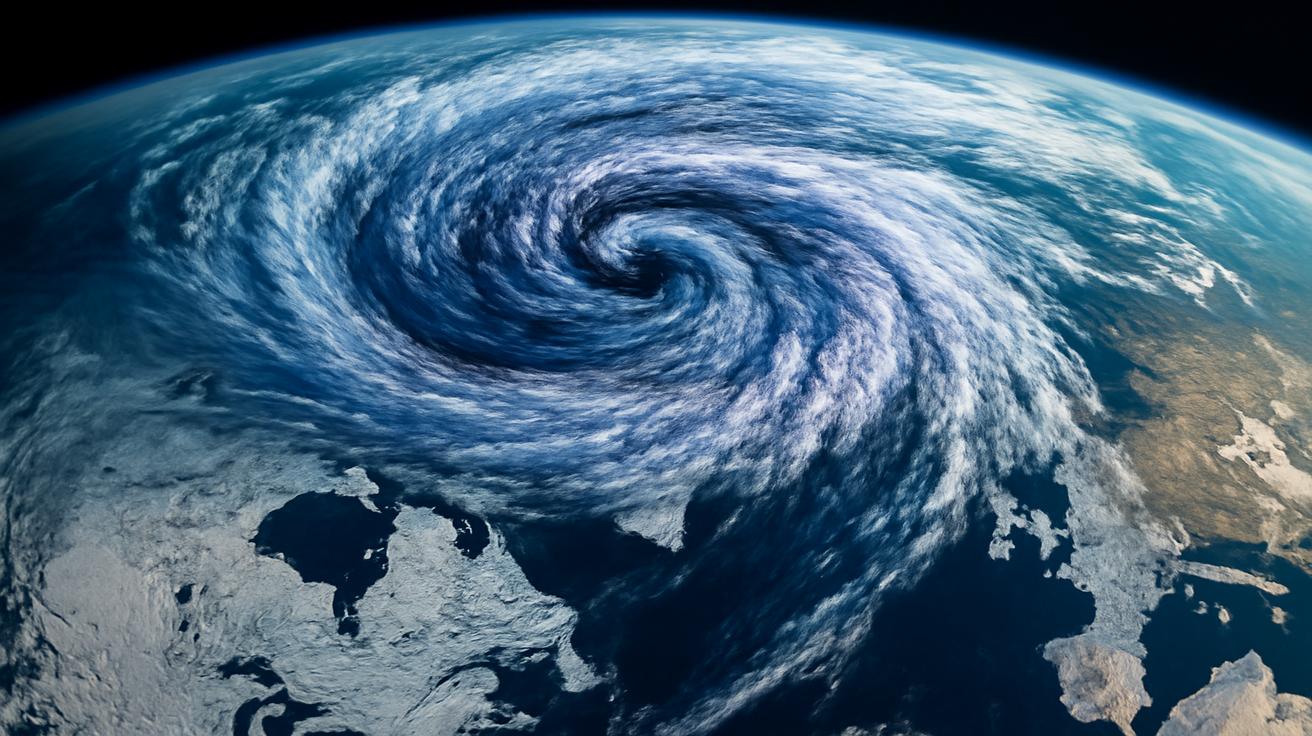
The sky doesn’t look different yet. The March light still has that gentle, thawing softness, the kind that makes you think of muddy trails, early blossoms, and the slow, creaky door of winter finally swinging open. But several dozen miles above that soft blue ceiling, the atmosphere is sharpening its knives. Winds that normally whip fiercely around the Arctic are stuttering, wavering, and beginning to break. A powerful, unusual disruption of the polar vortex is gathering force, and though you can’t feel it on your skin just yet, it may soon rearrange the weather map in ways that feel anything but springlike.
When Winter Refuses to Leave
March is supposed to be the month of compromise. Half winter, half spring. A drizzle of rain here, a stray snow shower there, and the sense that, even on cold days, the worst has passed. But when meteorologists talk about a “polar vortex disruption” this late in the season, what they’re really saying is that winter is not done negotiating.
High above the Arctic, in a region of the atmosphere called the stratosphere, a whirl of icy air normally spins like a well-disciplined top. That’s the polar vortex: a vast, cold, circumpolar wind engine that, in a typical year, keeps the deepest cold mostly locked over the far north. From the ground, you never see it. You only witness its personality in the way cold air masses behave—how they stay put, or spill south, or refuse to budge when you’re desperate for a thaw.
In early winter, polar vortex headlines are almost routine now. We’ve grown used to the idea that something can “suddenly warm” high above the pole and knock the vortex off balance. But an event this strong in March is different. It feels like the universe letting go of the handrail at the top of a staircase just as you were sure you’d made it safely to the next floor.
The Vortex Above, the Weather Below
To really grasp why this disruption is so unusual, you have to imagine the atmosphere as a layered, living system. Near the ground, where we breathe and shovel and plant, is the troposphere—the realm of clouds and storms and all the weather apps on your phone. Above that, starting around 10 to 12 miles up, the stratosphere quietly hums along, thinner and colder, but far from irrelevant.
In winter, the stratosphere over the Arctic gets exceptionally frigid and dark. That cold, dense air spins under the influence of Earth’s rotation, forming the polar vortex: a ring of strong westerly winds that can scream along at over 100 miles per hour. When that ring is intact, it behaves like a fence. The coldest air stays corralled near the pole. The mid-latitudes—where most of us live—can still get snowstorms and cold snaps, but those brutal, prolonged Arctic outbreaks are less likely.
But the atmosphere is not a quiet, layered cake. Waves of energy ripple upward from mountains, storm systems, and land–sea contrasts. These waves can slam into the vortex, slowing it down, distorting it, even breaking it apart. When they do, something dramatic can happen: the Arctic stratosphere can heat up by tens of degrees in just a few days—a “sudden stratospheric warming.” The vortex weakens or splits in two, and the cold air it once guarded can leak south, spilling over continents in bizarre, looping patterns.
Meteorologists sometimes describe this like knocking over a spinning top. Hit it hard enough, and it wobbles, tips, and then careens off in a new direction, no longer predictable or well-behaved. This March, the “hit” is looking bigger than usual.
An Exceptionally Strong Disruption
What’s catching scientists’ attention now isn’t just that a polar vortex disruption is on the way. It’s how forceful this one appears to be, especially for the time of year. In many years, by March, the vortex is already on its natural path toward seasonal breakdown as sunlight returns to the Arctic. It loosens like a knot at the end of winter’s rope. But this time, numerical models are suggesting a sharp, decisive blow instead of a gentle unraveling.
The stratosphere over the pole is projected to warm rapidly—far faster than the slow brightening of spring sunlight would cause on its own. Winds at high altitude, usually strong and westerly around the Arctic, are forecast to collapse and even reverse, blowing east to west. That reversal is a hallmark of a major sudden stratospheric warming, the atmospheric equivalent of slamming on the brakes at highway speed.
In the language of the small but passionate community of polar vortex watchers, this is “exceptionally strong” not only in the magnitude of the warming but also in how much it disrupts the structure of the vortex itself. Instead of a tidy circle of cold air, the vortex can stretch, warp into a lopsided egg shape, or split into multiple lobes, each one wandering off over different parts of the northern hemisphere like a broken crown drifting down a river of air.
That is where the story at the top of the sky begins to matter a lot closer to the ground.
From the Stratosphere to Your Street
One of the strangest things about polar vortex disruptions is the way they unfold in time. The big drama happens first in the stratosphere—far above jetliners—where most of us would never know anything had changed. Days to a couple of weeks later, the consequences begin to trickle down. It’s like dropping a stone into a deep well and waiting for the ripples to reach the surface.
As the disrupted vortex interacts with the layers below, it can reshape the familiar weather patterns we see on maps. High-pressure domes, low-pressure troughs, and the jet stream itself can be nudged into new positions. Sometimes, this encourages blocking patterns—stubborn configurations in which cold air pools in one place for far longer than usual, or where storm tracks loop and stall.
Here’s one way to picture it: imagine the jet stream as a restless river flowing around the northern hemisphere. A healthy polar vortex tends to keep that river fairly zonal—moving west to east in broad, gentle bends. Once the vortex is smashed, the river can buckle into deep meanders, swooping far south and then arcing back north. On the southern side of those swoops, unseasonably mild weather can surge; on the northern side, cold air can lunge toward regions that thought they’d already put away the snow shovels.
For everyday life, it doesn’t much matter whether you can recite the science behind it. What you feel are the outcomes: a late-season Arctic blast where buds had already started to swell, a stretch of raw, sleety days when you were expecting sun and mud, or a wet, stormy period shaped by the shifted jet stream. The disruption doesn’t guarantee a specific local forecast, but it tilts the odds toward more unusual patterns—more stubborn cold in some places, more persistence of whatever weather you get.
What Makes This March So Different?
To appreciate how odd this coming disruption is, it helps to glance backward. Many of the polar vortex events that have grabbed headlines in recent years have happened in mid-winter—December through February—when the stratosphere is darkest and most primed for sudden shifts. Those mid-winter hits can trigger long, frigid spells at the surface if the pieces line up just right.
March is trickier. The sun is rising higher each day, gradually cutting into the Arctic cold. The vortex, even on its strongest years, is beginning to age. A major disruption now is like a plot twist late in the story—still powerful, but interacting with a different seasonal script. Snowpack is already shrinking in many regions. Daylight is longer. The contrast between day and night is sharper. All of that changes how the troposphere responds.
Yet models suggest that the scale of the upcoming disruption rivals some of the big mid-winter events of the past decade. The winds at 10 hPa (a standard stratospheric level used by meteorologists) are projected to weaken dramatically and perhaps reverse with intensity that places this event near the top tier of recorded sudden stratospheric warmings—especially surprising for so late in the season.
In simple language: this is not your typical “end-of-winter fadeout.” It’s a jolt.
How Forecasters Read a Polar Vortex
Inside weather offices and research centers, the atmosphere is currently being interrogated by armies of computers. Ensemble models—those sprawling webs of slightly different forecast runs—are being combed for common themes. The big questions: Where will the split or displacement of the vortex place the cold core? How will the jet stream respond? Which continents will feel the strongest echoes, and when?
Seasoned forecasters know that the link between a stratospheric disruption and surface weather is not a simple on–off switch. Sometimes, even strong events don’t translate into headline-grabbing cold at the ground. The troposphere has its own momentum, its own chaotic tendencies. But the odds do shift.
Many will be watching for the development of high-pressure “blocks” over the North Atlantic or Eurasia—a common aftermath of these events. Such blocks can shunt the jet stream south, dragging cold air into Europe or parts of North America. Elsewhere, the disrupted flow can mean more frequent storm systems tracking along newly bent pathways, bringing heavy rain or late-season snow.
To give a sense of how all this plays out, here’s a compact way of comparing a more typical late-winter pattern with one influenced by a strong polar vortex disruption:
| Feature | Typical Late Winter / Early Spring | With Strong March Polar Vortex Disruption |
|---|---|---|
| Polar vortex behavior | Gradual weakening and shrinking as sunlight returns to Arctic | Rapid warming aloft, strong weakening or splitting, winds may reverse |
| Jet stream shape | Moderately wavy, trending toward smoother west–east flow | Deep, persistent meanders; stronger north–south swings |
| Cold air outbreaks | Shorter, less intense; more frequent mild spells | Increased risk of sharp, late-season cold snaps in some regions |
| Storm tracks | Shifting northward with season; fewer major snow events at lower latitudes | Potentially more blocked or looping tracks; risk of heavy, wet snow where cold and moisture overlap |
| Day-to-day predictability | Generally improving as spring patterns establish | Greater volatility; patterns can lock in for weeks once they form |
All of this is still filtered through probability. A region under one lobe of the disturbed vortex may endure raw, late-season cold; another, under a ridge of high pressure, might bask in strangely warm March sun. The only guarantee is that the atmosphere’s dice are being shaken more vigorously than usual.
Living Through Atmospheric Whiplash
For most of us, the story of a polar vortex disruption is not lived in model diagrams or stratospheric wind charts. It’s lived in the small, sensory details of days that don’t match the calendar. Maybe you’ve already smelled damp soil and heard the first tentative birdsong in the mornings. Maybe early flowers have nudged through the thawed crust of your garden.
Then one morning, you step outside and the air has that metallic sting again. Breath clouds in front of you. The mud has crusted over. A north wind knifes down the street, and the sky has the flat, hard color of mid-January. Or, in another place, the opposite: you’d braced for one more month of scraping ice from windshields, but instead the pattern flips in your favor, delivering weeks of sun and mildness that feel almost illicit.
This kind of atmospheric whiplash can feel unsettling. Our bodies, our moods, even our local ecosystems expect a certain shape to the seasons. Trees time their budding. Insects wake up or stay asleep. Farmers eye soil temperatures for the first planting windows. A late polar vortex disruption, with its power to yank the jet stream and shuffle air masses, can nudge those rhythms out of sync.
For cities and infrastructure, the concern is partly about expectations. Crews may have shifted away from winter operations, only to face one more demand for plowing or de-icing. Energy grids, strained by wild swings between heating and early cooling demands, can be tested by sudden cold snaps. Even simple things—like when a city decides to remove sand and salt from roads—start to look like bets placed against an increasingly complicated sky.
Climate, Chaos, and the Polar Vortex
Whenever an extreme or unusual weather event appears, a natural question rises with it: is climate change involved? With polar vortex disruptions, the answer is nuanced and still evolving.
Some studies suggest that rapid Arctic warming and the loss of sea ice—one of the most striking signatures of climate change—may be altering the way the polar vortex behaves. A warmer, less stable Arctic could encourage more frequent or more intense disruptions, or change where the consequences are felt. Other research urges caution, noting that the atmosphere is inherently variable and that clear, long-term trends in vortex behavior are challenging to pin down.
What is certain is that we’re now watching these events in a different context than we were a few decades ago. The baseline climate has warmed. Snow cover in many regions has declined. Sea ice has thinned and retreated. When a classic pattern like a polar vortex disruption plays out atop this new background, its impacts can feel different: late-season snows that melt more quickly, rain-on-snow events that trigger floods, or cold snaps that clash with ecosystems already nudged toward earlier springs.
So while this upcoming March disruption is part of the natural atmospheric theater, it’s taking the stage in a climate that’s been subtly but steadily rewritten. That, more than any single storm or cold wave, is the deeper story: a familiar piece of sky behaving in an unfamiliar world.
Watching the Sky, Grounded in the Present
There’s a certain paradox to living in an age when we can diagnose the wobble of a high-altitude wind ring weeks before we feel its touch. On one hand, it’s empowering: foreknowledge that allows power companies, farmers, emergency planners, and ordinary people to prepare for a stretch of unusual weather. On the other, it can heighten the sense of tension—like knowing a plot twist is coming without being told who it will favor or wound.
Forecast discussions over the next couple of weeks will likely be peppered with references to “stratospheric influence,” “downward coupling,” and “high-latitude blocking.” Behind those technical phrases is something almost poetic: the idea that what happens in the thin, frigid air far above the Arctic can sift downward, shaping the way snowflakes fall—or don’t—on your own street.
As this exceptional March polar vortex disruption unfolds, you might find yourself paying closer attention to the subtle cues outside. The feel of the wind on an otherwise bright day. The way clouds line up along a stubborn boundary between air masses. The repeated appearance of similar weather on the same days of the week, hinting at a pattern that has locked in place.
In the end, the story of this event will be written not just in scientific papers and model re-analyses, but in the lives that intersect with it: the orchardist watching for frost on swelling buds, the child thrilled by one more snow day, the commuter silently pleading for dry roads, the migrating birds redirected by headwinds they didn’t expect. The polar vortex may be an abstract swirl of wind on a distant map, but its disruption is a reminder that we live inside a fluid, connected planet, where even the highest altitudes eventually come home to roost.
Frequently Asked Questions
What exactly is the polar vortex?
The polar vortex is a large-scale circulation of cold, low-pressure air that forms over the Arctic (and a separate one over Antarctica) in the stratosphere each winter. It’s surrounded by strong westerly winds that help keep the coldest air bottled up near the pole.
What is a polar vortex disruption or sudden stratospheric warming?
A disruption occurs when waves from the lower atmosphere disturb the vortex, causing the stratosphere over the pole to warm rapidly—often by tens of degrees in a few days. This can weaken, displace, or split the vortex and sometimes reverse the usual westerly winds to easterly.
Does a polar vortex disruption always mean extreme cold where I live?
No. While these events increase the chances of cold outbreaks in some mid-latitude regions, the exact impacts depend on how the disrupted vortex interacts with the jet stream and local weather patterns. Some areas may see unusual warmth instead.
Why is a strong disruption in March considered unusual?
By March, the polar vortex is typically weakening naturally due to increasing sunlight over the Arctic. A strong, sudden disruption at this stage is less common and can produce more complex, late-season weather responses than mid-winter events.
Is climate change making polar vortex disruptions more frequent?
The science is still evolving. Some studies suggest that rapid Arctic warming and sea-ice loss may influence the behavior of the vortex, potentially affecting the frequency or character of disruptions. Other research highlights large natural variability and cautions against firm conclusions. What’s clear is that these events now play out in a warmer background climate, which can change how their impacts are felt.







Leave a Comment