
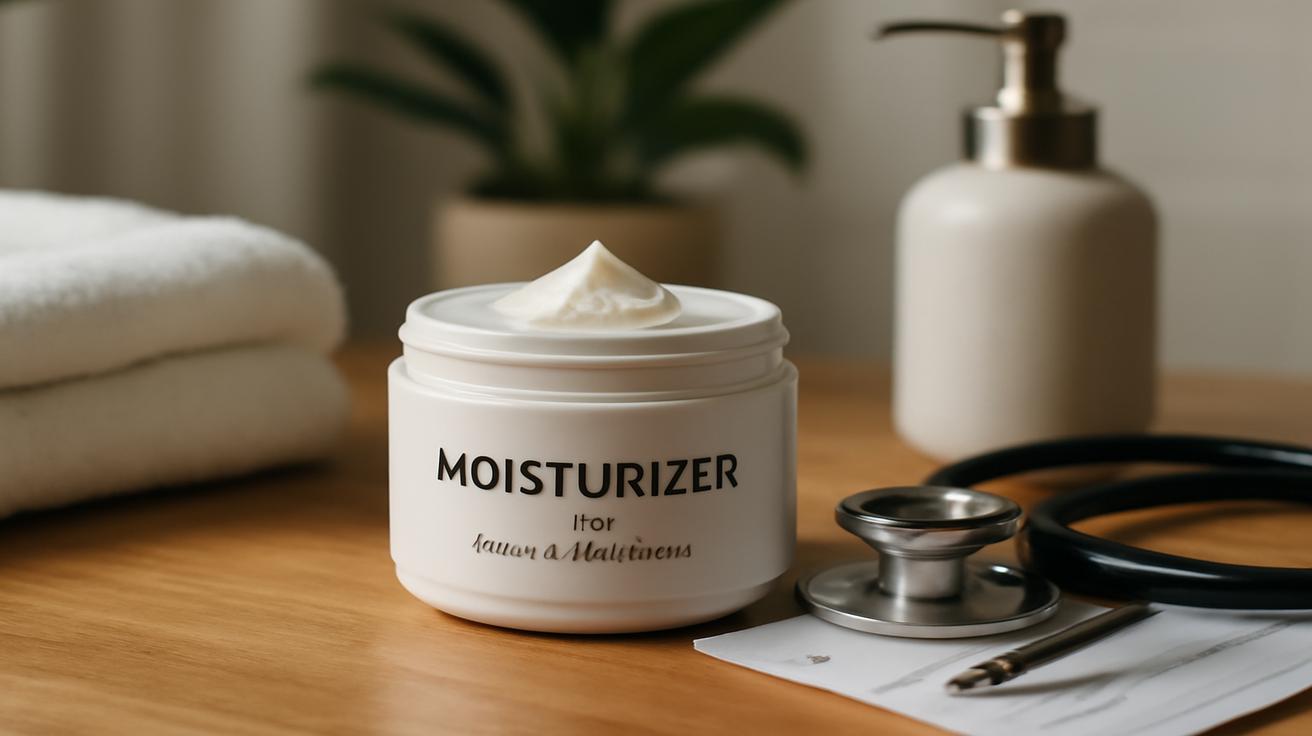
The jar doesn’t look like much. No frosted glass. No weighty gold lid. No botanical sketches laced around the label, whispering about alpine dew and moonlit petals. It sits low on the pharmacy shelf, almost sheepish in its plain white plastic, like it’s trying not to be noticed between the shimmering serums and “age-defying” miracles. You could almost mistake it for a generic hand cream your grandmother kept under the bathroom sink. And yet, this quiet, unassuming moisturizer—the kind that smells faintly of clean laundry and nothing else—has just been crowned the number one choice by dermatology experts.
In a world where skin care often feels like performance art, this is a bit like discovering the world’s best cup of coffee is the one from the unbranded diner on the corner. No latte art, no seasonal flavors. Just straight, expertly brewed comfort. It’s the kind of revelation that makes you pause in the aisle, your hand hovering between the glittering glass bottle that costs as much as a dinner out and the small, stubby tub that looks like it belongs in a 1980s medicine cabinet. Somewhere, a marketing executive is clutching their pearls.
The Moisturizer That Refused to Glow Up
Ask a dermatologist to name their favorite moisturizer, and you might expect something sleek and scientific, maybe with a Latin-derived name that sounds like it belongs in a research paper. Instead, what they often say sounds disarmingly simple:
“A basic, fragrance-free, occlusive cream that just…works.”
Old-school moisturizers are the orthopedically sound sneakers of the skin-care world. They’re not cute, they’re not photogenic, and they won’t inspire an influencer to whisper reverently into a ring light. But dermatologists quietly adore them. In hushed, fluorescent-lit exam rooms, where eczema flares and angry barrier damage tell their stories in red and raw, the heroes are almost always the same: thick, no-frills creams with ingredient lists short enough to read without an advanced degree.
There’s a certain stubbornness to these formulas. They didn’t “rebrand” for the age of glass skin and 10-step routines. They didn’t add crushed pearl, meteorite dust, or powdered crocodile tears. Instead, they kept three or four things that matter most in skincare:
- Humectants to draw water into the skin.
- Emollients to smooth and soften.
- Occlusives to lock it all in.
- And almost nothing else.
It’s the kind of minimalism that, at first, feels underwhelming—until you remember that your skin is not a lifestyle accessory. It’s your largest organ. It doesn’t care if your cream looks good on a marble sink; it cares whether its barrier is intact, its water content is preserved, and its irritants are kept at bay.
Why Dermatologists Keep Pointing to the Plain White Jar
There’s a joke among some dermatologists: “The best moisturizer is the one you’ll actually use.” But the older-school, no-luxury moisturizers have an edge that goes beyond simple compliance. They are ruthlessly focused on function over fantasy. When dermatology experts actually rank their favorites, certain themes keep emerging.
Ingredients That Do the Heavy Lifting
Strip away the branding, and what’s left is chemistry—clean, unpretentious, quietly powerful. When experts talk about their top choices, they talk about specific building blocks rather than poetic plant stories:
- Petrolatum: A powerhouse occlusive, clinically proven to reduce transepidermal water loss. In some studies, it even outperforms more glamorous oils in protecting the skin barrier.
- Glycerin: A humble, inexpensive humectant that pulls water into the outer layer of skin and helps keep it there.
- Ceramides: Lipids that mimic the “mortar” between our skin cells, crucial for barrier repair and resilience.
- Dimethicone: A silky-feeling occlusive that helps reduce water loss without feeling too greasy.
None of these ingredients sound romantic. They sound like they live in a lab, not a linen-curtained spa. But they are the ingredients that appear again and again in the moisturizer formulas dermatologists point to when someone sits on the exam table, cheeks flushing, voice low, and says, “I’ve tried everything.”
Luxury tends to sell the story; dermatology tends to sell the science. And the science, surprisingly often, leads straight back to the jar your grandmother used for decades without thinking twice.
How the “Number One” Was Crowned
Behind this unassuming champion moisturizer is no sleek marketing campaign. Instead, imagine a patchwork of small, unglamorous victories. A child whose eczema finally calms for the first time all winter. A nurse whose hands, split from sanitizer and soap, grow smooth again. A middle-aged runner whose windburned face stops stinging when they swap their perfumed “radiance cream” for something that looks like it belongs in the first-aid aisle.
Dermatology experts are not easily impressed. They spend their days staring at the consequences of poorly chosen products: contact dermatitis from a perfumed lotion, breakouts from an “oil-free” gel loaded with pore-clogging components, a rosacea flare triggered by a scented night cream boasting exotic flowers. In that landscape, the moisturizer that consistently helps, consistently calms, consistently does no harm—over years, over millions of faces—starts to look quietly extraordinary.
So when surveys, panels, and consensus lists ask dermatologists what they’d recommend if you could only buy one moisturizer, it’s often the old-school, unremarkable one that floats to the top. It may not win “best in beauty” from glossy magazines, but it wins something far more stubborn: clinical loyalty.
Performance Over Promise
Here’s where the story gets interesting. On paper, the luxe moisturizers and the no-name tubs often share the same core active ingredients. The difference lies in everything that’s been built around those actives.
Luxury creams often add:
- Fragrances, natural or synthetic, to create a sensorial experience.
- Colorants to look pretty in the jar.
- “Story” ingredients—tiny amounts of rare botanicals or high-tech complexes that sound impressive but lack strong evidence at the concentrations used.
- Heavier packaging costs that end up baked into the price.
The old-school formula takes another path. It lets the core ingredients carry the entire weight of the product’s promise. No distractions. No olfactory fireworks. Just a quiet, functional glide over the skin, a softening of roughness, a near-imperceptible sealing in of hydration. Day after day.
And so experts, who are overwhelmingly judged by outcomes rather than aesthetics, gravitate toward the option that repeatedly does what it says: protects, hydrates, restores, and doesn’t get in the way of healing.
The Psychology of “Plain” in a Shiny Skincare World
Standing in front of a skincare display today can feel a bit like walking into a perfume-drenched theater, where every bottle is trying to audition for the role of “your new holy grail.” Iridescent droppers. Frosted jars. Names that sound like dream sequences. There is a subtle emotional choreography at work, teaching us that value lives in the aesthetic, in the ritual, in the price.
So when dermatology experts rank a plain, cheap, old-school moisturizer above the $150 jar promising “bio-retinoid restructuring overnight transformation,” it feels a little bit like a plot twist. It forces us to question what we’ve been trained to associate with quality.
Part of the magic of the no-frills choice is exactly this: it demands a small act of rebellion. To walk past the glossy bottle and pick up the plain white tub is to say, quietly, “I care more about what my skin needs than what my bathroom shelf looks like.”
There’s a strangely liberating pleasure in that. In a culture that has made skincare into something close to performance, there’s something deeply grounding about treating it as care—simple, regular, honest care.
How the Old-School Favorite Actually Feels
If you’ve never tried one of these dermatologist-beloved classics, you might imagine something clinical and unpleasant. The reality is gentler, more familiar.
Picture opening the jar: the lid gives with a small plastic sigh. The cream inside is usually a soft, dense white, occasionally with the faintest sheen of petroleum or mineral oil. It doesn’t sparkle. It doesn’t swirl with pearlescent luminosity. It just waits.
On the skin, it may feel a little thicker than a modern gel cream, the kind that vanishes almost as soon as you touch it. This one takes its time. It melts slowly, like butter warming on toast, spreading out in a thin, even layer. You feel it, at first—a veil, a soft weight. Not smothering, but present, like a blanket tucked lightly over your shoulders.
Then, the quiet happens. Within minutes, tightness loosens. The faint, nagging itch of dryness goes still. Rough patches feel less defiant. Nothing is perfumed; nothing tingles. It is, almost shockingly, uneventful. And sometimes, uneventful is exactly what damaged, sensitive, or over-treated skin is desperate for.
Choosing Substance Over Story: A Quick Comparison
When dermatology experts explain why their number-one choice is often an old-school, unglamorous cream, the reasoning usually comes down to a few key points: simplicity, tolerability, effectiveness, and accessibility. Lined up against the typical luxury moisturizer, the contrast is quietly stark.
| Feature | Old-School Dermatologist Favorite | High-End Luxury Moisturizer |
|---|---|---|
| Primary Goal | Hydrate, protect, repair barrier | Hydrate, plus promise multi-benefit “transformation” |
| Core Ingredients | Humectants, emollients, occlusives, sometimes ceramides | Similar core plus “story” extracts and complexes |
| Fragrance | Usually fragrance-free | Often fragranced for luxury feel |
| Irritation Risk | Low, designed for sensitive skin | Can be higher due to perfumes and actives |
| Price Point | Accessible, budget-friendly | High, often paying for branding and packaging |
| Packaging | Plain, practical, sometimes “ugly” | Designed for display and social media |
Look closely at that table, and something becomes very clear: the reason dermatologists crown the no-frills option as their number one is not because they dislike pleasure or ritual. It’s because when you strip away everything that doesn’t directly serve your skin, you’re left with something that’s surprisingly powerful in its modesty.
Who This Old-School Champion Is Really For
There’s a temptation to think, “That’s just for people with serious skin conditions.” Yet the patient stories behind this quiet favorite stretch far beyond the exam room.
- The over-exfoliator: The person whose reflection looks a little raw and shiny after one too many acid peels and retinoid experiments. Their skin doesn’t need more actives; it needs a truce. A plain, barrier-focused moisturizer offers exactly that.
- The minimalist: Someone who wants one cream that works for face, hands, even body in a pinch. No 20-step routine. Just one dependable jar they can reach for without thinking.
- The budget-conscious: Skincare should not be a luxury sport. A truly effective moisturizer that respects your wallet as much as your skin is, in its own way, quietly radical.
- The sensitive-souled skin: People who flush, itch, or sting at the faintest hint of fragrance or “active” ingredient often find an ally in a formula that was never trying to be exciting in the first place.
Dermatologists don’t crown an old-school cream as number one because it’s trendy. They do it because it’s reliable—for the exhausted parent, the shift worker, the student living out of a single bag, the retiree on a fixed income, the person rebuilding trust with their own reflection after their skin turned against them.
Rethinking What “Good Skincare” Looks Like
Maybe the quiet triumph of this unbranded, unglamorous moisturizer is part of a wider shift—away from treating skincare as a status symbol, toward treating it as a basic form of self-respect. It’s not about abandoning pleasure. It’s about letting your skin’s actual needs lead, rather than the siren call of a shiny bottle.
There will always be room on the shelf for the occasional indulgence: the serum that feels like silk, the mist that smells like a walk in a botanical garden after rain. But when dermatology experts name their number-one choice, the message is sharp and clear: if you strip everything back to one product, make it the one that works hardest at the most fundamental job—holding your skin together, literally.
The old-school moisturizer will probably never trend on social media. It will not star in flat-lay photographs or brand collaborations. It will, however, sit patiently in your cupboard, waiting for the night you come home with wind-burned cheeks, or the morning your skin feels like parchment, or the week your new prescription cream makes your face itch and protest. And in those moments, what you’ll want is not a story. You’ll want relief.
When experts crown a humble jar with no luxury branding as number one, they’re quietly reminding us of something easy to forget in a hyper-visual world: skincare is not theater. It’s maintenance. It’s biology. It’s the small, quiet pact you make every day with the body you live in. And sometimes, the truest luxury is not the most beautiful bottle—but the one that simply, reliably, lets your skin exhale.
FAQ
Does a moisturizer need to be expensive to be effective?
No. Dermatologists frequently recommend affordable, old-school moisturizers because their effectiveness comes from proven ingredients and good formulation, not from price or packaging. Many low-cost creams outperform luxury options for basic hydration and barrier repair.
Are fragrance-free moisturizers really better?
For many people, yes—especially those with sensitive, reactive, or compromised skin. Fragrance is a common cause of irritation and allergies. Fragrance-free formulas reduce that risk and are often preferred by dermatology experts.
Can I use an old-school moisturizer on my face and body?
Often you can. Many classic, no-frills creams are safe and effective for both face and body, unless your skin is very acne-prone or you have specific concerns. If you’re unsure, test it on a small area of your face first or ask a dermatologist.
Will a plain moisturizer help with wrinkles and dark spots?
A basic moisturizer won’t erase wrinkles or pigmentation, but well-hydrated, well-protected skin always looks healthier, smoother, and more resilient. For targeted concerns like wrinkles or dark spots, you may still need specific actives, but a solid moisturizer is the foundation that makes those actives more tolerable.
How do I know if a simple moisturizer is right for my skin type?
Check the label: look for “non-comedogenic” if you’re acne-prone, “fragrance-free” and “for sensitive skin” if you’re reactive, and richer, creamier textures if you’re dry. When in doubt, start with a small amount, use it consistently for a week or two, and watch how your skin responds.






Leave a Comment