
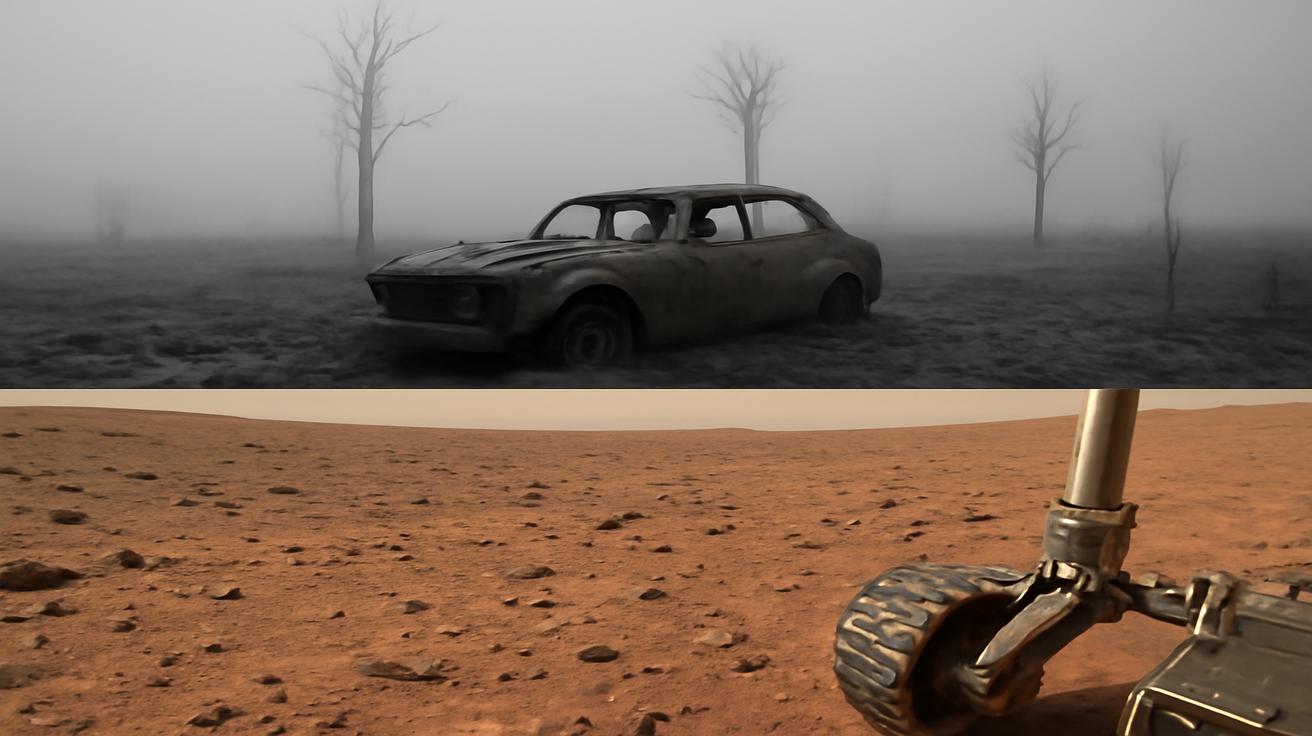
The room went very quiet after the astrophysicist said it. Not because the words were especially loud, but because they cut through the comfortable futurist optimism like a clean blade. “Even after a nuclear apocalypse,” she said, “Earth would still be a paradise compared to Mars.” Someone near the back laughed, assuming it was a joke. It wasn’t.
The Night an Astrophysicist Punctured the Mars Dream
It was one of those sleek, future-facing conferences that smell faintly of coffee, projector heat, and ambition. The panel was titled something like “Becoming a Multi‑Planetary Species,” a phrase that now appears on slides so often it feels like a brand name.
Elon Musk’s vision hovered over the whole event, even though he wasn’t in the room. He didn’t have to be. His rockets had become part of the cultural wallpaper: booster landings replayed as GIFs, Mars colony concept art shared like postcards from a future that hasn’t happened yet. The idea is seductive: a backup planet, a clean slate, a red canvas where humanity can overwrite all the mistakes of the blue one.
So when the moderator tossed out the familiar question—“Is Mars our insurance policy against a global catastrophe on Earth?”—people leaned forward. They expected nuance. Debate. Maybe some caveats. What they got instead was a line that felt like a slap.
“No,” the astrophysicist said. “Mars is not a backup Earth. It isn’t even close. If we nuked our own planet into a radioactive nightmare, it would still be vastly more habitable than Mars on its best day.”
Someone set their cup down too hard. A spoon chimed against ceramic. The silence stretched.
What “Habitable” Really Means
We throw the word “habitable” around the way we throw around “cozy” on real estate listings. Suggestive, a little vague, vaguely hopeful. But for an astrophysicist—someone who lives all day in the hard numbers of atmospheres, gravities, and spectra—“habitable” is not a mood. It’s a checklist. Oxygen. Liquid water. Pressure. Temperature. Radiation protection. Gravity that won’t quietly unspool a human body over the years.
On Earth, we rarely think about this checklist. We go for a walk without a suit. We breathe without calculating the partial pressure of oxygen. Rain falls out of the sky in drinkable form. Soil grows tomatoes without reminding you it’s trying to kill you.
Meanwhile, Mars sits out there like a gorgeous, barren postcard. Rust‑red vistas, romantic sunsets, thin blue tints on the horizon in enhanced images. It looks calm. Stable. Lonely, in a way that appeals to a story-hungry brain. You could imagine a flag there. A greenhouse. A dome with warm yellow light.
What you can’t feel, looking at those photos, is that the air is so thin it’s basically vacuum. That the atmosphere is 95% carbon dioxide, completely unbreathable. That the ground is soaked with toxic perchlorates, salts that would turn your garden into poison. That cosmic radiation punches straight through the sky most days, unbothered by the ghost of a magnetosphere. It is the aesthetic of a desert with the kindness of space.
Habitable? For machines, maybe. For short-term visitors, with the right gear. For life as we know it, by any natural standard? Not even close.
Earth After Everything Goes Wrong
The astrophysicist wasn’t romanticizing Earth. Her vision of our planet after a nuclear war was not a vague “we’ll be fine” shrug. It was clinical, unsparing, and somehow still strangely full of love.
“Imagine the worst,” she said. “Cities burned. Infrastructure shattered. A nuclear winter drawing a curtain of dust and soot across the sky. Radiation hotspots. Crop failures. Ecosystems in convulsions.” She let the picture hang there, the way smoke hangs in a still room.
Then she laid out the physics.
- The oceans would still be here—vast, slow-moving reservoirs of water and heat.
- The atmosphere, though scarred and dirty for a time, would still wrap the planet in thick, protective pressure.
- Earth’s magnetosphere would continue deflecting the lethal strom of charged particles from the Sun.
- Gravity would remain the steady 1 g every bone and muscle in your body quietly depends on.
Yes, radiation would spike in certain regions, deadly in the short term and dangerous in the long. Yes, agriculture would suffer. Yes, many species would go extinct. But the same systems that cradle life now—air, water, rock, a molten churning core—would still be working, often brutally, always relentlessly, to keep the planet in the narrow band where chemistry stubbornly turns into biology.
Somewhere, in deep ocean trenches, around volcanic vents, in pockets of forest and valley spared the worst, life would go on. Grass would claw its way back through broken pavement. Algae would bloom in contaminated lakes. Crows, rats, cockroaches, and the hardy fringe of the living world would watch the ruins and start again.
Compared to Mars, this version of Earth is still a paradise because it does something Mars has never done for us: it tries, constantly, to keep us alive without asking for anything in return.
Why Mars Feels Like Hope
So why, then, does Mars still occupy so much human longing? Why does Elon Musk’s vision of a million-person Martian city land with such emotional weight? Why did that conference room feel, for a moment, like someone had unplugged the dream machine?
Because space, in our stories, is not just about physics. It’s about myth. Mars is the canvas we project our rage at ourselves onto—a distant stage where the play can start fresh. No history, no wars, no politics as we know them. Just dust, rock, and the shimmer of new beginnings. Colonies, in the glossy renders, never show poverty. They never show inequality. The windows are always clean.
There’s something deeply human in wanting a clean slate. If we’ve botched this world, maybe we can do better on the next one. Musk’s language feeds directly into that: “backup civilization,” “multi-planetary species,” “insurance policy.” The vocabulary of tech and finance repurposed as existential salvation.
But underneath the inspiration lies a physics problem that no rhetoric can erase: every breath you take on Mars is a technological product. Every drop of water is a controlled resource. Every failure of infrastructure is immediately life-threatening. There is no outside you can retreat to, no walk you can take to clear your head without a carefully maintained machine strapped to your body.
On post-apocalyptic Earth, however bad it gets, you can still walk out under the sky with nothing between your skin and the air. You can still, in many places, find rain in puddles. You might be sick. It might be dangerous. The world might be broken. But the basic ingredients of human survival still grow from the ground instead of being trucked in on rockets and sealed in tanks.
The Harsh Math of Two Worlds
To hammer this home, the astrophysicist did something scientists sometimes do when they’re tired of being misunderstood: she made a table. Not flashy. Not visually dramatic. Just columns of numbers and reality-checks that stubbornly refused to play along with fantasy.
| Condition | Post‑Apocalyptic Earth | Present‑Day Mars |
|---|---|---|
| Atmospheric Pressure | Still close to 1 bar; breathable in many regions | ~0.6% of Earth’s; near vacuum, instantly lethal without a suit |
| Oxygen Availability | Reduced quality in some areas, but abundant and self-renewing | Trace amounts; must be fully manufactured |
| Liquid Water | Contaminated but widespread on surface | Locked in ice or underground; energy-intensive to access |
| Radiation Levels | Elevated in hotspots; still shielded by magnetosphere and thick atmosphere | Chronic high exposure; no robust natural shielding |
| Food Production | Damaged but possible in open soil and fields, with time | Only in sealed, high-tech greenhouses; soil toxic without heavy processing |
Even squinting at the numbers on a conference screen, the conclusion was hard to avoid. If you woke up with no plan, no infrastructure, and no outside help, you would choose scorched Earth over pristine Mars every single time.
The Invisible Cost of Life in a Can
What rarely gets discussed in those Mars colony concept videos is the psychology of permanent dependency. On Earth, even now, our lives are knitted to massive systems—electric grids, supply chains, bureaucracies. But there is always the feeling, however illusory, that nature is bigger than all of that. You can step outside. You can sit under a tree. You can turn off the main switch and still breathe.
On Mars, the emergency is forever. Step outside without a suit, you die. Lose pressure, you die. A manufacturing hiccup in life support consumables? A software bug in air handling? A cracked seal in a docking port? These are not inconveniences. They are existential threats, every day, forever.
Humans can survive in submarines and space stations and Antarctic bases, yes. But those are temporary, fringed by the knowledge that home, the wide forgiving air of Earth, is still out there. A Martian colony would invert that. The “outside” would be the enemy. Nature would no longer be the background that sustains you; it would be the thing that tries, relentlessly and impersonally, to erase you.
Even in a ruined Earth, stripped bare by its own children, you could still lie down in the dirt and feel the pulse of a world that, in some deep way, is on your side.
Mars as Teacher, Not Escape Hatch
None of this means we shouldn’t go to Mars. The astrophysicist was clear about that, too. Exploration is stitched into us. We went to the poles, to the deep ocean, to the Moon. We build telescopes and particle colliders and robotic emissaries precisely because staying home forever is its own kind of slow death.
The problem, she argued, isn’t the dream of Mars itself. It’s what we expect Mars to do for us.
“Mars is a laboratory,” she said. “It’s a test of our engineering, our psychology, our ethics. It’s a mirror held up to our abilities and our limits. But it is not an exit door from our responsibilities here. If anything, it is a brutal reminder of how astonishingly rare and generous Earth is.”
In that framing, Musk’s rockets are not arks but questions. Can we build closed-loop life-support systems that actually work over decades? Can we manage resources in a place where resupply is almost impossible? Can we design social structures that function in claustrophobic, high-stakes environments?
If we can, those lessons circle back to Earth with terrifying relevance. Because the future here, even without nuclear war, is tightening: climate change, resource stress, rising seas. The skills you’d need to keep a hundred people alive under a Martian dome are exactly the skills you’d need to keep millions alive in a future where the comfortable margins of nature are shrinking.
In that sense, Mars isn’t our Plan B. It is, ironically, part of Plan A: understand how to live within limits before those limits stop negotiating.
The Paradise We Keep Forgetting We Live In
After the panel ended, after the polite applause and the clink of glasses at the reception, people drifted outside. It was evening. The conference center’s glass façade reflected a low sky bruised with clouds. Someone lit a cigarette. Someone else pulled their coat tighter. The astrophysicist walked out too, alone for a moment under the smeared orange of streetlights.
You could hear, even there, the sounds a Martian city would never have: tree leaves whispering in the wind. Distant, messy traffic. The layered chorus of a hundred unrelated lives colliding and crossing paths in the open air. Somewhere a dog barked. Somewhere else, laughter cut you could not quite see the source of.
You could smell wet pavement, exhaust, the faint green bite of nearby grass. All of it, in some sense, trivial. All of it, in another sense, miraculous.
This is what her comment about nuclear apocalypse and paradise was really about. Not downplaying risk. Not sugar-coating the horror of what we’re capable of doing to this planet. But insisting that we see, with scientific and emotional clarity, what kind of cosmic lottery we’ve already won.
Earth is not just the place we happen to be. It is a finely tuned, violently beautiful machine for turning starlight into food, rock into forests, ocean currents into weather. It is the only world we know where clouds are not just chemical haze but participants in the drama of life. It is the only world whose air has been mixed and remixed by the breath of billions of organisms for billions of years.
Compared to that, Mars is a training ground. A reminder. A hard teacher waiting out in the dark.
So, yes, build the rockets. Send the robots. One day, send the people. Just don’t confuse a survival bunker on a hostile world with salvation. Don’t treat the backup file as more precious than the living, breathing original.
Because even on its worst day—even after we’ve done our absolute worst—Earth will still be the closest thing to paradise humanity is ever likely to know.
Frequently Asked Questions
Is Mars completely uninhabitable for humans?
Mars is not naturally habitable for humans. Its atmosphere is extremely thin and mostly carbon dioxide, surface temperatures are well below freezing much of the time, and radiation levels are high. Humans could only survive in carefully controlled habitats with advanced technology providing air, water, heat, and shielding.
Could terraforming make Mars more like Earth?
Terraforming Mars—gradually altering its climate and atmosphere to support life—is a speculative, multi-century (or longer) project. It would require unimaginable energy and resources, and current science does not offer a clear, practical path to making Mars truly Earth-like. It’s an interesting thought experiment, but not a near-term solution.
Why do some people call Mars a “backup” for humanity?
The idea is that if a global catastrophe occurs on Earth, a self-sustaining colony on Mars could preserve human civilization. However, building such a colony would be extremely difficult, and even a functioning Mars base would be far more fragile and dangerous than life on a damaged Earth.
Does this mean we shouldn’t go to Mars at all?
No. Exploring Mars has enormous scientific value and can teach us a lot about planetary evolution, the potential for past life, and how to build resilient life-support systems. The key is to view Mars as a place for exploration and learning, not as an excuse to neglect Earth.
Is Earth really that much better, even after a catastrophe?
Yes. Even after severe damage—like a hypothetical nuclear war—Earth would still have thick air, liquid water on the surface, a protective magnetosphere, and ecosystems capable of recovery. Those basic conditions make it far more hospitable than Mars, where none of those life-supporting features exist naturally.

Leave a Comment