
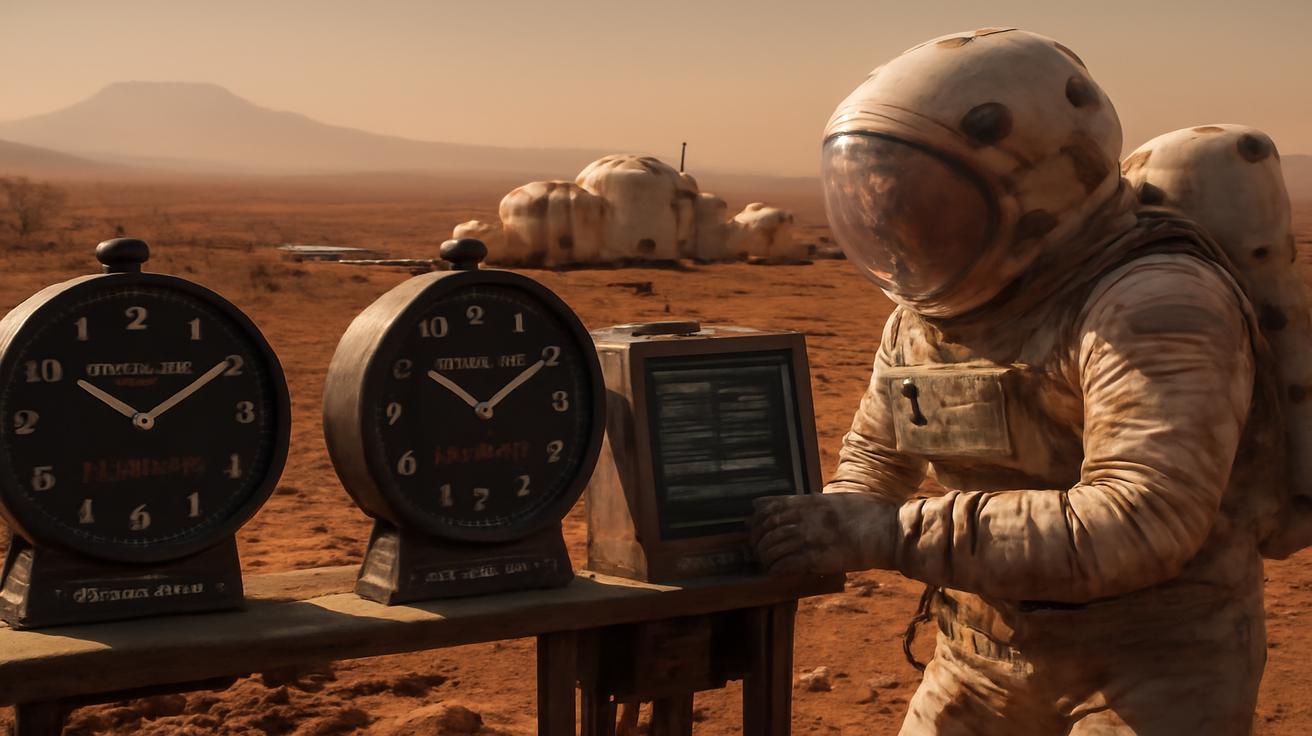
The first thing you’d notice is the silence. Not the peaceful kind you find in a forest at dawn, with birds and wind threading through the branches—but an absolute, airless stillness. You’re standing on the flank of a dusty Martian ridge. The Sun looks smaller here, sharper somehow, like an overexposed coin in a blacker sky. Your boots are heavy with red dust, your shadow short and crisp in the thin atmosphere. And on your wrist, your mission chronometer is ticking—steady, faithful, familiar.
Except it isn’t telling Earth’s time anymore. It’s telling Mars time.
Your day is now 39 minutes longer than the one you grew up with. Your body doesn’t know what to make of it yet. You’re tired when the clock insists you’re mid-shift; you’re alert when the habitat lights politely dim for “night.” Somewhere 225 million kilometers away, another clock on Earth disagrees with yours—displaced not just by distance, but by gravity and motion. And whether you feel it or not, your seconds are stretching and shrinking, obeying the same strange rule Albert Einstein wrote down over a century ago.
When Einstein Looked at the Planets and Saw Clocks
Einstein never set foot on Mars, of course. He wandered through forests near Zurich and Berlin, not canyons carved into rusty rock. But in 1915, when he completed his theory of general relativity, he gave us a blueprint for how time would behave on every world in the solar system—including one that, at the time, was just a blurry disk in the eyepiece of telescopes.
General relativity says something both simple and endlessly unsettling: gravity and motion change the flow of time. Where gravity is stronger, clocks tick a little slower. Where gravity is weaker, they tick a little faster. Move very fast—really fast, close to the speed of light—and motion itself stretches time like taffy. It was an idea that seemed almost mystical in the early 1900s, when humans hadn’t yet launched so much as a paper airplane above the atmosphere.
Yet Einstein’s equations quietly implied a strange consequence: if you placed one clock on Earth and another on Mars, they would disagree, not because one was broken but because each was doing exactly what spacetime demanded. Different mass, different gravity, different orbit, different tick.
For decades, this was a curiosity, the sort of thing theorists liked to ponder over chalkboards. Mars was a distant, pinkish dot; time there was as unreal as the fictional canals people thought they saw carved into its surface. But physics is patient. It waits. It knows that one day we’ll build precise clocks, launch ambitious spacecraft, and start asking questions whose answers depend on the tiniest of seconds.
The Red Clock: How Time Actually Flows on Mars
The first real human encounter with Martian time began not with astronauts but with robots. When NASA started sending landers and rovers to the Red Planet, mission teams quickly realized they were going to have to live, in a very real sense, on another planet’s clock.
Mars spins more slowly than Earth. A Martian day, or sol, lasts about 24 hours, 39 minutes, and 35 seconds. That extra 39 minutes doesn’t sound like much, until you start living inside it. For mission controllers operating rovers like Spirit, Opportunity, Curiosity, and Perseverance, daily activities had to be synchronized with the sunrise and sunset on Mars, not in California. That meant their workday shifted forward by 39 minutes every Earth day. After a week, their “morning” began in the middle of the night. After a month, they were out of phase with the rest of humanity.
This quirk—this slow drift of the clock—comes from simple planetary mechanics. But layered on top of it is Einstein’s deeper twist: because Mars is smaller and less massive than Earth, its surface gravity is weaker. That means, according to general relativity, that time passes just a little faster on Mars than it does on Earth.
Not by much. The difference is tiny, measurable only with exquisitely precise instruments. But tiny doesn’t mean unimportant. Our spacecraft depend on timing measured in billionths of a second. Our navigation systems, our orbital insertions, our landings on knife-edge trajectories—all of it relies on knowing, down to absurd precision, when things are happening.
And as we’ve placed more spacecraft in Martian orbit and rolled more hardware across its dusty plains, we’ve confirmed, over and over, what Einstein said would happen: our clocks don’t agree. Time on Mars drifts, ever so slightly, relative to time on Earth. The rovers’ circuits and the orbiters’ atomic references have become quiet witnesses to spacetime’s strange bookkeeping.
The Numbers Behind Martian Time
Think of it this way: put one clock on the surface of Earth and another at the same “height” on Mars. Leave them running for years. Thanks to weaker gravity, the Martian clock would race ahead—just a tiny bit, but enough to matter for high-precision science and engineering.
Mission designers account for this. They have to. When Perseverance landed in Jezero Crater, everything—parachute deployment, heat shield separation, powered descent—depended on exquisitely timed commands. Those commands had to be calculated with relativistic effects included: Earth’s gravity, Mars’s gravity, the spacecraft’s high-speed trajectory, the way light itself takes minutes to cross the space between worlds.
Einstein’s prediction is no longer a blackboard curiosity. It’s baked into the software that steers us safely onto alien ground.
Living in a Planet With a 39-Minute Shadow
Stand again in that imagined Martian dust, and time becomes a bodily thing. The sky is butterscotch at noon and violet at dusk. The horizon curves subtly beneath a thin peach haze. A clock inside the nearby habitat quietly clicks over from Sol 183 to Sol 184. You feel it not as a number but as weariness in your bones.
Future astronauts won’t just be visiting Martian time; they’ll be inhabiting it. Their schedules, their circadian rhythms, their work and sleep cycles will have to adapt to a day that never quite lines up with the one wired into human physiology by millions of years under Earth’s sky.
Early tests of “Mars time living” have already happened here at home. During rover missions, some teams followed a Mars sol schedule, letting their days drift later and later. People reported a strange jet lag with no airplane, a sense of perpetual adjustment, of never quite arriving at a stable morning. On Mars, that wobble will be permanent.
| World | Length of Day | Surface Gravity | Relative Time Flow* |
|---|---|---|---|
| Earth | 24 hours | 1 g | Baseline |
| Mars | 24h 39m 35s | 0.38 g | Ticks slightly faster than Earth |
| Low Earth Orbit | ~90 min per orbit | Microgravity | Faster due to weaker gravity, slower due to speed |
*Relative to clocks on Earth’s surface; differences are tiny but measurable.
For crews on Mars, mission planners will have to answer very terrestrial questions with cosmic consequences: Do we force a strict Mars sol schedule, letting bodies slowly adapt to the 39-minute stretch? Or do we maintain something closer to Earth time inside habitats, creating a quiet dissonance between human routine and the world outside the airlock?
Time on Mars won’t just be a line on a mission chart. It will be a daily negotiation between biology, technology, and physics.
Einstein in the Airlock: Why Future Missions Must Adapt
Space agencies can’t afford to treat these questions as philosophical musings. They are safety issues, engineering challenges, and logistical puzzles rolled into one.
Consider communications. Right now, signals between Earth and Mars take anywhere from about 5 to 20 minutes to travel one way, depending on the planets’ positions in their orbits. That delay is simple light-speed geometry. But layered on top of it are the relativistic effects: slight differences in how clocks run at each end, shaped by gravity and motion.
As long as humans are driving rovers from Earth like slow, cautious video game avatars, those effects can be corrected on the ground—folded into software models, smoothed out by high-precision timing systems. But when crews are living on Mars, making critical decisions in real time, it gets more complicated.
Imagine coordinating a high-stakes maneuver: an orbital supply ship braking into the thin Martian atmosphere, its trajectory fine-tuned by both ground control on Earth and a crew in a dusty habitat. Their clocks must agree—must speak the same temporal language—despite sitting in different gravitational wells, spinning on different worlds, separated by millions of kilometers and a gap in signal time.
To cope, missions will need what might be called a “time architecture”: networks of synchronized, relativistically corrected clocks on Mars, in its orbit, and back on Earth. Time will be treated like any other critical resource—managed, modeled, budgeted, and monitored, the way we track fuel or oxygen.
Building a New Kind of Clockwork
We are already very good at time, by Earth standards. The atomic clocks that govern our GPS satellites are masterpieces of precision. They’re so sensitive that if you raise one a few centimeters higher above Earth’s surface, it can tick at a slightly different rate. Engineers already correct for both general relativity (gravity) and special relativity (motion) so your phone can tell you where you are when you ask for directions.
But Mars ups the stakes. A human presence there would require something like a Martian version of GPS—a constellation of satellites in orbit around the Red Planet, broadcasting signals that let surface explorers figure out exactly where they are. Those satellites will need clocks. Those clocks will need corrections. And those corrections will need to acknowledge Einstein.
On Earth, we’ve built a shared, global time standard: Coordinated Universal Time (UTC), a kind of collective heartbeat that power grids, stock markets, and airplanes rely on. On Mars, we’ll need something similar: a Coordinated Martian Time, perhaps, that defines what a “second” and a “noon” mean when the Sun hangs over Olympus Mons.
The Red Planet’s very geography will be woven into that clockwork. Longitudinal lines for Martian time zones, local noon determined by the Sun’s path in the thinner sky, mission planners deciding which colony lives slightly ahead of which. The reality will feel like a blend of sci-fi and ship navigation logs, yet all of it anchored in equations first scribbled by a man staring at rivers and railway timetables.
Chronobiology Meets Cosmic Physics
Hidden inside the machinery and math is something more intimate: the beating of human bodies against alien days. Our internal clocks—those deep, ancient circadian rhythms—are tuned to roughly 24 hours. On Earth, we cheat a little with electric light and rigid schedules, but the planetary rotation still underpins our sleep, hormones, temperature, even our mood.
How will we respond to 24 hours and 39 minutes? It’s just close enough to be tempting, just far enough to be disruptive. Some sleep researchers think we might adapt better to a slightly longer day than a shorter one. That extra sliver of time could slot into our internal rhythms like a quiet expansion, a deeper exhale. Others warn that even small deviations, repeated endlessly, can throw biology off balance, leading to chronic fatigue, metabolic issues, or mental strain.
Layer onto that the subtle reality that, from a relativistic perspective, the Mars settlers’ clocks really are ticking a bit faster than the ones they left behind. Over years and decades, their “now” and Earth’s “now” will drift apart in ways only a physicist’s graph can truly appreciate, but which might still whisper something eerie into the human experience of distance.
Picture a child born under Martian skies, celebrating a 20th birthday on a world with its own days and seasons. To someone back on Earth, trying to measure that lifespan in Earth-seconds, the number isn’t quite the same. No one will feel it directly; it’s not a sci-fi aging spell. But the math will be there in the background, reminding us that leaving Earth means not just crossing space, but subtly diverging in time.
A Tale of Two Home Worlds
In the age of ocean exploration, sailors carried chronometers to keep track of their home port’s time while they charted new lands. Longitude, navigation, and survival depended on the careful comparison between where the Sun was here and what the clock said it must be there. Time was the invisible thread tying ships to shore.
Our voyages to Mars echo that older era in ways seafarers could never have imagined. Spacecraft now carry clocks that know, with brutal precision, how far their “home” world’s gravity stretches each second. Signals between planets are timestamped, cross-checked, run through relativistic filters. Navigation is no longer just about where you are, but when you are, with respect to a web of other whens.
As Mars moves from a target of robotic curiosity to a place where humans will likely plant roots, the idea of “home time” will fragment. A Martian city might keep its own calendar, its own workweek, its own rhythm of holidays tied to local seasons—a Martian New Year when the planet reaches a particular point in its longer, more elongated orbit.
Video calls between worlds will already contend with agonizing radio delays, but there’s another subtle barrier: scheduling across different days, different midnights, different gravitationally curved ticking. Time zones on Earth feel cumbersome enough; interplanetary ones will make us reinvent how we think about shared events, from scientific experiments to family conversations.
In all this, Einstein’s insight stands quietly in the background like a guiding star: there is no single, universal time that all clocks must obey. Each world gets its own, and we must learn to translate between them with care.
More Than a Quirk: Why Martian Time Matters for Us
It might be tempting to treat these differences as mere engineering annoyances, the kind of thing software can handle while we focus on the romance of rockets and domes beneath a salmon sky. But the way time flows on Mars—and the way we adapt to it—says something profound about our species.
For most of human history, time was local. Noon was when the Sun stood highest above your village. Night was when your horizon went dark. Only recently, with railways and telegraphs, did we start synchronizing across distances, ironing out the patchwork of local times into shared standards. That shift reshaped economies, politics, and even our inner lives.
Now, as we step toward becoming a multi-planet species, we’re facing a new threshold. We’re learning that time itself isn’t a monolithic stage on which the cosmos plays out. It’s a fabric that bends and stretches, and when we venture far enough, we have to take scissors and thread to it ourselves.
Mars isn’t just a dusty rock where we’ll test bigger rockets. It’s a place where human stories will unfold at a slightly different tempo than ours—a place whose days and years will cradle lives lived just a little askew from the ones left behind on Earth. In a way, the Red Planet is forcing us to confront a truth Einstein wrote down long ago but that we’ve only just begun to feel in our bones: time is not one thing, but many.
Frequently Asked Questions
Does time really pass faster on Mars than on Earth?
Yes, but only by a very tiny amount. Because Mars has weaker gravity than Earth, general relativity predicts that clocks on Mars will tick slightly faster than identical clocks on Earth’s surface. The difference is extremely small—far too small for a person to feel—but it matters for precision navigation and scientific measurements.
What is a sol, and how is it different from an Earth day?
A sol is a Martian day: the time it takes Mars to complete one rotation on its axis. A sol lasts about 24 hours, 39 minutes, and 35 seconds, which is roughly 39 minutes longer than an Earth day. Future Mars missions must account for this longer day when planning crew schedules and operations.
Will astronauts on Mars age differently than people on Earth?
Technically, yes—but the effect is so tiny that it’s negligible for human lifespans. Due to the combination of weaker gravity and different motion, a person spending years on Mars would accumulate a slightly different amount of elapsed time compared with someone on Earth. However, the difference would be measured in tiny fractions of a second, not noticeable changes in biological aging.
Why do space missions care so much about time differences?
Spacecraft navigation and landings rely on extremely precise timing. Small errors in clock synchronization can lead to large errors in position or trajectory. Relativistic effects—like time running slightly differently in different gravitational fields—must be included in mission calculations to ensure that spacecraft arrive and land safely where they’re supposed to.
Will Mars have its own time zones and calendar?
Most likely, yes. As human presence on Mars grows, settlers will need practical ways to track local time, schedule work, and mark seasons. That could mean Martian time zones based on longitude and a calendar tied to Mars’s longer year and unique seasons. Engineers and scientists are already discussing standards for a Coordinated Martian Time system.






Leave a Comment