
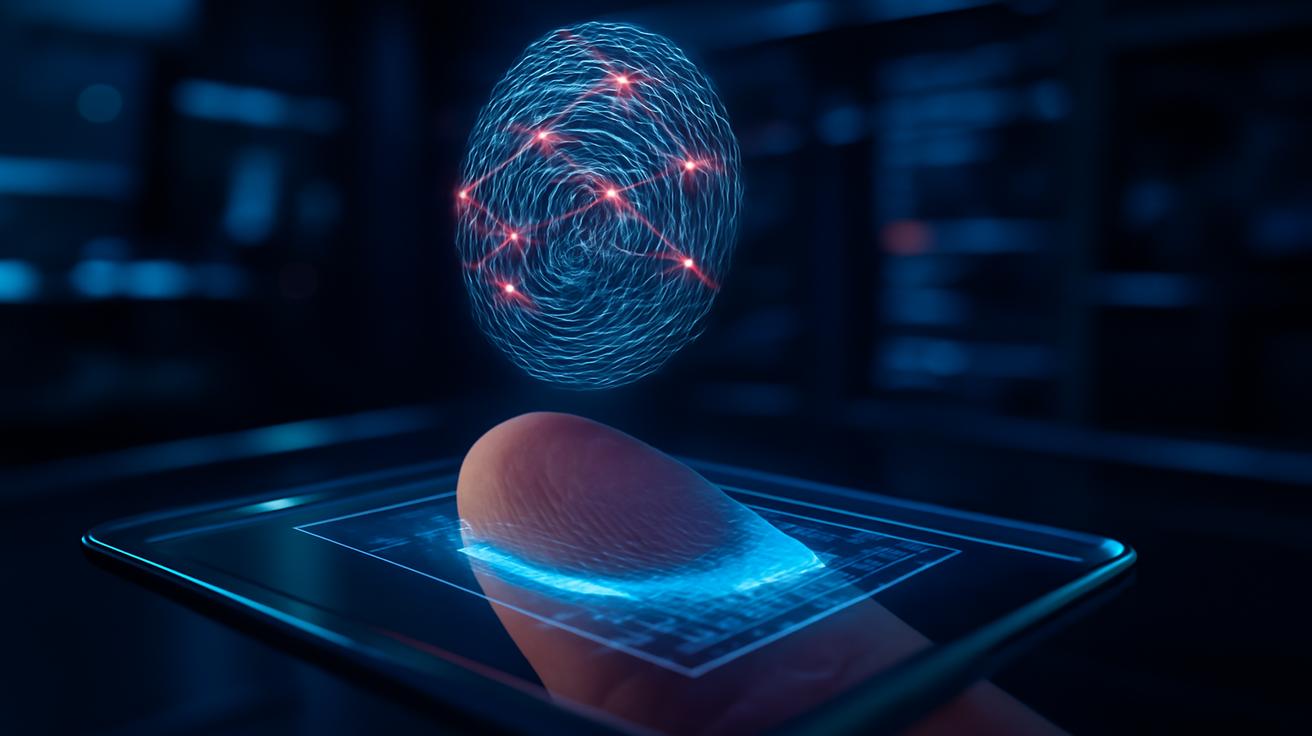
The photograph arrives on your screen like any other close-up of a fingertip: pale ridges, dark valleys, a familiar swirl of loops and whorls that looks almost boring in its familiarity. But this image is different. It isn’t just a picture. It’s a dataset. Each tiny ridge is mapped, measured, cross‑referenced. Colors bloom across the pattern as an artificial intelligence model “reads” the fingerprint—almost as if it’s listening to the quiet biography written in your skin.
For over a century, we’ve treated fingerprints as static signatures: unique, unchanging labels we leave behind on doorknobs, glass, and crime scenes. But now AI is tugging at that assumption. It’s finding patterns we never knew were there—patterns that could change how we think about security, policing, and even the story of who we are.
The Old Promise of Fingerprints Meets a New Kind of Intelligence
Imagine being back in an early 20th‑century police station. The room smells of ink and paper. A detective presses a suspect’s fingertip onto a card, lifts it, and studies the black whorl it leaves behind. To him, that print is a simple promise: this mark belongs to one person, and one person only. It’s identification, nothing more, nothing less.
That was the power of fingerprints as we were taught to understand them. Loops, arches, whorls. Minutiae points. A set of ridges that doesn’t change from childhood to death. Courts built cases on them. Borders relied on them. Phones learned to unlock with them. We folded fingerprints into our daily lives until they felt almost ordinary—old technology in a sleek, digital world.
But fingerprints are still physical, organic, born from the same messy biology that shapes our faces, our health, and perhaps our behavior. That’s what makes them interesting to AI. Because where humans see “a swirl,” AI sees numbers. It sees textures, densities, ratios, and relationships between points that our eyes glide past. And once something becomes a sequence of numbers, it becomes searchable, learnable—something that can be correlated with other data, sometimes in ways we never intended.
When you hand fingerprints to a learning system and say, “Tell me what you see,” you’re not just asking it to match one identity to one print. You’re opening the door to questions we’ve barely begun to ask. Do fingerprints carry clues about our genetics, our sex, even our ancestry? Could they hint at health conditions or lifestyle? Could they make predictions we’re not ready for—and maybe shouldn’t be making at all?
What the Algorithms Started Whispering
In recent years, research labs quietly fed tens of thousands of fingerprint images into machine‑learning models. At first, the goal was straightforward: improve matching speed and accuracy. Faster crime scene hits. Better phone security. Fewer errors in giant databases.
But then a strange thing began to happen. The models started to succeed at tasks they weren’t explicitly trained for. A neural network asked only to match prints from the same person across different fingers started to pick up deeper consistencies—a kind of “style” in each person’s skin ridges that spanned more than one fingertip. Another model, given enough examples, learned to estimate with surprising accuracy whether a print came from a man or a woman.
The ridges we thought were random weren’t completely random after all. They carried echoes of heredity and biology. To a human analyst, two fingerprints from different fingers can look almost unrelated. To AI, they hum with the same underlying pattern, like songs composed in the same key. The machine doesn’t know what a “person” is in any emotional sense. But statistically, it can sense continuity—something shared and traceable.
And once that door cracked open, the questions grew. If AI can link two different fingers to the same person, what about partial smudges from a crime scene and a distant database? What about prints degraded by time, moisture, or low-quality surfaces? What about the faint trace you leave on a coffee cup that never looked “good enough” for traditional forensic analysis?
You begin to see the shift: fingerprints are no longer just ID tags. They’re signals, rich with correlated information. The machine is not simply confirming, “This is you.” It’s starting to say, “This looks like someone who also has this feature, or comes from this background, or might have this trait.” That’s where the story gets powerful—and unsettling.
The New Forensic Imagination
Now imagine a different room: dim, quiet, humming with servers. On one wall glows a high‑resolution scan of a partial print lifted from shattered glass at a break‑in. To the naked eye, it’s frustratingly incomplete: broken lines, missing edges, blurred detail from the angle of the touch.
An investigator used to shrug at such evidence. “Not enough to run,” they might say. But an AI‑driven system doesn’t shrug. It fills in the gaps by leaning on millions of examples it’s studied before. It guesses the missing ridges, estimates how this fragment might fit a complete fingertip, and begins aligning it with candidate prints in a database. The more it learns, the better it gets at searching through noise and damage, like a language model reconstructing sentences from a few scattered words.
In future crime labs, a partial fingerprint might no longer be a weak clue; it could be a strong one. The AI may be able to say: “This partial print is 99.9% likely from the same person who left this other print years ago in a different city—even if that old print came from a different finger.” For cold cases, that’s a stunning possibility. Patterns that once lay dormant in dusty files might spring to life as the algorithms find hidden consistency across decades of evidence.
At the same time, AI is changing how prints are captured in the first place. High‑resolution scanners can record not just the ridge shape but micro‑textures, pores, even subtle three‑dimensional features. Thermal or multispectral imaging might reveal variations invisible to the human eye. Feed that kind of rich signal into machine learning, and the system can distinguish between real skin and a silicone fake more reliably, or detect whether a print was pressed willingly or under duress.
Yet this forensic renaissance is not simply about catching “the bad guys” faster. It’s also about what else we choose to ask of these patterns—and what we should never ask at all. Because for every investigative breakthrough, there’s a shadow of possible misuse: overreach, bias, secret profiling. The same power that can rescue a case from obscurity can also push us closer to a world where your fingertip tells a story you never consented to share.
Fingerprints as Biography: Security’s New Temptation
Consider the place where your fingerprint most often meets AI today: the glass surface of your smartphone. A soft click, a pulse of light, a nearly instantaneous decision—yes, that’s you, come on in. Biometrics, we were told, are safer than passwords because you can’t forget them, and no one can “guess” them. Your fingerprint is you.
But once AI starts discovering deeper patterns in prints, the equation changes. Your fingerprint could become more than a key; it could be a clue. Companies and governments may be tempted to squeeze more value out of this single, durable identifier. If a system can estimate sex or even ancestry from a fingerprint, imagine the marketing fantasies this fuels. Imagine the profiling fantasies.
Suddenly, the same ridges that unlock your bank app might whisper to some distant algorithm: This person likely belongs to this demographic; this region; maybe even has these health risks. Even if today’s science is still cautious about the strength of such inferences, the temptation alone matters. Once something looks even remotely predictable, someone will want to try to predict it.
There’s also an uncomfortable truth about biometrics: you can’t revoke them. If a database of passwords leaks, you change your password. If a database of fingerprints leaks—and some already have—you don’t get new fingertips. AI‑boosted analysis makes those stolen prints more valuable, not less, as models get better at cross‑matching, linking partials, or combining prints with other breached data.
Security experts are already rethinking their playbook. Multi‑factor authentication that once leaned heavily on fingerprints now has to consider a future where prints are powerful, but permanently exposed. We might need systems that use fingerprints only locally, never sharing raw images, or that transform biometric data into encrypted, one‑way templates impossible to reverse engineer. We might need laws that limit what anyone is allowed to infer from biometric traces, regardless of what the algorithms can technically do.
The irony is sharp: the very feature that made fingerprints feel so magical—“they’re always with you”—turns into their biggest vulnerability in an AI world. The story etched into your skin may be more revealing than you ever intended.
Dark Edges: Bias, Misuse, and the Fingerprint Panopticon
Underneath the technical glow of this research runs a darker current. AI is only as fair as the data it’s trained on and the institutions that deploy it. For decades, fingerprint databases have been fed disproportionately by certain communities—those more heavily surveilled, more frequently arrested, more systematically policed. That imbalance doesn’t disappear when you add machine learning. It can deepen.
Think of an algorithm that gets really, really good at pulling a “maybe match” from a giant fingerprint database. If that database is already skewed toward certain neighborhoods or racial groups, those communities may see even more frequent “hits,” more investigative attention, more potential for wrongful suspicion. An AI model that can link partial prints across years might be celebrated as a tool for justice, but who shoulders the weight of its mistakes?
And what if fingerprints stop being a tool used only in serious investigations and become a routine layer of everyday tracking? Turnstiles that require a fingertip scan, workplaces that log entry and exit with biometric readers, public kiosks that quietly collect prints in the name of “convenience” or “safety.” In such a world, every surface becomes a sensor, every touch a record. Layer AI on top of that, and you’re not just verifying identity—you’re mapping movement, building histories, maybe guessing attributes.
Here, the science fiction feeling creeps in: a society where invisible systems can connect the dots between smudges you left behind at a protest, a clinic, a café. The ridge patterns that once felt neutral could become part of a vast, ambient surveillance field.
We still have choices. Laws can require strict warrants for fingerprint search. Public debate can set red lines: no predictive profiling from prints, no demographic inference, no silent expansion of biometric databases. But those choices require awareness. And awareness begins with recognizing that “just a fingerprint” is no longer a modest claim when powerful AI is listening.
What AI “Sees” That We Can’t: A Closer Look
To understand why this shift is happening, it helps to peek behind the curtain of how an AI model looks at a fingerprint. It doesn’t know what a finger is. It doesn’t care that those ridges once pressed into a tree branch or ran across a lover’s palm. It only sees patterns—high and low values, lines, intersections, textures—plotted out in dizzying dimensional space.
The model is trained on enormous datasets of prints labeled in simple ways: “same person,” “different person,” “left index,” “right thumb.” It chews through example after example, adjusting internal weights that we rarely fully understand. Over time, it develops a kind of fingerprint “intuition”: an ability to cluster similar patterns, to map them closer together in its invisible mental landscape.
That inner landscape is where the surprises emerge. Two prints from different fingers, once labeled as different, start falling into the same region of the model’s internal map if they belong to the same person. Without human instruction, the AI learns that “this swirl here, this ridge density there, this slope of arches” tend to co‑occur in the same bodies.
When researchers begin asking the model different questions—like, “Can you tell if this is male or female?”—they’re tapping into that same emergent structure. The answers are not perfect, and good scientists are quick to highlight limits and uncertainties. But the fact that the model can answer at all means there is statistically meaningful information encoded in those ridges beyond mere identity. Ridges, it turns out, may be quiet echoes of the genes and developmental processes that built them.
This raises a profoundly human question: how much of ourselves do we want our bodies to speak on our behalf, especially to systems we don’t fully control or understand?
A Quick Glance at How This Changes the Landscape
Here is a simplified snapshot of where AI‑enhanced fingerprint analysis is nudging us:
| Aspect | Traditional View | AI‑Age Shift |
|---|---|---|
| Role of fingerprint | Static, unique ID tag | Rich signal with hidden traits and links |
| Matching ability | Needs clear, full print | Partial, noisy prints can still be highly informative |
| Security focus | Unlocking devices and doors | Preventing sophisticated spoofing and data leakage misuse |
| Privacy risk | Mainly database theft | Profiling, cross‑linking across systems, demographic inference |
| Investigative use | Simple one‑to‑one or one‑to‑many match | Pattern discovery across time, spaces, and partial traces |
Standing at the Threshold
Some revolutions arrive with fanfare. Others sneak up in the fine print, in the quiet ridges under your thumb.
AI’s newfound ability to read more deeply into fingerprints doesn’t look dramatic on the surface. There’s no glowing gadget, no obvious new ritual to adopt. You still touch the screen; the door still clicks open. But behind that simple gesture, a transformation is under way. The same old prints now live in a new interpretive universe.
In one future, this could mean a better, fairer justice system: fewer wrongful matches, more solved cases, powerful tools to exonerate the innocent and locate the missing. In another, it could mean a subtle slide into biometric overreach, where your body’s micro‑patterns are mined for insight without your informed consent, and where a smudge on a surface says more about you than you ever agreed to share.
We are not passive characters in this story. We can shape how it unfolds—through policy, public debate, technical design choices, and the simple act of staying informed. It starts with recognizing that our fingerprints were never as simple as we thought, and that AI is not just improving the old system; it’s changing what that system is capable of knowing.
Somewhere, right now, another model is spinning up, another dataset is being fed into a learning algorithm. Another image of another fingertip appears on a researcher’s screen, and invisible math begins to hum across its surface. The ridges have always been there. What’s new is how intently something is finally listening.
Frequently Asked Questions
Can AI really tell personal traits from my fingerprints?
Current research suggests AI can sometimes estimate broad traits like sex with better‑than‑chance accuracy by spotting statistical patterns in fingerprints. However, these inferences are not perfect, and claims about predicting personality, behavior, or very specific attributes from fingerprints are not scientifically solid. The bigger concern is not perfect prediction, but the temptation to use even partial inferences for profiling.
Does this make fingerprint‑based phone unlocking unsafe?
Your phone’s fingerprint lock is still generally safer and more convenient than many passwords, especially if your device stores biometric data locally in a secure enclave. The main risk comes from large external databases that store raw fingerprint images. If those leak, AI could eventually make them more useful for cross‑matching or misuse. Using biometrics as part of multi‑factor authentication, rather than the only factor, is a wise approach.
Could AI make it easier to frame someone with fake fingerprints?
AI actually has the potential to make it harder to successfully use fake fingerprints. High‑resolution and multispectral sensors, combined with machine learning, can learn to distinguish living skin from artificial replicas. However, if raw fingerprint images are widely available, sophisticated attackers might try to use them to create better spoofs. This is why limiting access to raw biometric data is critical.
Will AI‑enhanced fingerprints increase wrongful convictions?
AI can reduce some kinds of error by improving matching quality and highlighting uncertainty, but it can also amplify existing biases if the underlying databases and practices are skewed. The impact will depend heavily on how systems are audited, how transparent their limitations are, and how much courts and investigators rely on them without independent review. Strong oversight and clear standards are essential.
What can be done to protect my fingerprint privacy?
You can minimize where you voluntarily share fingerprints—think carefully before enrolling in optional biometric systems. Support policies and regulations that restrict biometric data collection, require strong security protections, and limit what can be inferred or shared. On the technical side, pushing for systems that use encrypted templates rather than raw images, and that perform matching locally on your device, can significantly reduce privacy risks.








Leave a Comment